
elDoc Invited to Speak on Secure AI Adoption for Public Services at HKPC Workshop in Hong Kong

elDoc is pleased to have been invited to speak at “Realising AI-Powered Public Services: The Roadmap to Internal Efficiency and Service Excellence,” a free AI Transformation Workshop organised by the Hong Kong Productivity Council (HKPC).
Taking place on Wednesday, 4 November 2026, in Hong Kong, the workshop will bring together managers, operations professionals and technology experts to explore practical approaches to AI implementation across government departments, statutory bodies and public utilities. View the workshop announcement.
As Hong Kong advances its “AI+” agenda for public services, organisations have opportunities to reduce administrative workloads, improve access to information and deliver more responsive services. Achieving these outcomes requires a foundation that protects sensitive information and keeps AI use accountable as adoption grows.
For government and public sector organisations, security is fundamental to making AI usable, trusted and scalable.
Why AI Security Matters in Government and Public Services
Public sector organisations handle information that directly affects people’s lives: identity records, applications for assistance, financial information, procurement documents, legal correspondence and confidential case files.
Introducing AI into these environments creates questions that extend beyond the quality of a generated answer. Organisations need to understand which information AI can access, where processing takes place, who can review the results and what actions the system is permitted to perform.
Protecting Citizen Information and Public Trust
A single application or case file may contain sensitive information about an individual, their family and their circumstances. AI workflows can create additional copies or representations of that information through prompts, extracted data, search indexes and generated responses.
Security therefore needs to cover the complete information journey. Protecting the original document is only one part of protecting how its contents are retrieved, processed and used.
The consequences of a failure can extend beyond operational disruption. An inappropriate disclosure or an inaccurate response can affect citizens and undermine confidence in the institution responsible for their information.
Preserving Access Boundaries
Government organisations maintain different levels of access across departments, teams and individual roles. Connecting documents to an AI assistant must preserve those boundaries.
An employee authorised to view general administrative guidance should not gain access to confidential personnel records or restricted case files through an AI query. The same access rules need to apply whether information is opened directly or retrieved to support an AI-generated response.
Controlling AI Outputs and Actions
AI can produce inaccurate information, and instructions embedded in documents can attempt to manipulate its behaviour. These risks become more consequential when AI can update records or initiate workflows.
Public sector adoption therefore requires clear controls over both information access and operational authority, with appropriate review before consequential actions proceed. These risks are addressed in elDoc’s enterprise AI security framework.
As adoption expands, departments also need consistent oversight. A pilot involving a small team and selected documents presents different demands from a service used across multiple teams, repositories and connected systems.
How elDoc Enables Secure AI Adoption
elDoc brings together document processing, enterprise knowledge retrieval, workflow automation and governance capabilities. This enables organisations to introduce AI within the processes through which public service work is reviewed, approved and delivered.
Keeping Data and AI Processing Under Organisational Control
Government organisations need deployment options that reflect the sensitivity of their information and their infrastructure policies.
elDoc supports on-premises, private cloud and isolated deployment architectures, including air-gapped environments. With an appropriately configured private deployment, documents and AI workloads can remain within organisation-controlled infrastructure.
Its model-agnostic architecture also supports private and locally deployed language models. This gives organisations flexibility to select models according to their security, performance and operational requirements, without requiring dependence on a public AI service.
For departments evaluating sensitive use cases, this provides a practical foundation for deciding where information is stored and processed, and which models are permitted to handle it. Explore elDoc’s government deployment approach.
Applying Existing Permissions to AI Access
elDoc’s AI Agents and Agentic RAG operate within established user permissions. Indexing a document for AI retrieval does not make it available to every user.
For example, a staff member could use an AI assistant to consult authorised operating procedures while restricted investigation files remain outside their permitted information scope.
The platform also supports enterprise authentication, including multi-factor authentication, single sign-on and Active Directory integration, alongside granular document permissions. These controls help organisations manage who can access information and which activities they can perform. Read about elDoc’s access and security controls.
Retaining Human Oversight and Controlling AI Actions
Public service workflows frequently require professional judgement, supervisory review and formal approval.
elDoc supports human validation and approval workflows, allowing organisations to place review at appropriate stages. AI can prepare information for consideration while designated staff retain responsibility for reviewing it.
For AI Agents, application permissions govern the functions available to the model. Confirmation or approval can be required before changes are executed. This allows departments to define which tasks AI may assist with, which actions it may perform and where human authorisation is necessary.
Supporting Accountability and Operational Review
Public bodies need visibility into how information is handled throughout a workflow.
elDoc provides audit trails, document histories, version control, AI task history and sharing activity records. These capabilities support investigation and operational review by helping teams understand how documents have been accessed, changed, shared and processed.
Together with encryption at rest and in transit, these controls help organisations protect information while maintaining the records needed for oversight.
Turning Secure AI into Practical Public Service Improvements
These capabilities become valuable when applied to everyday administrative work.
For example, elDoc can support a citizen request workflow by classifying incoming submissions, extracting relevant information from documents, preparing case summaries and routing material for review. Staff can use AI-assisted retrieval to consult authorised policies and prepare draft responses.
Human review can remain part of the process before a response is issued or a decision advances. This creates opportunities to reduce repetitive preparation work while retaining control over sensitive information and consequential outcomes.
The practical value lies in connecting document understanding, knowledge access and workflow controls. Staff receive support within the work they need to complete, and managers retain defined points of oversight.
Moving from Initial Projects to Wider Adoption
Scaling AI requires evidence that a workflow performs reliably within its intended boundaries.
A practical starting point is a clearly defined process with measurable outcomes: preparation time, review effort, exception rates and response turnaround. Departments can evaluate these outcomes alongside access controls, output quality and approval requirements before extending adoption.
elDoc’s combination of document management, AI capabilities and governed workflows provides a foundation for this progression. Organisations can establish how information is accessed and reviewed within an initial use case, then apply that experience as they introduce further workflows.
The objective is to make useful AI capabilities repeatable across public services, with security and accountability built into daily operations.
elDoc to Share Insights on Secure AI Adoption and Scaling
Rita Chan, APAC Business Development Head at elDoc, will represent elDoc at the HKPC workshop, sharing insights into how government authorities and public sector organisations can adopt AI securely and scale its use with confidence.
Her contribution will focus on the considerations involved in turning AI ambitions into practical outcomes while addressing data protection, governance and operational oversight.
The workshop will also provide opportunities to explore AI solutions at on-site booths and speak directly with experts about implementation questions, including privacy and system integration.
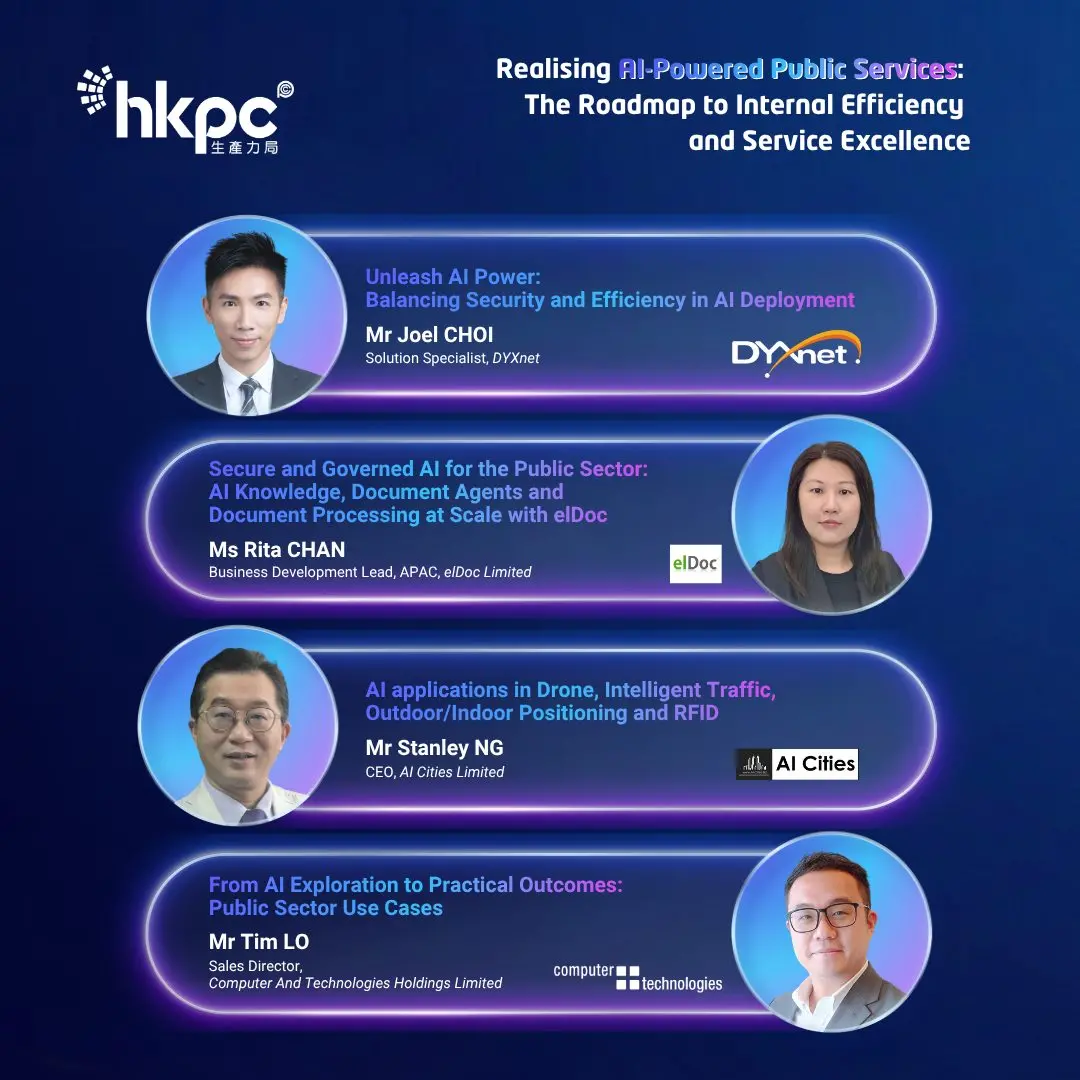
elDoc thanks HKPC for the invitation and looks forward to contributing to the discussion on secure AI adoption and better public services.
Event Details
Organiser: Hong Kong Productivity Council (HKPC)
Date: Wednesday, 4 November 2026
Time: 15:00–17:30 Hong Kong time
Venue: Inno Network, 1/F, HKPC Building, 78 Tat Chee Avenue, Kowloon, Hong Kong
Language: Cantonese
Admission: Free
Register for the free workshop and join elDoc and fellow industry professionals to explore practical approaches to secure AI adoption in public services.