
Enterprise AI Security, Governance and Control Framework: How elDoc Keeps AI Under Enterprise Control

Enterprise adoption of Generative AI is moving rapidly from experimentation to production.
But for governments, financial institutions, critical infrastructure operators and other regulated organizations, deploying AI is not simply a question of connecting a Large Language Model (LLM) to corporate documents.
The fundamental question is:
How can an organization use AI without losing control over its data, users, documents, infrastructure and business processes?
Generative AI introduces an additional layer of enterprise risk. Sensitive information could be exposed to unauthorized users. Prompt injection could attempt to manipulate retrieval. AI could generate inaccurate information, initiate inappropriate actions or consume uncontrolled resources. Organizations must also consider where their data is processed, which AI models have access to it and how AI-generated actions are governed.
The elDoc Security, Governance & Control Framework for Enterprise AI addresses these challenges by placing AI inside established enterprise security boundaries rather than allowing the LLM itself to become the security authority.
The principle is straightforward:
AI operates within the security and governance boundaries established by elDoc. It does not replace, bypass or independently determine those controls.
Why Enterprise AI Requires More Than LLM Security
An LLM is only one component of an enterprise AI architecture.
Organizations also need to control identity, authentication, document permissions, information retrieval, RAG pipelines, AI actions, outputs, infrastructure, data lifecycle and model connectivity.
This distinction is particularly important when AI is connected to enterprise knowledge.
Imagine an organization containing millions of documents across HR, Legal, Finance, Operations and Management. An employee may have legitimate access to only a small subset of those documents.
Connecting an AI model to the entire repository without an enterprise authorization layer creates an obvious security problem.
elDoc approaches the architecture differently.
The underlying LLM does not independently decide which enterprise information a user can access. Before information is supplied to AI, elDoc determines whether the authenticated user has permission to access it.
This creates an important separation between AI intelligence and enterprise authority.
The Six Pillars of the elDoc Security & Control Framework
elDoc structures its enterprise security and AI governance architecture around six interconnected pillars.
| Security & Governance Pillar | Enterprise Control |
|---|---|
| 1. Platform Availability & Security | Resilient architecture, infrastructure security, monitoring and high availability |
| 2. Access & Authentication | MFA, SSO and authenticated AI access |
| 3. Roles, Permissions & Access-Aware AI | RBAC, groups, document permissions and permission-aware RAG |
| 4. Encryption, Data Protection & Sovereignty | Encryption, controlled processing and flexible/on-premise AI deployment |
| 5. Granular Document Control | Control over viewing, downloading, printing, copying, editing and sharing |
| 6. AI Governance & Responsible AI | Controlled agency, HITL, grounded responses, model governance and AI consumption controls |
Together, these controls establish security across the complete interaction between users → documents → RAG → LLMs → AI Agents → enterprise actions.
1. Secure and Resilient Enterprise AI Infrastructure
AI security begins before a prompt ever reaches an LLM.
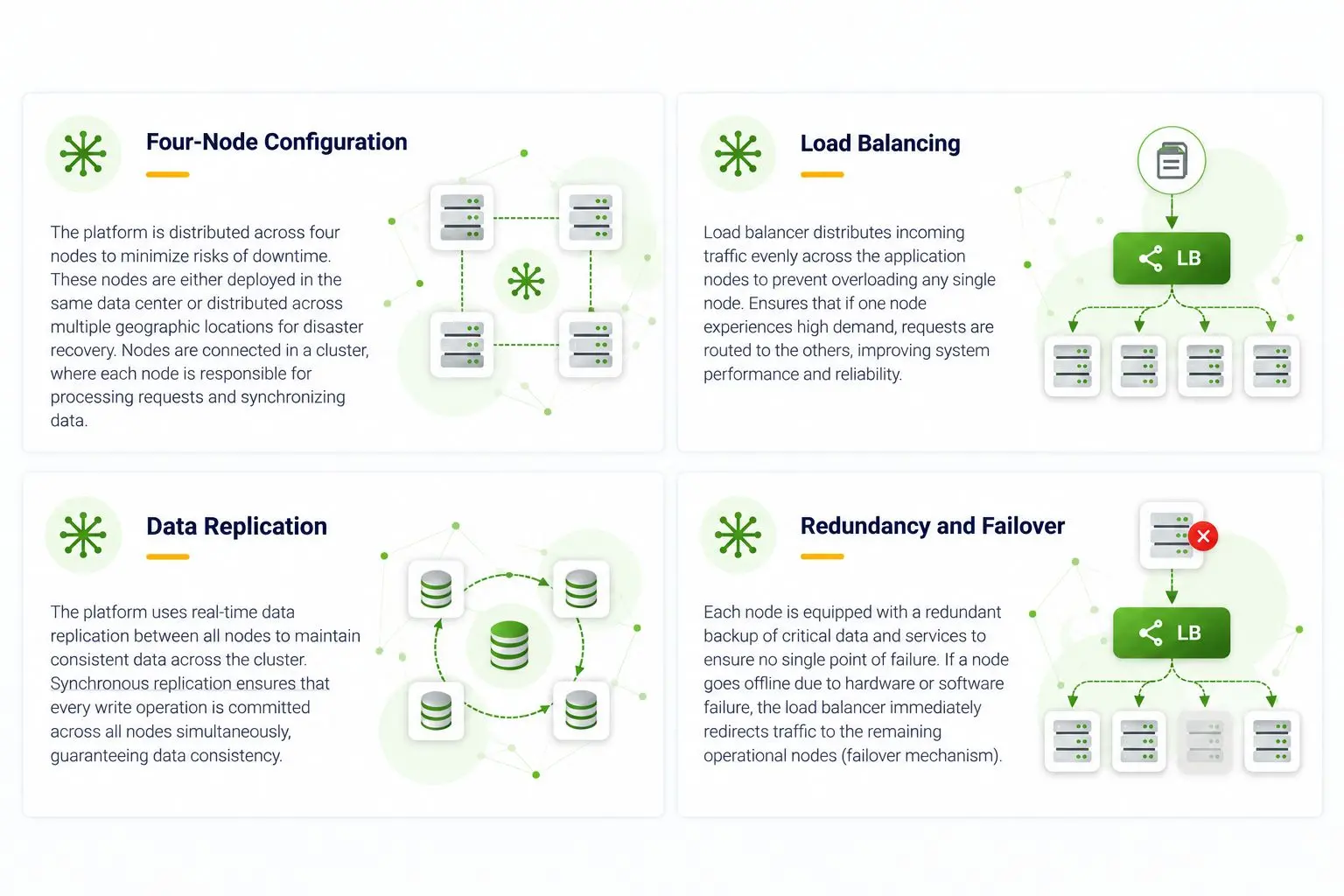
elDoc provides a resilient platform architecture designed to maintain secure and continuous availability of enterprise document and AI services.
High-availability architecture, redundancy, infrastructure controls and monitoring provide the operational foundation required for enterprise deployments.
This is particularly important when AI becomes embedded into document-intensive business processes. Once employees depend on AI for document retrieval, classification, extraction, review and workflow operations, AI availability becomes part of business continuity.
Security therefore needs to address not only confidentiality but also availability, integrity and operational resilience.
2. Enterprise Authentication Before AI Access
AI should never become an alternative route around enterprise authentication.
Access to elDoc can be governed through enterprise authentication mechanisms including:
- Multi-Factor Authentication (MFA)
- Single Sign-On (SSO)
- Identity authorization
- User and group management
- Role-Based Access Control (RBAC)
Users must authenticate before obtaining access to enterprise information or AI-enabled functionality.
When an authenticated employee interacts with AI, the interaction continues within that employee’s existing security context.
There is no separate “AI identity” with unrestricted access to enterprise knowledge.
The AI inherits restrictions — not privileges.
3. Access-Aware RAG: AI Can Only Retrieve What the User Can Access
This is one of the most important controls for enterprise Generative AI.
Traditional RAG implementations can focus heavily on indexing and retrieval accuracy while overlooking a fundamental question:
Is this particular user actually authorized to retrieve this information?
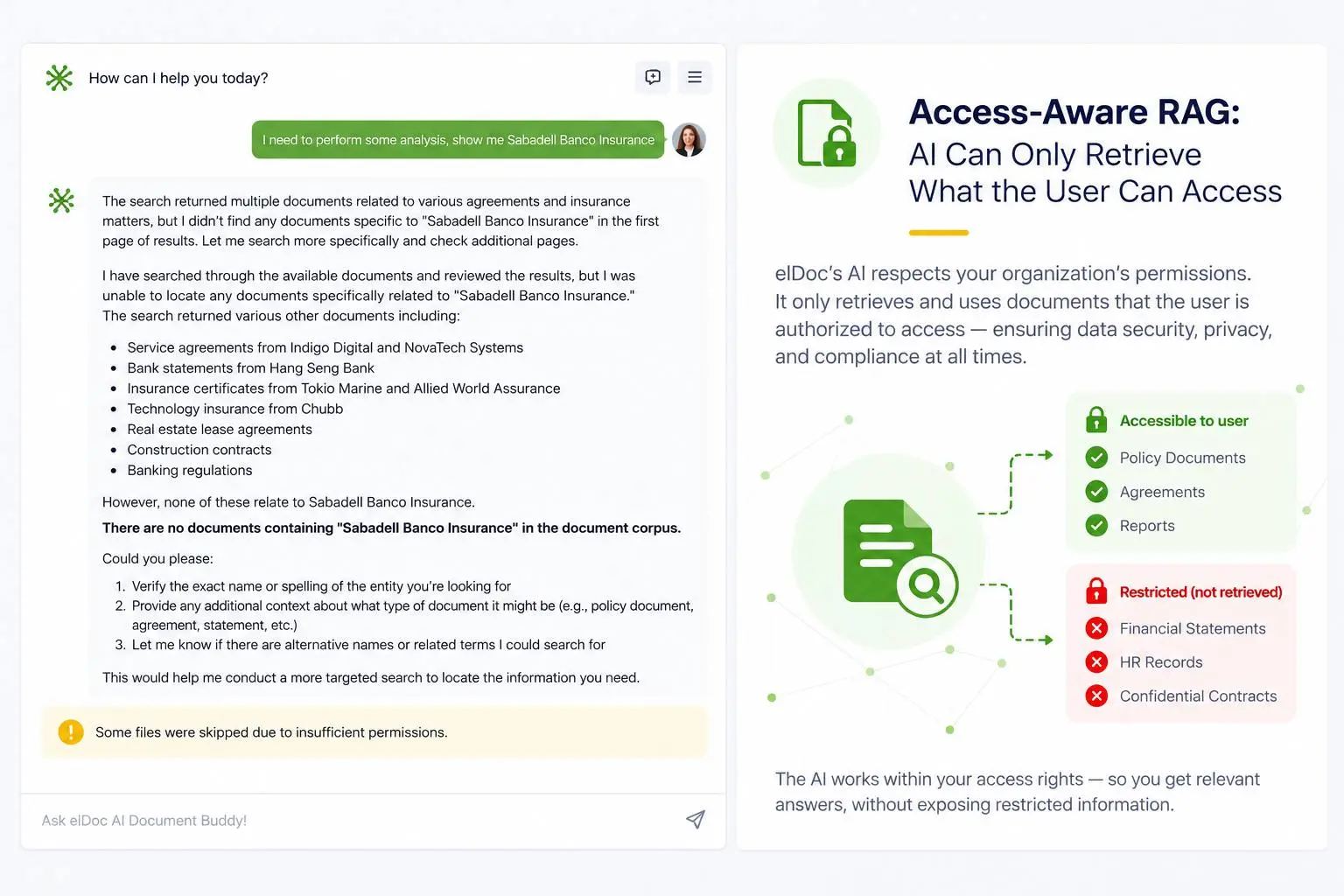
elDoc combines Role-Based Access Control, user and group permissions and granular document-level authorization with its RAG architecture.
Before document content or RAG context is provided to an LLM, elDoc verifies the authenticated user’s authorization.
Only information that the user is permitted to access can become part of the AI processing context.
Example
Suppose an enterprise knowledge repository contains:
10,000,000 documents
but Employee A is authorized to access:
27,500 documents
The employee’s AI interaction should not suddenly provide semantic access to all 10 million documents simply because they have been indexed.
The effective AI knowledge boundary remains the employee’s authorized information scope.
This means document permissions remain authoritative regardless of whether information is accessed manually or through an AI-assisted query.
It also provides an important architectural defense against attempts to obtain unauthorized information through prompt injection, RAG manipulation, vector weaknesses or other AI-oriented attack techniques.
4. Data Protection and AI Data Sovereignty
Enterprise AI governance increasingly depends on a simple question:
Where does our data actually go?
elDoc protects information through controlled processing and encryption mechanisms, including protection of information in transit through secure TLS channels and encryption at rest.
But enterprise AI requires another dimension: AI data sovereignty.
Organizations may need control not only over where documents are stored, but also over where their:
- document repositories,
- RAG infrastructure,
- vector databases,
- embeddings,
- AI processing components,
- and Large Language Models
are deployed and operated.
Depending on the selected architecture, these components can be maintained within controlled environments, including on-premise infrastructure.
This enables organizations to design an AI architecture aligned with their regulatory, cybersecurity, infrastructure and data-sovereignty requirements rather than automatically transferring sensitive enterprise information to external AI services.
The framework is designed to support environments operating under stringent security and information-protection requirements, including requirements associated with ISO 27001, GDPR and HIPAA.
5. Granular Document Security Does Not Disappear When AI Arrives
An enterprise document may be accessible to an employee while still being subject to restrictions.
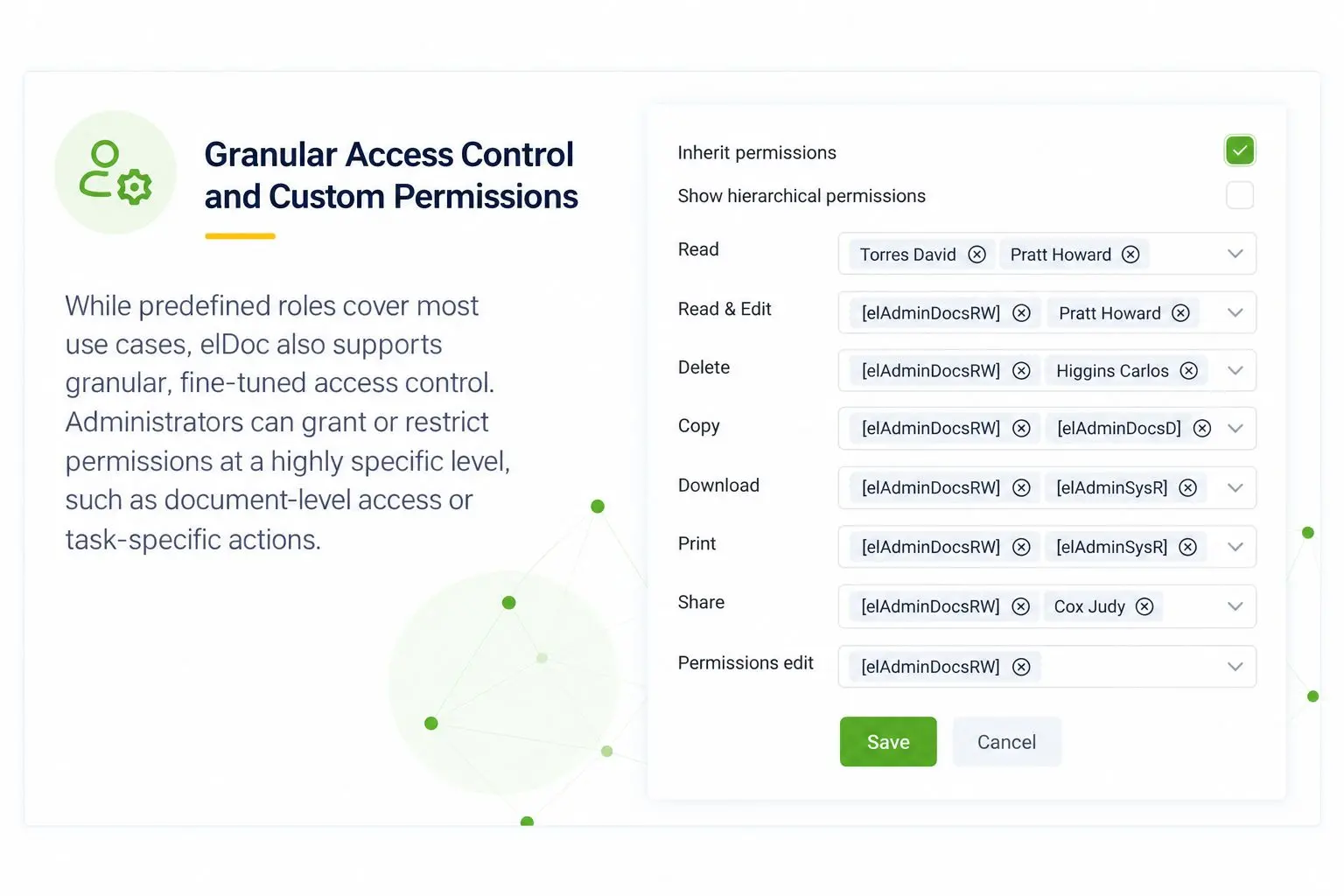
For example, the organization may allow a user to view a document but prohibit downloading, printing, copying, editing or sharing it.
elDoc therefore extends security beyond basic repository access.
Granular controls can govern:
| Document Operation | Can Be Controlled |
|---|---|
| View | ✓ |
| Download | ✓ |
| ✓ | |
| Copy | ✓ |
| Edit | ✓ |
| Share | ✓ |
These document-level controls remain relevant when AI capabilities are introduced.
AI is not intended to become an alternative mechanism for circumventing restrictions applied to the underlying information.
The security classification and authorization of the source document remain authoritative throughout conventional and AI-assisted document operations.
6. AI Governance: Controlling What AI Is Allowed to Do
Enterprise AI security is not only about what an LLM can see.
It is increasingly about what AI can do.
As organizations move from AI chat toward AI Agents and agentic workflows, this distinction becomes critical.
An AI system capable of retrieving information presents one category of risk.
An AI Agent capable of changing documents, modifying metadata or initiating workflow actions presents another.
elDoc therefore does not provide unrestricted autonomous authority to the underlying LLM.
AI capabilities are exposed through explicitly defined application functions and remain subject to application permissions and controls.
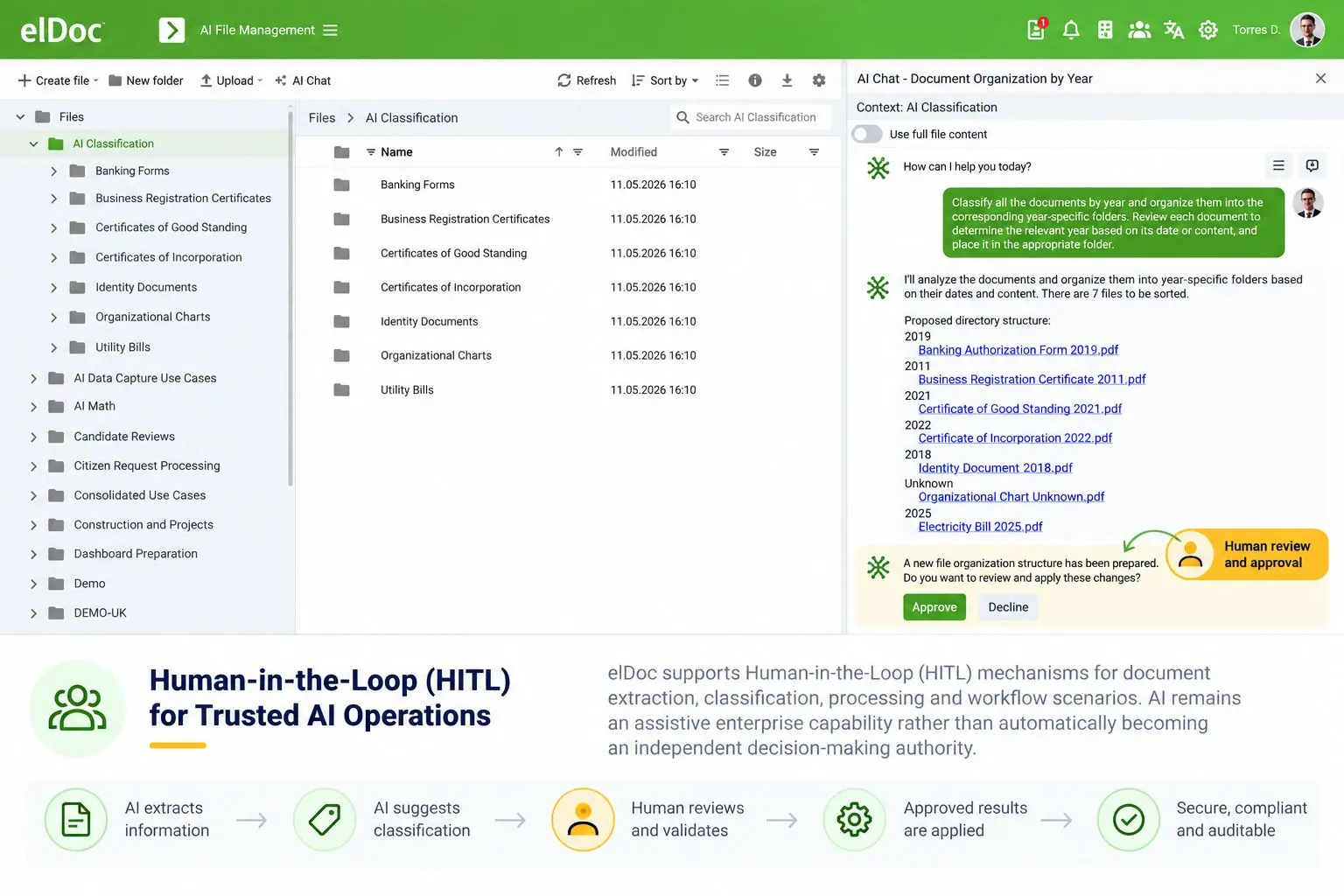
For state-changing or write operations, user confirmation or approval can be required before execution.
This establishes an important control boundary:
The LLM can propose an action. The enterprise application determines whether that action is permitted and how it can be executed.
This helps reduce risks associated with excessive AI agency, prompt manipulation, unintended changes and inappropriate autonomous operations.
Human-in-the-Loop Is an Enterprise Control, Not an AI Limitation
Full autonomy is not necessarily the objective of enterprise AI.
In high-impact processes, organizations may deliberately require human validation.
elDoc supports Human-in-the-Loop (HITL) mechanisms for document extraction, classification, processing and workflow scenarios.
A typical controlled process can therefore follow:
Document → AI Processing → Validation → Authorized Human Approval → Business Process
This allows organizations to determine which operations can be automated and which require human oversight before information progresses to subsequent stages.
AI remains an assistive enterprise capability rather than automatically becoming an independent decision-making authority.
Reducing Hallucination Risk Through Grounded Enterprise Knowledge
Generative AI can produce convincing answers that are not supported by enterprise information.
For regulated organizations, that represents a significant operational concern.
elDoc uses Retrieval-Augmented Generation to ground AI responses in authorized enterprise documents.
Where applicable, responses can reference their underlying source documents, allowing users to validate generated information against enterprise content.
This creates a more transparent knowledge process:
Question → Authorized Retrieval → Enterprise Sources → LLM Reasoning → Referenced Response
RAG cannot guarantee that an LLM will never produce an incorrect response. Instead, the architecture reduces dependence on unsupported model knowledge and gives users greater ability to trace and validate AI-generated information.
Customer Documents Are Not Used by elDoc to Train the LLM
Another important distinction concerns inference versus training.
elDoc does not use customer documents to train or fine-tune the underlying LLM.
Authorized enterprise information is supplied as contextual information during RAG and inference rather than being incorporated into the model’s training parameters.
Enterprise information therefore remains managed through the controlled elDoc environment and continues to be subject to configured access, retention, lifecycle and deletion policies.
This separation limits elDoc’s direct exposure to risks associated with customer information becoming incorporated into model parameters through elDoc-operated training.
Controlled AI Outputs
LLM output should never automatically become trusted executable input.
Within elDoc, AI-generated output is treated as application data and processed through controlled application logic.
AI-generated code is not automatically compiled or executed within the application or underlying infrastructure.
Similarly, an LLM cannot independently invoke privileged application functionality simply because a prompt instructs it to do so.
State-changing actions remain subject to the appropriate authorization and application controls.
This creates another important separation:
LLM generation ≠ application authorization.
LLM-Agnostic Architecture as a Governance Control
AI models are evolving extremely quickly.
An organization choosing a particular LLM today may decide to replace it because of security, regulatory, performance, cost, data-sovereignty or organizational requirements.
elDoc therefore maintains an LLM-agnostic architecture.
The enterprise security architecture does not fundamentally depend on one specific AI model.
Organizations can select and replace LLMs while maintaining the elDoc authorization, document security, RAG and application-control layers.
This also provides a clearer separation of responsibilities.
elDoc Application Layer Controls
elDoc governs areas such as:
- authentication,
- authorization,
- enterprise information access,
- document permissions,
- access-aware RAG,
- AI-enabled application actions,
- output handling,
- document lifecycle,
- and interaction between AI and enterprise functionality.
Underlying LLM Risks
Characteristics such as:
- model training-data composition,
- inherent model bias,
- memorization characteristics,
- model documentation,
- fairness characteristics,
- and provider-specific model limitations
depend on the selected LLM and its provider.
An LLM-agnostic approach allows organizations to reassess or replace the underlying model if its characteristics no longer satisfy their required risk profile.
AI Consumption and Cost Governance
AI governance also has an operational and financial dimension.
Without appropriate controls, enterprise AI adoption can result in uncontrolled token consumption, excessive concurrent requests, resource contention and unpredictable costs.
elDoc restricts AI functionality to authenticated users and provides application-level mechanisms through which AI resource consumption can be controlled and monitored.
Depending on deployment requirements, organizations can constrain request concurrency and resource consumption while monitoring usage to support both operational and financial governance.
Enterprise AI therefore becomes not only security-controlled, but also consumption-controlled.
Ready to Build Secure and Governed Enterprise AI?
Moving from an AI proof of concept to production requires more than selecting an LLM. It requires a security and governance architecture that protects enterprise information before, during and after every AI interaction.
Talk to an elDoc Enterprise AI expert to explore how your organization can implement Generative AI, Agentic RAG and AI Document Agents while maintaining control over data access, document permissions, AI actions, Human-in-the-Loop approvals, LLM selection, AI data sovereignty and deployment architecture.
Whether your organization requires cloud, private infrastructure or fully on-premise AI deployment, elDoc provides the security and control framework needed to introduce AI into sensitive and regulated document environments.
Bring AI to your enterprise knowledge without giving up control of your enterprise data. Talk to an elDoc Expert