
GenAI for Government and Regulated Institutions: Secure AI for Document and Data Intelligence

Generative AI has moved from experimentation to enterprise reality almost overnight.
Organizations across the world are already using AI to accelerate operations, automate workflows, improve decision-making, reduce costs, and unlock new forms of operational intelligence. Executives see enormous opportunities in AI-driven productivity and automation.
But government agencies, public sector organizations, healthcare providers, financial institutions, legal departments, and regulated enterprises operate under a very different reality.
They manage:
- Sensitive citizen information
- Classified or restricted data
- Legal and regulatory records
- National infrastructure information
- Financial and compliance documentation
- Mission-critical operational systems
For these environments, GenAI adoption is not simply a technology initiative.
It is a governance, security, compliance, and sovereignty challenge.
The real strategic question is no longer whether organizations should adopt GenAI — but how to deploy it responsibly, securely, and within controlled enterprise environments.
Why Public Cloud AI Creates Challenges for Regulated Environments
Many organizations begin their AI journey using public cloud AI services or consumer-grade AI platforms.
While these tools are powerful for general productivity use cases, they often introduce serious concerns for highly regulated institutions.
The Core Problem with Cloud-Based AI Services
When organizations submit information to external AI platforms, they frequently lose direct control over:
- Where data is processed and stored
- Whether information remains within sovereign boundaries
- How long data is retained
- Whether data is accessed by third parties
- Whether prompts or documents contribute to future model training
- Auditability and governance visibility
- Compliance with internal and government security policies
For regulated industries, these are not theoretical concerns.
They directly impact:
- Regulatory compliance
- Privacy obligations
- National data sovereignty
- Legal exposure
- Operational risk
- Public trust
Cloud AI does not automatically equal secure enterprise AI.
Most public AI platforms were originally designed for broad-scale commercial use — not for sovereign, classified, or mission-critical environments.
Government and Regulated Industries Require a Different AI Architecture
Government institutions and regulated enterprises require AI systems designed around:
Data Sovereignty
Sensitive information must remain inside controlled environments and within national or organizational boundaries.
Governance and Auditability
Every interaction, workflow, and AI-generated output must be traceable, explainable, and auditable.
Enterprise Access Control
AI systems must respect role-based permissions, identity policies, and security boundaries already established inside the organization.
On-Premise and Isolated Deployment
Organizations need the ability to deploy AI entirely within their own infrastructure — without dependency on public internet AI services.
Multi-System Integration
Enterprise AI must connect securely with existing document repositories, archives, databases, workflows, ERP systems, and operational platforms.
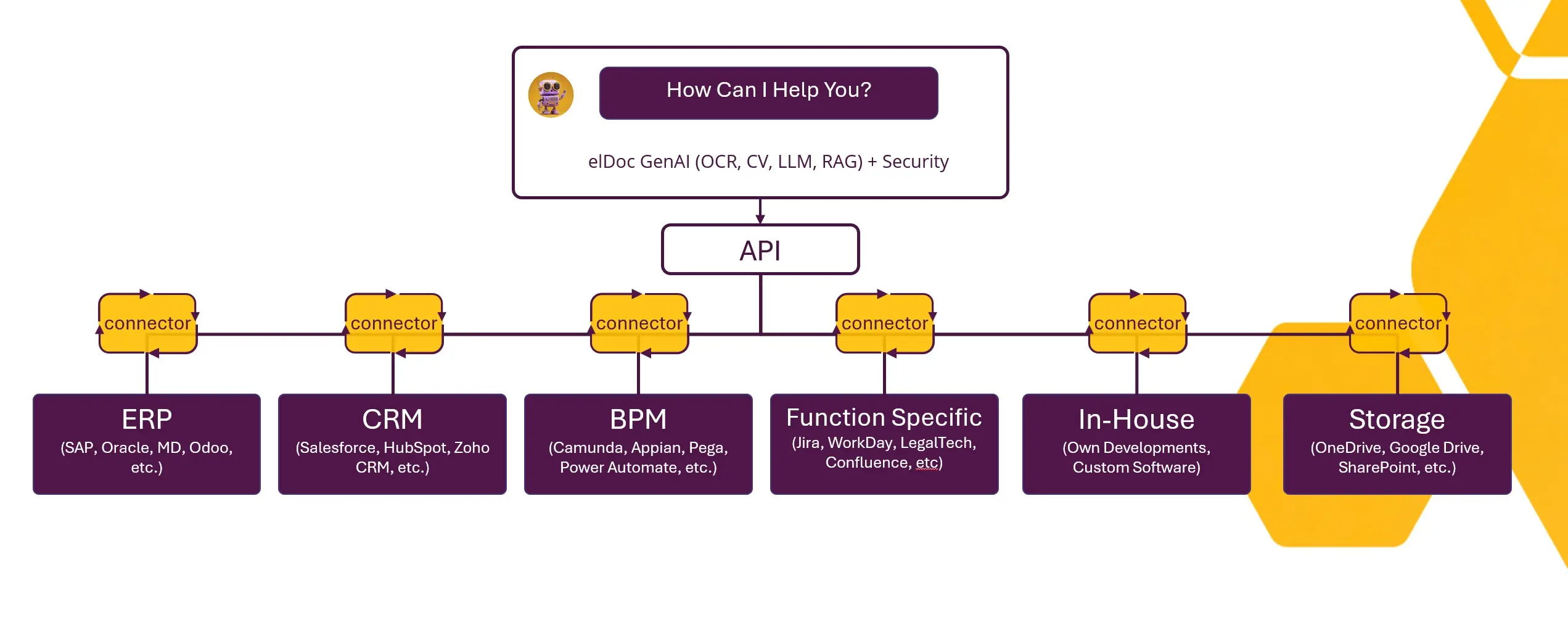
Human-in-the-Loop Validation
AI outputs often require human review, approvals, exception handling, and controlled operational workflows.
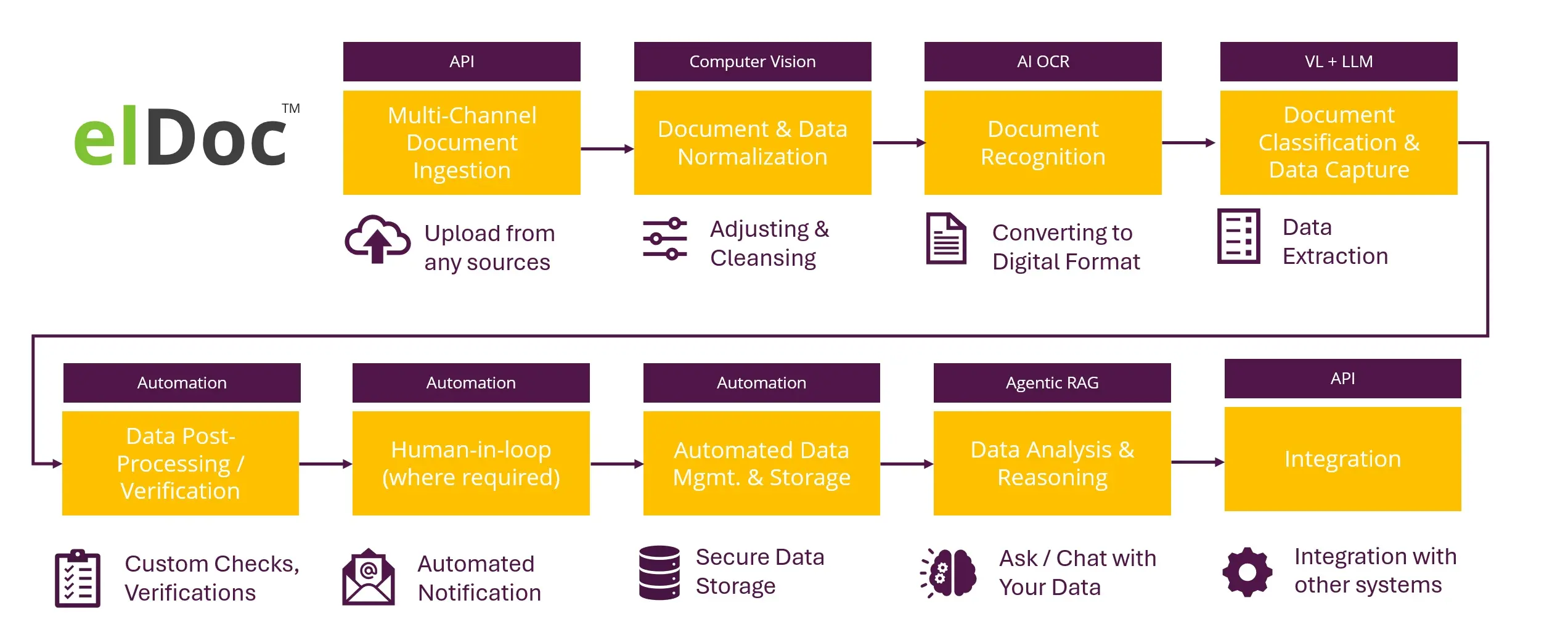
Introducing elDoc: Secure Enterprise GenAI for Regulated Environments
elDoc Vioma is an enterprise-grade GenAI platform designed specifically for complex, regulated, and mission-critical environments.
The platform combines:
- Enterprise GenAI
- Agentic RAG
- Intelligent document processing
- AI OCR and visual document understanding
- Workflow orchestration
- Human approvals
- Governance and auditability
- Enterprise integrations
- Secure deployment infrastructure
into a unified operational AI platform.
Unlike generic AI chat tools, elDoc is engineered to operationalize AI securely across enterprise ecosystems.
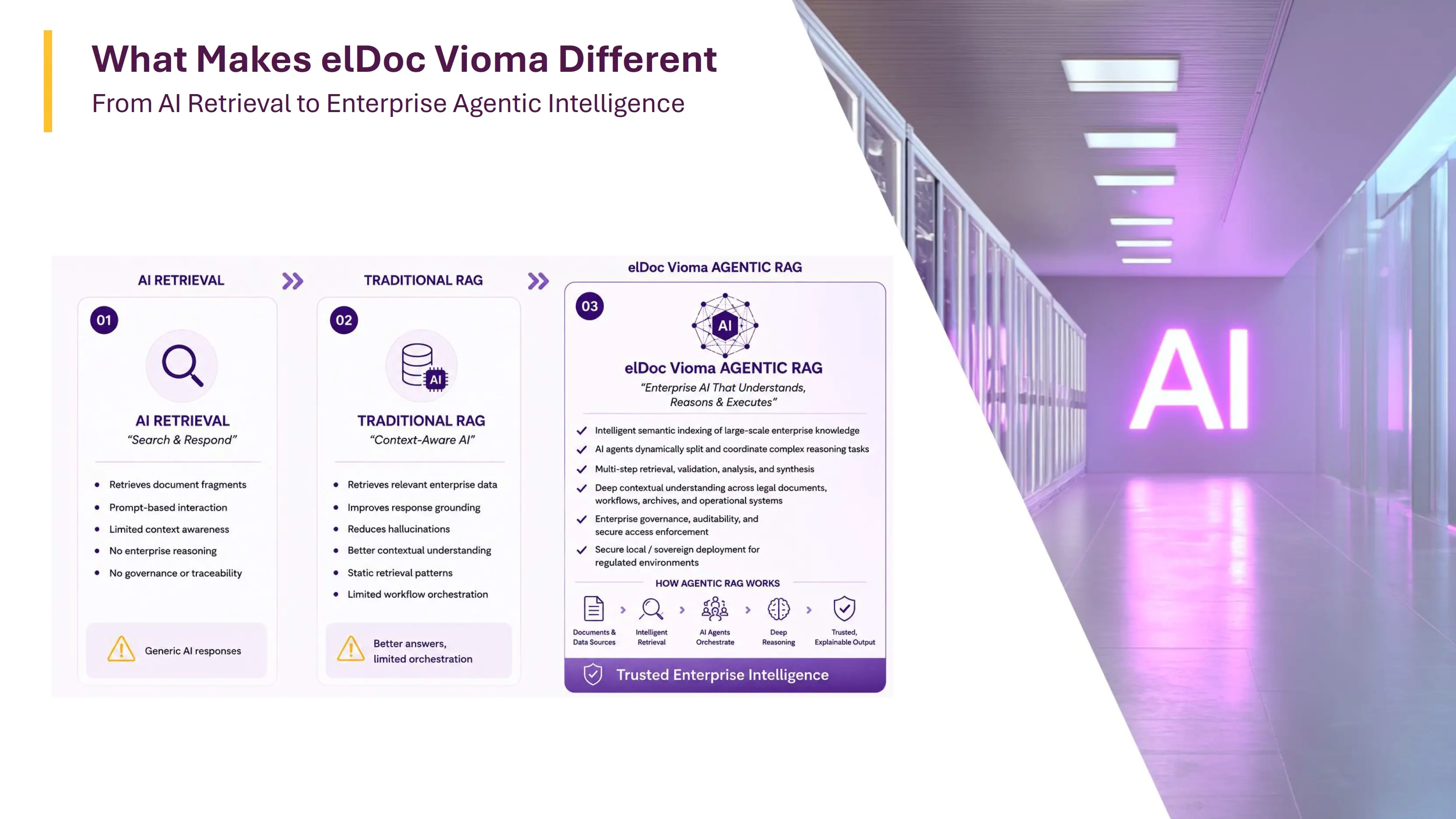
Beyond Traditional AI Retrieval
Most AI systems stop at connecting an LLM to enterprise documents.
elDoc was designed to go significantly further.
From Retrieval to Enterprise Agentic Intelligence
Traditional retrieval systems typically:
- Search document fragments
- Return isolated responses
- Depend heavily on prompts
- Lack contextual reasoning
- Have limited workflow orchestration
- Provide minimal governance
Traditional RAG improves contextual grounding but still remains largely retrieval-focused.
elDoc introduces Enterprise Agentic RAG.
This enables AI systems to:
- Understand enterprise relationships
- Perform multi-step reasoning
- Coordinate AI agents dynamically
- Validate and synthesize information
- Execute governed workflows
- Maintain explainability and auditability
- Operate securely across large-scale enterprise data ecosystems
The result is not simply AI search. It is enterprise operational intelligence.
Secure On-Premise Enterprise AI Architecture
Fully Isolated AI Infrastructure
elDoc supports fully isolated deployment architectures including:
- On-premise deployment
- Sovereign cloud environments
- Air-gapped infrastructure
- Private GPU environments
- Hybrid enterprise architectures
Organizations maintain full ownership and control over:
- Infrastructure
- Models
- Data
- Security policies
- Governance rules
- AI workflows
No dependency on public AI services is required.
LLM Flexibility Without Vendor Lock-In
One of the biggest challenges enterprises face is becoming locked into a single AI vendor or model ecosystem.
elDoc supports multiple LLM strategies including:
- Open-source LLMs
- Local LLM deployment
- Private enterprise models
- Multi-model orchestration
- Specialized reasoning models
- Vision AI and multimodal models
This allows organizations to optimize AI workloads while maintaining strategic control over their AI ecosystem.
The platform can orchestrate different LLMs for:
- Retrieval
- Reasoning
- Classification
- Summarization
- Workflow execution
- OCR understanding
- Document analysis
without exposing sensitive information externally.
Enterprise Governance and Security by Design
Security is foundational to enterprise AI adoption.
elDoc includes enterprise-grade governance capabilities including:
- Role-based access control (RBAC)
- Multi-factor authentication (MFA)
- Audit trails
- Encryption at rest and in transit
- Tenant isolation
- Activity monitoring
- Secure API integrations
- Workflow governance
- Permission-based access control
- Explainable AI operations
Governance is embedded directly into the architecture — not added afterward.
Ready-to-Deploy Enterprise AI Platform
Many organizations underestimate the complexity of building enterprise AI infrastructure internally. Developing secure AI environments often requires:
- AI infrastructure engineering
- GPU environments
- Vector database architecture
- LLM orchestration
- Security engineering
- Governance frameworks
- Workflow development
- Integration engineering
- Model tuning and operationalization
elDoc Vioma provides a ready-to-deploy enterprise AI foundation that accelerates time-to-value while reducing operational complexity.
The Future of Enterprise AI Will Be Secure, Governed, and Operational
The next phase of GenAI adoption will not be defined by public AI chat interfaces. It will be defined by enterprise operational intelligence platforms capable of securely integrating AI into real-world business and government operations.
Organizations that succeed will be those that combine:
- AI innovation
- Enterprise governance
- Secure infrastructure
- Human oversight
- Operational integration
- Data sovereignty
within a unified architecture. That is the challenge elDoc was designed to solve.