
Government AI Use Case: Transforming Citizen Request Management with Generative AI

Government organizations receive thousands of citizen requests covering everything from routine questions and public service inquiries to claims, reported incidents, suspected criminal matters, human rights concerns, and other potentially critical situations.
This use case demonstrates how a government organization in a one of the European country implemented elDoc GenAI to transform the way such citizen requests are processed.
The challenge was not simply to respond faster. It was to ensure that every incoming request could be understood, correctly classified, prioritized, and routed according to its actual context and urgency.
With elDoc, straightforward requests can receive immediate AI-assisted consultation and responses, while complex, sensitive, or potentially critical cases can be automatically identified and immediately escalated to the responsible government personnel for human review and further action.
Routine request → understand, classify, and provide immediate assistance.
Complex or critical request → identify, prioritize, and immediately escalate for human review.
The result is a more responsive approach to citizen services that combines Generative AI, Agentic RAG, intelligent classification, workflow automation, and human-in-the-loop controls.
Customer Profile
The customer is a government organization in a one of the European country responsible for receiving, reviewing, and responding to citizen requests and submissions.
Citizens contact the organization regarding a broad range of matters — from general inquiries and requests for information to complaints, claims, reported incidents, suspected criminal matters, human rights concerns, and other potentially sensitive or urgent cases.
The organization therefore required more than a traditional citizen request management system. It needed an intelligent processing environment capable of understanding incoming requests, identifying their context and urgency, providing faster responses to straightforward matters, and ensuring that potentially critical cases receive immediate human attention.
The objective was clear:
Provide citizens with faster responses while ensuring that complex, sensitive, and potentially urgent matters are identified and escalated without unnecessary delay.
Challenges
Sensitive Citizen Information Could Not Be Processed Through Public AI Cloud Services
Citizen requests can contain highly sensitive, confidential, and personally identifiable information, particularly when submissions relate to claims, reported incidents, suspected criminal matters, human rights concerns, or other sensitive cases.
For the government organization, sending such information to public AI cloud services was not an acceptable processing model due to its security, privacy, data protection, and data sovereignty requirements.
This created a fundamental challenge: the organization wanted to benefit from Generative AI while maintaining control over where citizen data is stored, where AI processing takes place, which models process the information, and whether sensitive data can leave the controlled government environment.
The required solution therefore had to support a secure and controlled GenAI architecture suitable for processing sensitive government information.
Large Volumes of Unstructured Citizen Requests
Citizen requests are inherently difficult to standardize.
While structured forms can capture basic information, citizens frequently describe their situations in their own words and may attach supporting documents containing additional context.
The actual meaning and importance of a request therefore cannot always be determined from a predefined category, form field, or simple keyword-based classification.
Identifying What Requires Immediate Attention
Not every request carries the same urgency.
A routine question about a government service may require only a straightforward informational response. Another submission may describe circumstances potentially involving an incident, serious claim, suspected criminal activity, threat, abuse, human rights violation, or another matter requiring urgent review.
The organization needed an intelligent way to distinguish between these situations and prioritize incoming requests without relying exclusively on citizens to select the correct category.
Manual Triage Created Delays
Employees had to spend significant time reviewing incoming requests simply to determine:
What is this request about? How important is it? Who should handle it? Does it require immediate attention?
At scale, this manual triage consumed valuable government resources and could increase the time before potentially important cases reached the appropriate personnel.
Providing Faster Responses to Routine Requests
A considerable share of citizen inquiries could be addressed using existing government information, policies, procedures, and approved knowledge resources.
Requiring employees to manually prepare responses to every straightforward inquiry created unnecessary workload and increased response times for citizens.
The organization therefore needed to automate initial assistance for routine matters while maintaining human oversight and controlled escalation for sensitive, complex, or consequential cases.
Approach to Solving the Challenges with elDoc GenAI
The organization selected elDoc GenAI to establish a secure, on-premise AI environment for citizen request processing. The implementation was built around four key elements.
1. On-Premise GenAI Deployment
A fundamental requirement was that sensitive citizen information could not be processed through public AI cloud services.
elDoc GenAI was therefore deployed on-premise, within infrastructure controlled by the government organization. This enabled documents, citizen data, AI processing, indexes, and the required AI models to remain within the controlled environment.
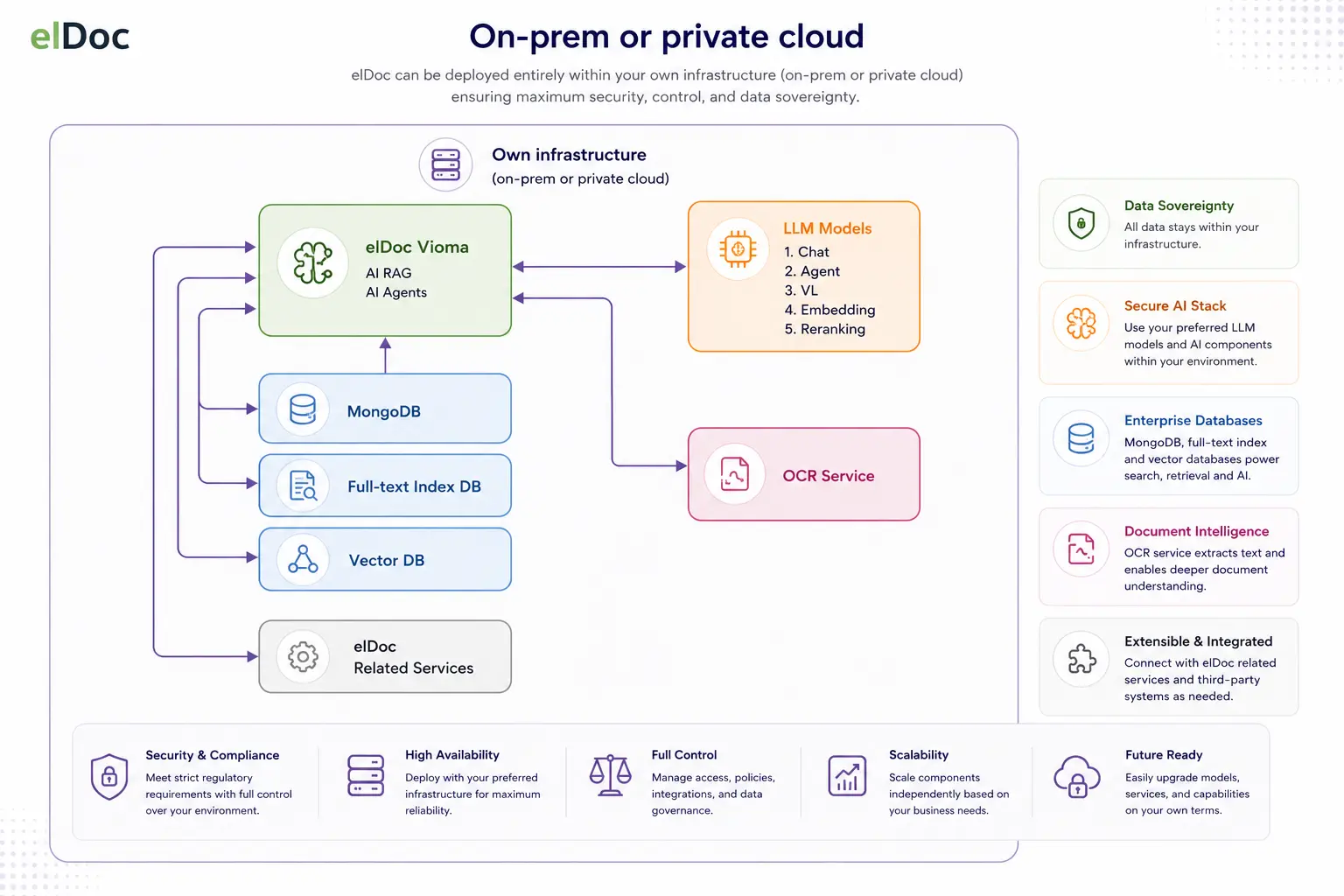
Running Generative AI on-premise required significant computing capacity and infrastructure resources. Given the sensitivity of the processed information and the organization’s security and data sovereignty requirements, however, this investment was unavoidable.
The objective was not simply to introduce Generative AI, but to introduce it while keeping sensitive citizen and government information under the organization’s control.
2. GenAI-Powered Request Understanding and Classification
elDoc GenAI was used as the intelligent processing layer for incoming citizen requests.
Instead of relying only on predefined categories, keywords, or traditional rule-based classification, AI analyzes the actual content and context of each submission and its supporting documents.
The system can identify:
- Request type and subject
- Context and key information
- Relevant government service or department
- Priority and potential urgency
- Information required for subsequent processing
This enables requests written in natural, unstructured language to be automatically understood and classified at scale.
3. Secure Agentic RAG for Routine Requests
For routine and informational requests, elDoc Agentic RAG provides AI with access to approved government knowledge sources, including policies, procedures, instructions, and other authorized information.
Based on this controlled knowledge, GenAI can provide an immediate contextual consultation or prepare an appropriate response without requiring an employee to manually process every routine inquiry.
The Agentic RAG environment remains part of the controlled architecture, ensuring that sensitive information does not need to be transferred to a public AI service.
4. Intelligent Prioritization and Human-in-the-Loop Escalation
Not every citizen request should be handled automatically.
When elDoc identifies a request as complex, sensitive, potentially critical, or requiring professional judgment, the system assigns the appropriate priority and initiates the predefined human workflow.
Requests potentially related to serious incidents, claims, suspected criminal matters, threats, abuse, human rights concerns, or other critical circumstances can therefore be immediately surfaced and escalated to the responsible government personnel.
AI supports the process through understanding, classification, summarization, prioritization, and routing. Authorized government personnel retain responsibility for legal, administrative, and other consequential decisions.
Routine request → GenAI + Agentic RAG → Immediate assistance
Complex or critical request → GenAI classification → Priority escalation → Human review
This approach enabled the organization to combine the efficiency of Generative AI with the security of on-premise deployment and the necessary human oversight for sensitive government processes.
Results Achieved
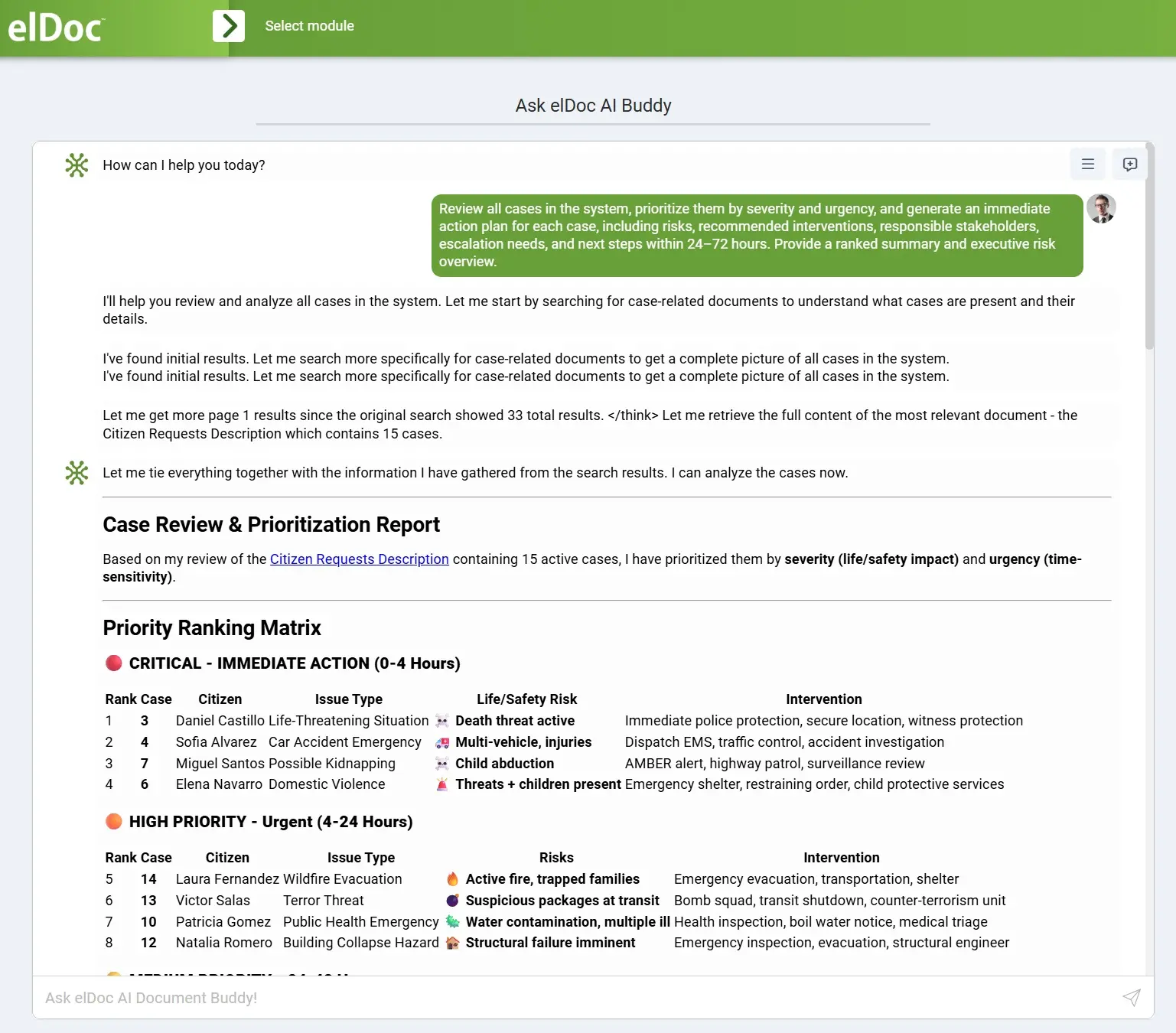
The implementation transformed citizen request handling from predominantly manual triage into an AI-assisted citizen service and case-processing workflow.
Faster Initial Response to Citizens
Straightforward informational requests can be processed immediately using Generative AI and approved government knowledge sources, significantly reducing the time citizens need to wait for basic information.
Immediate Identification of Potentially Critical Requests
Requests containing information that may indicate serious or urgent circumstances can be identified during initial processing and immediately escalated according to predefined workflows.
This helps ensure that important submissions are not simply processed in chronological order within a general request queue.
Reduced Manual Triage
Automated understanding, classification, summarization, and routing reduce the amount of time employees need to spend reviewing routine submissions.
Government specialists can consequently dedicate more attention to cases where their expertise and judgment provide the greatest value.
More Consistent Request Classification
AI-assisted classification provides a consistent first layer of processing across citizen submissions, including free-form requests that do not follow standardized terminology.
Better Allocation of Government Resources
Routine inquiries can be addressed through automation while complex matters are directed to appropriate personnel, creating a more efficient balance between AI automation and human expertise.
Improved Citizen Service Without Removing Human Oversight
The implemented approach does not attempt to replace government decision-making with AI.
Instead, elDoc helps the organization determine what can be addressed immediately, what requires additional processing, and what should be brought to human attention without delay.
The result: faster citizen assistance, reduced administrative workload, more consistent request processing, and accelerated escalation of potentially critical cases.
What This Use Case Demonstrates for Government AI
This European government use case demonstrates that introducing a chatbot is not enough to transform citizen request processing.
Citizen services are not limited to questions and answers. A request may need to be understood, classified, analyzed together with supporting documents, checked against government knowledge, prioritized according to urgency, answered automatically, or immediately escalated to the responsible personnel. Each of these activities forms part of a broader operational process.
This is why effective government AI requires an orchestrated, end-to-end GenAI processing pipeline behind the citizen-facing experience.
With elDoc GenAI, the complete process can be brought together within one controlled environment:
Citizen Request → GenAI Understanding → Document Processing → Classification → Priority Assessment → Agentic RAG → Automated Response or Human Escalation → Workflow → Resolution
For routine requests, Generative AI and Agentic RAG can provide immediate assistance based on approved government knowledge. For complex, sensitive, or potentially critical requests, the same pipeline can identify their significance, establish the appropriate priority, and initiate a controlled workflow for human review.
The use case also highlights another critical consideration for government AI: where and how AI processing takes place matters as much as what the AI can do. When citizen requests contain sensitive or confidential information, relying on public AI cloud services may not satisfy the organization’s security and data sovereignty requirements. In this implementation, an on-premise GenAI architecture enabled the government organization to maintain control over sensitive data, AI models, processing, and supporting infrastructure.
Running advanced AI on-premise required substantial computing resources, but this was a necessary architectural requirement for enabling Generative AI in a controlled government environment.
Ultimately, the value comes not from adding another AI interface, but from integrating AI into the underlying citizen-service process.
elDoc brings together Generative AI, secure Agentic RAG, intelligent document processing, AI Document Agents, human-in-the-loop controls, and workflow automation to orchestrate citizen requests from initial submission through to response or resolution.
The next stage of Government AI is not simply about giving citizens a chatbot. It is about building secure, end-to-end AI-powered processes that can understand what citizens need, automate what is routine, prioritize what is important, immediately escalate what is critical, and keep humans in control where judgment matters.