
Enterprise AI for Document and Data Intelligence: Secure AI for Mission-Critical Organizations

What Is Enterprise AI?
Artificial Intelligence is rapidly becoming a core enterprise technology, but Enterprise AI is far more than deploying a chatbot or providing employees with access to a Large Language Model (LLM).
Enterprise AI is the application of Artificial Intelligence across an organization’s documents, data, business processes, and institutional knowledge while operating within enterprise-grade security, governance, and compliance requirements.
Unlike consumer AI services that rely primarily on publicly available information, Enterprise AI securely connects to an organization’s internal knowledge. It understands business context, respects existing user permissions, integrates with enterprise systems, and helps employees not only find information but also analyze it, make decisions, and automate business processes.
A modern Enterprise AI platform typically combines multiple technologies—including Large Language Models (LLMs), Agentic RAG, AI Agents, enterprise search, Intelligent Document Processing (IDP), workflow automation, and secure system integrations—to create an intelligent operating layer across the entire organization.
The goal is simple: transform fragmented information into trusted business intelligence that employees can access and act upon through natural language, while maintaining complete control over security, privacy, and compliance.
Enterprise AI for Document and Data Intelligence
One of the most impactful applications of Enterprise AI is Document and Data Intelligence.
Every organization generates and manages enormous volumes of information—from contracts, invoices, policies, emails, and technical documentation to customer records, ERP transactions, CRM data, engineering drawings, and countless other business assets. While this information is essential for daily operations and strategic decision-making, it is typically dispersed across multiple repositories, applications, and databases, making it difficult to locate, understand, and use effectively.
Enterprise AI for Document and Data Intelligence brings these disconnected information sources together into a single intelligent platform. By combining Large Language Models (LLMs), Agentic RAG, AI Document Agents, Intelligent Document Processing (IDP), enterprise search, workflow automation, and secure integrations, the platform understands not only the contents of documents but also the relationships between documents, structured data, business processes, customers, suppliers, projects, and organizational knowledge.
Instead of simply retrieving files, Enterprise AI understands context. It can answer complex business questions, compare documents, extract critical information, generate reports, automate document-centric workflows, and execute business tasks—all while enforcing enterprise security policies and respecting existing user permissions.
The result is a secure enterprise knowledge platform where documents and business data become part of a unified intelligence layer, enabling organizations to make faster decisions, automate knowledge-intensive work, improve operational efficiency, and unlock the full value of their information without compromising security or compliance.
Core Pillars of Enterprise AI
Building Enterprise AI is not simply about connecting a Large Language Model to enterprise documents. A true Enterprise AI platform requires a secure, scalable, and resilient architecture capable of supporting mission-critical business operations.
The architecture behind elDoc Enterprise AI Platform is built around several core pillars that enable organizations to deploy Generative AI securely while maintaining complete control over their data, infrastructure, and governance.
1. Enterprise Security by Design
Security is the foundation of every Enterprise AI deployment. Unlike consumer AI services, Enterprise AI must be designed to protect sensitive information, enforce corporate governance, and comply with industry regulations from the ground up – not as an afterthought.
As AI gains access to an organization’s most valuable assets – its documents, business data, and institutional knowledge – it must operate within the same security boundaries as every other enterprise application. This means AI can never bypass existing permissions or expose confidential information to unauthorized users.
Enterprise AI platforms such as elDoc integrate directly with an organization’s existing identity and security infrastructure, ensuring that every AI interaction adheres to established access policies and governance rules.
Core security capabilities include:
- Role-Based Access Control (RBAC)
- Enterprise authentication (Active Directory, LDAP, Identity Providers, MFA)
- Document-, folder-, and data-level permissions inherited from connected systems
- End-to-end encryption for data in transit and at rest
- Secure document repositories and vector databases
- Complete audit trails and AI activity logging
- Human approval workflows for sensitive AI actions
- Data residency and sovereignty controls
- Compliance with organizational governance and industry regulations
The fundamental principle is simple: AI can only access the information a user is already authorized to view. If an employee cannot access a document manually, neither can the AI. This security-first approach allows organizations to confidently deploy Generative AI across mission-critical operations while maintaining complete control over their data, privacy, and compliance.
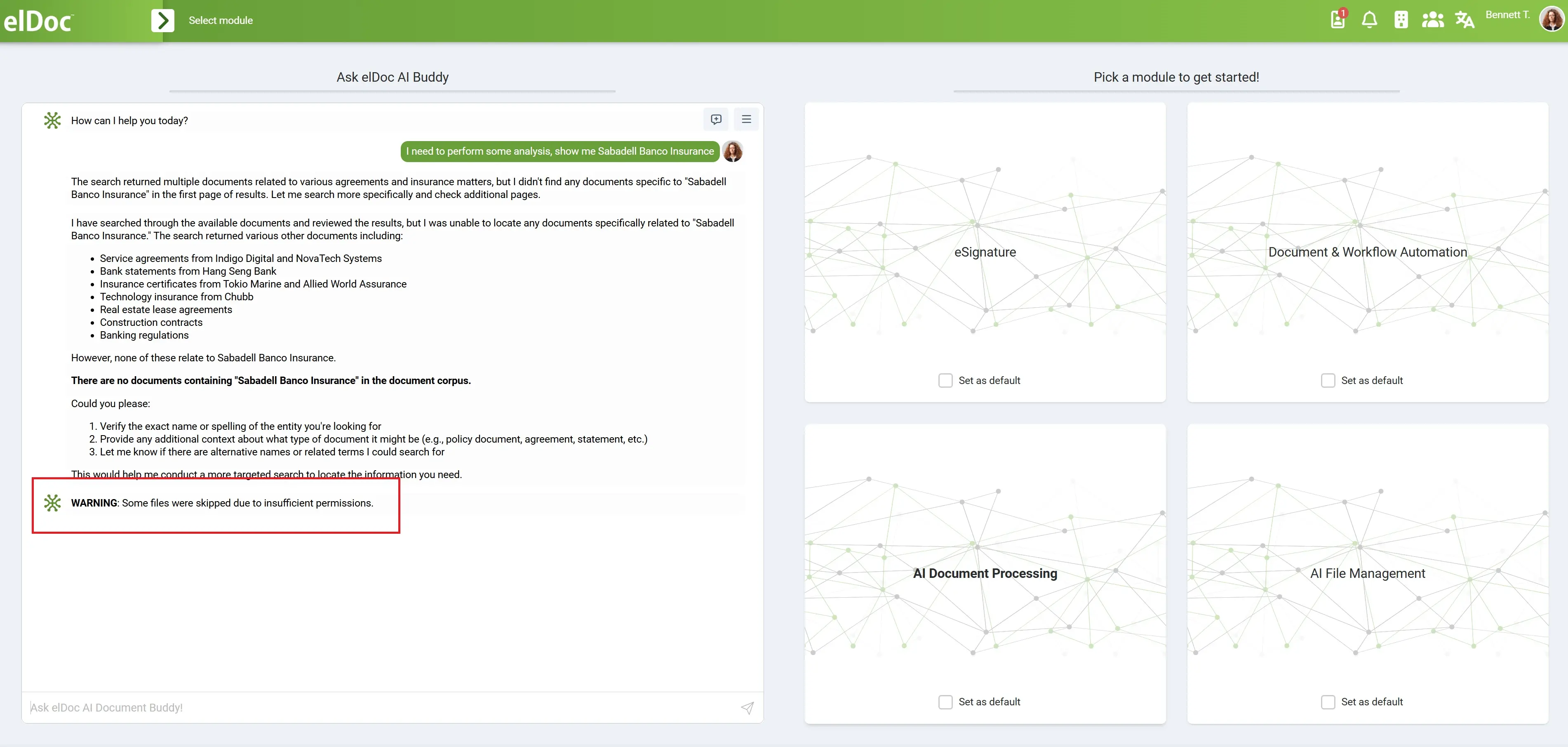
For critical document-centric processes, Enterprise AI should operate under Human-in-the-Loop (HITL) governance, ensuring that important decisions remain under human supervision. Rather than acting autonomously, AI assists employees by analyzing documents, extracting information, classifying content, or preparing actions, while automatically routing tasks for review whenever business rules or confidence thresholds require human intervention.
Within elDoc, Human-in-the-Loop capabilities are embedded directly into AI-powered document workflows. The examples below illustrate how this governance model can be implemented for specific business scenarios. These are representative examples only – similar approval mechanisms can be incorporated into respective AI-driven document tasks where required.
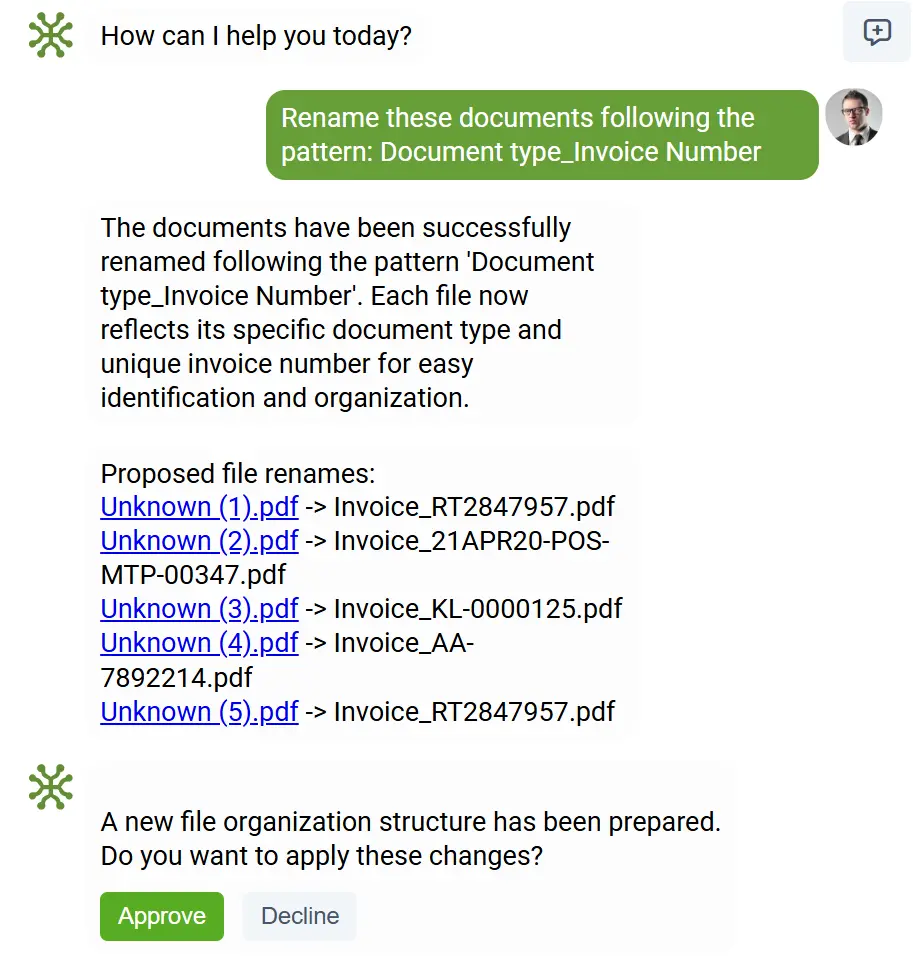
Example: AI-Assisted Document Reorganization
When reorganizing enterprise repositories, elDoc AI can automatically classify, rename, and relocate documents according to predefined business rules. Before any changes are committed, the proposed actions are presented to authorized users for review and approval. Every AI recommendation, user decision, approval, rejection, and document modification is recorded in a comprehensive audit trail, ensuring complete transparency and governance throughout the process.
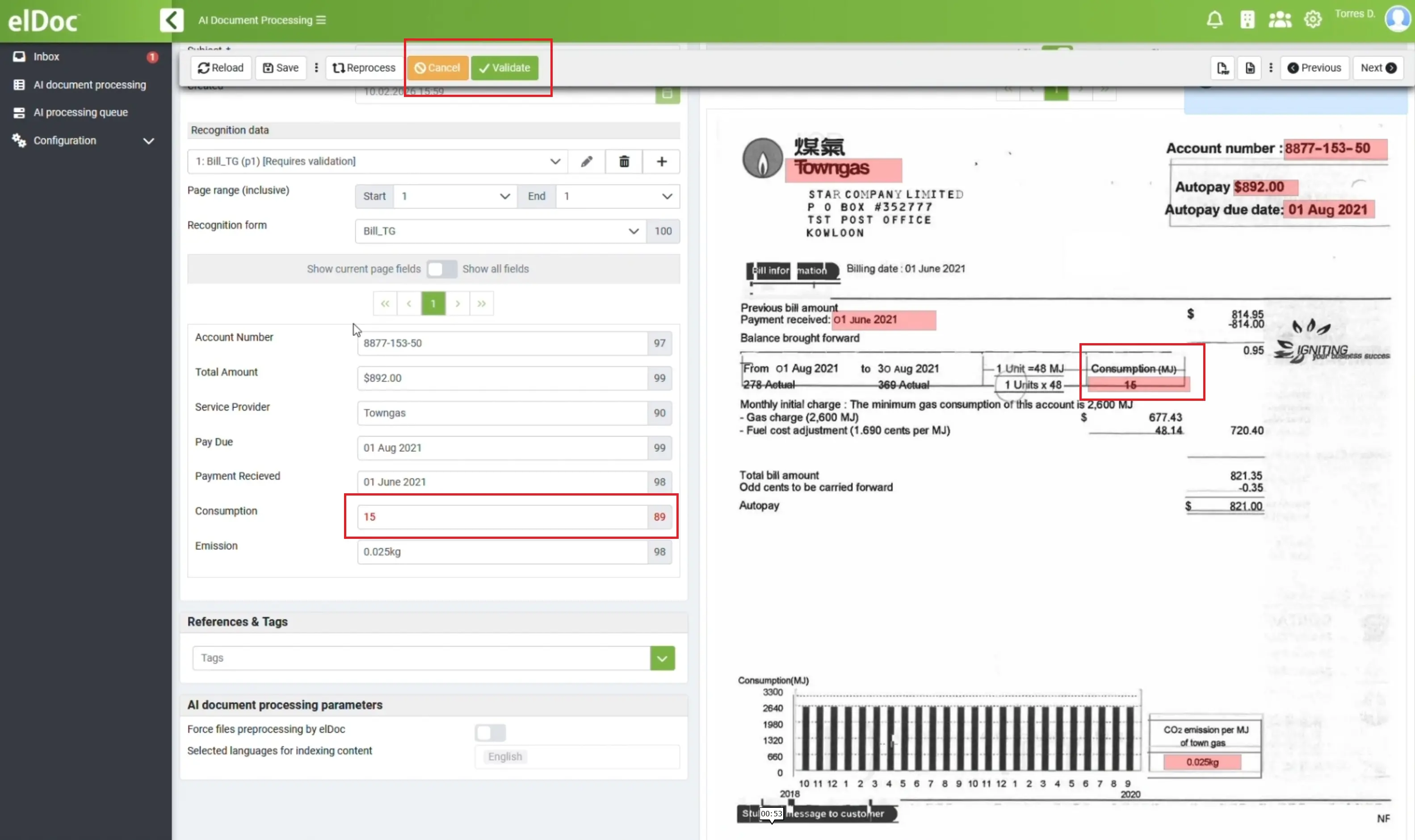
Example: Confidence-Based Data Verification
During Intelligent Document Processing, elDoc AI automatically extracts information from invoices, contracts, application forms, and other business documents. If the AI determines that the confidence level for extracted data is below an acceptable threshold—or detects inconsistencies or missing information – it automatically triggers a review and approval workflow. Users validate or correct the extracted information before it is transferred to downstream business systems, ensuring both data quality and regulatory compliance.
These examples demonstrate how Human-in-the-Loop governance can be integrated into AI-driven business processes. The same approach can be applied to contract approvals, compliance verification, records management, document classification, workflow automation, and many other enterprise scenarios where AI accelerates work while people retain final authority over critical business decisions.
2. LLM-Agnostic Architecture
One of the most important architectural principles of Enterprise AI is freedom of choice. Organizations should never be locked into a single Large Language Model (LLM) or AI vendor. As AI technologies evolve rapidly, the ability to adopt new models, balance costs, and meet changing regulatory requirements becomes a strategic advantage.
elDoc is built on an LLM-agnostic architecture, enabling organizations to select the language models that best align with their business objectives, security policies, compliance requirements, language support, performance expectations, and operational budgets. Models can be deployed on-premises, within private cloud environments, or securely accessed through approved cloud providers, giving organizations complete flexibility over where and how AI is executed.
More importantly, Enterprise AI should not rely on a single model for every task. Different LLMs excel at different capabilities – some deliver exceptional reasoning, others provide faster responses at lower cost, while others specialize in multilingual processing, coding, document understanding, or regional language support.
Rather than selecting one model for the entire platform, elDoc orchestrates multiple LLMs in parallel within the same AI workflow. Each AI task is automatically routed to the model best suited for the job, optimizing both performance and cost.
For example, an enterprise workflow may simultaneously use:
- A cost-efficient model for everyday enterprise chat and knowledge discovery.
- A premium reasoning model for analyzing complex legal contracts or financial reports.
- A specialized vision model for OCR and document understanding.
- A multilingual or regional model for processing local-language documents and communications.
- A coding or structured data model for generating scripts, SQL queries, or workflow logic.
This multi-model orchestration allows Agentic AI to combine the strengths of several LLMs for different tasks and workflows, producing more accurate results while reducing operational costs and response times.
An LLM-agnostic architecture also protects organizations from vendor lock-in. As new models emerge with better capabilities, improved security certifications, or lower operating costs, they can be integrated into the platform without redesigning the overall AI architecture. Organizations remain free to evolve their AI strategy, adopt the best available technologies, and maintain complete control over their Enterprise AI ecosystem.
In a rapidly changing AI landscape, flexibility is not simply a technical feature – it is a long-term business strategy. An LLM-agnostic architecture ensures that Enterprise AI remains adaptable, future-ready, and capable of continuously leveraging the best AI technologies available.
3. Enterprise Data Foundation for Generative AI
The effectiveness of Enterprise AI depends on the strength of its underlying data architecture. Even the most advanced language models cannot deliver reliable results without fast, secure, and well-organized access to enterprise information.
elDoc provides a modern Enterprise Data Foundation specifically designed for Generative AI, combining enterprise document management, operational databases, metadata repositories, full-text search, and vector databases into a single intelligent knowledge platform. This architecture enables AI to efficiently discover, understand, and reason across both unstructured documents and structured business data.
The platform includes:
- Secure enterprise document repositories
- Metadata and document relationship management
- High-performance full-text search
- Vector databases for semantic search and similarity matching
- Enterprise knowledge indexing
- Intelligent content management
- Automatic OCR, document enrichment, and metadata extraction
- Optimized retrieval for Agentic RAG and AI Document Agents
Rather than maintaining isolated document repositories and disconnected business systems, elDoc transforms enterprise content into a unified knowledge layer. Every uploaded document is automatically processed, indexed, enriched, and made available for secure enterprise search, AI reasoning, and business process automation.

This modern data foundation enables AI to retrieve the right information quickly, accurately, and securely, ensuring that every AI response is grounded in trusted enterprise knowledge rather than relying solely on the language model itself. It is the combination of a robust data architecture and advanced AI orchestration that allows Enterprise AI to scale across millions of documents while maintaining performance, accuracy, and governance.
4. Flexible Deployment and Data Sovereignty
Every organization operates under different security policies, regulatory obligations, and infrastructure strategies. While some businesses are comfortable adopting cloud-based AI services, others – particularly government agencies, financial institutions, healthcare providers, and operators of critical infrastructure—must retain complete control over where their data is processed and stored.
For this reason, elDoc is designed with a deployment-agnostic architecture that enables organizations to implement Enterprise AI without compromising security, data sovereignty, or compliance requirements.
The platform supports a wide range of deployment models, including:
- On-premises data centers
- Private Cloud
- Hybrid Cloud
- Sovereign Cloud
- Government Cloud
- Air-gapped and highly secured environments
Organizations can choose the deployment model that best aligns with their security policies today while retaining the flexibility to evolve their infrastructure in the future. Whether AI operates entirely within an internal network or across a hybrid environment, sensitive enterprise information remains under the organization’s control.
This flexibility makes elDoc particularly well suited for highly regulated industries where compliance, privacy, and data residency are mandatory requirements rather than optional features.
5. High Availability and Enterprise Scalability
Enterprise AI rapidly becomes a mission-critical platform supporting thousands of users, millions of documents, and business processes that operate around the clock. As organizations increasingly rely on AI for daily operations, platform availability, resilience, and performance become just as important as AI capabilities themselves.
elDoc is engineered as an enterprise-grade platform capable of supporting large-scale AI deployments with continuous availability and resilient infrastructure.
Its architecture includes:
- High-availability deployment
- Load balancing across multiple services
- Clustered application architecture
- Automatic failover and fault tolerance
- Horizontal scaling for increasing workloads
- Distributed AI and Agentic RAG processing
- GPU resource optimization and workload distribution
- Enterprise backup and disaster recovery
This architecture enables organizations to scale from departmental deployments to enterprise-wide AI platforms without redesigning the underlying infrastructure. As document volumes, AI agents, and user demand continue to grow, elDoc provides the reliability and performance required for mission-critical business operations.
6. Enterprise Integration and AI Hub
Enterprise knowledge is rarely contained within a single application. Valuable business information is distributed across document management systems, ERP platforms, CRM applications, databases, collaboration platforms, email systems, cloud storage, and numerous industry-specific solutions.
Rather than creating another information silo, elDoc acts as a secure Enterprise AI Hub that connects these disparate systems into a single intelligent platform. Through its API-first architecture and extensive integration capabilities, elDoc enables AI to securely discover, retrieve, and reason across information regardless of where it resides.
The platform integrates with:
- Enterprise Core Systems
- SharePoint and Microsoft 365
- ERP platforms
- CRM applications
- HR systems
- Email platforms
- SQL and NoSQL databases
- Network file systems
- Cloud storage services
- Industry-specific business applications
- Legacy enterprise systems through APIs and connectors
By acting as a unified Enterprise AI Hub, elDoc eliminates information silos and creates a single, secure intelligence layer across the organization’s entire technology ecosystem, allowing employees and AI agents to work with trusted enterprise knowledge regardless of where that information is stored.
Building Enterprise AI on a Trusted Foundation
Building a complete Enterprise AI platform is significantly more complex than integrating a Large Language Model or deploying a chatbot. It requires a carefully designed architecture that securely connects enterprise knowledge, orchestrates multiple AI technologies, integrates with existing business systems, and performs reliably under enterprise-scale workloads.
Organizations can certainly choose to build these capabilities themselves by combining individual technologies and open-source components. However, designing, integrating, securing, optimizing, and fine-tuning such a platform for production environments often requires years of engineering effort. Achieving the levels of reliability, security, governance, scalability, and performance expected in high-volume enterprise operations is one of the greatest challenges of Enterprise AI adoption.
elDoc Enterprise AI Platform brings these proven capabilities together in a single, production-ready architecture. Developed and continuously refined through large-scale enterprise deployments, the platform provides enterprise-grade security, LLM-agnostic orchestration, a robust document and data foundation, Agentic AI capabilities, flexible deployment options, high availability, and extensive integration capabilities within a unified Enterprise AI Hub.
This enables organizations to accelerate their Enterprise AI journey while reducing implementation risk, avoiding lengthy integration projects, and leveraging an architecture that has already been validated in demanding production environments processing millions of enterprise documents and business transactions.
Enterprise AI is not simply about making information searchable. It is about transforming enterprise knowledge into a strategic asset that employees and AI agents can securely understand, reason over, and act upon. Organizations that build on a trusted Enterprise AI foundation are not just adopting Generative AI – they are creating a scalable, secure, and future-ready intelligent enterprise.