
AI Risk Assessment & Control Matrix: How elDoc Makes AI Governance Operational

A fundamental challenge with AI Governance is moving from principles and policies to controls that can actually be implemented, tested and demonstrated.
An organization may have an AI policy stating that confidential information must be protected, AI outputs must be reviewed, and AI activities must remain accountable. But the critical governance question is:
Which specific risk does each requirement address, which control mitigates that risk, and how can the organization demonstrate that the control is operating?
This is where the elDoc AI Risk Assessment & Control Matrix becomes important.
elDoc applies a defense-in-depth model in which AI risks are mapped to Preventive, Detective, Corrective and Governance controls. Rather than treating the LLM as a trusted security layer, controls are applied throughout identity, authorization, documents, RAG, AI processing, human validation, auditability and infrastructure.
elDoc AI Risk Assessment & Control Matrix
| AI Risk Domain | Key Risk | Risk Exposure | elDoc Control | Control Type | Governance Outcome |
|---|---|---|---|---|---|
| Identity & Authentication | Unauthorized person gains access to AI capabilities | Unauthorized access to enterprise knowledge and AI operations | MFA, SSO, identity authentication | Preventive | AI functionality remains within authenticated enterprise access |
| Authorization | User accesses information beyond authorized scope through AI | Confidentiality breach | RBAC, user/group permissions, document-level access controls | Preventive | Least privilege applies to users and AI |
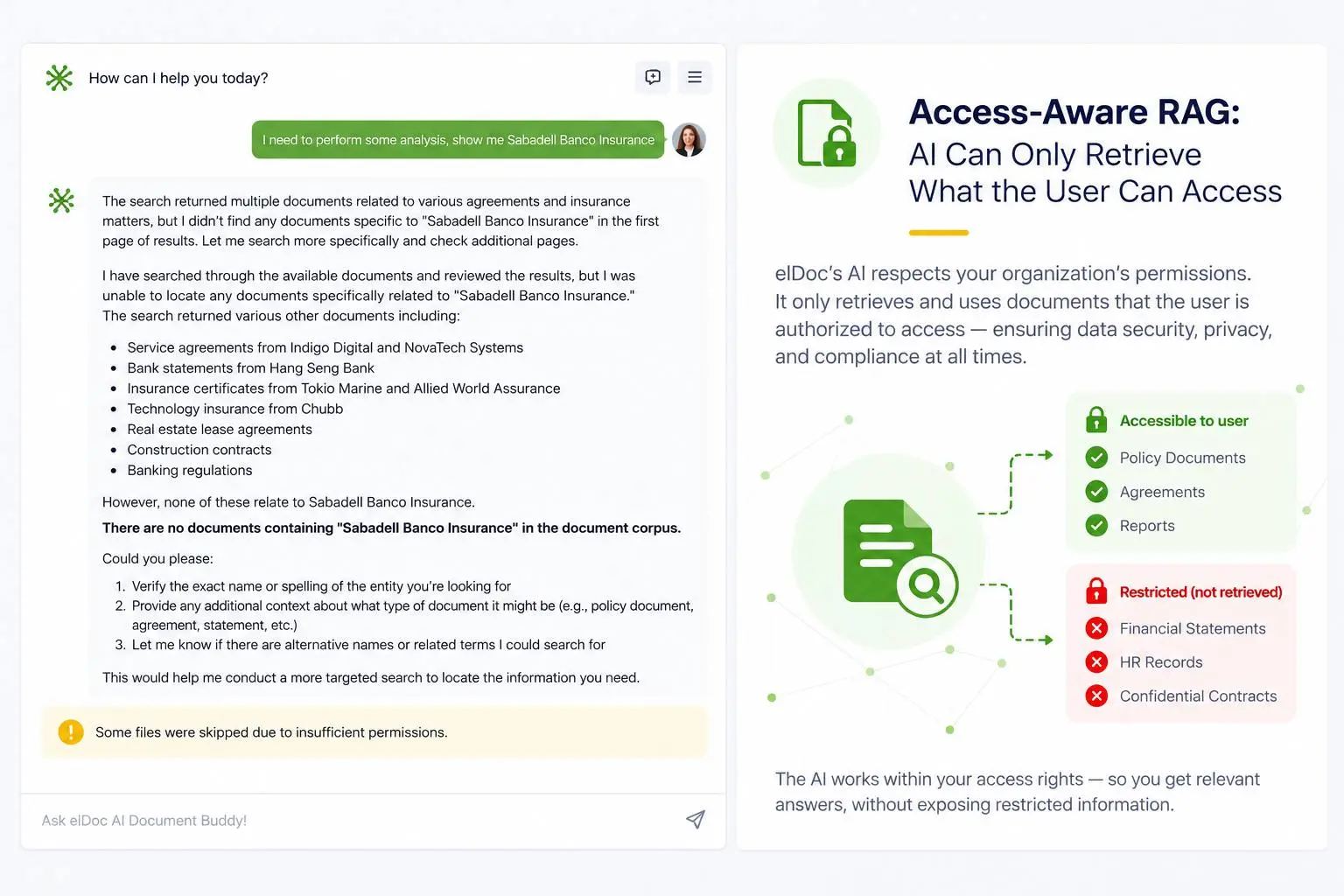
| AI Data Access | AI retrieves information the user cannot normally access | Critical information leakage risk | Access-Aware Agentic RAG | Preventive | AI inherits the user’s authorized information scope |
| Context Leakage | Unauthorized documents enter LLM context | Sensitive information may appear in AI responses | Authorization validation before retrieval | Preventive | Unauthorized information is excluded before LLM processing |
| Prompt Injection | User attempts to override restrictions through prompts | Unauthorized retrieval or manipulation | Application-enforced authorization independent of prompts | Preventive | Prompt instructions cannot independently expand access rights |
| Indirect Prompt Injection | Malicious instructions embedded in documents manipulate AI | AI behavior or actions could be influenced by retrieved content | Controlled RAG Context + Permission Enforcement + Controlled AI Actions | Preventive / Governance | Retrieved content cannot independently grant additional authority |
| Sensitive Data Disclosure | Confidential enterprise information is exposed through AI | Data leakage / confidentiality exposure | Controlled LLM interfaces + access-aware retrieval | Preventive | LLM access to enterprise information remains constrained |
| AI Data Sovereignty | Enterprise information is processed outside approved infrastructure | Regulatory, sovereignty and confidentiality exposure | On-premise / sovereign AI deployment | Preventive / Governance | AI processing can remain within customer-controlled infrastructure |
| External AI Dependency | External AI providers create unacceptable data exposure | Third-party and sovereignty risk | Fully air-gapped AI deployment | Preventive / Governance | LLM, RAG, embeddings and vector infrastructure can operate without external AI services |
| Customer Data & Training | Enterprise documents become part of model training | Loss of control over enterprise information | Separation of customer data from underlying LLM training | Preventive / Governance | Enterprise documents are not used by elDoc to train or fine-tune the underlying LLM |
| Hallucination | AI provides unsupported or inaccurate answers | Incorrect business decisions | RAG grounding + source references + human verification | Preventive / Governance | AI responses can be validated against enterprise source information |
| AI Output Accuracy | GenAI incorrectly extracts document values | Incorrect data enters business processes | Field-Level Data Scoring + HITL Validation | Preventive / Detective / Governance | Low-confidence results can be identified and validated |
| Low-Confidence Data | Uncertain AI results progress automatically | Processing and decision errors | Configurable validation thresholds | Preventive / Governance | Defined results can be routed to human review |
| Excessive AI Agency | AI performs unintended consequential actions | Operational or business impact | Controlled AI Actions + Human-in-the-Loop | Preventive / Governance | Humans retain authority over consequential operations |
| AI Document Changes | AI incorrectly classifies, renames, reorganizes or modifies documents | Document integrity and operational risk | Supervised AI operations + HITL | Preventive / Governance | Proposed AI actions can be reviewed, corrected, approved or rejected |
| AI Decision Risk | Incorrect AI decision advances through a workflow | Incorrect downstream business action | GenAI-Orchestrated Pipeline + HITL + Maker-Checker | Preventive / Governance | Validation can occur before subsequent workflow stages |
| AI Accountability | Organization cannot reconstruct AI-assisted activity | Governance and investigation gap | Audit logging + user-linked activity | Detective / Governance | AI-assisted actions and approvals can be traced |
| Critical Operations | Sensitive action occurs without independent validation | Fraud, error or unauthorized operation | Four-Eyes Principle | Preventive / Governance | Critical operations can require additional approval |
| AI Output Handling | LLM output triggers unintended application behavior | Security / operational impact | Controlled output processing | Preventive | LLM-generated content does not independently execute privileged functionality |
| Vector / Embedding Security | Vector infrastructure bypasses document permissions | Hidden authorization gap | Authorization-aware retrieval | Preventive | Vector search does not become an independent authorization mechanism |
| Model Dependency | Enterprise becomes dependent on an unsuitable model/provider | Operational, cost, sovereignty or security dependency | LLM-agnostic architecture | Governance / Corrective | Models can be replaced according to enterprise requirements |
| AI Supply Chain | External AI components introduce security/dependency risks | Third-party technology exposure | Controlled AI integration + replaceable components | Preventive / Governance | Individual AI components can be controlled, replaced or upgraded |
| AI Consumption | Uncontrolled AI usage increases cost or degrades service | Financial and operational risk | Usage tracking + resource constraints | Preventive / Detective | AI consumption can be monitored and constrained |
| AI Resource Exhaustion | AI workload affects application performance | Availability risk | Independent AI infrastructure sizing + concurrency controls | Preventive / Detective | AI capacity can scale independently from the core application |
| Availability & Resilience | Infrastructure failure interrupts AI-enabled processes | Business continuity risk | High-availability and resilient deployment | Preventive / Corrective | AI-enabled operations can be designed for service continuity |
From Risk Assessment to Operational AI Governance
The matrix highlights an important distinction between AI Governance on paper and AI Governance embedded into enterprise operations.
A policy may define what AI should or should not do. Operational AI Governance goes further by connecting each identified risk to a specific control, enforcement mechanism, human authority and auditable evidence.
The elDoc AI Governance Chain
AI Use Case → Risk → Business Impact → Control → Enforcement → Human Oversight → Audit Evidence
This creates a traceable governance chain from the initial risk assessment through to the technical and organizational controls used to manage that risk.
| AI Risk | elDoc Control | How It Is Enforced | Governance Outcome |
|---|---|---|---|
| AI exposes confidential information | Access-Aware Agentic RAG | User authorization is validated before document information is retrieved and supplied to the LLM | AI cannot independently expand the user’s authorized information scope |
| AI extracts an incorrect value | Field-Level Data Scoring + Validation Thresholds | Defined results can be routed to Human-in-the-Loop validation before progressing | Uncertain AI output does not automatically become trusted business data |
| AI performs an incorrect consequential action | Controlled AI Actions + HITL + Maker-Checker | Human authorization and independent validation can be introduced at defined workflow stages | AI can assist with operations while consequential decisions remain under organizational authority |
| AI activity cannot be investigated | Audit Logging + User-Linked Activity | Relevant AI-assisted actions, user activity and approvals are recorded within the applicable audit framework | Organizations maintain traceability and accountability for AI-assisted operations |
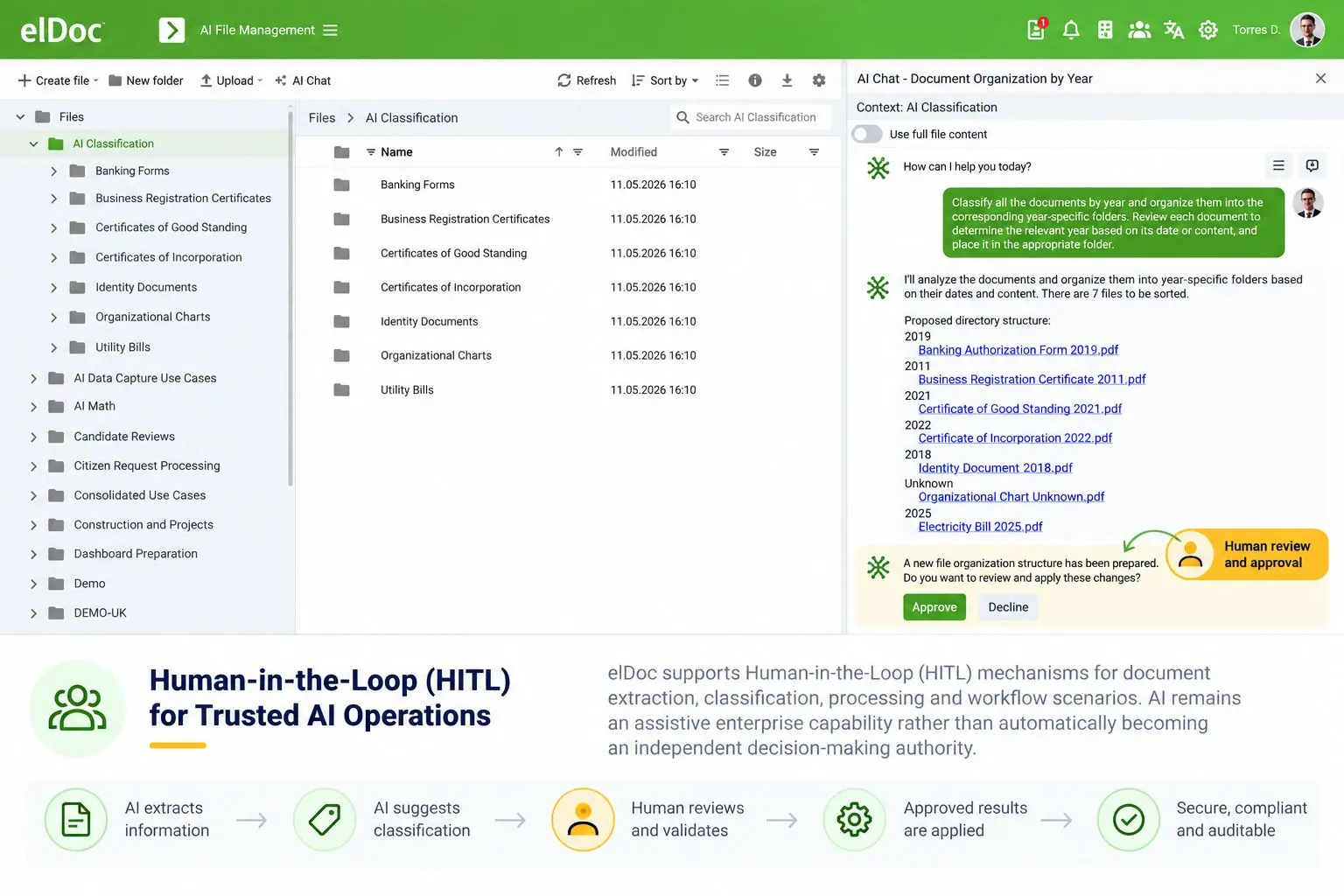
A Simple Example: From Risk to Evidence
Consider the risk of confidential information being exposed through an AI response.
01 — Identify the Risk
AI could potentially retrieve information that the requesting user is not authorized to access.
02 — Establish the Control
elDoc applies Access-Aware Agentic RAG and existing document-level authorization.
03 — Enforce the Control
Authorization is evaluated before enterprise information is retrieved and supplied as context to the LLM.
04 — Maintain Human and Organizational Authority
The LLM does not become an independent authorization layer and cannot grant itself or the user additional document permissions.
05 — Establish Evidence
Applicable document and system audit mechanisms provide traceability of relevant user and document activity.
The result is a complete governance relationship:
Risk Identified → Control Established → Control Enforced → Activity Governed → Evidence Maintained
This is the core of the elDoc approach to AI Governance by Design.
AI Governance is therefore not limited to policies describing acceptable AI behavior. It becomes a combination of technical enforcement, security controls, human oversight, monitoring and auditability embedded directly into the enterprise AI environment.
Four Layers of elDoc AI Governance Controls
The elDoc model can therefore be understood through four complementary control layers:
| Control Layer | Purpose | elDoc Examples |
|---|---|---|
| Preventive | Prevent unauthorized or unsafe activity before it occurs | MFA, RBAC, Access-Aware RAG, encryption, controlled AI actions, authorization-aware retrieval |
| Detective | Identify, monitor and reconstruct activity | Audit logs, document audit trails, user-linked AI activity, data scoring, consumption monitoring |
| Corrective | Recover, adapt or replace when conditions change | Version control, resilient architecture, replaceable LLMs/components |
| Governance | Keep consequential AI activity under organizational authority | HITL, Maker-Checker, Four-Eyes Principle, validation thresholds, sovereign AI policies |
No single layer should be considered sufficient.
Prevent → Detect → Correct → Govern
This defense-in-depth model means that if one control does not completely eliminate a risk, additional controls provide further protection, visibility and human oversight.
AI Governance Must Be Demonstrable
For regulated organizations, saying “our AI is secure” is not enough.
Organizations increasingly need to answer much more specific questions:
What AI risks have you identified?
Which controls address them?
Where are those controls enforced?
Who can override or approve an AI action?
What happens when AI confidence is insufficient?
Can an AI action be reconstructed afterward?
Can you demonstrate that unauthorized information never became part of the AI context?
This is why elDoc approaches AI Governance as an operational control framework rather than simply an AI policy.
The objective is to establish a traceable relationship between:
Risk → Control → Enforcement → Human Oversight → Evidence
That relationship is what turns AI Governance from documentation into an operational enterprise capability.
AI Governance by Design with elDoc
AI Governance should not be added after an AI solution has already been deployed.
It should be designed into the architecture from the beginning.
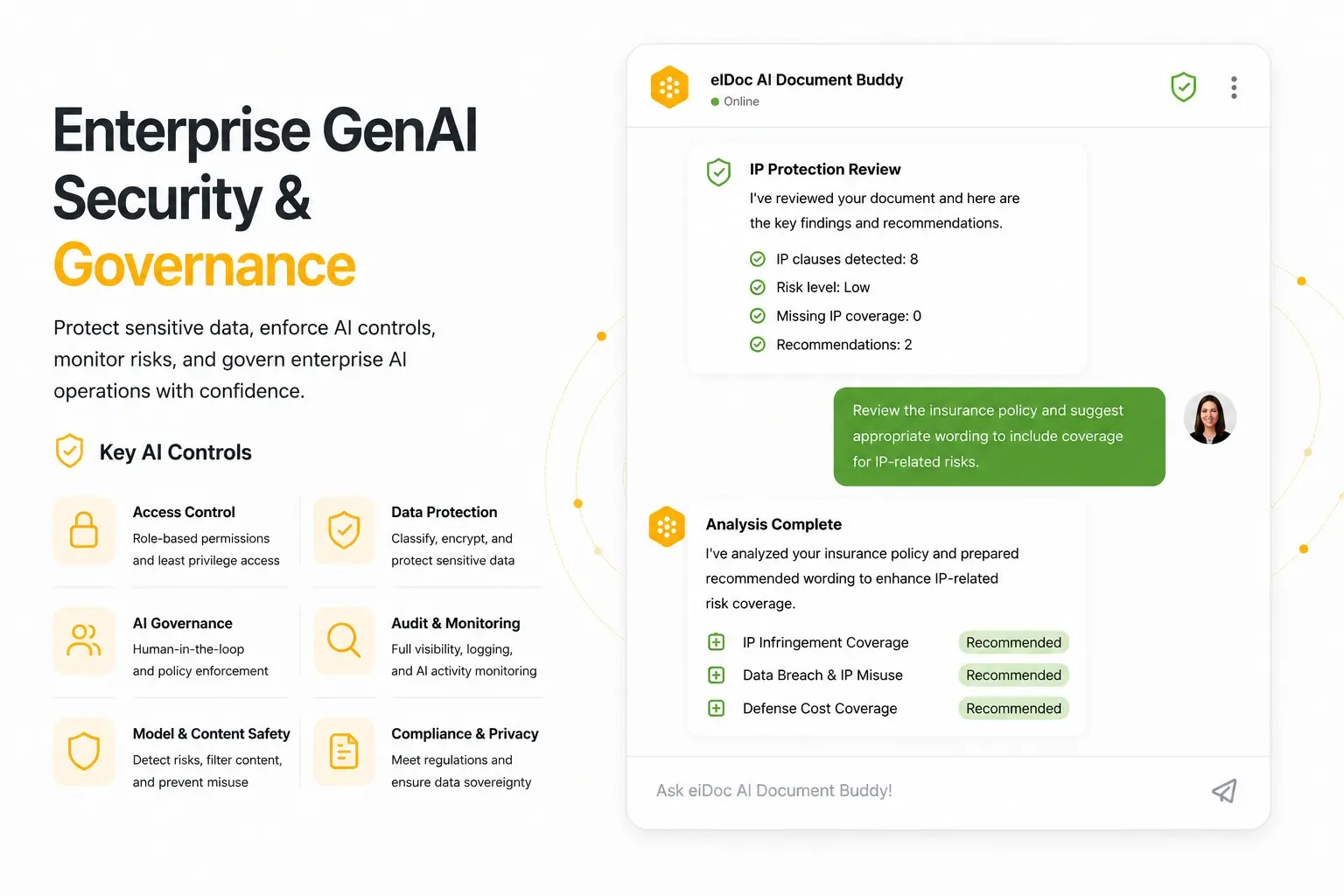
elDoc brings together enterprise document security, Access-Aware Agentic RAG, controlled LLM interfaces, Human-in-the-Loop validation, Maker-Checker controls, AI data scoring, auditability, sovereign deployment and controlled AI actions within the same governance architecture.
This allows organizations to move beyond the question:
“Can we use GenAI?”
toward the more important enterprise question:
“Can we demonstrate that our GenAI operates within defined risks, permissions, controls, human authority and auditability?”
That is the foundation of AI Governance by Design.