
Secure GenAI for Enterprise Documents: Why Security, Access Control and AI Governance Must Be Built In from Day One

Generative AI is rapidly changing how organizations interact with documents and enterprise knowledge. Employees no longer need to manually search through folders, repositories, archives, and document management systems. With Agentic RAG and AI Document Agents, they can ask questions in natural language, analyse large document collections, extract information, compare records, summarize content, and initiate document-driven workflows.
But for governments, financial institutions, critical infrastructure operators, healthcare organizations, defence-related environments, and other regulated enterprises, the biggest challenge is not simply whether AI can understand their documents.
The more important question is:
How can an organization give AI access to millions of documents without giving users access to information they were never authorized to see?
This is where many enterprise GenAI projects become significantly more complicated.
An LLM alone does not understand an organization’s security structure. It does not inherently know which employee belongs to which department, which documents are confidential, who is permitted to download a file, which administrator can delete information, or whether a user asking a question is authorized to retrieve the underlying content.
Enterprise GenAI therefore requires much more than an LLM connected to a vector database.
It requires a security-aware Document and Knowledge Intelligence architecture in which identity, permissions, document controls, encryption, governance, auditability, AI retrieval, and workflow controls operate together.
This is the principle behind the elDoc Resilient Security & Control Framework.
Enterprise AI Introduces a New Access Layer
Traditional enterprise security has historically focused on direct interaction between a user and an application.
A user authenticates. The system identifies the user. Permissions are evaluated. The user is then allowed—or denied—access to a particular folder, file, record, or function.
GenAI changes this model.
Imagine that an employee asks an AI Agent:
“Find all contracts related to this supplier, identify the pricing conditions and summarize any termination clauses.”
The employee may never directly open the underlying documents.
Instead, the AI system searches enterprise knowledge, retrieves relevant information, processes it, and generates an answer.
That creates an important security requirement:
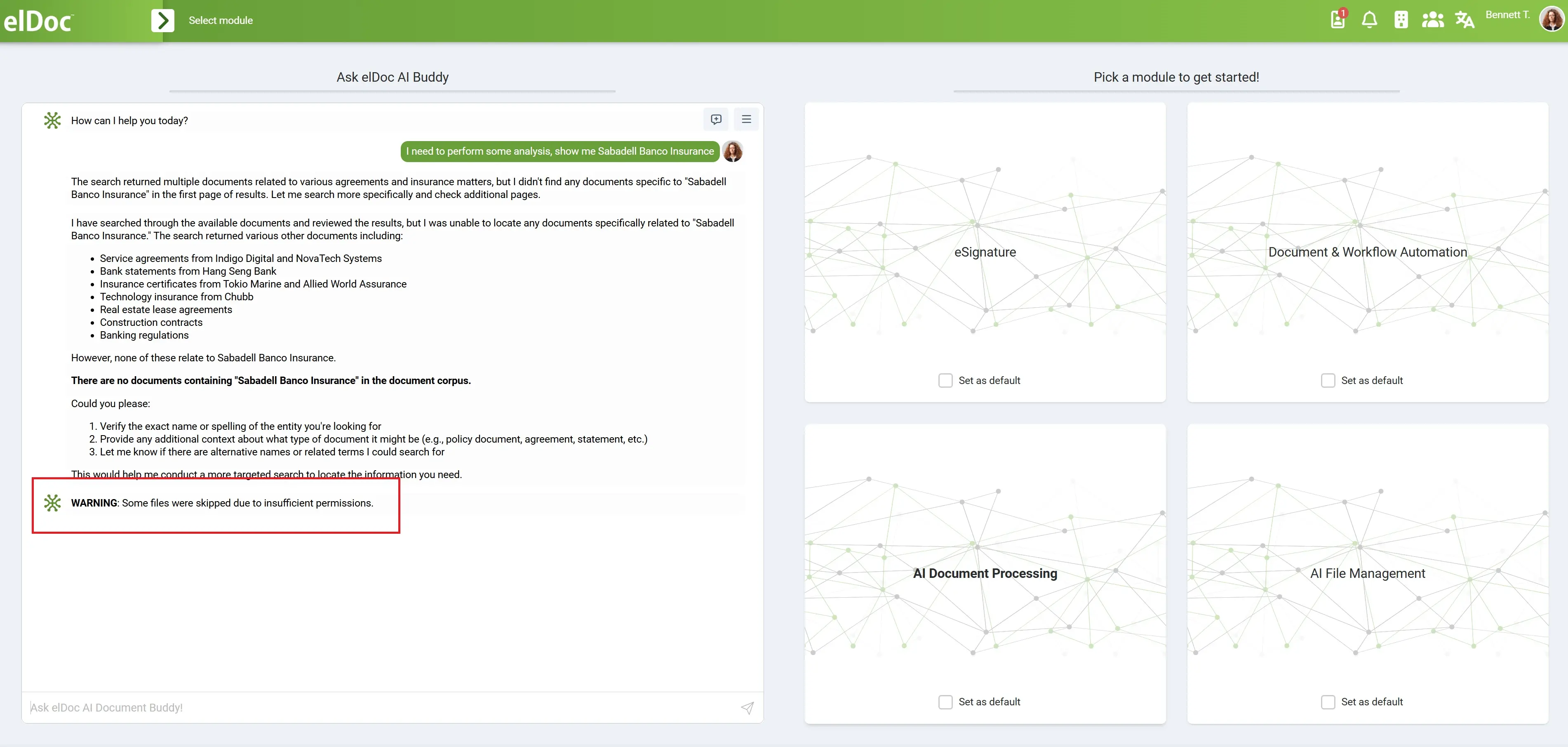
AI retrieval must never become a mechanism for bypassing normal document permissions.
If a user is authorized to access 20 documents out of a repository containing two million files, the AI should not search two million documents on that user’s behalf and expose information from documents outside those permissions.
The AI should operate within the same authorized information boundary as the user.
That is a fundamental principle behind elDoc’s approach to secure Agentic RAG.
Security Before AI
A common approach to enterprise GenAI is to begin with an LLM, connect enterprise documents, create embeddings or a vector database, and then consider security afterward.
For regulated environments, the architecture should work in the opposite direction.
Security must exist before the AI query is executed.
elDoc’s framework is built around multiple interconnected layers of enterprise protection.
| Security Layer | Purpose | Importance for GenAI |
|---|---|---|
| Platform Availability & Security | High availability, redundancy, replication and business continuity | Keeps enterprise AI and knowledge services operational |
| Authentication | MFA, SSO, OTP and enterprise identity integration | Establishes who is making an AI request |
| Roles & Permissions | RBAC, organizational permissions and least privilege | Determines which information the user can access |
| Action-Based Controls | Read, edit, copy, download, print, share and permissions controls | Controls what users and processes may do with information |
| Encryption & Data Protection | Protection in transit, at rest and during processing | Protects enterprise information throughout its lifecycle |
| Secure Sharing | OTP, passwords, expiry, secure viewing and watermarking | Extends governance outside the organization |
| Audit & Tracking | Logs and structured workflow history | Creates accountability for document operations |
| Agentic RAG Security | Permission-aware enterprise knowledge retrieval | Prevents AI from bypassing existing information boundaries |
The result is a fundamentally different architecture from a standalone enterprise chatbot.
AI becomes another controlled way of interacting with enterprise information—not an uncontrolled layer sitting above it.
Identity Becomes the First AI Security Boundary
Before an AI platform can determine what information a person is allowed to retrieve, it first needs to establish who that person is.
elDoc implements a layered authentication model designed for enterprise environments.
Multi-Factor Authentication
Multi-Factor Authentication adds additional verification beyond usernames and passwords and can integrate with commonly used authentication applications.
This helps reduce exposure associated with compromised credentials.
Single Sign-On
Single Sign-On allows organizations to connect elDoc with their existing identity infrastructure.
Rather than creating a completely separate identity environment specifically for document intelligence or GenAI, enterprises can incorporate the platform into their established authentication ecosystem.
Active Directory Synchronization
For organizations using Microsoft Active Directory, elDoc can synchronize users, organizational groups, and associated permissions.
This has significant implications for AI.
If an employee changes department, leaves the organization, or has their permissions modified, access to enterprise knowledge should follow the organization’s identity and authorization policies rather than requiring a completely separate AI permissions structure.
OTP for External Access
External document collaboration introduces another security boundary.
elDoc supports One-Time Password authentication for externally shared information, helping ensure that possession of a shared link alone does not necessarily provide access.
Together, these controls establish a chain of trust:
Identity → Authentication → Role → Permissions → Authorized Documents → Agentic RAG → AI Response
Breaking any part of that chain can create security exposure.
AI Must Respect Role-Based Access Control
Authentication answers who the user is.
Authorization answers the much more important question:
What is that person actually allowed to see and do?
elDoc implements Role-Based Access Control based on the principle of least privilege.
Users receive access according to their responsibilities rather than simply receiving broad access to an entire enterprise repository.
Permissions can also dynamically align with organizational structures, including job functions, reporting structures, and departments.
This becomes extremely important when GenAI is introduced.
Consider an organization with:
- HR documents;
- legal agreements;
- procurement files;
- board documents;
- customer records;
- engineering documentation;
- financial information;
- confidential management reports;
- operational procedures;
- regulatory correspondence.
All of these documents may exist within the same enterprise knowledge environment.
That does not mean every employee—or every AI Agent operating for that employee—should have access to all of them.
Enterprise Knowledge does not mean Enterprise-Wide Access.
The knowledge platform needs to understand not only what information exists, but also who is permitted to retrieve it.
From Role-Based Security to File-Level Control
Broad role permissions are still insufficient for many regulated organizations.
Two employees in the same department may have different access rights. A project team may be allowed to access a specific set of files while other departmental documents remain restricted.
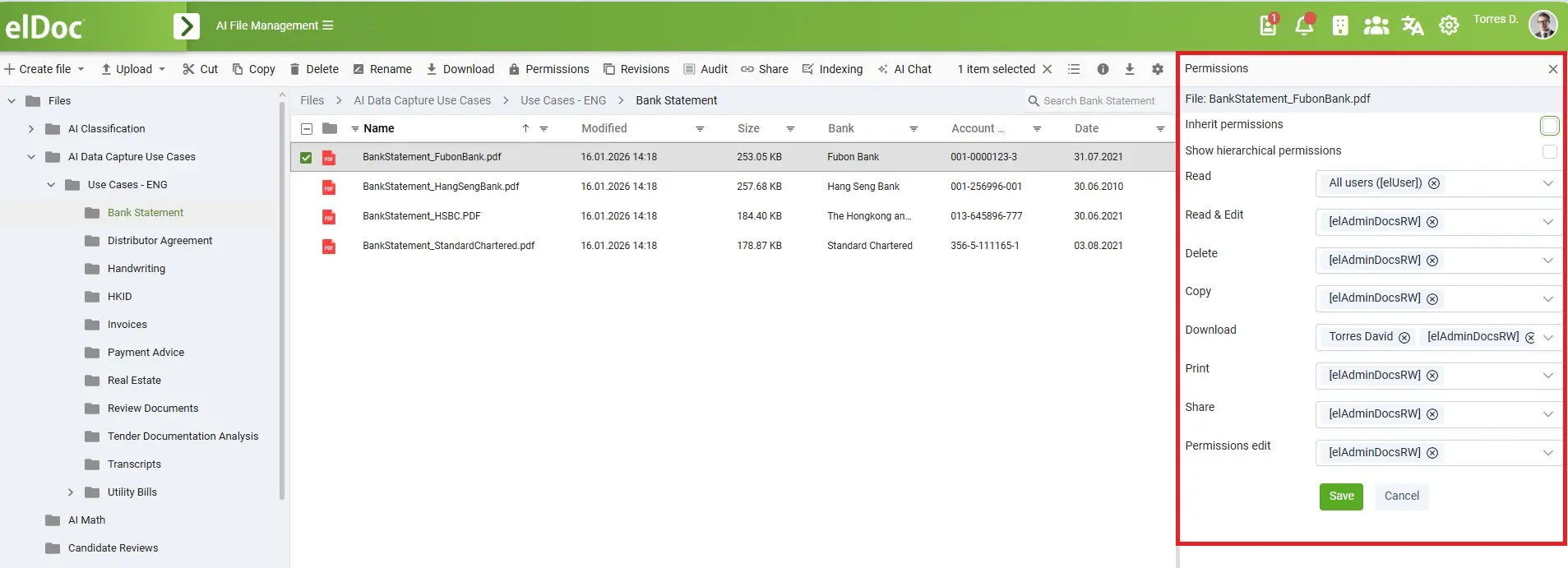
elDoc therefore extends governance to granular document-level permissions.
Its action-based controls can govern individual activities such as:
| Action | Example Control |
|---|---|
| Access | Whether the user can access a file or dataset |
| Read | Whether content can be viewed |
| Read & Edit | Whether authorized users can modify content |
| Copy | Whether information can be duplicated |
| Download | Whether a document can leave the controlled environment |
| Whether physical copies can be produced | |
| Share | Whether information can be distributed internally or externally |
| Permissions Edit | Whether a user can change access rights |
These restrictions can be applied at broader platform levels and to particular files.
This distinction is critical for enterprise AI.
Being permitted to read information through an AI interface does not automatically mean a user should be permitted to download, modify, redistribute, or delete the underlying document.
AI Should Never Become a Super-Administrator
One of the greatest architectural mistakes in enterprise GenAI is giving the AI retrieval layer broad access to the entire repository and attempting to filter the final answer afterward.
From a governance perspective, this creates unnecessary exposure.
elDoc instead applies the security model to AI interactions so that AI operates within authorized boundaries.
This principle can be summarized simply:
The AI should not know more on behalf of a user than that user is authorized to know.
When an authenticated user interacts with AI capabilities, access restrictions remain part of the retrieval process.
This becomes particularly important as organizations move beyond simple question-and-answer systems toward AI Document Agents capable of performing operations.
AI Agents Need Governance, Not Just Intelligence
The next stage of enterprise GenAI is not simply better chat.
It is Agentic AI.
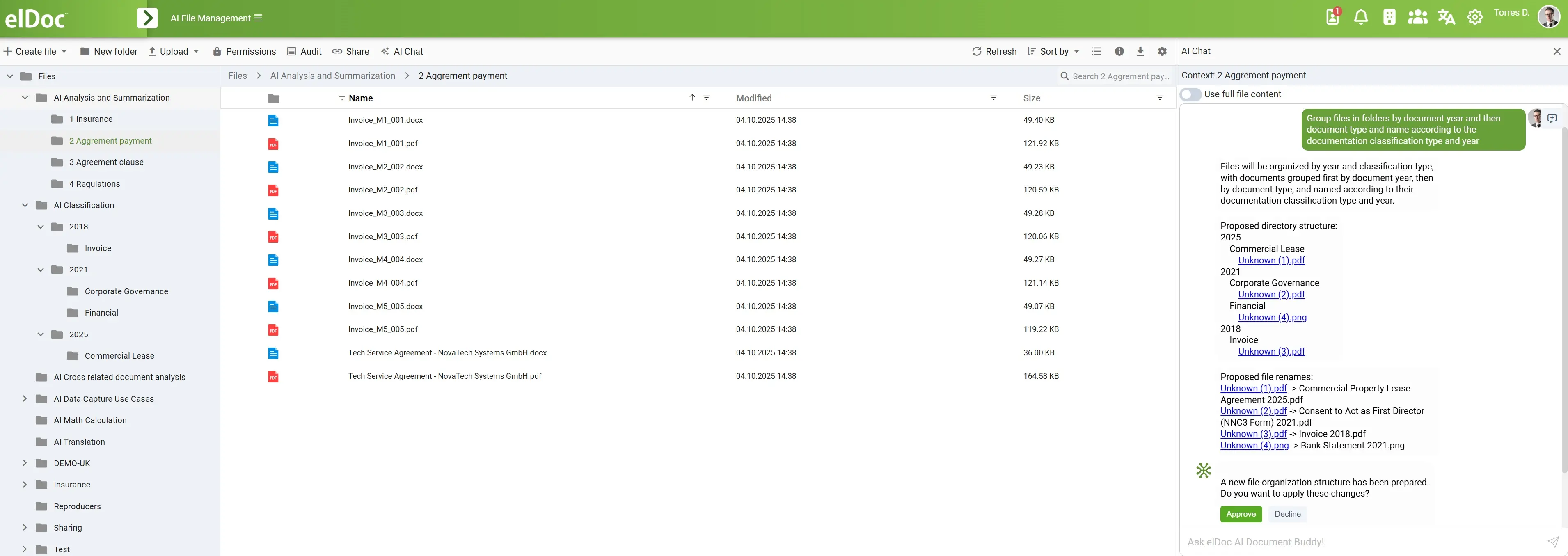
AI Agents can increasingly perform actions involving enterprise documents and workflows rather than merely generating text.
This introduces a major governance distinction.
There is a significant difference between asking:
“Summarize this contract.”
and asking:
“Process this contract, update its metadata, route it for approval and notify the responsible department.”
The second request moves AI from information retrieval into business operations.
For this reason, enterprise AI architecture needs to distinguish between:
what an AI Agent can understand, what it can access, and what it is authorized to do.
The underlying permissions, workflow rules, approval structures, and audit mechanisms therefore become increasingly important as AI autonomy increases.
Human-in-the-Loop Remains Essential
Secure enterprise AI does not mean removing people from every process.
In many regulated environments, human approval remains an essential control.
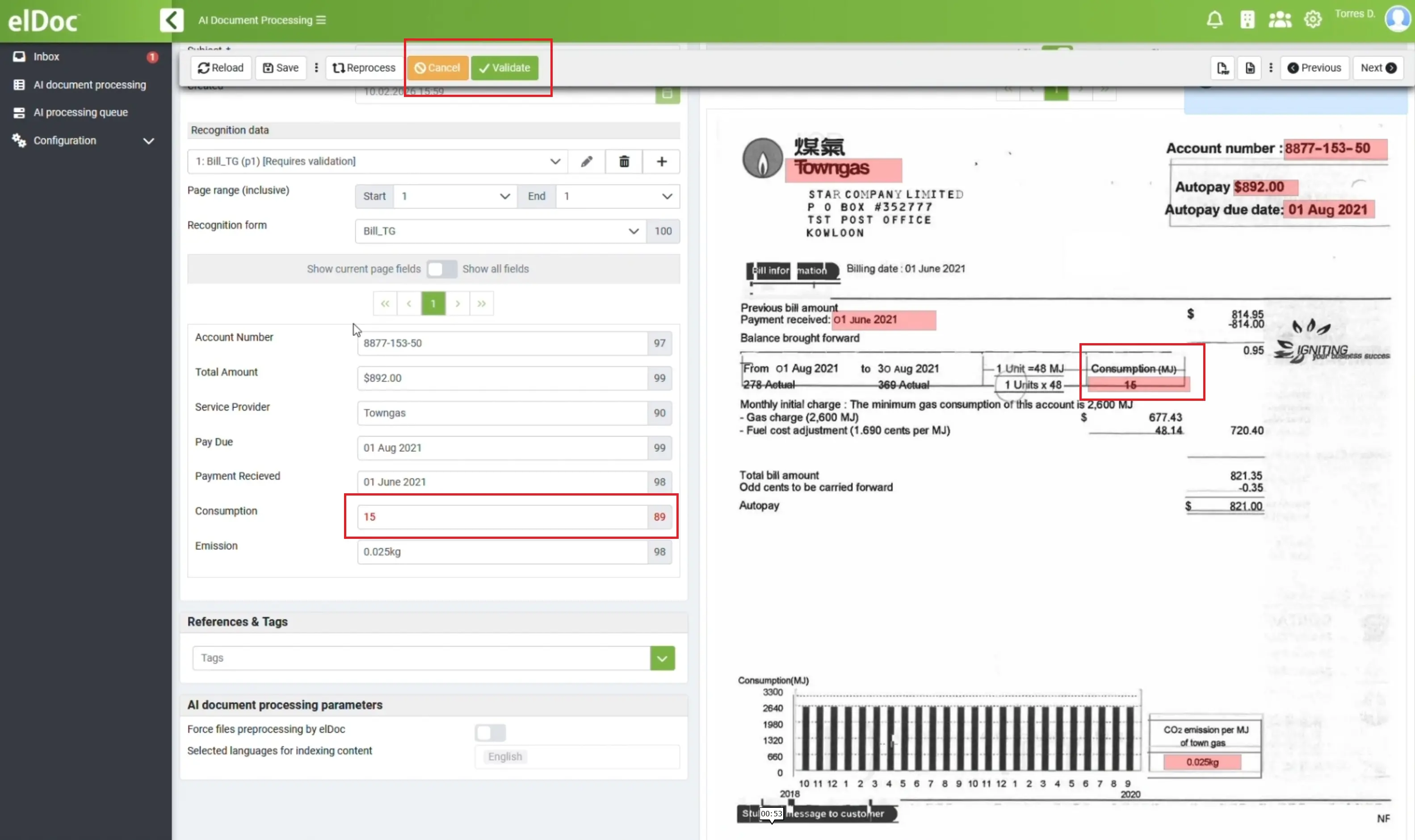
elDoc’s security architecture incorporates separation of duties and the four-eyes principle for sensitive operations.
For example, the framework separates different administrative responsibilities and introduces additional safeguards around document deletion.
The underlying governance principle is highly relevant to Agentic AI:
High-risk actions should not automatically become autonomous simply because AI is technically capable of performing them.
Organizations can therefore combine AI-driven automation with human review and authorization at appropriate points in document workflows.
This allows enterprises to increase automation without abandoning accountability.
Encryption Across the Information Lifecycle
Access control protects who can access information.
Encryption protects the information itself.
elDoc’s framework addresses multiple stages of the data lifecycle.
Encryption in Transit
Communication between clients, servers, and cluster components is protected using Transport Layer Security, with the framework describing TLS 1.2 as enabled by default.
This helps protect information while it moves between systems and infrastructure components.
Encryption at Rest
Stored files, indexes, snapshots, and other data volumes can be protected using AES-256 encryption.
This is particularly important for enterprise AI because an AI-enabled knowledge environment can contain millions of indexed documents and associated information.
Customer-Controlled Encryption Keys
The architecture also supports integration with key-management services such as:
AWS KMS, Google Cloud KMS and Azure Key Vault.
This allows organizations to maintain additional control over cryptographic key management according to their infrastructure and governance requirements.
Protecting Data During Processing
The framework additionally addresses encryption in use through client-side encryption and customer-controlled keys.
The objective is a broader lifecycle approach:
Protect enterprise information when stored, when transmitted, and when processed.
This is especially relevant when GenAI becomes part of enterprise document processing because information may move through multiple retrieval, indexing, processing, and AI operations.
Secure Enterprise AI Also Requires Secure Sharing
Not every information security risk originates from AI.
Documents still need to be shared with suppliers, partners, customers, auditors, consultants, regulators, and other external stakeholders.
elDoc therefore provides a multi-layer secure file-sharing model.
| Security Control | Function |
|---|---|
| OTP Authentication | Adds recipient verification to external access |
| Password Protection | Adds an additional access barrier |
| Expiration Controls | Automatically ends access after a defined period |
| Secure Viewing Mode | Restricts how sensitive documents can be consumed |
| Dynamic Watermarking | Adds recipient/timestamp information for accountability |
| Permissions Management | Controls downloading, editing, uploading and resharing |
Dynamic watermarking is particularly valuable for sensitive documents.
A shared document can carry identifying information associated with the recipient and time of access, strengthening traceability and discouraging unauthorized redistribution.
Security should continue after a document leaves its original folder or workflow.
That principle becomes even more relevant as AI makes enterprise information easier to discover and use.

Auditability: Knowing What Happened Matters as Much as Preventing It
Security is not only about preventing unauthorized activity.
Organizations also need the ability to reconstruct what happened.
This is particularly important for governments and regulated enterprises, where compliance teams, auditors, and security officers may need evidence showing how information was accessed and processed.
elDoc maintains detailed records of document-related activities, including operations such as:
- creation and editing;
- approvals and declines;
- deletion;
- reviews and comments;
- delegation;
- timestamps;
- authenticated user activity.
Beyond individual audit events, elDoc maintains structured workflow history.
This provides context around how a document moved through a business process.
Organizations can use that visibility to determine whether approvals occurred in the correct sequence, identify unexpected changes, detect delays, and investigate deviations from established workflows.
This becomes increasingly important in AI-enabled processes.
As AI Agents perform more document operations, organizations need to maintain the ability to answer:
What happened? Who initiated it? What information was involved? Which permissions applied? What workflow was followed? Was human approval required?
Enterprise AI without accountability can create significant governance challenges.
Enterprise AI with traceable workflows becomes considerably easier to control.
Availability and Resilience Are Security Requirements Too
Confidentiality receives much of the attention in AI security discussions, but enterprise information security also requires availability and integrity.
An AI-powered knowledge platform may eventually become a core operational system.
Employees may depend on it to retrieve policies, analyse contracts, process cases, find technical information, perform document operations, and support decisions.
Downtime therefore becomes a business risk.
elDoc’s framework includes architecture for:
high-availability clustering, load balancing, data replication, redundant components, regional continuity, and disaster recovery.
This allows organizations to design deployments appropriate to their operational requirements, from smaller environments through distributed enterprise architectures.
For organizations operating across regions or running mission-critical document operations, the platform can be designed to avoid a single point of failure.
Production-ready enterprise AI requires more than an accurate model. It requires production-ready infrastructure.
Cloud, On-Premise and Sovereign AI Requirements
For many organizations—particularly government, defence, critical infrastructure, and highly regulated enterprises—where AI runs can be almost as important as what AI does.
The security framework supports both cloud and on-premise environments, allowing organizations to align deployment architecture with internal security, infrastructure, regulatory, and data-governance requirements.
This becomes particularly relevant to the growing requirement for Sovereign AI.
Organizations may need greater control over:
- where enterprise documents are stored;
- where indexes are maintained;
- where AI processing takes place;
- how encryption keys are controlled;
- which LLMs are used;
- how information moves between infrastructure components;
- who can administer the environment.
Secure GenAI therefore needs to be considered as an architecture—not simply an AI subscription.
ISO/IEC 27001: Security Supported by an Internationally Recognized Framework
Security claims are particularly important in enterprise GenAI.
Organizations should therefore look beyond feature lists and evaluate how information-security practices are governed at the organizational level.
In 2026, elDoc achieved ISO/IEC 27001 certification, with the certification stated as valid until 22 March 2029.
According to the scope described in the security framework, the certification covers:
Information security, cybersecurity and privacy protection associated with the design and delivery of enterprise-grade GenAI platforms for Document and Data Intelligence, together with managed solutions across cloud and on-premise environments.
This is particularly relevant because elDoc operates at the intersection of several highly sensitive technology domains:
enterprise documents + organizational knowledge + GenAI + Agentic RAG + AI Agents + workflow automation.
ISO/IEC 27001 provides an internationally recognized framework for establishing, implementing, maintaining, and continually improving an Information Security Management System.
For organizations evaluating enterprise GenAI platforms, certification therefore complements the technical controls implemented within the product.
Technology Controls + Information Security Governance
The distinction is important.
Technical capabilities such as MFA, encryption, RBAC, granular permissions, audit logs, secure sharing, and high availability protect the technology environment.
An information security management framework addresses the broader organizational processes through which information-security risks are managed.
For regulated customers, both dimensions matter.
From Secure Documents to Secure Knowledge Intelligence
The larger transformation taking place across enterprises is a move from traditional document management toward Knowledge Intelligence.
Historically, organizations primarily needed systems capable of storing documents and helping employees find them.
GenAI changes what is possible.
Enterprise information can now become a knowledge layer that AI can query, analyse, compare, summarize, and use within automated processes.
But this transformation also changes the role of the document platform.
A modern enterprise knowledge platform needs to understand:
| Traditional Document Management | AI-Powered Knowledge Intelligence |
|---|---|
| Where is the document? | What does the document mean? |
| Who can open it? | What information may AI retrieve for this user? |
| Who can edit it? | What operations may an AI Agent perform? |
| Who shared it? | Can AI use its information in a response? |
| What happened to the file? | What happened throughout the AI-assisted workflow? |
| Is the document protected? | Is the complete AI-to-document interaction governed? |
This is why enterprise GenAI security cannot be separated from enterprise document security.
The two architectures are becoming one.
Zero Data Leakage Must Be an Architectural Objective
Organizations adopting GenAI frequently focus on preventing sensitive information from leaving their environment.
But data leakage can occur in several ways.
A user may retrieve information from a document they were not supposed to access. An AI system may combine information across security boundaries. Sensitive information may appear in generated output. An external share may remain active longer than intended. An administrator may have unnecessarily broad privileges.
For this reason, the elDoc security model approaches protection across multiple layers rather than relying on a single AI safeguard.
The objective is straightforward:
AI should generate responses only from enterprise information that is approved, protected, and accessible to the requesting user.
That requires identity, authorization, retrieval security, encryption, document governance, and auditability to operate together.
AI & Data Sovereignty: Keeping Enterprise Intelligence Under Your Control
For governments, defence organizations, critical infrastructure operators, financial institutions, and other highly regulated enterprises, data sovereignty is no longer limited to where documents are stored. With Generative AI, organizations must also consider where documents are indexed, where prompts are processed, where embeddings and AI indexes reside, which LLM processes the information, and whether any enterprise data leaves the controlled infrastructure.
elDoc can support an on-premise architecture in which the Document Intelligence platform and the AI technology stack are deployed within the client’s controlled infrastructure. The security framework specifically supports on-premise deployments and customer-controlled security architecture; the precise AI components and LLM deployment are determined by the selected implementation architecture.
Sovereign AI means controlling not only your data, but also the infrastructure, AI processing, models, access, and governance surrounding that data.
A Sovereign GenAI Architecture
A fully controlled deployment can bring the major components required for Document and Knowledge Intelligence inside the organization’s infrastructure:
| Component | Sovereign / On-Premise Architecture |
|---|---|
| Enterprise Documents & Files | Stored within the organization’s controlled infrastructure |
| Document Management | elDoc deployed on-premise |
| Knowledge Base | Enterprise knowledge maintained within the controlled environment |
| Document Indexing | Indexing performed within the enterprise environment |
| AI OCR / Document Processing | Can be deployed as part of the local document-processing architecture |
| Search & Retrieval | Enterprise retrieval services remain within the controlled environment |
| Agentic RAG | Retrieval operates against authorized enterprise knowledge and user permissions |
| AI Document Agents | Operate within the governed elDoc environment |
| LLM | Local/on-premise LLMs can be selected where required by the deployment |
| Prompts & AI Responses | Can be processed within the controlled AI environment when using local models |
| Identity & Authentication | Integrated with enterprise identity infrastructure, including AD/SSO |
| Access Controls | RBAC and granular document-level permissions |
| Encryption | Protection for information in transit, at rest and during processing |
| Audit & Workflow History | Enterprise activities remain traceable through the platform |
| Infrastructure | Client-controlled servers, storage, networking and, where required, GPU infrastructure |
From Data Sovereignty to AI Sovereignty
Traditional data sovereignty focuses primarily on where information is stored.
GenAI expands that requirement.
An organization pursuing Sovereign AI may need control over the complete processing chain:
Documents → OCR & Processing → Indexing → Knowledge Base → Permissions → Agentic RAG → AI Agents → LLM → Response
If these components are designed for the organization’s own infrastructure, sensitive enterprise information does not need to be sent to a public AI service simply to obtain an AI-generated answer.
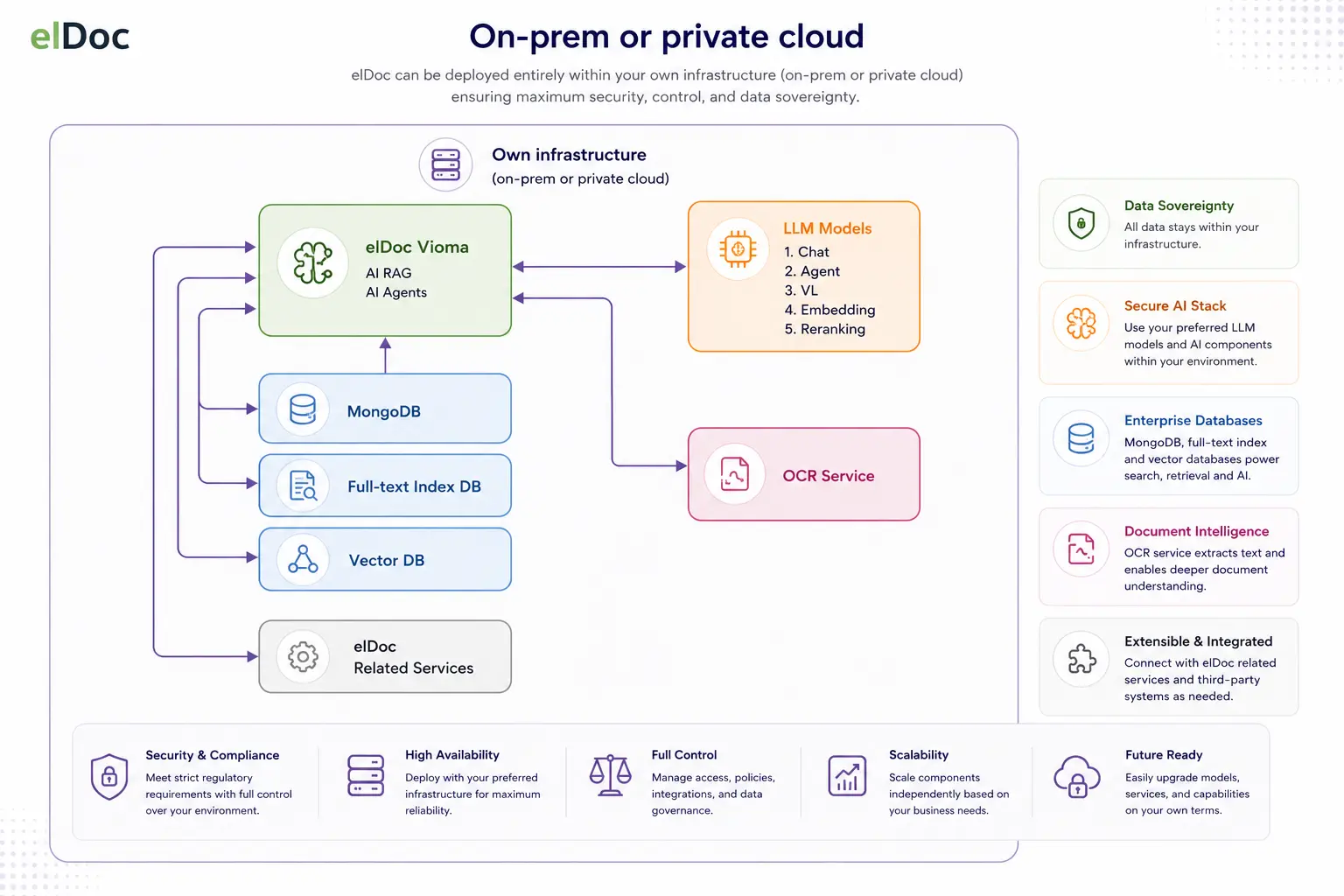
This is particularly important for environments where documents may contain classified, confidential, commercially sensitive, personal, operational, or security-critical information.
On-Premise LLMs
A sovereign deployment can use locally hosted LLMs, subject to the models and infrastructure selected for the implementation.
This enables organizations to design an environment where prompts, retrieved document context, and generated responses are processed by models running on infrastructure under their control rather than relying exclusively on external public LLM APIs.
At the same time, elDoc’s architecture can support an LLM-agnostic approach, allowing the AI layer to be designed around the organization’s security, performance, infrastructure, and governance requirements rather than locking the enterprise knowledge architecture to a single model.
The Future of Enterprise GenAI Is Controlled Intelligence
The future of enterprise AI is not simply about giving an increasingly powerful LLM access to more information.
It is about giving AI the right information, for the right user, under the right permissions, for the right operation—and maintaining accountability throughout the process.
That is the difference between uncontrolled AI access and governed Knowledge Intelligence.
elDoc brings together enterprise document management, granular security, resilient infrastructure, encryption, access-aware Agentic RAG, AI-powered document capabilities, workflow controls, secure sharing, and comprehensive auditing within a unified environment.
The underlying philosophy is simple:
Security should not be added after enterprise GenAI has been deployed. Security must be part of the architecture from day one.
For organizations operating in regulated and security-sensitive environments, this provides a path toward adopting GenAI without abandoning the controls, accountability, and governance on which enterprise information management depends.
Talk to an elDoc Expert
Organizations planning secure GenAI, Agentic RAG, enterprise Knowledge Bases, AI Document Processing, Sovereign AI, or on-premise AI should begin with the security and governance architecture—not simply with the choice of LLM.
Talk to an elDoc expert to explore how to build a secure, access-aware and production-ready GenAI environment for your enterprise documents and knowledge.