
LLM-Agnostic Architecture and Multi-LLM Orchestration: How elDoc Brings Model Flexibility to Enterprise AI

The Generative AI landscape is evolving at a pace that makes committing an enterprise AI strategy to a single Large Language Model increasingly difficult to justify.
New models are continuously introduced. Existing models improve, pricing changes, deployment options expand, and enterprise security and regulatory requirements evolve. At the same time, different models demonstrate different strengths across reasoning, document understanding, multilingual processing, extraction, summarization, and other enterprise workloads.
For organizations implementing AI across multiple business processes, the question is therefore no longer simply “Which LLM should we choose?”
A more important question is:
How can we build an enterprise AI architecture where the organization can use the right model for the right process — while retaining control over its data, security, governance, deployment, and future technology choices?
This is the principle behind the LLM-agnostic architecture and Multi-LLM Orchestration capabilities of elDoc.
Rather than building enterprise processes around one AI provider, elDoc introduces an orchestration layer between enterprise applications, business processes, organizational data, and the underlying AI models.
The result is an architecture in which different models can be used for different workloads, multiple models can coexist within the same enterprise environment, and sensitive workloads can remain completely isolated through privately deployed models.
One Enterprise Platform. Multiple AI Models.
Different enterprise processes have fundamentally different requirements.
A KYC process may involve hundreds of documents, multilingual content, cross-document validation, customer risk analysis, and complex reasoning.
A credit review process may require deep analysis of financial statements, lending documentation, collateral information, and supporting documents.
Invoice processing may prioritize high-volume document extraction, classification, validation, and workflow automation.
Processing highly confidential customer information may introduce another requirement entirely: the data must never leave the organization’s controlled infrastructure.
There is little reason to assume that one model will always be optimal for all these scenarios.
With elDoc, organizations can design their AI architecture accordingly.
For example:
- KYC processing can run with Kimi, where its capabilities are appropriate for the organization’s KYC workload.
- Credit review can use Claude for document analysis and complex reasoning across lending documentation.
- Invoice processing can use OpenAI models for document understanding, extraction, validation, and Generative AI processing.
- Sensitive customer-data processing can use an open-weight model deployed entirely on-premises or inside the organization’s private cloud/VPC, maintaining AI data residency within the organization’s infrastructure.
These do not need to exist as separate AI projects.
They can operate within the same elDoc enterprise platform, governed through a common security, document-processing, workflow, monitoring, and AI orchestration architecture.
From LLM Integration to LLM Orchestration
Connecting an application to several LLM APIs is relatively straightforward.
Enterprise Multi-LLM architecture requires considerably more.
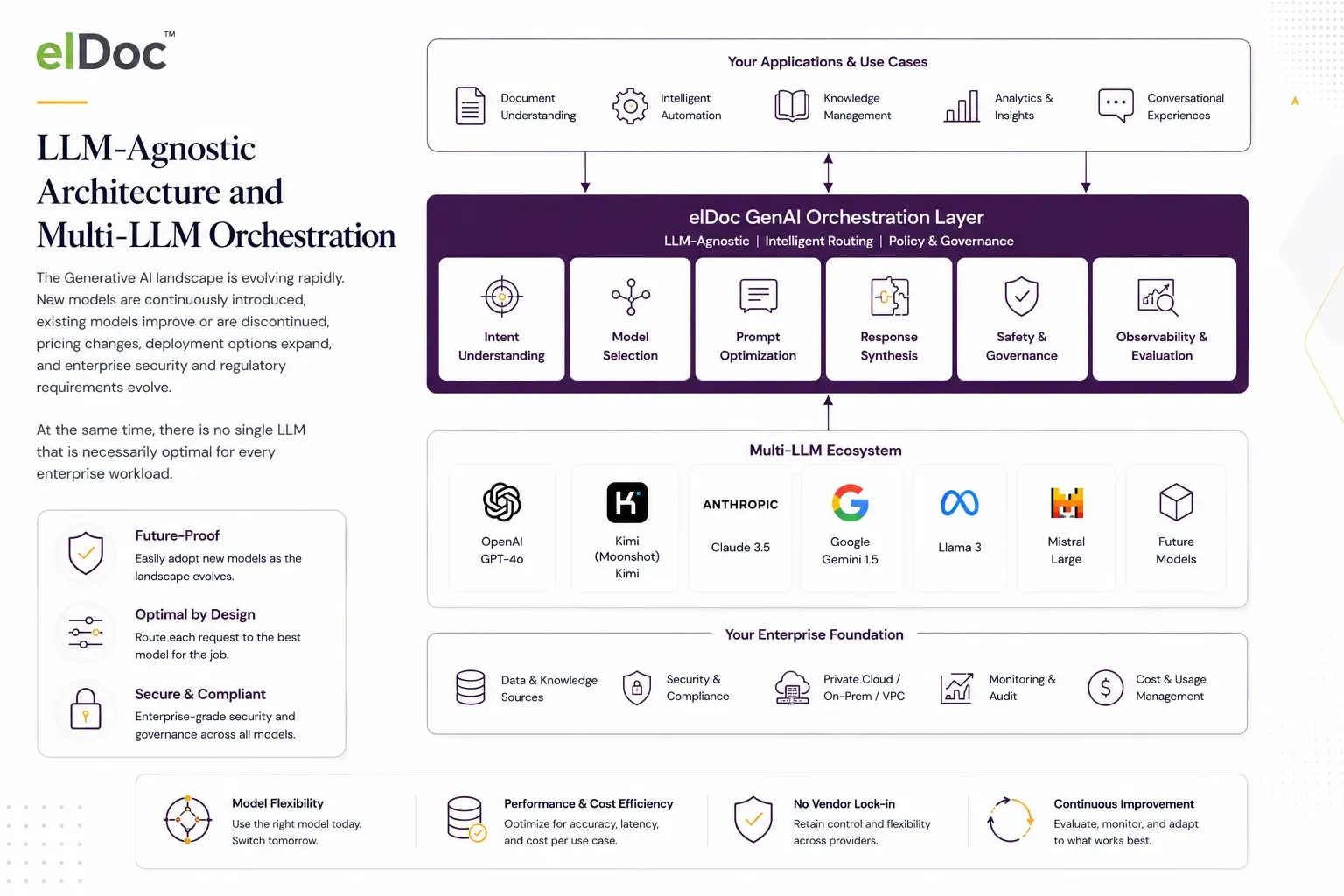
elDoc provides a GenAI Orchestration Layer that sits between enterprise applications and the underlying model ecosystem. Instead of applications being directly dependent on a particular model, AI requests can be managed through this orchestration layer.
Depending on the implemented scenario, the elDoc GenAI Orchestration Layer can incorporate capabilities such as:
| Orchestration Capability | What It Does |
|---|---|
| Intent Understanding | Identifies what the user, document process, AI Document Agent, or automated workflow is trying to accomplish and determines the appropriate processing path. |
| Model Selection | Routes each request to the most appropriate LLM or multimodal model based on the use case, task complexity, security requirements, deployment policy, performance, and other predefined criteria. |
| Prompt Optimization | Adapts instructions, context, and model parameters for the selected model and specific business task to improve the quality and consistency of AI outputs. |
| Response Synthesis | Transforms and consolidates model outputs into structured information that can be consumed by users, applications, APIs, workflows, AI Document Agents, or subsequent processing stages. |
| Safety & Governance | Enforces enterprise policies around model access, data processing, approved repositories, user permissions, AI operations, and data residency requirements. |
| Observability & Evaluation | Provides visibility into AI usage, model performance, processing quality, token consumption, and associated costs, enabling continuous evaluation and optimization across models and use cases. |
The objective is not simply to connect multiple LLMs. It is to create an intelligent orchestration layer that determines which model should perform which task, under which security and data-residency requirements, and at what performance and cost profile.
This abstraction is particularly important because the AI model becomes a replaceable component of the architecture rather than the architecture itself.
The Right Model for the Right Job
LLM-agnostic architecture does not mean that all models are treated as identical.
Quite the opposite.
It recognizes that models are different — and turns those differences into an architectural advantage.
An organization may determine that one model provides better reasoning for complex credit cases, while another delivers a better cost-to-performance ratio for large-volume document processing. A third model may perform particularly well with a language or document type important to the organization.
Another workload may not be permitted to use an external AI service at all.
elDoc allows organizations to build these differences into the AI architecture instead of forcing every business process through the same model.
A simplified enterprise configuration could therefore look like this (illustrative example):
| Enterprise Process | AI Configuration | Primary Requirement |
|---|---|---|
| KYC & Customer Due Diligence | Kimi | Large-context and document-intensive analysis |
| Credit Review | Claude | Complex document reasoning and analysis |
| Invoice Processing | OpenAI | Document understanding and automated processing |
| Confidential Customer Data | Private open-weight LLM | On-premises processing and AI data residency |
| Internal Knowledge Assistant | Any Supported LLM | Secure retrieval from approved repositories |
| Visual Document & Image Understanding | Qwen-VL | Multimodal understanding of documents, images, layouts, and visual content |
The actual model selection remains an enterprise decision and can evolve together with the organization’s AI strategy.
AI Data Residency: When Information Cannot Leave the Enterprise
For banks, government organizations, healthcare providers, financial institutions, and other regulated enterprises, model performance is only one part of the AI decision.
Where the AI processing happens can be equally important.
Certain documents may contain customer information, financial data, confidential agreements, personally identifiable information, internal corporate information, or other regulated data.
Organizations may therefore establish different AI processing policies for different information categories.
For standard workloads, approved external or privately hosted commercial models can be used.
For highly sensitive workloads, elDoc can be architected with open-weight models deployed within the customer’s own infrastructure — on-premises, in a private cloud, or within a controlled VPC environment.
In such a configuration, the organization can maintain control over:
- where documents are stored;
- where prompts and contextual information are processed;
- where the LLM is deployed;
- which repositories the AI is permitted to access;
- which users and processes can invoke the model;
- and where AI-generated outputs and logs are retained.
This makes AI data residency an architectural capability rather than merely a contractual statement.
For example, a bank could allow a cloud-based model to process certain non-sensitive operational documents while requiring customer-identifiable documentation to be processed exclusively by an internally deployed model.
Both workloads can still be orchestrated through elDoc.
Avoiding AI Vendor Lock-In
Vendor lock-in is becoming an increasingly important consideration in enterprise Generative AI strategies. An AI model that appears optimal today may not necessarily remain optimal two years from now.
A provider can change its pricing.
A new generation of another model can deliver significantly better performance.
A previously cloud-only model may become available for private deployment.
New regulatory requirements may affect where certain workloads can be processed.
Or an organization may simply negotiate a more advantageous enterprise agreement with another provider.
When business processes are tightly engineered around one model, changing providers can require substantial application redevelopment.
An LLM-agnostic architecture reduces this dependency by separating the business application and document-processing architecture from the underlying model layer.
Organizations can therefore evaluate new models and progressively introduce them without redesigning the entire document management and automation environment.
Future Models Become an Extension of the Architecture
Multi-LLM orchestration is also about preparing for models that do not yet exist. The models leading particular benchmarks today will not necessarily be the models enterprises select tomorrow.
For this reason, the elDoc architecture is designed around an extensible model ecosystem rather than a permanently fixed list of AI providers.
As new models and deployment approaches become suitable for enterprise use, they can be evaluated and incorporated into the architecture according to organizational requirements.
This enables organizations to continuously optimize for factors such as:
accuracy, reasoning quality, security, latency, deployment model, data residency, context capacity, language performance, and cost per use case.
Instead of requiring a new enterprise AI strategy every time the model landscape changes, the underlying architecture is designed to accommodate that change.
From “Which LLM?” to “Which AI Architecture?”
Enterprises should not have to predict which LLM will dominate the market several years from now before they can start implementing Generative AI today.
The more sustainable approach is to build an architecture capable of adapting as models, regulations, costs, and enterprise requirements change.
With elDoc, an organization can run KYC with Kimi, credit review with Claude, invoice processing with OpenAI, and highly sensitive customer-data workloads with privately deployed open-weight models — while keeping these processes within one governed document and AI automation environment.
Tomorrow, the organization may choose different models.
The business processes, enterprise data foundation, security controls, workflows, AI governance, and document architecture do not need to change with every model decision.
That is the purpose of an LLM-agnostic architecture.
And Multi-LLM Orchestration takes this concept further: not simply giving enterprises access to multiple models, but enabling them to determine which model should be used, for which workload, under which security and data-residency conditions, and as part of which business process.
The competitive advantage is therefore not choosing one “best” LLM.
It is building an enterprise AI platform capable of continuously using the right AI for the right job — without surrendering control of the architecture, the process, or the data.
Build an AI Architecture That Can Evolve
The question for enterprises is no longer which single LLM to standardize on. It is how to build an AI architecture that can continuously adapt as models, business requirements, security policies, costs, and regulatory expectations evolve.
With elDoc’s LLM-agnostic architecture and Multi-LLM Orchestration, organizations can combine commercial and privately deployed open-weight models within a single enterprise environment — selecting the right AI for each use case while maintaining control over data, access, workflows, AI governance, and data residency.
KYC can run with one model, credit review with another, visual document intelligence with a multimodal model, while particularly sensitive customer information can remain entirely within an on-premises AI environment. As better models emerge, the architecture can evolve without rebuilding the underlying business processes around a new AI provider.
The objective is not to predict which LLM will be the best tomorrow. It is to ensure that your enterprise architecture is ready to use it.
Planning an enterprise GenAI initiative or evaluating how Multi-LLM orchestration could fit into your existing architecture?
Talk to an elDoc expert to discuss your use cases, security and AI data residency requirements, model strategy, and deployment options — and explore how an LLM-agnostic architecture can be designed around your organization.