
Document Management with AI for Banking: Enterprise AI with Security, Compliance and Data Control

Banks operate in one of the most document-intensive environments of any industry. Customer onboarding files, KYC documents, loan applications, financial statements, contracts, correspondence, transaction records, compliance documentation, credit reports, collateral documents, and internal policies generate enormous volumes of information every day.
Traditional Document Management Systems (DMS) have helped banks centralize and organize these documents. However, storing documents is no longer enough.
Modern financial institutions increasingly need systems that can understand documents, extract information, analyze content, answer questions, identify risks, trigger workflows, and help employees make faster decisions.
This is where AI-powered Document Management changes the traditional approach.
Instead of treating documents as static files stored inside folders, AI transforms the document repository into an intelligent banking knowledge environment where information can be automatically processed, classified, analyzed, searched, and used across business processes.
What Is AI-Powered Document Management for Banking?
AI-powered Document Management combines traditional document and records management capabilities with technologies such as Generative AI, Intelligent Document Processing (IDP), Large Language Models (LLMs), Retrieval-Augmented Generation (RAG), OCR, workflow automation, and AI Document agents.
A traditional Document Management System primarily helps banking employees answer a basic question:
Where is the document?
An AI-powered Document Management platform goes far beyond document storage and retrieval. It can understand what a document is, analyze its content and context, connect information across multiple documents, and determine what should happen next.
Based on the automatic classification of an incoming document, the system can trigger the respective workflow and assign specific tasks to AI agents. Instead of simply locating a document, AI agents can perform deeper, predefined activities such as:
What type of document is this, and which banking process does it belong to?
What information does the document contain, and which data should be extracted?
Does the document meet predefined banking, compliance, or operational requirements?
Is any mandatory information or supporting documentation missing?
Does the information correspond with other documents within the same customer, KYC, loan, or transaction file?
Are there discrepancies between names, dates, amounts, addresses, authorized signatories, contractual terms, or other relevant information?
Are there unusual conditions or exceptions that require additional attention?
Should the case continue automatically, or should it be escalated for human review?
This creates an entirely different approach to Document Management in banking. AI agents can analyze documents in context, build connections between information across multiple files, perform predefined checks, identify and list discrepancies, prepare summaries, and initiate the appropriate next step in a workflow.
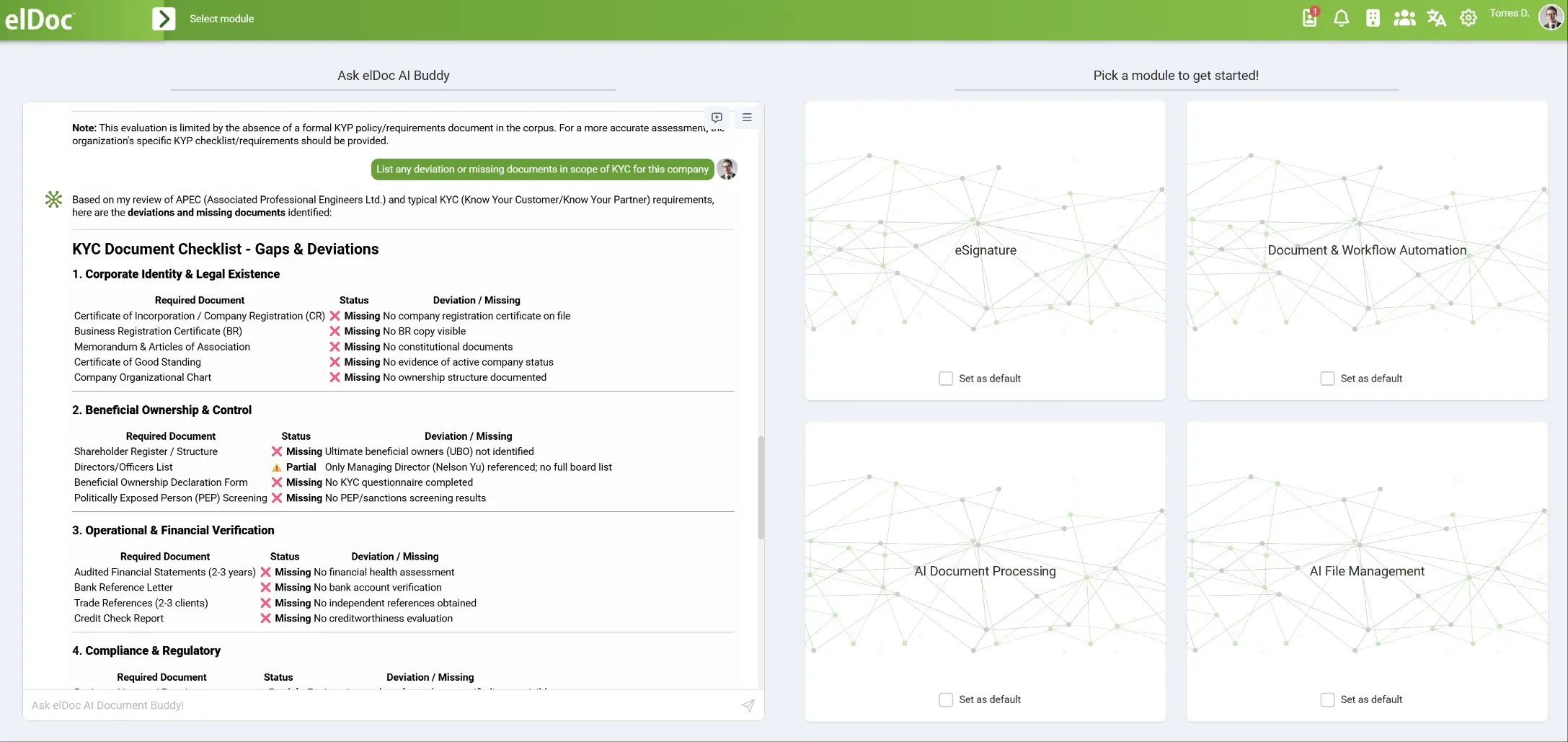
For example, once a document is classified as part of a corporate KYC application, the system can automatically initiate the corresponding KYC workflow. An AI agent could extract company and director information, compare the application against Articles of Association and identification documents, verify whether the signatory corresponds with the authorized representatives, identify missing documentation, and generate a structured discrepancy report for the responsible employee.
Rather than employees manually opening documents, searching for information, entering data, comparing files, recording discrepancies, and routing cases between departments, these activities can become part of a single intelligent and automated document process — with human review triggered whenever predefined conditions require it.
One Secure Repository for Banking Documents and Knowledge
Banks frequently have information distributed across departments, shared folders, archives, legacy systems, email, CRM platforms, core banking applications, and multiple Document Management Systems. In an AI-driven banking environment, fragmented information is increasingly becoming a barrier to automation, faster decision-making, and effective use of enterprise knowledge.
With elDoc, banking information can be centrally managed within a secure enterprise repository and organized according to the bank’s operational and security requirements. This can include both customer-related files and internal banking knowledge, with separate structures, permissions, and access policies applied to each.
Customer documentation can be organized by customer, corporate entity, account, loan, transaction, case, branch, financial year, or document type. A corporate customer file, for example, may contain Articles of Association, certificates of incorporation, shareholder and director information, identification documents, financial statements, bank statements, agreements, correspondence, and application forms.
At the same time, internal banking documents — including policies, procedures, compliance manuals, lending guidelines, product documentation, legal templates, operating instructions, and other institutional knowledge — can be maintained within dedicated repositories with respective secure and role-based access.
AI-powered classification can automatically identify incoming documents, understand what they are, determine which customer file or internal repository they belong to, and trigger the appropriate processing workflow.
Where Secure Agentic RAG Becomes Critical for Banking
This centralized and governed information environment creates the foundation for one of the most important capabilities for modern banking: Secure Agentic RAG.
Rather than giving an AI model unrestricted access to the bank’s entire document repository, Secure Agentic RAG enables AI agents to retrieve, connect, and analyze information from the specific documents and knowledge sources the user or process is authorized to access.
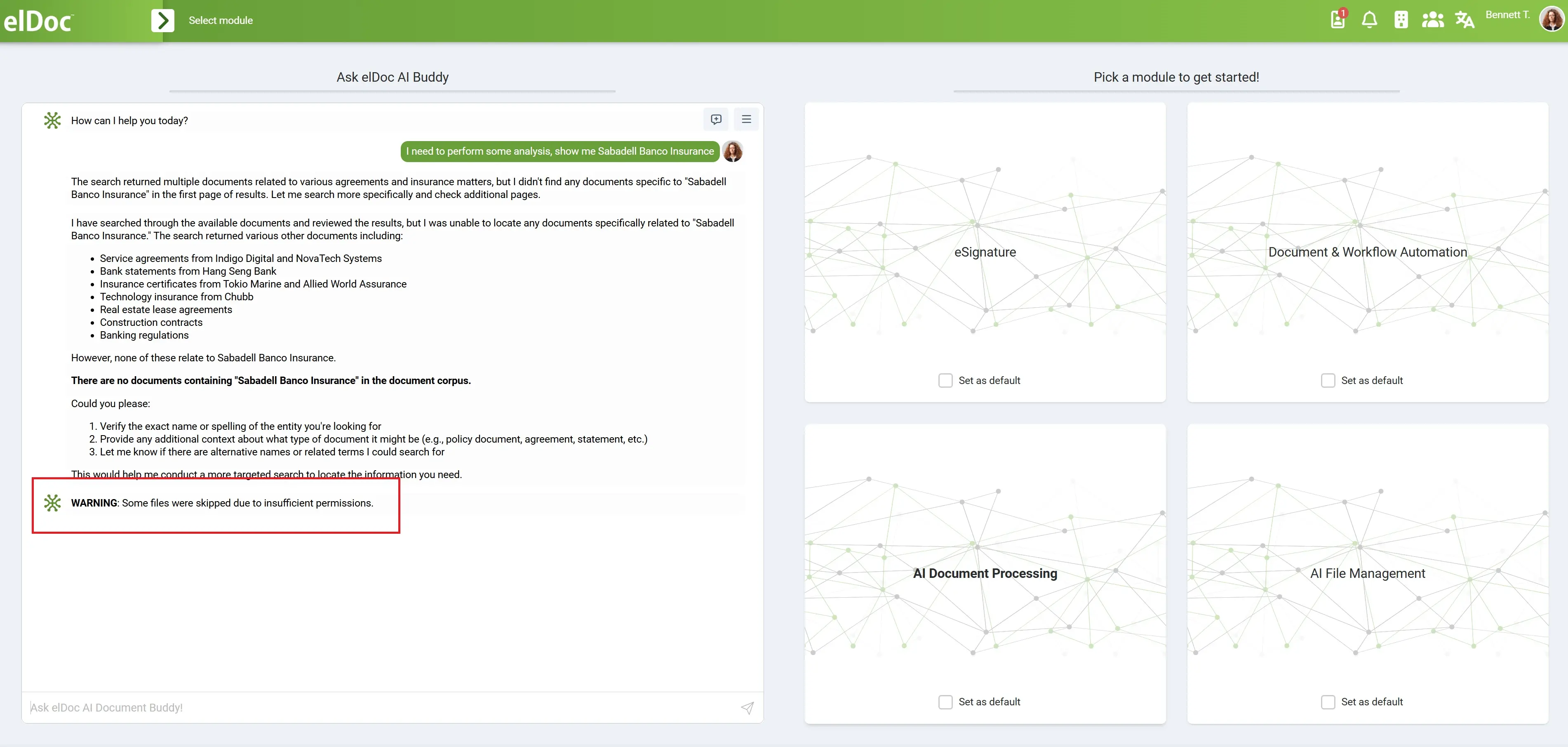
The AI agent can go beyond simply finding a document. It can retrieve relevant information across multiple permitted sources, understand relationships between documents, compare information, perform predefined checks, identify discrepancies, prepare summaries, and support or trigger subsequent workflows.
For example, an authorized corporate banking employee could ask the AI to analyze a customer’s complete file, compare information across corporate documents and applications, identify inconsistencies, and summarize the findings. A compliance employee could interact with a different set of permitted KYC policies and customer documents, while another employee might only have AI access to approved internal procedures and product documentation.
The underlying principle remains the same: AI should only be able to work with the information it is permitted to access.
This is particularly important for banking. Enterprise RAG without proper document permissions, governance, auditability, and information boundaries can introduce significant security risks. Secure Agentic RAG makes access control part of the AI architecture itself, helping ensure that enterprise AI respects the bank’s existing information-security model.
The result is more than a centralized document repository. It becomes a secure, permission-aware enterprise knowledge layer where authorized AI agents can reason across banking information and turn documents into actionable intelligence.
For modern financial institutions, this capability is rapidly becoming part of the technological foundation required to compete in an AI-driven banking market. Banks need to move beyond simply storing and retrieving information toward securely enabling AI to understand, connect, analyze, and act on enterprise knowledge — without losing control over who can access it and how it is used.
From Secure Agentic RAG to AI-Triggered Banking Workflows
Secure Agentic RAG creates the foundation for something much more powerful than simply allowing employees to chat with banking documents. Once AI agents can securely retrieve, understand, and connect information across authorized customer files and internal banking knowledge, the same intelligence can become part of automated banking processes.
This is where Document Management evolves from a repository and knowledge platform into an intelligent process automation environment.
AI does not need to operate only as a standalone chatbot where an employee selects documents and manually asks questions. AI agents can be embedded directly into predefined banking workflows, automatically performing specific tasks whenever a document is received, classified, updated, or moved to a particular stage of a process.
A typical process could look like:
Document Received → Automatically Classified → Data Extracted → Secure Agentic RAG Analysis → Requirements Checked → Documents Cross-Checked → Discrepancies Identified → Result Evaluated → Workflow Triggered → Human Review Where Required
Once a document is classified, elDoc can determine which process it belongs to and automatically trigger the respective workflow. Different AI agents can then be assigned to perform specific tasks according to the bank’s predefined requirements.
This means AI is not simply answering “Where is the document?” or even “What does this document contain?” It can determine what needs to be checked, which other authorized documents and policies should be consulted, whether information is consistent across the complete case, what discrepancies exist, and what should happen next.
AI-Triggered KYC Processing
Consider a corporate KYC onboarding process.
Once documents are received, AI-powered classification can automatically identify Articles of Association, certificates of incorporation, identification documents, shareholder information, application forms, proof of address, financial statements, and other supporting documentation.
Based on the document classification, the appropriate KYC workflow can be triggered automatically.
AI agents can extract required customer and corporate information and, through Secure Agentic RAG, retrieve relevant information from the authorized customer file together with applicable internal KYC requirements.
The system can then perform predefined checks across the complete case.
For example, it can determine whether all mandatory documents have been submitted, whether identification documents remain valid, whether company registration information is consistent, whether names and addresses correspond across documents, whether the person signing the application is identified as an authorized representative, and whether other predefined KYC requirements have been satisfied.
Instead of reviewing each document independently, AI can build connections across the complete customer file and generate a consolidated view of the case.
If all predefined requirements are satisfied, the case can automatically proceed to the next stage.
If documentation is missing, the system can trigger a missing-document workflow.
If discrepancies are identified, AI can generate a structured discrepancy report and assign the case to the appropriate employee.
And if predefined higher-risk conditions are detected, the case can be immediately escalated for human review.
AI Agents for Credit Review Processes
The same approach can be applied to credit assessment, where the complexity of document analysis can be significantly greater.
A credit file may contain loan applications, financial statements, bank statements, management accounts, corporate documents, existing agreements, collateral information, valuation reports, contracts, and other supporting documentation.
Once the documents are classified, a Credit Review workflow can automatically begin.
Different AI agents can perform different stages of the review. One agent may extract financial information, another may analyze bank statements, while another can compare declared figures against supporting documentation or evaluate the submitted information against predefined lending requirements.
Through Secure Agentic RAG, AI agents can securely retrieve and connect relevant information across the customer’s authorized documents and applicable internal credit policies.
The system could, for example, compare several years of financial statements, identify significant changes in revenue or expenses, analyze incoming and outgoing transactions, compare declared income against bank statements, identify contractual obligations, summarize existing liabilities, check required documentation, and highlight discrepancies between information provided in different sources.
Instead of a credit officer manually searching through hundreds of pages to assemble this information, AI can prepare a structured Credit Review Summary containing extracted information, key findings, document references, discrepancies, and items requiring professional assessment.
Human-in-the-Loop: Automation with Banking Control
The objective of AI-powered banking workflows is not to remove people from sensitive banking decisions. It is to automate repetitive document-intensive work while ensuring that human expertise is applied where it matters most.
Banks can define precisely when a process may continue automatically and when human intervention is mandatory.
These escalation criteria can be based on missing mandatory documents, inconsistencies between documents, unusual transactions, predefined risk indicators, significant financial discrepancies, confidence thresholds, policy exceptions, or any other criteria established by the bank.
A standard KYC case with complete and consistent documentation could progress through predefined workflow stages with minimal manual processing. A case containing discrepancies or predefined risk indicators could automatically be routed to a KYC or Compliance Officer with the AI-generated findings already prepared.
The same principle applies to credit review. AI can perform the initial document-intensive analysis and prepare the case, while credit officers remain responsible for assessments, exceptions, approvals, and decisions requiring professional or regulatory judgment.
The employee therefore does not start with a folder containing dozens of documents and a blank screen. They receive a structured case containing the relevant information, AI analysis, identified discrepancies, supporting document references, and the specific issues requiring their attention.
This is where Secure Agentic RAG, AI agents, workflow automation, and human oversight come together.
Rather than choosing between manual banking processes and uncontrolled AI automation, banks can establish a governed model where AI processes what can be automated, workflows coordinate what happens next, and humans remain in control of the decisions that require accountability and professional judgment.
AI Governance and Security Should Be Built into the Banking AI Architecture
For banks, AI governance cannot simply be a policy document created after AI systems have already been deployed. Governance, security, access control, human oversight, and auditability need to be incorporated directly into the technology architecture.
The fundamental principle is straightforward: AI should not be able to access information or perform actions beyond the permissions and controls established by the bank.
This becomes particularly important as AI evolves from simply answering questions to AI agents capable of analyzing documents, initiating workflows, and performing predefined actions.
Role-Based Access Control Across Documents and AI
Access control should apply not only to documents but also to the AI layer interacting with those documents.
Banks can establish granular role-based access controls (RBAC) defining which users, departments, and AI processes are permitted to access specific repositories, folders, customer files, document categories, and AI capabilities.
For example, a Legal department may have access to contractual repositories, Credit teams may work with lending and financial documentation, Compliance teams may analyze KYC files, while other employees may only interact with an approved knowledge base containing internal policies and procedures.
The same security boundaries should extend to Secure Agentic RAG. When an AI agent searches, retrieves, connects, or analyzes information, it should only work with documents the respective user or process is authorized to access.
This helps prevent enterprise AI from becoming an uncontrolled gateway to sensitive banking information.
Human-in-the-Loop for Critical AI Actions
As AI agents become capable of performing tasks rather than simply generating answers, human-in-the-loop controls become even more important.
Banks can determine which activities AI may perform automatically and which require explicit human confirmation.
Routine activities — such as classification, data extraction, document comparison, summarization, or predefined checks — can be automated where appropriate.
Critical operations, however, can require confirmation from an authorized employee before execution.
This may include actions such as moving sensitive files, changing permissions, deleting documents, approving a workflow stage, modifying important records, exporting sensitive information, or executing other actions classified by the bank as critical.
An AI agent could therefore recommend:
“Based on classification I will move these documents to the approved customer file.”
But if moving the documents is defined as a controlled action, an authorized user must confirm it before the operation is executed.
The same principle can apply to deletion. AI may identify duplicate or obsolete documents, but the bank can require explicit human authorization before any document is permanently removed.
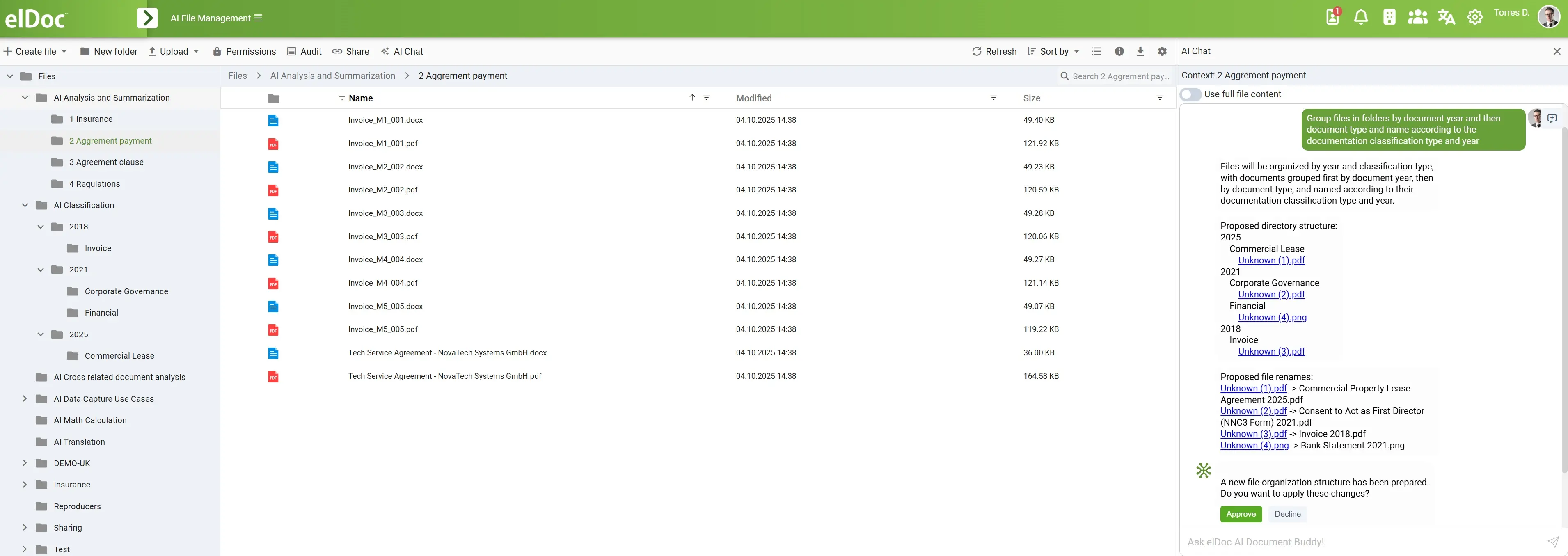
This provides banks with the benefits of Agentic AI while keeping consequential operations under controlled human authority.
Complete Audit Trail for Documents, Users and AI Agents
Every significant activity within an enterprise banking environment should be traceable.
This includes not only traditional user activities but also actions initiated or recommended by AI agents.
Depending on the configured process, audit records can capture activities such as document uploads, downloads, access, modifications, movement between folders, workflow transitions, approvals, exports, permission changes, and deletion activities.
AI-related activities can similarly be governed and recorded, including AI interactions, prompts, document references, processing activities, model usage, workflow actions, AI-generated results, human confirmations, and subsequent actions.
This creates an important chain of accountability:
Who initiated the action? → What information was accessed? → What did AI analyze or recommend? → What action was proposed? → Who approved it? → What action was executed? → When did it occur?
For regulated banking environments, this level of traceability helps transform AI from an opaque productivity tool into a controlled enterprise capability.
Multi-Factor Authentication and Identity Security
Access to sensitive banking documents and AI functionality should begin with strong identity controls.
Multi-Factor Authentication (MFA) can provide an additional layer of protection beyond usernames and passwords, helping reduce the risk associated with compromised credentials.
Combined with enterprise identity management and role-based permissions, MFA helps ensure that access to confidential customer documents, internal knowledge, administrative functions, and AI capabilities is limited to authenticated and appropriately authorized users.
Encryption for Sensitive Banking Information
Banking documents can contain highly sensitive personal, financial, corporate, and transactional information. Protecting that information throughout its lifecycle is therefore essential.
Enterprise Document Management architecture can apply encryption for data in transit and at rest, helping protect information while it is being transmitted between systems as well as while it is stored within the controlled environment.
Security considerations should extend beyond the original document to the wider AI processing environment, including extracted data, enterprise knowledge repositories, integrations, and other components containing sensitive information.
Document Watermarking and Controlled Distribution
Security does not end when an authorized employee opens a document.
For particularly sensitive information, banks may require additional controls around document distribution and use.
Document watermarking can provide an additional layer of information protection by visibly identifying documents, users, organizations, or other relevant information when documents are viewed or distributed.
Combined with access permissions, download controls, audit trails, and other document-security measures, watermarking can help banks maintain greater control over sensitive information throughout its lifecycle.
High Availability, Backup and Disaster Recovery
For banks, security also means ensuring that critical information and systems remain available.
Document Management and enterprise AI platforms may become part of important operational processes such as KYC, lending, compliance, customer onboarding, and internal knowledge access. System availability therefore needs to be considered as part of the overall architecture.
Depending on the selected infrastructure and deployment architecture, organizations can implement high availability, backup, redundancy, and disaster recovery strategies aligned with their business continuity requirements.
The objective is not only to protect banking information from unauthorized access but also to ensure that critical documents and processes can be recovered and operations restored when infrastructure failures or other disruptions occur.
Security, Governance and AI Should Operate as One Architecture
For banking, AI governance cannot be separated from cybersecurity, Document Management, access control, workflow governance, and human accountability.
These controls need to work together:
Role-Based Access → Secure Agentic RAG → AI Permissions → Human-in-the-Loop → Critical Action Confirmation → Complete Audit Trail → Encryption → MFA → Information Protection → High Availability & Disaster Recovery
This means a Credit Officer can use AI against the information required for credit assessment without automatically receiving access to unrelated repositories. A Compliance Officer can analyze authorized KYC documentation while remaining within established access boundaries. An AI agent can identify a document that should be moved or deleted, while the actual critical operation can remain subject to human confirmation.
At the same time, relevant actions can be logged to provide traceability across both human and AI activity.
The objective is therefore not simply to make Generative AI available to banking employees. It is to create a secure and governed enterprise AI environment where every user, document, AI agent, and critical action operates within clearly defined controls.
For highly regulated financial institutions, this distinction is fundamental. Banks should be able to benefit from Generative AI and Agentic AI without sacrificing security, compliance, data control, operational resilience, or human accountability.
AI Data Residency and Sovereignty
For banks, controlling who can access data is only one part of AI governance. Financial institutions also need to control where their data is stored, where AI processing takes place, and which external systems or models can receive that information.
This becomes particularly important with Generative AI. A banking document may remain inside an approved repository, but if its content, extracted data, prompts, embeddings, or contextual information are transmitted to an external AI service, the organization may still face data residency, privacy, security, and regulatory concerns.
For this reason, AI data residency should cover the complete AI processing chain, not simply the location of the original document.
Depending on the bank’s requirements and selected architecture, this can include control over where:
Documents are stored → Data is extracted → Prompts are processed → Embeddings are generated and stored → Vector databases reside → RAG retrieval occurs → AI models operate → AI responses and processing logs are retained
For financial institutions operating under strict regulatory or national data residency requirements, elDoc can support deployment approaches where document management and AI processing are maintained within controlled infrastructure, including private cloud, dedicated environments, or fully on-premises deployments, depending on the required configuration.
With a fully on-premises architecture, sensitive documents and associated AI processing can remain within the bank’s controlled infrastructure. This can include the document repository, document processing, RAG components, embeddings, vector databases, and locally deployed AI models, depending on the architecture selected by the institution.
This gives banks greater control over not only where their documents reside, but where their AI actually operates.
It also introduces an important element of AI sovereignty. Banks can establish policies defining which AI models are permitted, which information they can process, where those models are hosted, which repositories they can access, and whether particular categories of data are permitted to interact with external AI services at all.
Different policies can therefore be established according to information sensitivity. Highly confidential customer or regulated information could be restricted to locally deployed models, while other approved use cases could utilize different models according to the bank’s governance policies.
Most importantly, AI data residency works together with the other controls rather than operating independently.
Data Residency & AI Sovereignty → Role-Based Access → Secure Agentic RAG → AI Permissions → Human-in-the-Loop → Critical Action Confirmation → Complete Audit Trail → Encryption → MFA → Information Protection → High Availability & Disaster Recovery
Together, these controls create the foundation for a secure and governed banking AI architecture in which financial institutions maintain control over where information resides, who can access it, which AI can process it, what AI agents are permitted to do, which actions require human approval, and how every critical activity is recorded.
For banks, this is the fundamental difference between simply adopting AI tools and establishing enterprise AI infrastructure designed for highly regulated financial environments.
The Next Banking Advantage Will Be Built on Secure Enterprise AI
Banks already have the data. They already have the documents. They already have decades of institutional knowledge distributed across customer files, policies, contracts, credit documentation, correspondence, financial records, and internal systems.
The next competitive advantage comes from how securely and intelligently that information can be used.
The transition from traditional Document Management to AI-powered banking is therefore much bigger than adding a chatbot to an existing repository. It is about creating an environment where documents can be automatically understood, information can be connected across thousands of files, AI agents can perform specialized tasks, and the results can immediately become part of real banking workflows.
A newly received document can be classified, analyzed, cross-checked against an entire customer file, evaluated against internal requirements, and passed into the appropriate KYC or Credit Review workflow. Secure Agentic RAG can connect the relevant information and institutional knowledge. AI agents can identify discrepancies and prepare the case. Human experts can intervene precisely where judgment, approval, or accountability is required.
And all of this can happen within an architecture designed around data residency, AI sovereignty, access control, auditability, encryption, human-in-the-loop governance, and operational resilience.
This is where the real opportunity lies.
The question for banks is becoming less about whether AI should be introduced and more about how quickly they can turn their existing documents and enterprise knowledge into a secure AI infrastructure that delivers measurable operational value.
elDoc is built for that transition — from documents to knowledge, from knowledge to AI-driven processes, and from isolated AI experiments to secure enterprise-scale adoption.
If your bank is evaluating where Generative AI and Agentic AI can deliver practical value today, start with the processes where your organization already has the greatest concentration of knowledge: your documents.
Explore with elDoc how one of your existing KYC, Credit Review, Compliance, or document-intensive banking processes could operate when Document Management, Secure Agentic RAG, AI agents, and workflow automation work as one system.