
How to Connect Generative AI to Enterprise Data Across ERP, CRM, SharePoint and More

Enterprise data is everywhere.
Customer information may live in Salesforce or Microsoft Dynamics. Financial and operational data sits in SAP, Oracle, Odoo, or another ERP. Contracts and corporate documents are stored in SharePoint, OneDrive, Google Drive, or file servers. Business processes run through BPM and workflow platforms. Legal, HR, procurement, compliance, and service teams rely on their own specialized applications.
For Generative AI to deliver meaningful enterprise value, it needs to work with this information.
But connecting an LLM to one repository is relatively easy. Connecting Generative AI securely to enterprise data distributed across dozens of systems — while maintaining permissions, governance, data residency, reliability, and flexibility over which AI models are used — is a very different challenge.
This is why enterprises need to think beyond individual AI integrations.
Rather than building a separate AI architecture for every ERP, CRM, repository, or business application, organizations can establish a shared Enterprise GenAI Hub that connects AI capabilities with distributed enterprise data and processes.
With its LLM-agnostic architecture, Multi-LLM Orchestration, Agentic RAG, AI Document Agents, orchestrated document processing pipelines, APIs, and enterprise connectors, elDoc provides a framework for building this unified GenAI layer.
Why Connecting Enterprise Data to Generative AI Is Difficult
Most enterprises were not designed around AI.
Their technology environments have developed over years or decades, with different applications introduced for different business functions.
As a result, information is naturally fragmented across systems such as:
| Enterprise Environment | Typical Information |
|---|---|
| ERP | invoices, purchase orders, transactions, vendors, financial and operational data |
| CRM | customers, accounts, opportunities, communications, service history |
| SharePoint / OneDrive | contracts, policies, reports, project files, corporate documents |
| BPM / Workflow | tasks, approvals, cases, business processes |
| Document & File Storage | PDFs, scans, spreadsheets, images, archives |
| Function-Specific Systems | HR, legal, procurement, compliance, ITSM and industry applications |
| In-House Systems | proprietary applications, databases and legacy platforms |
When organizations start introducing Generative AI, the natural tendency is often to add AI separately to each environment.
One team builds a RAG solution for SharePoint.
Another connects an LLM to CRM.
Another creates an AI assistant for ERP.
Legal deploys a separate contract AI solution, while compliance builds another architecture for KYC.
The organization can quickly end up creating new AI silos on top of existing data silos.
Why Building a Separate AI Architecture for Every System Does Not Scale
Every standalone enterprise AI implementation potentially requires its own:
- LLM integration;
- RAG architecture;
- vector indexing and knowledge retrieval;
- document processing pipelines;
- OCR, Computer Vision, and Visual Models;
- prompts and AI Agents;
- authentication, permissions, and access controls;
- security and data protection mechanisms;
- monitoring, logging, and observability;
- AI governance and human-in-the-loop controls;
- APIs, connectors, and system integrations;
- model configuration and lifecycle management.
At first, creating an individual AI solution for a single application may appear manageable. However, the complexity increases quickly when the same architecture has to be recreated for multiple enterprise systems.
An organization may build one RAG environment for SharePoint, another AI integration for CRM, a separate document-processing solution for ERP, and additional AI Agents for procurement, legal, HR, compliance, and customer service. Each implementation then has its own integrations, indexes, prompts, security configurations, model dependencies, monitoring, and maintenance requirements.
Multiply this across ten, twenty, or hundreds of enterprise applications and the organization is no longer managing a few AI use cases — it is maintaining an increasingly fragmented AI infrastructure landscape.
There is also significant duplication. The same document may be indexed several times for different AI solutions. Similar connectors may be developed repeatedly. Security and permission logic has to be implemented across different environments. The same enterprise knowledge may be processed through several independent RAG architectures, while different teams maintain their own prompts, Agents, models, and governance policies.
This increases infrastructure costs, implementation effort, operational complexity, and the difficulty of introducing consistent enterprise-wide AI governance.
More importantly, enterprise business processes rarely exist entirely inside one system.
A customer case may involve CRM data, contracts stored in SharePoint, invoices in ERP, correspondence in another repository, and an approval process managed through BPM. If each AI implementation can only understand its own application silo, AI never receives the complete business context.
This is why the challenge is not simply to add AI to every enterprise application independently.
The more scalable approach is to establish a shared enterprise GenAI architecture where common capabilities — document processing, indexing, Agentic RAG, AI Document Agents, model orchestration, security, governance, and APIs — can be reused across systems and business processes.
Instead of building another AI silo for every existing data silo, enterprises can create a common GenAI layer that securely connects intelligence across their existing technology landscape.
A Better Approach: Build a Common Enterprise GenAI Layer
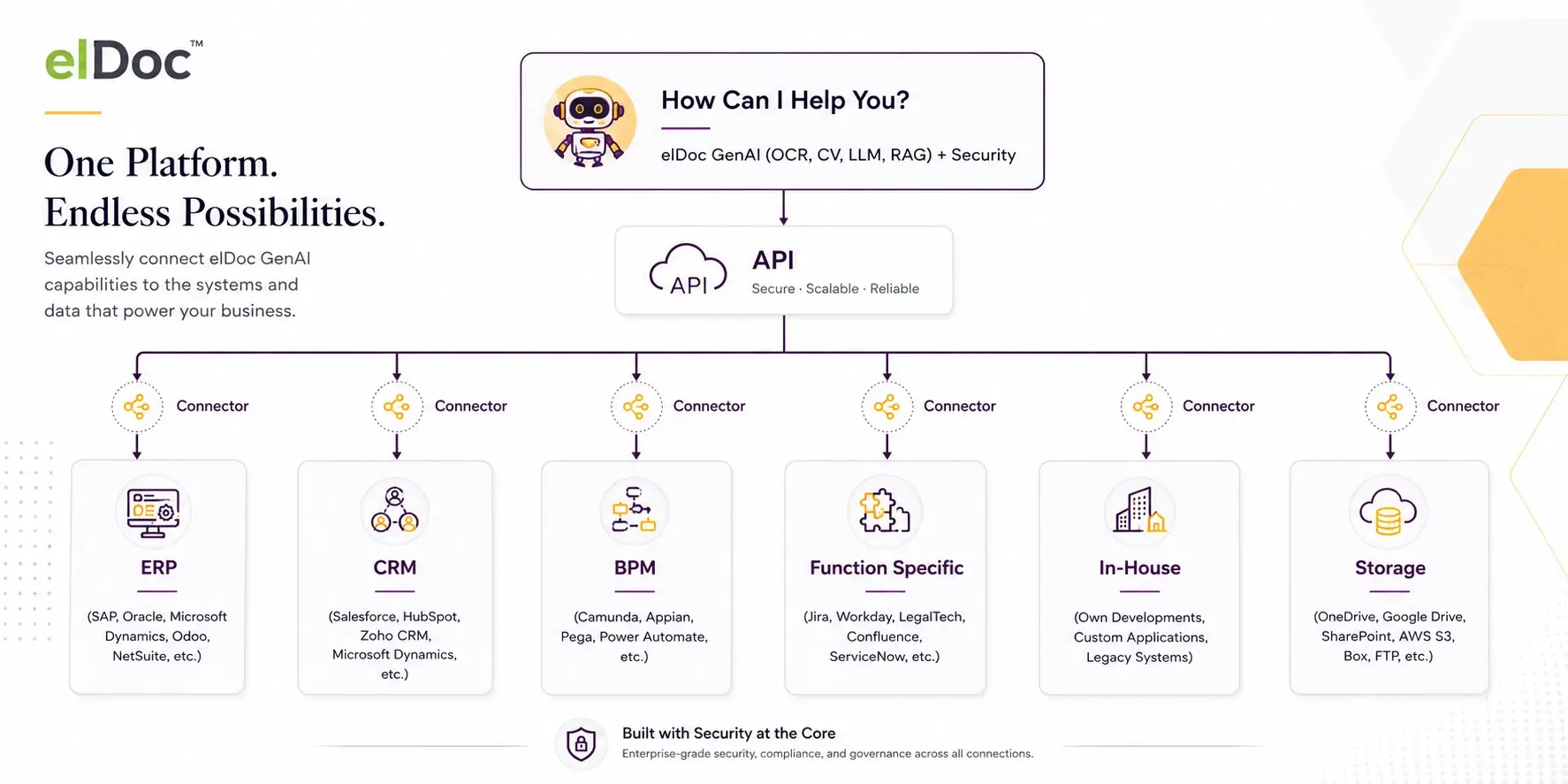
Instead of implementing AI independently within every application, organizations can establish a common GenAI architecture between enterprise systems, data, business processes, and AI models.
This is the role of the elDoc GenAI Hub.
Through APIs and connectors, elDoc can provide a unified AI layer across different categories of enterprise technology:
| Enterprise Systems | Examples | How They Connect to the GenAI Layer |
|---|---|---|
| ERP Systems | SAP, Oracle, Microsoft Dynamics, Odoo, NetSuite | Connect financial, operational, supplier, invoice, purchase order, and other enterprise data with AI-powered processes. |
| CRM Platforms | Salesforce, HubSpot, Zoho CRM, Microsoft Dynamics | Make relevant customer, account, communication, and case information available to authorized AI processes. |
| BPM & Workflow Platforms | Camunda, Appian, Pega, Power Automate | Connect AI analysis with existing business processes, approvals, tasks, routing, and workflow automation. |
| Enterprise Repositories | SharePoint, OneDrive, Google Drive, AWS S3, Box, FTP | Enable authorized enterprise documents and knowledge to be processed, indexed, retrieved, and analyzed through GenAI and Agentic RAG. |
| Function-Specific Applications | Jira, Workday, Confluence, ServiceNow, LegalTech, procurement and compliance platforms | Extend GenAI capabilities into specialized departmental and business applications without requiring an entirely separate AI architecture for each system. |
| In-House & Legacy Systems | Proprietary applications, internal databases, custom portals, legacy systems | Connect existing enterprise technology and data with modern GenAI capabilities through APIs and custom integrations. |
The objective is not to replace these systems or move every business process into another application. ERP remains responsible for ERP processes, CRM continues managing customer relationships, SharePoint remains an enterprise content repository, and BPM platforms continue orchestrating workflows.
What changes is the AI layer above and across them.
elDoc provides a common framework through which capabilities such as AI OCR, Computer Vision, Visual Models, GenAI Agentic RAG, Multi-LLM Orchestration, security, and governance can be reused across connected enterprise environments.
Instead of building a new RAG implementation, document-processing pipeline, AI Agent framework, and LLM integration every time another system requires Generative AI, enterprises can extend the existing GenAI Hub with additional connectors, repositories, Agents, and use cases.
ERP remains ERP. CRM remains CRM. SharePoint remains SharePoint. elDoc provides the common GenAI layer connecting AI with enterprise knowledge, documents, systems, and business processes across them.
From Scattered Enterprise Data to Unified Agentic RAG
Connecting enterprise systems is only one part of the challenge. The next question is more important: how can Generative AI securely discover and use relevant information when enterprise data is scattered across dozens of systems and repositories?
A single business case may depend on information distributed across ERP, CRM, SharePoint, OneDrive, cloud storage, BPM platforms, databases, departmental applications, and legacy systems. Without a common retrieval architecture, each AI application sees only a fraction of the enterprise context.
elDoc addresses this by providing a framework for unified enterprise indexing and Secure Agentic RAG.
Through APIs and connectors, authorized information from connected enterprise sources can be processed and indexed within a common AI knowledge architecture:
| Enterprise Data Source | Examples of Information Made Available for AI Retrieval |
|---|---|
| ERP | invoices, purchase orders, suppliers, transactions, financial and operational information |
| CRM | customers, accounts, cases, communications and relationship data |
| SharePoint / OneDrive | contracts, policies, reports, procedures, project files and corporate documents |
| Enterprise Storage | PDFs, scans, spreadsheets, images, archives and other unstructured content |
| BPM & Workflow Systems | cases, tasks, approvals, process information and supporting documentation |
| Business Applications | HR, legal, procurement, compliance, service management and other functional data |
| In-House & Legacy Systems | proprietary databases, internal applications, portals and historical enterprise information |
Rather than creating an isolated RAG index for every individual application, elDoc can provide a unified indexing and retrieval framework across connected and authorized enterprise information sources.
Importantly, unified indexing does not mean that all enterprise data must simply be copied into one centralized elDoc repository. Depending on the architecture and integration requirements, elDoc can connect distributed information sources, process and index the relevant content, maintain the necessary metadata and relationships, and make it discoverable to authorized AI processes while the source systems continue performing their original roles.
From Unified Indexing to Agentic Retrieval
This is where Agentic RAG becomes particularly important.
Traditional RAG is often designed around a single repository: a user asks a question, the system searches an index, retrieves several relevant chunks, and sends them to an LLM.
Enterprise questions are rarely that simple.
An AI Agent may need to determine where to search, what information is required, which sources are relevant, whether additional documents should be retrieved, and how information from multiple systems should be combined before generating an answer or performing the next step in a process.
For example, when reviewing a supplier case, an AI Document Agent could retrieve:
Supplier master data from ERP → contractual documents from SharePoint → previous correspondence from CRM → technical documentation from enterprise storage → procurement policies from the corporate knowledge base → current approval information from BPM.
The Agent can then reason across this information as part of one business context, rather than treating each enterprise system as an isolated AI environment.
The same architecture can support KYC, credit analysis, contract review, procurement, audit, claims processing, employee knowledge, customer service, and many other document-intensive scenarios.
Build One GenAI Foundation for the Enterprise
Enterprise data will continue to remain distributed across ERP, CRM, SharePoint, cloud storage, BPM platforms, databases, business applications, and legacy systems. At the same time, AI models, Agentic AI capabilities, and enterprise use cases will continue to evolve.
The answer is not to build another isolated AI architecture every time a new system, model, or use case needs Generative AI.
Enterprises need a reusable GenAI foundation that can connect existing systems, index authorized enterprise knowledge, orchestrate different AI models, and make that intelligence available to AI Agents, applications, users, and automated workflows.
This is the role of the elDoc GenAI Hub.
By bringing together LLM-agnostic architecture, Multi-LLM Orchestration, unified enterprise indexing, Secure Agentic RAG, AI Document Agents, AI OCR, Computer Vision, Visual Models, and orchestrated GenAI Document Processing, elDoc helps organizations create one AI framework across previously disconnected enterprise systems and data.
Connect the systems you already have. Unify the knowledge scattered across them. Build one secure GenAI experience across the enterprise.
Instead of asking “How do we add Generative AI to each of our systems?”, organizations can start with a more future-ready question:
“How do we build one enterprise AI architecture capable of working securely across all of them?”
Ready to Connect Your Enterprise Data with Generative AI?
Talk to an elDoc expert to explore how your ERP, CRM, SharePoint, enterprise repositories, and business applications can become part of a secure, LLM-agnostic GenAI architecture — powered by unified Agentic RAG and AI Document Agents.