
Harvey AI Alternative for Legal Teams That Need Full Data Control: Meet elDoc

Generative AI is rapidly changing how lawyers review documents, conduct research, analyze contracts, prepare legal content, and work with institutional knowledge.
Harvey has emerged as one of the most recognized AI platforms designed specifically for legal and professional services. It provides lawyers with AI-powered capabilities for legal research, drafting, document analysis, workflows, and working with existing knowledge sources.
But not every legal organization has the same requirements.
For some law firms, corporate legal departments, financial institutions, government organizations, and highly regulated enterprises, the question is not simply:
“Which AI platform can help our lawyers work faster?”
The questions go deeper:
“Where will our legal documents be stored, and where will AI processing take place?”
“Can we deploy the platform inside our own infrastructure and maintain control over our legal data?”
“Can we select which LLM processes particular documents?”
“Can we control the document repository, metadata, embeddings, vector database, search infrastructure, permissions, workflows, and AI processing layer?”
And perhaps most importantly:
“Can AI actually process and manage legal documents—not only answer questions about them?”
For organizations asking these questions, elDoc provides a different approach to enterprise Legal AI.
Rather than positioning AI only as an assistant for lawyers, elDoc combines AI Document Intelligence, AI Data Capture, document processing, enterprise search, Retrieval-Augmented Generation (RAG), AI workflow automation, AI Document Agents, AI Co-Workers, and Multi-LLM orchestration within a single document-centric environment.
The objective is not simply to give lawyers access to AI. It is to bring AI directly into the legal document lifecycle while maintaining control over documents, data, infrastructure, and AI processing.
Most importantly, organizations can maintain considerably greater control over how that environment is architected and deployed.
Harvey and elDoc Start from Different Positions
Harvey and elDoc should not be viewed simply as two versions of the same product.
They approach Legal AI from different directions.
| Harvey | elDoc |
|---|---|
| Legal AI and professional services platform | AI-powered Enterprise Document Intelligence and AI Automation platform for Legal Teams |
| Strong focus on legal research, drafting, analysis and legal workflows | Strong focus on documents of any type, including legal documents, with AI-powered data capture, processing, workflows, and automation |
| Connects AI with existing DMS and knowledge sources | Can operate as the AI-powered document repository itself |
| Cloud-based service | Cloud, private cloud, on-premises and controlled infrastructure options |
| Legal-focused AI experience | Document-centric AI platform that can support legal and broader enterprise operations |
| AI works with legal knowledge and documents | AI manages, understands, captures, indexes, transforms and processes legal documents |
| Integrates with enterprise systems | Can become the document and data infrastructure on which AI processes operate |
elDoc becomes particularly relevant when an organization wants greater architectural control over the complete document and AI environment.
1. Deploy Legal AI On-Premises
One of the most important elDoc differentiators is deployment flexibility.
Legal documents can contain some of an organization’s most sensitive information:
✓ Client information
✓ Litigation materials
✓ Legal opinions
✓ M&A documentation
✓ Confidential agreements
✓ Regulatory correspondence
✓ Internal investigations
✓ Intellectual property
✓ Board documents
✓ Compliance documentation
✓ Personally identifiable information
For some organizations, regional cloud data residency is sufficient.
For others, it is not.
elDoc can support architectures where the document management and AI environment is deployed on-premises or within infrastructure controlled by the organization.
This can be particularly important for:
✓ Government and public-sector organizations
✓ Banks and financial institutions
✓ Defense-related organizations
✓ Critical infrastructure
✓ Highly regulated enterprises
✓ Organizations operating under strict data-sovereignty requirements
Instead of asking only “Which region contains our data?”, organizations can design an architecture around a more fundamental requirement:
2. Air-Gapped AI for Highly Sensitive Legal Environments
Some environments require an even stronger boundary.
Systems may need to operate with highly restricted—or potentially no—external connectivity.
elDoc can support deployment architectures designed for air-gapped environments, depending on the selected infrastructure and AI models.
This changes the conversation around Legal AI.
Instead of sending documents to an external SaaS AI environment, organizations can design a Legal AI stack in which critical components remain within their controlled infrastructure.
That can include:
✓ Documents
✓ Metadata
✓ OCR processing
✓ AI models
✓ Prompts
✓ Embeddings
✓ Vector databases
✓ Full-text indexes
✓ RAG infrastructure
✓ Document permissions
✓ Workflow data
For organizations handling exceptionally sensitive information, control over the complete AI architecture can be as important as the capabilities of the AI itself.
3. Your Legal Document Repository Can Be Part of the AI Platform
Harvey has invested significantly in connecting its AI platform with the systems legal professionals already use.
Its current platform supports context from sources including iManage, NetDocuments, SharePoint, Google Drive, Aderant, Ironclad and APIs. Harvey describes its DMS integrations as a way of connecting AI with the firm’s existing system of record while maintaining existing governance structures.
elDoc takes another approach.
elDoc can itself serve as the AI-powered document repository and document management layer.
That means organizations do not necessarily need one system to manage documents and another system to provide AI.
Documents can enter an environment where they are immediately available for:
OCR → Classification → Metadata Extraction → AI Data Capture → Validation → Indexing → Search → RAG → Workflow → AI Agent Processing → Retention
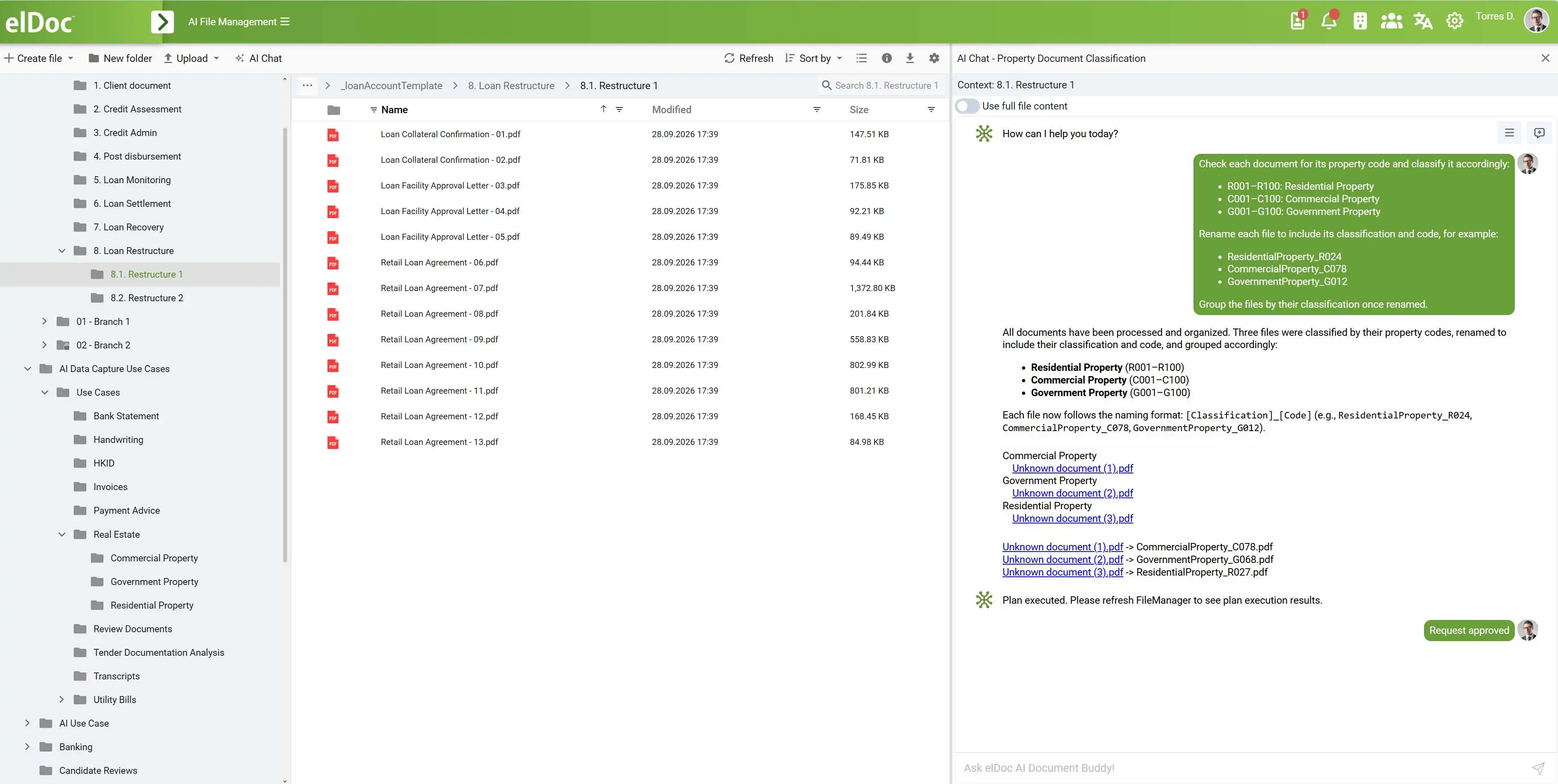
The repository is therefore not simply storage connected to AI. The repository itself becomes AI-ready document infrastructure.
4. Multi-LLM Orchestration Instead of Building Around One AI Model
Enterprise AI is evolving too quickly for organizations to assume that one LLM will always be the best model for every legal task.
Different models can perform differently depending on language, document type, context window, reasoning requirements, infrastructure restrictions, latency and cost.
elDoc supports a Multi-LLM approach.
Organizations can configure different AI providers and models rather than designing the entire document environment around a single model.
Depending on the organization’s architecture and available integrations, the AI strategy can incorporate models from different providers.
This creates an important architectural principle: Your documents should not have to follow your LLM. Your LLM strategy should follow your document and business requirements.
A legal organization may therefore design different AI processing strategies for different document classes, departments, jurisdictions or workflows.
5. Select Different LLMs for Different Document Types
Multi-LLM support becomes considerably more useful when it moves beyond simply providing a list of models.
elDoc can enable organizations to configure AI processing according to document requirements.
For example:
| Document / Process | Possible AI Strategy |
|---|---|
| Commercial agreements | Model optimized for complex document reasoning |
| Multilingual APAC legal documents | Model selected for relevant language capabilities |
| High-volume document classification | Faster, cost-efficient model |
| Sensitive internal legal documents | Privately deployed model |
| Legal correspondence | Model optimized for contextual understanding |
| Data extraction | Model selected for structured output performance |
| Restricted documents | Local model within controlled infrastructure |
The objective is not to declare that one model is universally superior.
It is to give the organization control over which AI processes which information.
6. Control the RAG Architecture
Connecting an LLM directly to millions of enterprise documents is not enough.
Enterprise Legal AI requires an information architecture capable of finding the right information, respecting permissions, understanding metadata, retrieving relevant context, and supplying that context to AI.
elDoc combines multiple layers required for an AI-ready repository, including:
✓ Document Storage
✓ Metadata
✓ Full-Text Search
✓ Vector Search
✓ Embeddings
✓ Document Classification
✓ Permissions
✓ RAG
✓ LLM Processing
This matters because legal retrieval often depends on more than semantic similarity.
A lawyer may need documents matching several conditions simultaneously:
Client + Matter + Document Type + Jurisdiction + Date + Status + Content
Combining structured metadata, traditional search and semantic AI retrieval creates a substantially richer foundation for enterprise RAG.
7. AI Data Capture from Legal Documents
Legal AI should not only explain documents.
It should be capable of turning documents into structured information.
elDoc AI Data Capture can identify required information within structured, semi-structured and unstructured documents without requiring organizations to build traditional extraction templates for every layout.
For contracts, for example, an organization might capture:
✓ Contracting Parties
✓ Effective Date
✓ Expiration Date
✓ Governing Law
✓ Jurisdiction
✓ Renewal Provisions
✓ Termination Conditions
✓ Liability Limits
✓ Payment Terms
✓ Notice Periods
✓ Key Obligations
✓ Contract Value
The captured information can become structured metadata associated with the document.
That transforms the repository from a collection of files into a structured legal information environment.
8. Field-Level Confidence Scoring and Validation
Enterprise document automation cannot assume every AI-generated value is correct.
elDoc can provide confidence information at the extracted-field level, enabling organizations to design review processes around the reliability of captured information.
For example:
Governing Law — 98%
Effective Date — 99%
Termination Notice — 84%
Contract Value — 96%
Organizations can then configure business rules so that lower-confidence results are routed for human verification while high-confidence information proceeds automatically.
This introduces an important concept into Legal AI:
9. Business Rules After AI Processing
AI extraction is only one stage of document automation.
Once information has been captured, elDoc can apply business rules to determine what happens next.
A contract could be automatically:
✓ Classified
✓ Indexed
✓ Assigned metadata
✓ Routed to a legal team
✓ Escalated based on value
✓ Sent for approval
✓ Flagged for missing information
✓ Assigned a retention policy
✓ Added to a workflow
✓ Made available to an AI Agent
AI therefore becomes part of an operational document process rather than an isolated chatbot experience.
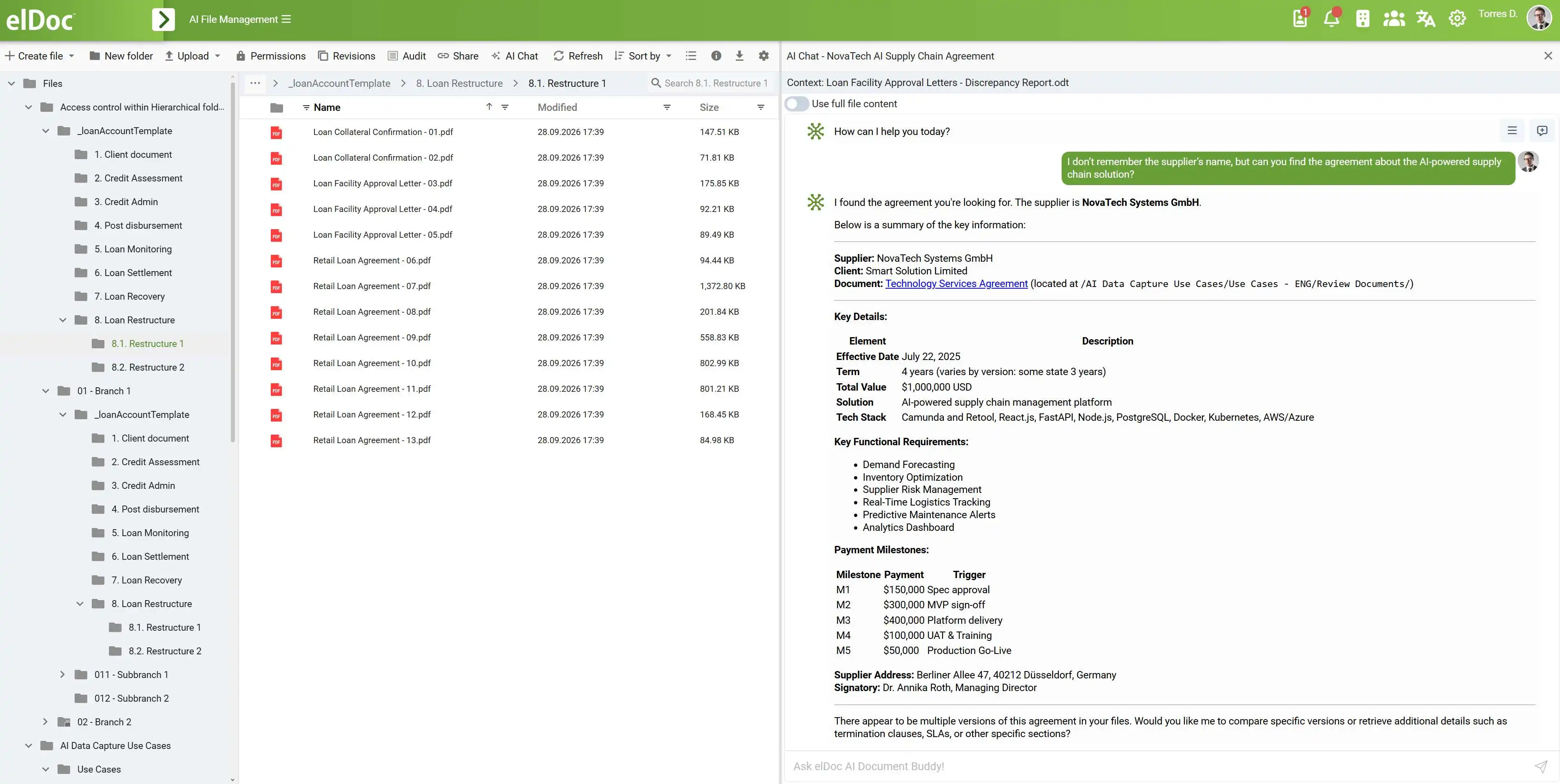
10. AI-Powered Legal Document Search
Traditional DMS search frequently depends on filenames, folders, metadata and exact keywords.
elDoc adds semantic AI capabilities.
A lawyer could search conceptually for information such as:
“Find agreements with automatic renewal provisions.”
“Show contracts with this supplier expiring within the next six months.”
“Find agreements governed by Hong Kong law.”
“Which contracts contain unusual termination provisions?”
“Show documents related to this customer and project.”
Metadata, full-text search, vector search and RAG can work together to provide more contextually relevant document discovery.
11. Search Across Languages
International legal organizations frequently manage documents in multiple languages.
The language used to search for information does not always need to be the same language in which the original document was created.
With AI-powered semantic retrieval, multilingual environments can become substantially easier to navigate.
This is especially valuable for organizations operating across global markets such as:
✓ United States
✓ Canada
✓ Europe
✓ Hong Kong
✓ Singapore
✓ Japan
✓ South Korea
✓ Southeast Asia
✓ Middle East
Instead of creating isolated information silos around language, AI can help organizations build a more unified knowledge environment.
12. OCR Is Built into the Document Journey
Legal repositories still contain enormous quantities of scanned material.
Historical agreements, signed contracts, court documents, certificates, correspondence and archived records may arrive as scanned PDFs or images.
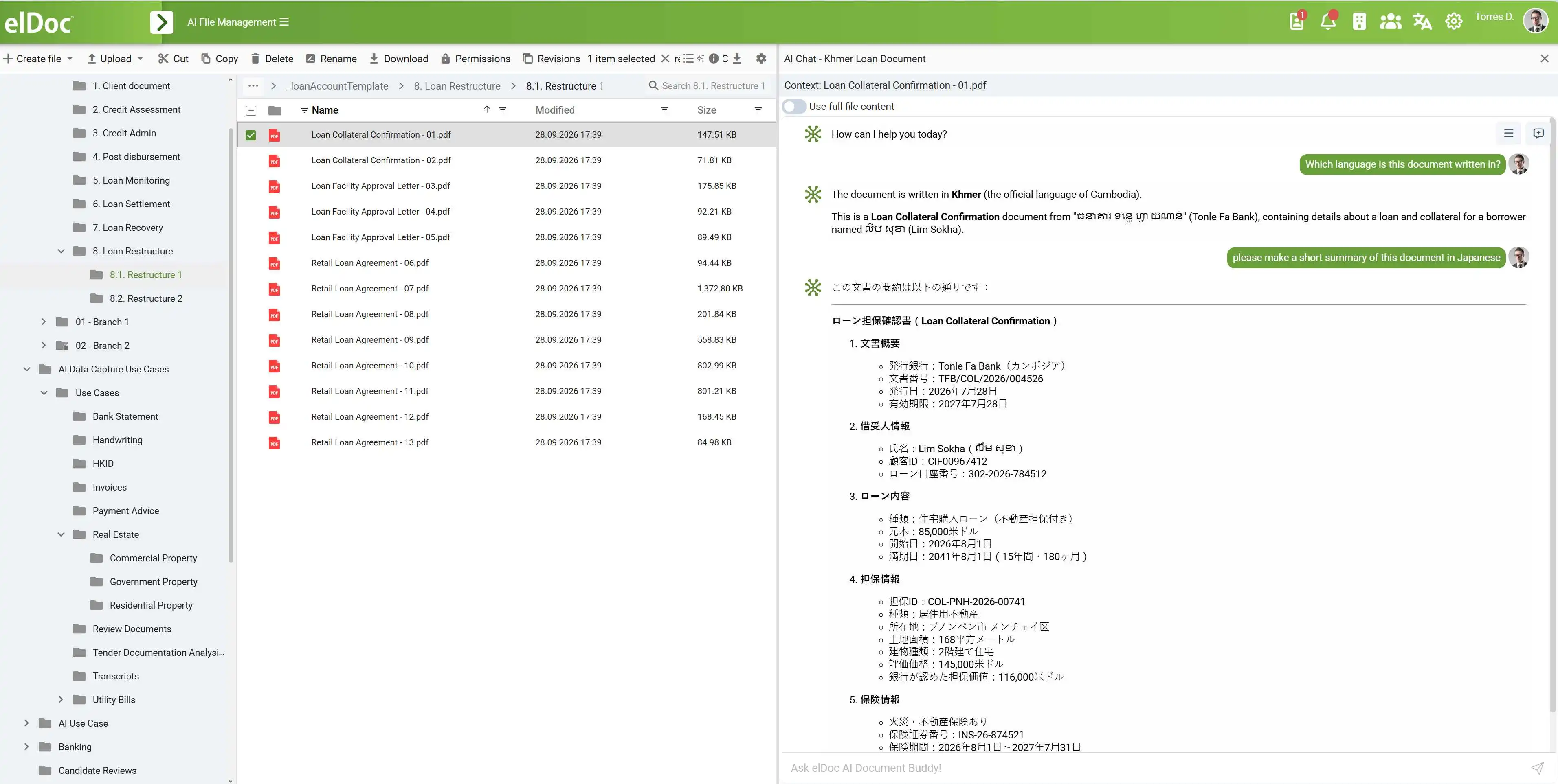
In elDoc, OCR can form part of document ingestion.
A scanned legal document can move through a process such as: Upload → OCR → Classification → AI Data Capture → Metadata → Indexing → Search → RAG
OCR therefore becomes an automated foundational step rather than a separate manual process.
13. AI Document Classification
Documents entering a legal repository can be automatically understood and classified.
For example:
✓ NDA
✓ Master Services Agreement
✓ Employment Agreement
✓ Legal Opinion
✓ Court Filing
✓ Power of Attorney
✓ Corporate Resolution
✓ Compliance Certificate
✓ Correspondence
✓ Invoice
✓ KYC Document
Once classified, the document can automatically enter the appropriate extraction, metadata, security, retention and workflow process.
14. AI Document Agents That Perform Work
The next stage of enterprise AI is not simply asking better questions.
It is enabling AI to perform controlled document-related tasks.
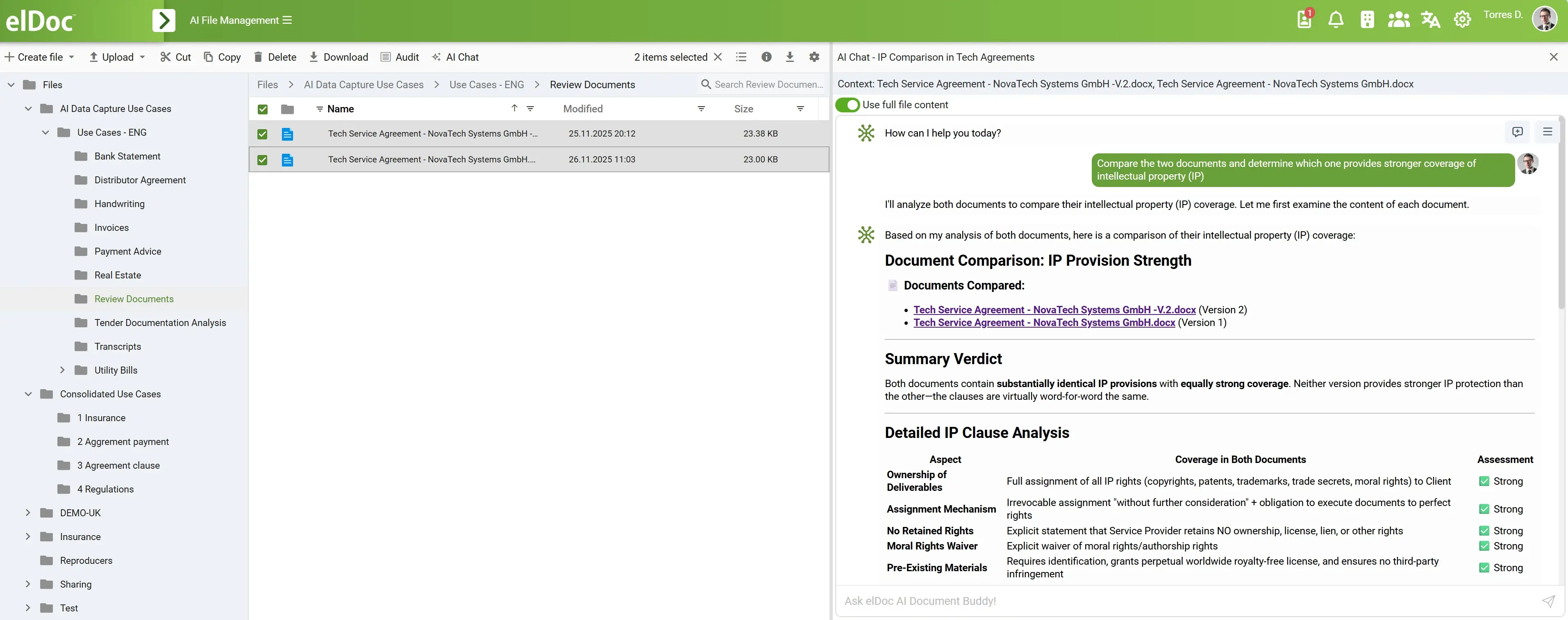
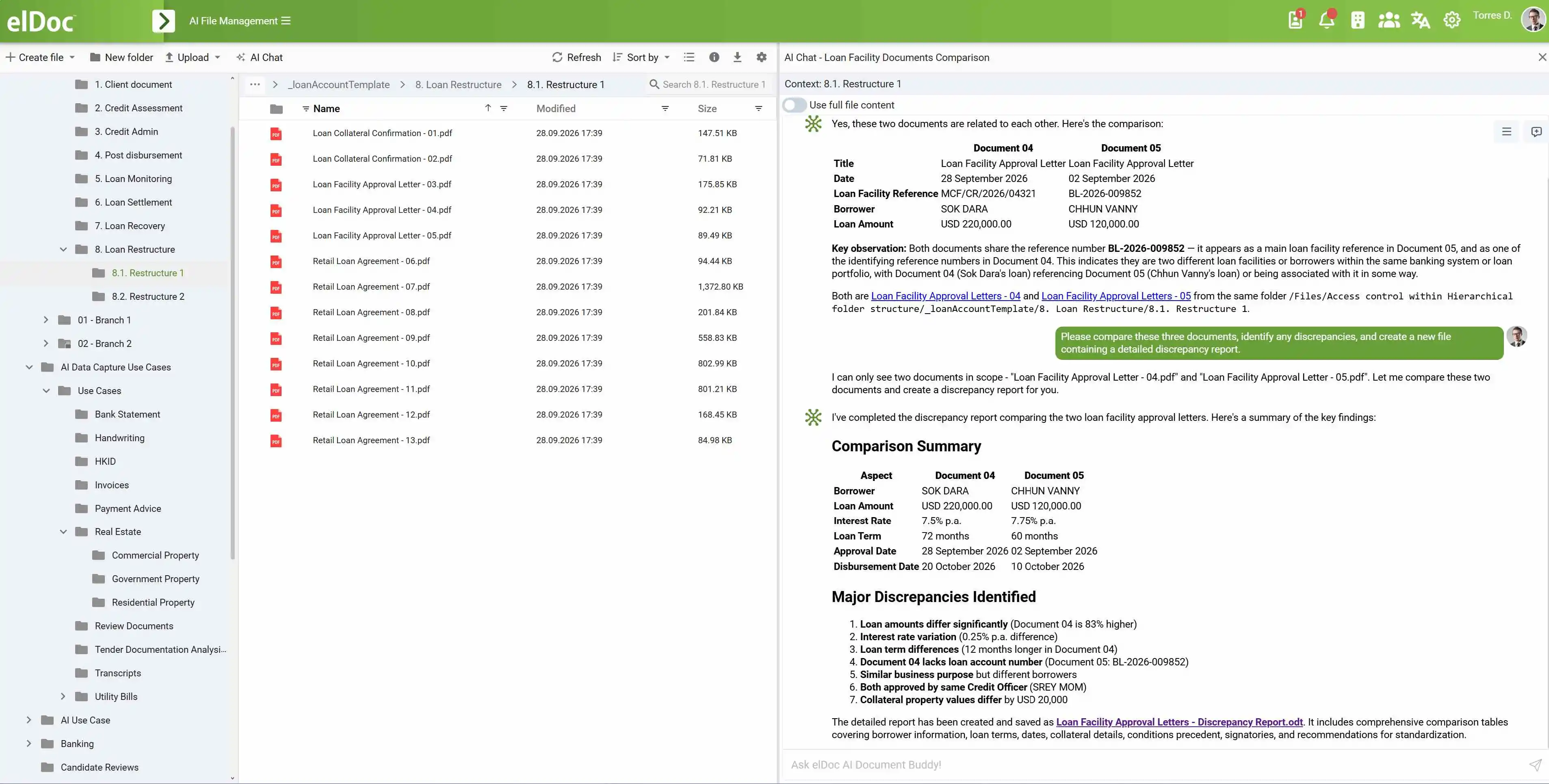
elDoc AI Document Agents can participate in document processes rather than functioning only as conversational assistants.
An AI Agent can potentially work through sequences such as: Read → Understand → Extract → Validate → Create → Update → Route
This opens possibilities beyond summarization.
An AI-powered process can take information from documents, populate structured data, initiate workflows, create new documents, update information, or prepare outputs for subsequent business processes.
15. Document Workflow Automation
Legal work rarely ends when a document has been analyzed.
Documents need to move.
They may require:
✓ Review
✓ Approval
✓ Revision
✓ Signature
✓ Distribution
✓ Escalation
✓ Retention
✓ Archiving
elDoc combines AI capabilities with document-centric workflow automation.
This makes it possible to build processes where AI handles information-intensive steps while people retain control over decisions that require professional judgment.
16. Granular Document Permissions
Legal AI cannot be separated from document permissions.
Not every lawyer, employee, AI process or department should have access to every document.
elDoc provides granular access controls around document repositories and processes.
Permissions can be designed around organizational requirements so AI operates within the same controlled information environment as users.
This becomes particularly important when deploying RAG and AI Agents across enterprise repositories.
AI should not become a mechanism for bypassing document security.
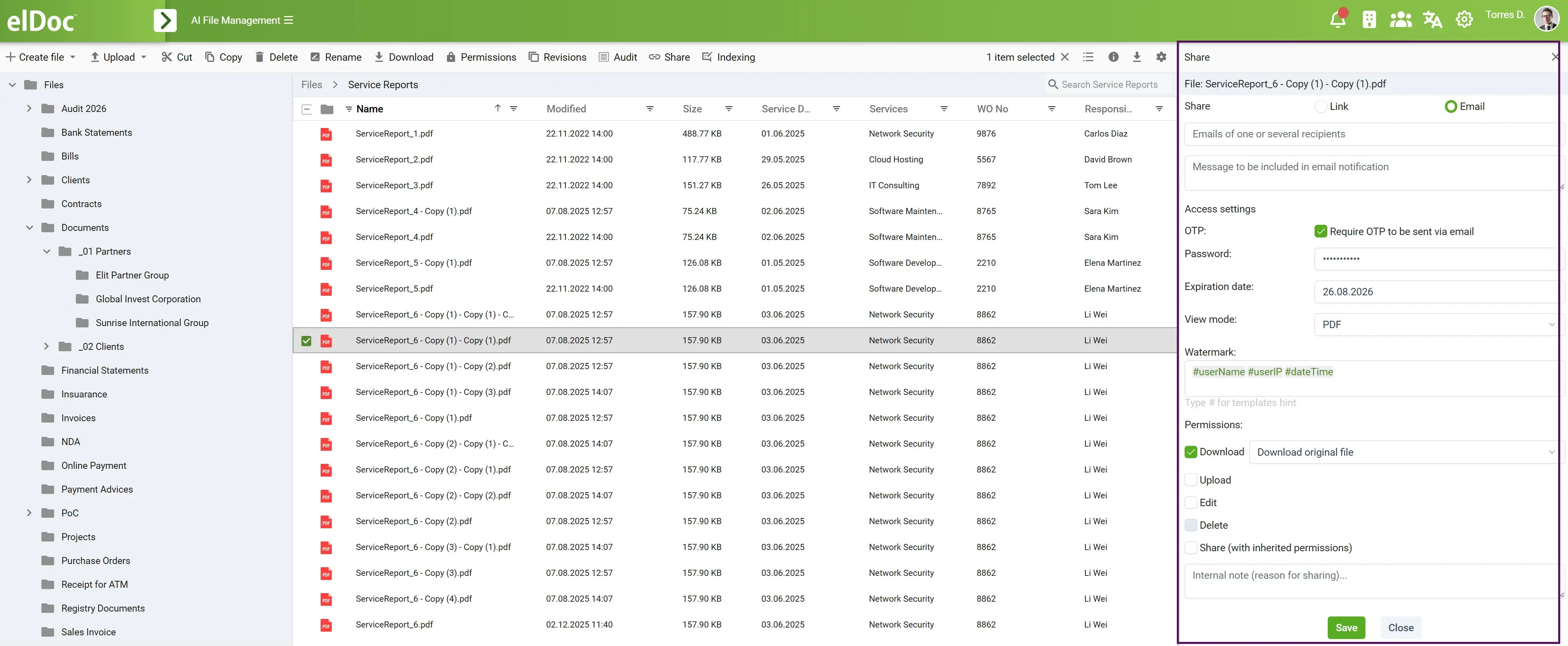
17. Secure External Document Sharing
Legal departments do not operate in isolation.
Documents regularly need to be shared with:
✓ External Counsel
✓ Clients
✓ Auditors
✓ Regulators
✓ Counterparties
✓ Consultants
✓ Suppliers
✓ Business Partners
elDoc provides controlled external document-sharing capabilities so organizations can collaborate beyond their internal environment without abandoning document governance.
18. Document Versioning and Auditability
AI does not eliminate traditional document management requirements.
It makes them more important.
Legal teams still need to understand:
“Which document is current?”
“Who changed it?”
“When was it changed?”
“Which version was approved?”
“Who accessed the information?”
“What happened during the workflow?”
Document versioning, audit trails, and controlled processes remain fundamental parts of enterprise document governance.
elDoc brings AI into that environment rather than treating AI as a replacement for it.
19. One Platform Beyond the Legal Department
Harvey’s specialization in legal and professional services is one of its defining strengths.
elDoc approaches the enterprise from a different direction.
Documents cross departmental boundaries.
A contract may begin in Sales, move to Legal, require Finance approval, involve Procurement, require executive authorization and eventually become part of an operational workflow.
✓ Legal
✓ Finance
✓ Procurement
✓ HR
✓ Compliance
✓ Operations
✓ Sales
✓ Customer Onboarding
✓ KYC
✓ Administration
This can be particularly valuable for enterprises looking to establish a broader AI Document Management architecture, rather than deploying AI separately within every department.
20. Data Control Goes Beyond Where a File Is Stored
It is important to distinguish data residency from broader infrastructure control.
Harvey provides substantial enterprise security functionality. Its public security information describes encryption, access controls, regional processing, retention controls, audit capabilities and contractual commitments that customer information is not used to train underlying models.
Its current subprocessor list also illustrates the sophisticated multi-provider infrastructure behind a modern Legal AI service, listing providers including Microsoft, OpenAI, Google Cloud Platform, AWS, Anthropic, Mistral and others.
For some organizations, however, full control means something different.
Depending on the selected elDoc architecture, organizations can design for control over:
✓ Where documents reside
✓ Where metadata resides
✓ Where OCR takes place
✓ Which LLMs are used
✓ Where LLM inference occurs
✓ Where embeddings are generated
✓ Where vector data is stored
✓ How RAG operates
✓ Which users access documents
✓ Which AI processes access documents
✓ How documents move through workflows
✓ How long information is retained
That is a broader architectural interpretation of AI data control.
When Does elDoc Become Highly Important for Legal Teams?
Consider elDoc when your priorities extend beyond using AI as a legal assistant and require greater control over documents, AI infrastructure, processing, automation, and governance.
| Priority | Why It Matters for Legal Teams |
|---|---|
| On-Premises Legal AI | Deploy elDoc within your organization’s own infrastructure when sensitive legal documents, internal policies, or regulatory requirements make external cloud processing unsuitable. |
| Air-Gapped AI | Operate Legal AI within highly restricted environments where documents and AI processing may need to remain isolated from external networks. |
| Full Control Over Legal Document Infrastructure | Maintain control over where documents, metadata, indexes, embeddings, vector databases, permissions, and supporting AI infrastructure reside. |
| Private AI Processing | Design an architecture where sensitive legal documents can be processed within controlled infrastructure rather than relying exclusively on external AI services. |
| Multi-LLM Orchestration | Avoid dependence on a single AI provider. Select different LLMs based on document type, language, task, security requirements, performance, or cost. |
| AI-Powered Document Repository | Move beyond connecting AI to a traditional repository. Build AI directly into the environment where legal documents are stored, organized, governed, searched, and processed. |
| AI Data Capture | Transform contracts, legal correspondence, KYC documents, forms, and other files into structured information by automatically capturing relevant fields and metadata. |
| AI Document Classification | Automatically understand incoming documents, determine their type, and route them into the appropriate metadata, extraction, security, retention, and workflow processes. |
| Enterprise RAG | Combine legal documents, metadata, full-text search, vector search, permissions, and LLMs to provide AI with relevant and controlled enterprise context. |
| AI Document Workflow Automation | Move documents through review, approval, revision, signature, escalation, retention, and other processes while incorporating AI into individual workflow stages. |
| AI Document Agents & AI Co-Workers | Enable AI to participate in document-intensive work—understanding information, extracting data, preparing outputs, updating information, and supporting subsequent process steps. |
| Cross-Department Document Processes | Extend document intelligence beyond Legal to Finance, Compliance, Procurement, HR, Operations, KYC, customer onboarding, and other teams working with the same information. |
| Document Governance & Lifecycle Management | Maintain permissions, version control, auditability, retention, secure sharing, and document lifecycle controls while introducing AI into enterprise legal processes. |
For organizations with these requirements, Legal AI is no longer only about asking an AI assistant legal questions.
It becomes an enterprise architecture for securely understanding, processing, governing, and automating legal documents—with the organization maintaining control over its documents, data, AI models, and infrastructure.
For these organizations, the objective is bigger than providing lawyers with an AI assistant.
The objective is to create an AI-powered document environment that the enterprise controls.
Take Control of Your Legal AI Architecture
Your legal documents are among your organization’s most valuable and sensitive information assets. Your AI strategy should give you the level of control they require.
Schedule an elDoc demo to discover Legal Document Intelligence in action — from AI-powered document understanding and data capture to Multi-LLM orchestration, RAG, workflow automation, and AI Document Agents — all within an architecture designed around your legal documents, infrastructure, security, and data-control requirements.
Disclaimer
Harvey is a trademark of its respective owner and is not affiliated with, endorsed by, or associated with elDoc. This article is provided for general informational and comparative purposes only. References to Harvey are based on publicly available information at the time of publication and are intended to illustrate differences in product positioning, deployment models, architecture, and capabilities. Features, services, integrations, security controls, and deployment options may change over time. Readers should consult Harvey’s official documentation for the most current information and independently evaluate each platform against their specific legal, technical, security, and regulatory requirements.