
Private AI for Law Firms, Courts and Legal Departments: Complete Legal Document Intelligence with elDoc

Secure Legal AI. Private Infrastructure. Intelligent Document Collaboration. Complete Control.
Artificial Intelligence is transforming how legal professionals research legislation, draft agreements, review contracts, collaborate on legal matters and manage complex documentation.
However, for many law firms, courts, government legal departments and highly regulated organizations, adopting AI presents a fundamental challenge:
How can legal teams benefit from Generative AI without sending confidential legal documents, privileged communications and sensitive case information to the public cloud?
For organizations handling highly confidential legal matters, public cloud AI services may not be an acceptable option because of internal security policies, contractual obligations, regulatory requirements or data sovereignty considerations.
Legal teams need more than an AI chatbot. They need a complete Private AI environment where documents, AI models, legal knowledge, collaboration, approvals and external communications operate within infrastructure they control.
Ideally, this means deploying AI directly within the organization’s own IT infrastructure, with full control over document storage, AI processing, user permissions, access policies and audit records.
Is it possible to bring advanced Legal AI capabilities entirely into a privately controlled environment?
Yes. This is precisely the approach enabled by elDoc — an AI-powered Document Management and Legal Document Intelligence Platform designed for secure enterprise environments.
1. Why Public Cloud AI Is Not Always an Option for Legal Organizations
Legal professionals work with some of the most sensitive information within an organization.
Law firms manage confidential client communications, litigation strategies, transaction documents, commercial agreements and privileged legal advice.
Courts process case files, evidence, judgments, procedural documents and personal information.
Government legal departments handle regulatory matters, investigations, public-sector contracts and legally protected information.
Sending such documents to external AI services can create concerns regarding data residency, confidentiality, information governance and third-party access.
| Legal AI challenge | What legal organizations require |
|---|---|
| Client confidentiality | AI processing within a controlled environment |
| Attorney-client privilege | Protection of privileged legal communications |
| Data sovereignty | Control over where legal information is stored and processed |
| Court and government security | Support for private and isolated infrastructure |
| Unauthorized document access | Granular permissions and security-aware AI retrieval |
| AI provider dependency | Flexibility to select and manage AI models |
| Legal accountability | Document version history, audit trails and traceable workflows |
| Sensitive legal research | Controlled access to internal knowledge and authorized legal sources |
| External collaboration | Secure document sharing with defined recipient permissions |
For these organizations, the objective is not simply to adopt AI.
It is to make AI available to legal professionals without compromising control over their legal information.
2. Private Legal AI Infrastructure: Deploy AI on Your Own Terms
elDoc enables organizations to build a privately controlled Legal AI environment through flexible deployment architectures.
Depending on infrastructure and security requirements, elDoc can support on-premises deployment, private AI processing and isolated environments.
For organizations that cannot permit external network connectivity, an air-gapped deployment architecture can provide an additional level of isolation, subject to the selected AI models and infrastructure configuration.
| Private AI capability | How elDoc addresses legal requirements |
|---|---|
| On-Premises Legal AI | Deploy elDoc within organization-controlled infrastructure rather than relying on public cloud document processing |
| Air-Gapped AI | Support isolated environments with appropriately deployed local AI models and supporting services |
| Private LLM Integration | Connect compatible locally hosted language models for private document processing |
| Multi-LLM Orchestration | Configure different supported language models for different AI tasks and document processing requirements |
| Private Enterprise RAG | Combine authorized document retrieval with Generative AI within a controlled architecture |
| Controlled AI Document Repositories | Maintain centralized document storage with permissions, metadata, versioning and governance |
| AI Access Governance | Align document retrieval and AI interactions with applicable user access permissions |
| AI Processing Transparency | Provide visibility into supported AI model usage and billing information |
This architecture allows legal organizations to determine how AI interacts with confidential documents and where AI processing takes place.
Importantly, Private AI is not simply about hosting an LLM internally. It requires the entire document intelligence architecture — storage, indexing, search, retrieval, access control, AI processing and document workflows — to operate securely together.
That is where elDoc delivers value as an integrated platform.
3. AI-Assisted Legal Document Collaboration: The Foundation of Legal Productivity
Legal work is fundamentally document-driven.
Agreements move between associates, senior lawyers, partners, clients, counterparties and compliance teams. Legal opinions are prepared, reviewed, revised and approved. Court documents require controlled access, accurate records and traceable processing.
Traditional document management systems provide storage and basic collaboration.
Standalone AI tools can generate text or summarize uploaded documents.
Legal organizations need both capabilities working together within the same secure environment.
elDoc brings AI directly into legal document collaboration, allowing professionals to search, understand, draft, review, translate, approve and securely share documents without continuously switching between disconnected systems.
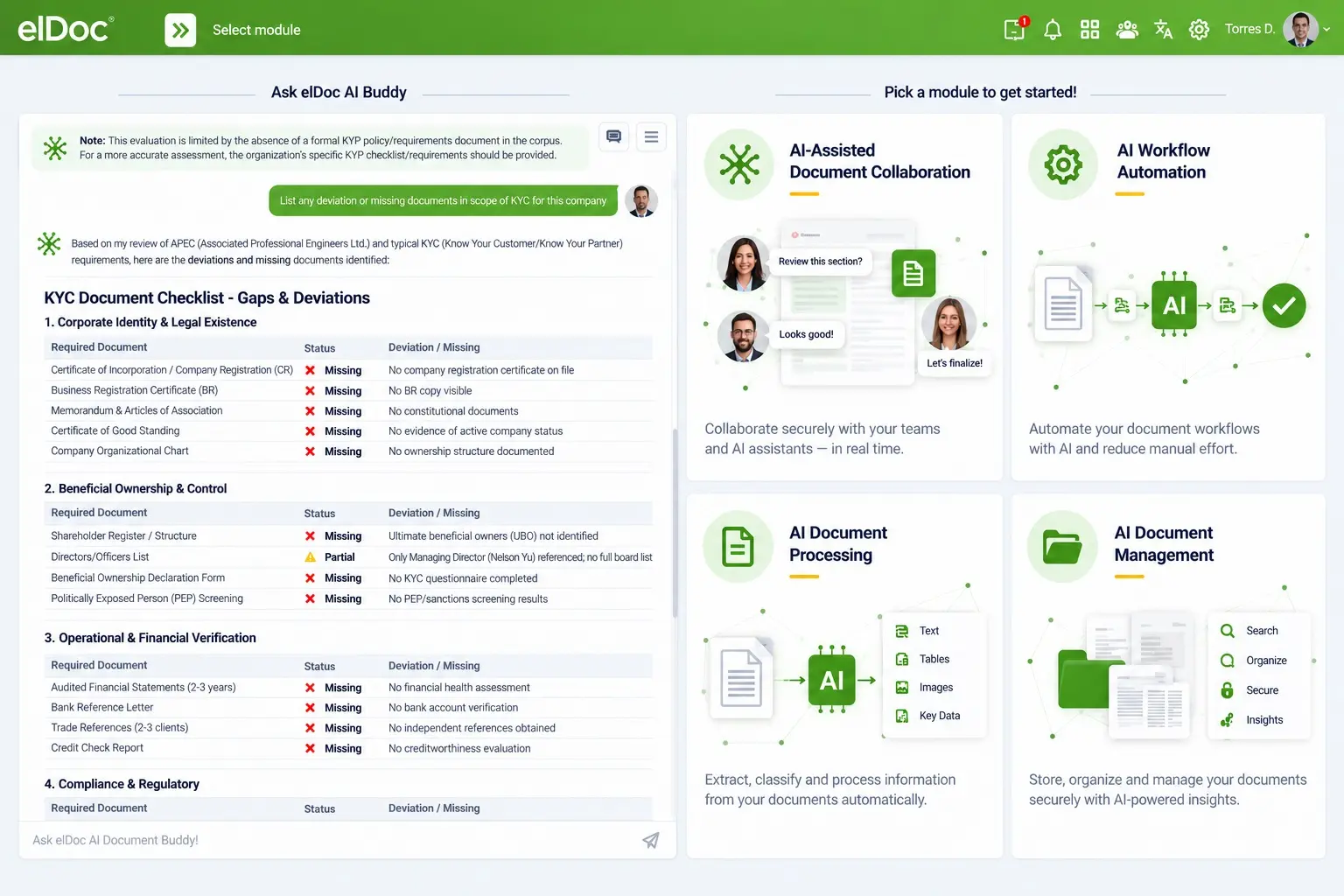
4. Secure AI Search Across Legal Documents — With Permission-Aware Retrieval
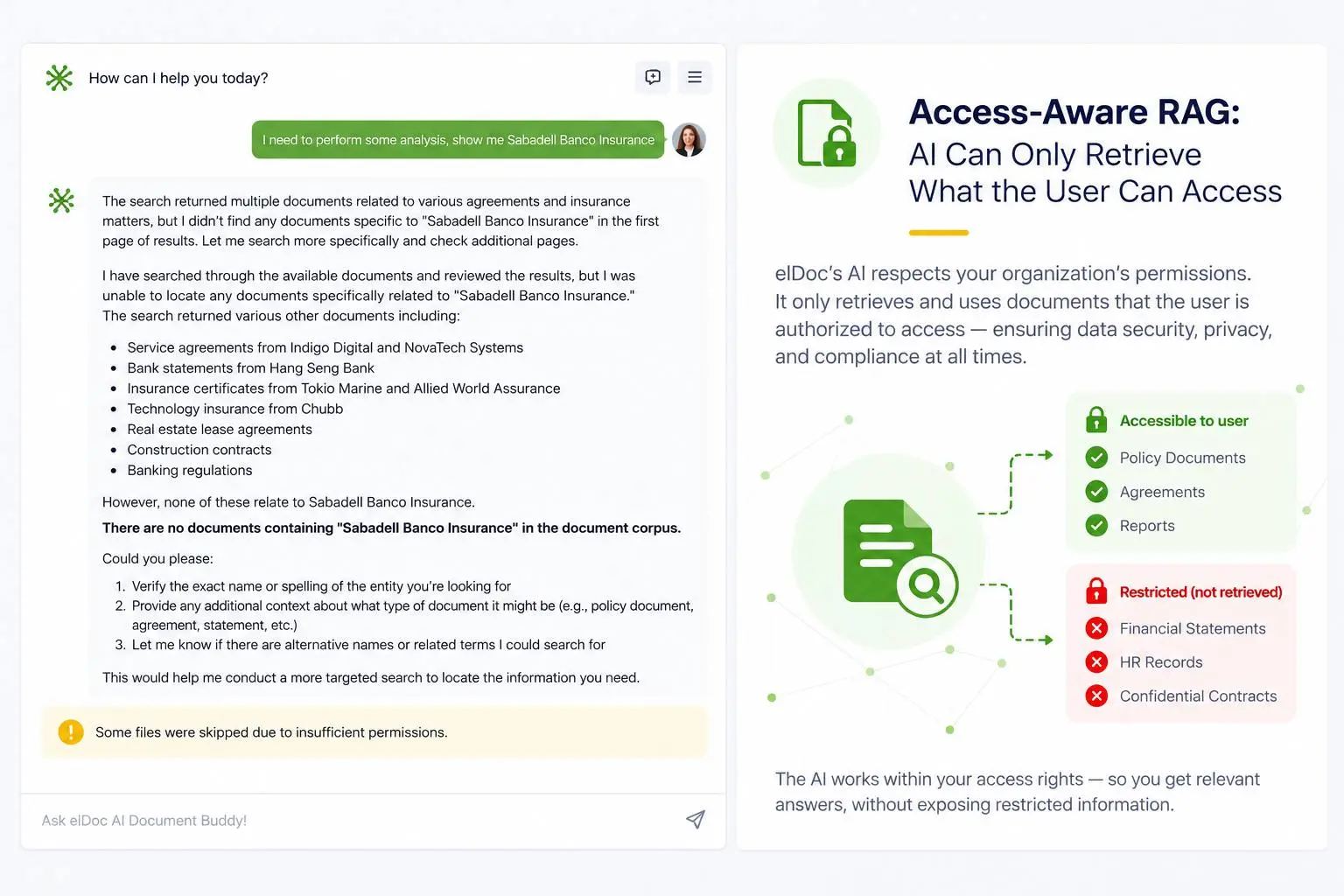
One of the most important requirements for enterprise Legal AI is ensuring that users can only retrieve information they are authorized to access.
Consider a law firm managing hundreds of clients and thousands of confidential matters.
An associate working on Client A must not be able to retrieve confidential documents belonging to Client B simply by asking an AI assistant a question.
Similarly, a court employee should not receive information from restricted case files outside their assigned access rights.
elDoc combines enterprise document permissions with AI-powered document retrieval.
Legal professionals can search using natural language rather than relying exclusively on filenames, folders or exact keywords.
For example:
“Find the latest approved agreement with this client.”
“Identify contracts containing non-standard termination provisions.”
“Show all legal opinions related to this regulatory matter.”
“Which agreements expire within the next 90 days?”
“Find documents referencing this legislation or court decision.”
Security remains fundamental: AI retrieval must respect the same access boundaries that protect the underlying documents.
With appropriately configured access controls and retrieval architecture, elDoc helps organizations implement secure AI search across legal repositories.
5. AI-Assisted Legal Document Creation and Agreement Drafting
Legal teams spend considerable time preparing agreements, drafting correspondence, creating legal opinions and producing revised versions of existing documents.
elDoc introduces AI-assisted document creation directly into the document management environment.
Instead of starting from an empty document or manually searching through previous agreements, legal professionals can work with authorized internal documents and AI assistance to prepare new content.
AI-assisted legal drafting capabilities include:
- Creating initial agreement drafts based on user instructions and relevant source documents.
- Preparing legal correspondence, memoranda and internal legal notes.
- Drafting contractual clauses and alternative wording.
- Reusing information from existing agreements and approved document sources.
- Generating summaries and structured outputs from complex legal documentation.
- Preparing revised drafts for subsequent legal review.
For example, a lawyer may request:
“Prepare a new service agreement based on our approved agreement structure, incorporating the commercial terms from the attached proposal.”
Or:
“Draft an alternative limitation of liability clause for review by the senior legal partner.”
The objective is not to replace professional legal judgment.
It is to reduce repetitive document preparation while keeping lawyers responsible for reviewing, validating and approving legal content.
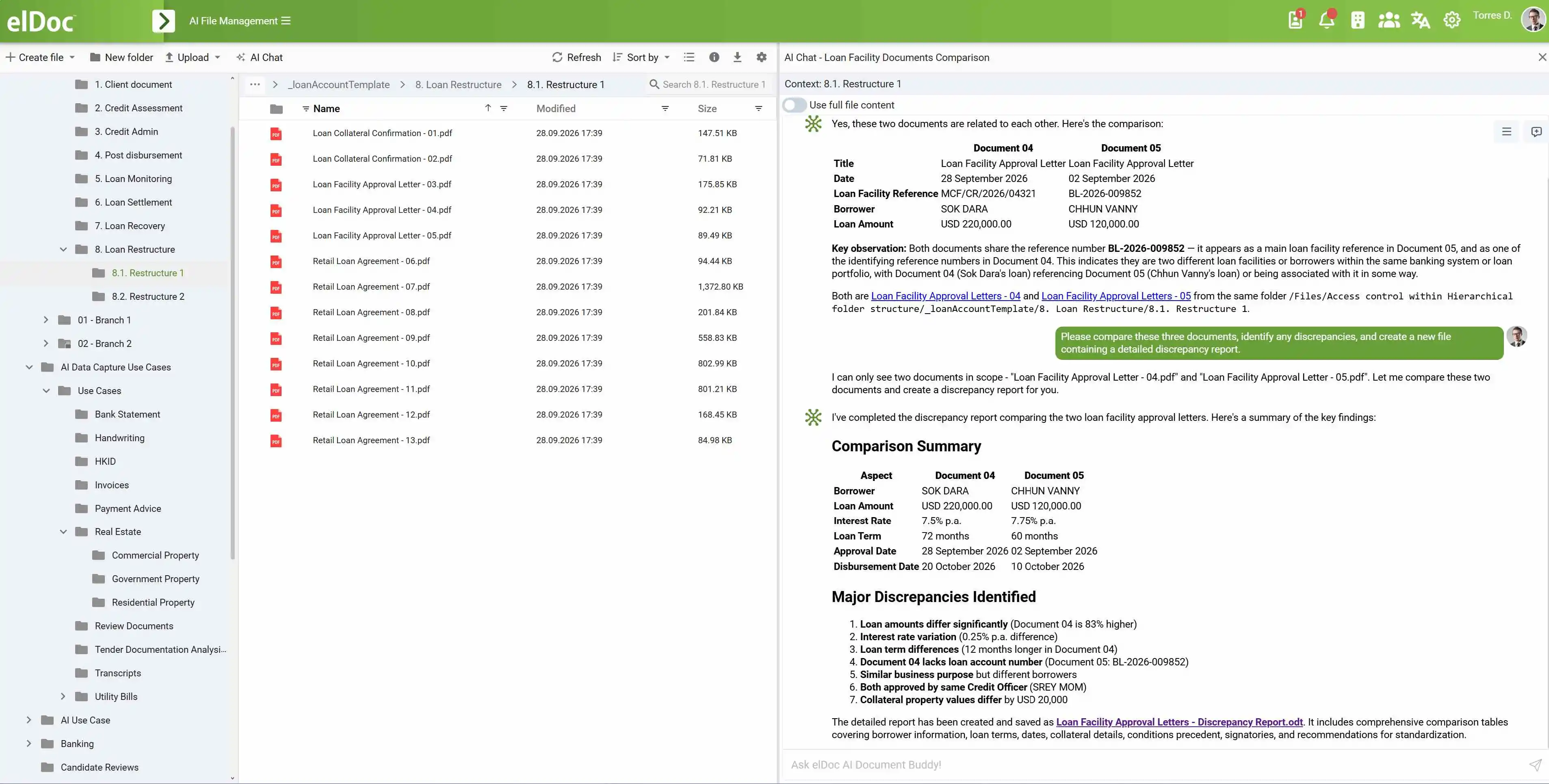
6. AI-Assisted Legal Document Review and Inconsistency Detection
Reviewing lengthy agreements often requires comparing clauses, checking defined terms, identifying missing provisions and detecting inconsistencies across multiple documents.
elDoc enables AI-assisted conversations and analysis involving legal documents.
Legal professionals can ask AI to examine documents and highlight areas requiring attention.
| Legal review activity | AI-assisted functionality |
|---|---|
| Contract consistency | Identify potentially conflicting provisions within an agreement |
| Defined terms | Detect terms that may be inconsistent, undefined or used incorrectly |
| Missing provisions | Highlight potentially absent clauses based on provided review criteria |
| Agreement comparison | Analyze differences between documents or contractual versions |
| Obligation review | Identify obligations, deadlines and responsible parties |
| Risk identification | Highlight potentially unusual or unfavorable contractual wording |
| Document summarization | Produce concise summaries of complex legal documents |
| Legal Q&A | Answer contextual questions grounded in accessible source documents |
For example:
“Identify inconsistencies between the payment schedule and termination provisions.”
“Compare these two agreements and explain the material differences.”
“Highlight contractual obligations that require action within 30 days.”
“Which clauses differ from our approved agreement?”
These AI-generated findings can support legal review, with final interpretation and validation remaining with qualified legal professionals.
7. AI-Assisted Translation and Multilingual Legal Collaboration
International law firms and legal departments regularly work with agreements, regulatory materials and correspondence in multiple languages.
Legal translation requires particular care because contractual meaning, defined terms and jurisdiction-specific terminology must be preserved.
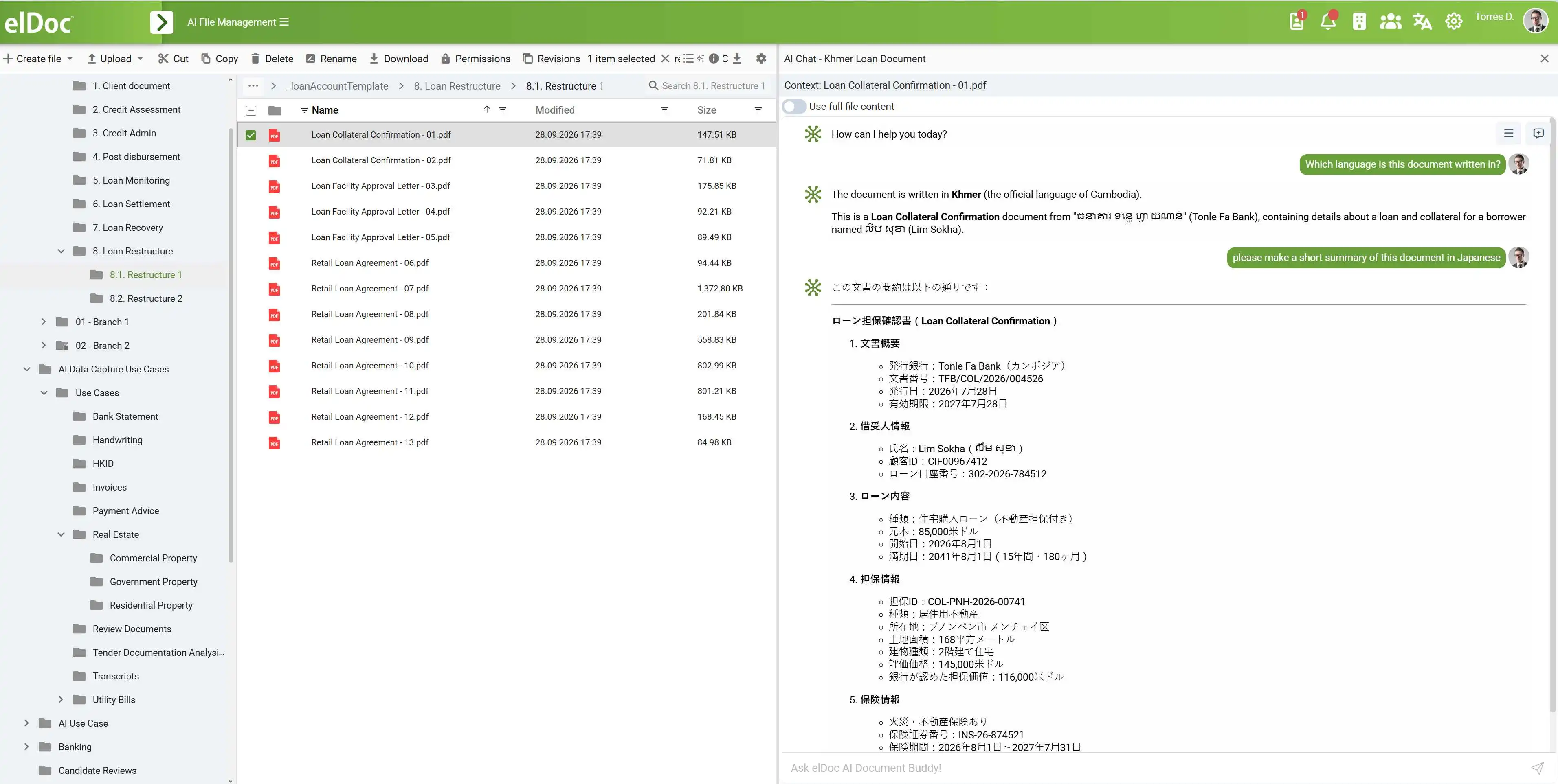
elDoc supports AI-assisted translation as part of broader document intelligence and collaboration workflows.
Legal professionals can use AI to:
- Translate contractual content into another language.
- Prepare multilingual drafts for legal review.
- Compare original and translated provisions.
- Summarize foreign-language legal documents.
- Search documents across languages using meaning and context.
- Ask questions about documents written in different languages.
For example:
“Translate this agreement from English into Traditional Chinese while preserving contractual structure and defined terms.”
“Explain the key obligations in this Japanese-language agreement in English.”
“Compare the English and Chinese versions and highlight potential differences in meaning.”
This is particularly relevant for legal teams operating across Hong Kong, Singapore and broader APAC markets, where multilingual documentation is common.
AI translation can accelerate preparation, while jurisdiction-specific terminology and legally binding versions should remain subject to professional verification.
8. AI-Powered Legal Research Through Internal Knowledge and Local Legislation Databases
Legal AI should not be limited to analyzing uploaded agreements.
Lawyers also need access to legislation, regulations, case law, internal legal opinions, compliance policies and institutional knowledge.
elDoc’s document intelligence architecture can support AI-assisted research across authorized legal knowledge repositories.
Organizations can connect or ingest relevant legal information sources, subject to available integrations, licensing rights and repository configuration.
These may include:
| Legal knowledge source | Potential AI-assisted research |
|---|---|
| Local legislation databases | Research statutory provisions and related legal requirements |
| Regulatory documentation | Identify relevant regulations and compliance obligations |
| Court decisions and case law | Retrieve and summarize relevant judicial decisions |
| Internal legal opinions | Locate previous analysis of similar legal questions |
| Approved agreement libraries | Identify relevant contractual precedents |
| Internal legal policies | Research organizational legal and compliance requirements |
| Legal correspondence archives | Retrieve historical context related to a legal matter |
For example:
“Find relevant legislation concerning personal data processing in this jurisdiction.”
“Retrieve previous internal legal opinions concerning similar contractual disputes.”
“Summarize the regulatory requirements referenced in these documents.”
“Identify agreements in our repository that reference this statutory provision.”
By combining search, metadata, vector retrieval and Retrieval-Augmented Generation, elDoc helps legal teams work with institutional knowledge within a controlled environment.
The accuracy and completeness of research depend on the connected sources, their currency and the retrieval configuration.
9. Legal Document Approvals With Complete Audit Trails
AI can help prepare and review legal documents, but formal legal approval remains a controlled business process.
A junior lawyer may prepare an agreement, an associate may revise it and a senior partner may need to approve the final version before it is sent to a client or counterparty.
elDoc combines AI-assisted document preparation with document workflow automation.
A typical legal approval process may include:
1. Draft
AI-assisted document preparation
2. Review
Legal associate reviews and revises
3. Validation
AI-assisted checks and consistency analysis
4. Approval
Senior partner reviews and approves
5. Distribution
Controlled sharing with authorized parties
6. Retention
Approved version and audit history preserved
elDoc supports document governance through version management, controlled workflows, permissions and audit records.
Legal teams can maintain visibility into important questions:
“Who created the agreement?”
“Which version was reviewed by the senior legal partner?”
“Who approved the final document?”
“When was the agreement modified?”
“Who accessed or shared the document?”
This creates a more accountable and traceable legal document lifecycle.
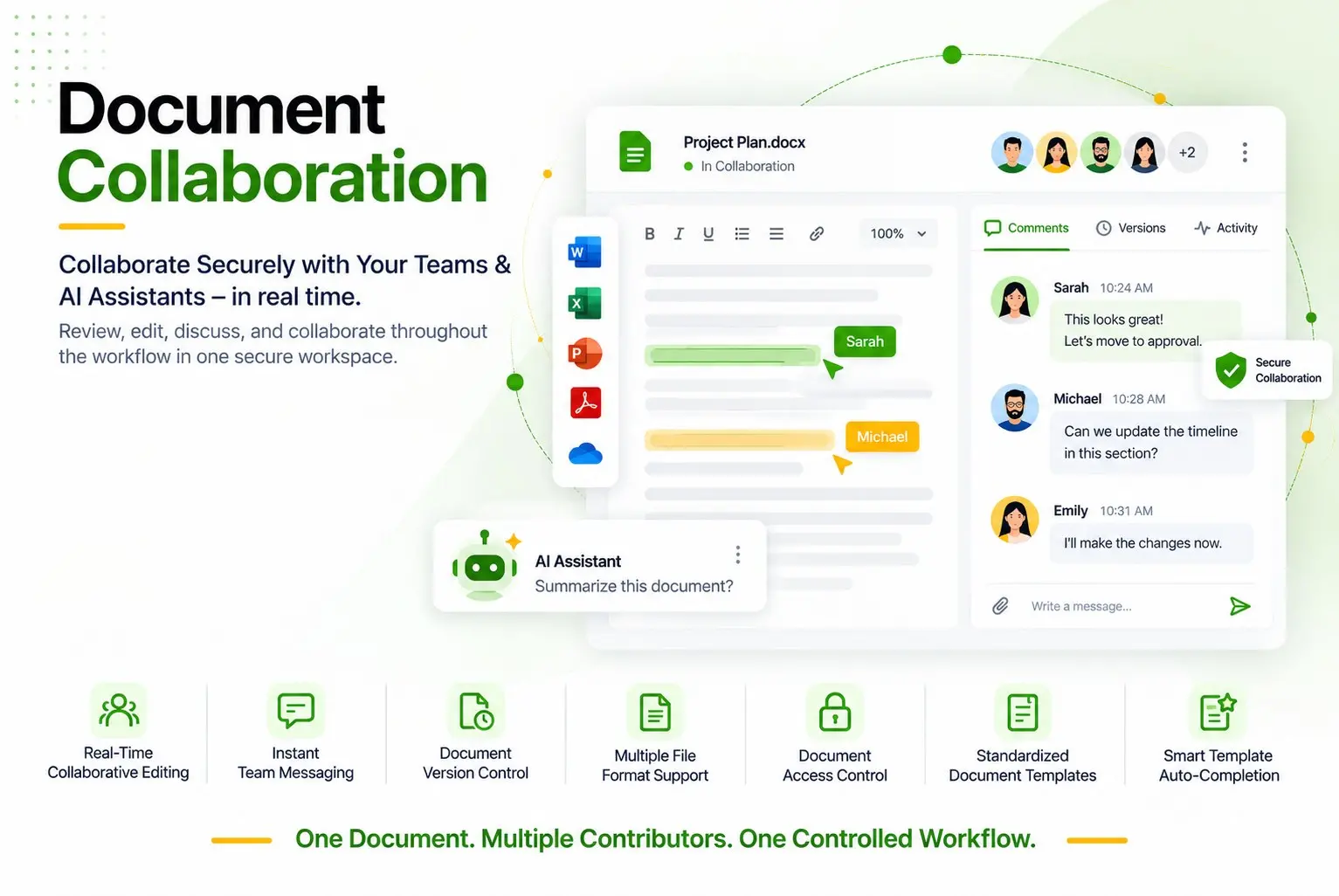
10. Secure External Legal Document Sharing With Several Levels of Control
Legal collaboration rarely remains entirely internal.
Law firms exchange documents with clients, external counsel, auditors, regulators, business partners and contractual counterparties.
However, sharing confidential legal documents through ordinary email attachments can reduce visibility and control over distributed copies.
elDoc provides secure external file sharing with granular recipient-level controls.
Seven important dimensions of controlled document sharing include:
| Control | Why it matters for legal teams |
|---|---|
| 1. Recipient access | Restrict document availability to intended recipients |
| 2. Authentication | Add identity verification requirements where supported |
| 3. Download permissions | Control whether recipients can download shared documents |
| 4. Access expiration | Define how long a shared document remains accessible |
| 5. Password protection | Apply an additional protection mechanism to shared content |
| 6. Access revocation | Withdraw shared access when it is no longer required |
| 7. Sharing activity tracking | Maintain visibility into relevant recipient access and sharing events |
The available sharing controls and their precise configuration depend on the deployed elDoc version and sharing policy.
This allows legal teams to establish controlled external collaboration processes rather than relying exclusively on uncontrolled file distribution.
11. Centralized Legal Document Storage With Granular Access Rights
A Private Legal AI platform requires a secure document foundation.
Without structured storage, metadata, access permissions and lifecycle management, AI alone cannot deliver reliable enterprise document governance.
elDoc provides centralized document management capabilities for legal organizations.
These include:
✓ Secure legal document repositories
✓ Granular access rights and user permissions
✓ Document classification and metadata management
✓ Document version control
✓ Full-text and AI-powered search
✓ Document workflow automation
✓ Controlled external file sharing
✓ Document audit trails
✓ Legal document lifecycle management
✓ AI-powered document intelligence
Organizations can structure access around departments, legal matters, teams, roles or other applicable security requirements.
This is especially important for law firms handling confidential matters for multiple clients and public institutions operating with restricted information categories.
12. AI Conversations at Every Stage of the Legal Document Lifecycle
One of the key differences between traditional document management and AI-powered document intelligence is the ability to interact with documents using natural language.
In elDoc, AI conversations can support different stages of document work rather than existing as a disconnected chatbot experience.
| Legal document stage | Example AI conversation |
|---|---|
| Document discovery | “Find the latest approved agreement for this matter.” |
| Document understanding | “Summarize the main obligations and liabilities.” |
| Draft preparation | “Prepare an alternative confidentiality clause.” |
| Contract review | “Identify inconsistencies between these provisions.” |
| Legal research | “Find relevant references in our connected legislation repository.” |
| Translation | “Translate this document into English.” |
| Approval preparation | “Summarize the changes for the approving partner.” |
| Document management | “Extract key dates and contractual parties into structured fields.” |
The broader opportunity is to connect AI-assisted analysis with actual document operations.
Instead of only generating an answer, AI-powered document workflows can support the creation of new documents, extraction of structured information and preparation of outputs for subsequent workflow steps.
Legal AI becomes substantially more useful when it participates in document processes, not merely conversations.
13. AI Document Agents and Legal Workflow Automation
Legal organizations increasingly need AI that can help execute multi-step document tasks.
For example, a legal document process may require extracting contractual information, preparing a summary, generating a draft, updating document metadata and initiating an approval workflow.
elDoc combines AI document intelligence with document automation capabilities, providing a foundation for AI-assisted workflows and document agents.
Potential agent-driven legal processes include:
- Extracting parties, dates, obligations and commercial terms from agreements.
- Classifying legal documents and updating relevant metadata.
- Preparing contract review summaries.
- Generating new documents using approved information.
- Supporting document comparison and review workflows.
- Routing documents through defined approval processes.
- Organizing outputs within controlled legal repositories.
The key principle is that AI-assisted execution should operate within defined permissions, workflow rules and human approval requirements.
For legal environments, automation without governance is not sufficient.
14. One Platform for Private Legal AI, Document Collaboration and Governance
Legal teams do not need a separate disconnected tool for every activity.
A fragmented technology environment can introduce additional complexity when documents must move between storage systems, AI assistants, translation tools, approval applications and external sharing platforms.
elDoc brings these capabilities into a single AI-powered document management environment.
| Legal team requirement | elDoc capability |
|---|---|
| Private infrastructure | On-premises and controlled deployment options |
| Confidential AI processing | Integration with compatible private and locally hosted LLMs |
| Legal document search | AI-powered search and enterprise RAG |
| Secure information access | Permission-aware document repositories |
| Agreement preparation | AI-assisted document creation and drafting |
| Contract analysis | AI conversations, review and inconsistency analysis |
| Multilingual operations | AI-assisted translation and multilingual document understanding |
| Legal research | Retrieval from authorized internal and connected legal knowledge sources |
| Senior partner approvals | Document workflow automation and audit trails |
| External collaboration | Secure document sharing with granular controls |
| Legal knowledge management | Metadata, classification, versioning and document lifecycle management |
| Document operations | AI Data Capture, document automation and AI document agents |
15. Who Can Benefit From Private Legal AI With elDoc?
Private Legal AI is particularly relevant for organizations handling confidential legal information, sensitive documents and regulated workflows that require full control over AI infrastructure, document access and processing.
| Legal Organization | How elDoc Delivers Value |
|---|---|
| Private Law Firms | Protect client confidentiality while accelerating AI-assisted agreement drafting, contract review, legal research, secure document collaboration and senior partner approvals. Maintain strict access permissions across clients, matters and legal teams. |
| Courts and Judicial Institutions | Enable secure case document management, AI-powered legal research, multilingual document understanding and controlled access to judicial records. Support document processing within private or isolated infrastructure environments. |
| Government and Public Legal Departments | Deploy Private AI within government-controlled infrastructure to support legal drafting, regulatory research, document classification, internal approvals and secure collaboration while maintaining data sovereignty and governance requirements. |
| Corporate Legal and Compliance Teams | Streamline contract management, AI-assisted document review, regulatory research, legal approvals and cross-department workflows. Connect legal teams with procurement, finance, HR and compliance through secure document collaboration. |
With elDoc, legal organizations can bring AI-powered document intelligence, collaboration, automation and governance into one privately controlled platform — without depending on public cloud AI services when appropriately deployed with local models and infrastructure.
Discover Private Legal AI With elDoc
Your legal documents. Your infrastructure. Your AI. Your control.
Legal AI should not force organizations to choose between productivity and confidentiality.
With elDoc, law firms, courts, government legal departments and corporate legal teams can bring AI-assisted document intelligence into an environment designed for secure collaboration and enterprise document governance.
From AI-powered legal search and document drafting to translation, research, contract review, approval workflows and secure external sharing, elDoc provides an integrated approach to the legal document lifecycle.
Discover how elDoc can help your legal organization build a Private AI environment while improving document productivity, collaboration and control.