
elDoc – Secure AI for Lawyers: Why Sensitive Legal Documents Need More Than Cloud AI

AI is rapidly becoming part of everyday legal work.
Lawyers can use AI to search large case files, summarize contracts, compare clauses, extract information, review evidence, classify documents, prepare drafts, and navigate thousands of pages of legal material.
But for many legal organizations, the most important question is not:
“Can AI help our lawyers?”
The more important question is:
“Can we use AI without sending our most sensitive legal documents outside the environment we control?”
For many law firms, corporate legal departments, government authorities, financial institutions and other regulated organizations, this question can determine whether AI can be adopted at all.
A convenient cloud AI service may provide a fast route to AI adoption.
But legal documents are not ordinary business data.
They may contain privileged communications, litigation strategies, evidence, personal information, acquisition plans, regulatory investigations, confidential contracts, intellectual property and information whose disclosure could materially affect an organization or its clients.
In these environments, cloud deployment may simply not be an acceptable option.
This is where elDoc takes a fundamentally different approach.
Rather than requiring organizations to move sensitive documents into an external AI environment, elDoc can bring AI to the organization’s documents and infrastructure.
Legal AI Has a Different Security Problem
Consider what lawyers actually work with every day.
| Legal activity | Potentially sensitive information |
|---|---|
| Litigation | Evidence, witness information, legal strategy, privileged communications |
| Mergers & acquisitions | Transaction documents, valuations, negotiations, due diligence |
| Internal investigations | Employee records, allegations, evidence, investigation reports |
| Regulatory matters | Correspondence with regulators, compliance findings, remediation plans |
| Corporate legal work | Contracts, board documents, intellectual property, legal opinions |
| Government legal work | Restricted records, investigations, citizen information, internal government documents |
| Banking & financial services | KYC files, financial information, regulatory documents, customer records |
| Legal discovery | Potentially millions of documents containing confidential and privileged material |
The consequences of processing these documents through an inappropriate AI environment can be very different from using AI to write a marketing email.
This is also why legal regulators increasingly emphasize that AI adoption does not remove lawyers’ existing professional responsibilities.
The American Bar Association’s Formal Opinion 512 states that lawyers using generative AI must consider obligations including competence, protection of client information, communication, supervision and accuracy.
The UK’s Solicitors Regulation Authority has similarly warned about confidential client information being entered into AI systems without appropriate safeguards. Its 2026 guidance specifically highlights considerations including unauthorized third-party access, model training, retention and whether client data remains within a secure environment.
The principle is straightforward:
Using AI does not make confidentiality less important.
It makes understanding the AI architecture more important.
The Convenience of Cloud AI vs. the Control Required for Legal AI
Cloud AI has an obvious advantage: convenience.
An organization can subscribe to a service and give lawyers access relatively quickly.
There may be no AI infrastructure to deploy internally, no models to maintain and comparatively little technical work before users can begin experimenting.
For many general business activities, this can be entirely appropriate.
But legal teams handling highly sensitive information may have additional requirements.
Questions Legal Teams Should Ask Before Adopting AI
For legal teams working with confidential, privileged, regulated, or government information, adopting AI requires more than evaluating its features. Organizations need to understand how information moves through the entire AI architecture.
| Question | Why It Matters for Legal & Regulated Organizations |
|---|---|
| Where is the document processed? | Sensitive legal documents may be subject to confidentiality, contractual, regulatory, or internal security requirements that restrict where processing can occur. |
| Where is the document stored? | Organizations need visibility and control over where original files, extracted text, metadata, and processed information reside. |
| Which external systems receive its content? | A document workflow may involve OCR services, AI APIs, analytics platforms, or other third-party systems. Each additional service can expand the data-processing boundary. |
| Does a prompt leave our infrastructure? | Even when the original document remains internal, prompts sent to an external LLM may contain confidential document excerpts, questions, names, or other sensitive context. |
| Can a third party technically access the information? | Legal teams may need to understand not only contractual protections but also which providers or administrators could technically access processed information. |
| Is information retained after processing? | Retention policies matter when dealing with privileged communications, litigation materials, investigations, personal information, or confidential transactions. |
| Could information be used for model improvement or training? | Organizations should understand whether prompts, documents, outputs, or other information can be reused beyond the immediate processing purpose. |
| Where is the AI model hosted? | Model hosting determines whether AI inference occurs internally, in a private environment, or through external infrastructure. |
| Where are embeddings stored? | Embeddings are part of the AI knowledge architecture and may represent information derived from confidential documents. Their storage and protection therefore require consideration. |
| Where is the vector database? | RAG systems can depend on vector databases containing representations and indexes derived from large collections of organizational knowledge. Legal teams may require this infrastructure to remain internally controlled. |
| Which jurisdiction contains the infrastructure? | Data location can affect sovereignty, contractual requirements, regulatory obligations, cross-border transfers, and organizational policies. |
| Can the environment operate without Internet connectivity? | Government agencies and highly regulated organizations may require restricted-network, isolated, or air-gapped deployments where external AI services cannot be used. |
These are not merely IT questions. They are questions of legal confidentiality, information governance, data sovereignty, regulatory compliance, client trust, and organizational control.
For sensitive legal AI, security should therefore be evaluated across the entire information chain — documents, OCR, extracted data, prompts, models, embeddings, vector databases, retrieval, storage, and user access.
The Client May Not Want Its Documents Processed by an External AI Provider
This point becomes particularly important in high-value and sensitive matters.
Imagine a company preparing for an acquisition.
Its legal team may be reviewing thousands of documents covering:
- acquisition targets;
- financial information;
- intellectual property;
- employee agreements;
- customer contracts;
- potential liabilities;
- negotiation positions;
- valuation information;
- board materials.
AI could dramatically accelerate the review.
But the organization may not want this information processed through infrastructure operated by an external AI provider.
The same applies to litigation.
A litigation repository can contain years of correspondence, internal communications, evidence, witness information, expert reports and legal strategy.
The question therefore becomes:
How can lawyers receive the productivity advantages of modern AI without unnecessarily expanding the infrastructure and third parties involved in processing the underlying documents?
This is one of the problems elDoc is designed to address.
Government Legal Teams Face an Even Stronger Constraint
For some government departments, public authorities, defense-related organizations, and other highly regulated institutions, processing sensitive documents through a public or externally hosted AI platform may be restricted by internal policy, security requirements, data-sovereignty rules, or the classification of the information involved.
In these environments, AI must operate within the organization’s security boundaries, rather than requiring sensitive information to be transferred to external AI infrastructure.
| Security Requirement | What It Means for AI Deployment |
|---|---|
| On-Premises Deployment | The document and AI environment can be deployed within infrastructure controlled by the organization. |
| Private Infrastructure | Documents, processing services, databases, and AI components operate within a dedicated and controlled environment. |
| Local AI Models | AI models can run locally or within approved private infrastructure instead of depending exclusively on public AI services. |
| No External API Calls | Sensitive document processing can be architected without sending document content or prompts to external AI APIs. |
| No External LLM Processing | Confidential information can be processed by locally or privately deployed models where required. |
| Locally Controlled Vector Databases | Embeddings, indexes, and RAG infrastructure can remain within the organization’s controlled environment. |
| Strict Access Controls | Access to documents and AI-powered knowledge can be governed according to organizational roles, permissions, and security policies. |
| Separation from Public AI Services | Sensitive workloads can be isolated from public AI platforms and external AI processing services. |
| Restricted or Air-Gapped Operation | Where required by the deployment architecture, AI and document-processing environments can operate within networks with restricted or no Internet connectivity. |
For these organizations, the question is not simply which AI platform provides the most features.
The fundamental question is:
Can we use AI while keeping our documents, prompts, models, embeddings, and knowledge infrastructure within an environment we control?
elDoc: Bring AI to the Legal Documents
elDoc is designed around a different enterprise architecture.
Instead of assuming that sensitive information must be moved to an external AI service, organizations can deploy the document AI environment according to their infrastructure and security requirements.
The objective is simple:
Keep control of the documents, AI processing and knowledge infrastructure while still giving legal teams access to modern AI capabilities.
Depending on the selected architecture, this can extend across the complete document AI pipeline.
| Requirement | elDoc approach |
|---|---|
| Documents cannot leave organizational infrastructure | Deploy elDoc on-premises |
| Legal documents cannot be sent to an external LLM | Use private/local model deployment |
| Vector data must remain internally controlled | Keep vector/RAG infrastructure within the organization’s environment |
| External AI APIs are prohibited | Configure an architecture based on locally deployed AI components |
| Internet access is restricted | Deploy within isolated infrastructure according to the required architecture |
| Different matters require different access | Apply controlled document and user access |
| Lawyers need AI search over internal documents | Build controlled RAG/knowledge workflows around authorized enterprise content |
| Documents require OCR and extraction | Process documents through integrated document AI workflows |
| AI output requires review | Incorporate human validation and oversight into document workflows |
Access Control Matters as Much as AI and elDoc Addresses It at the Document Level
For legal organizations, secure AI is not only about where the model runs or where documents are stored. It is equally important to control who can access each client, matter, document, and AI-generated answer.
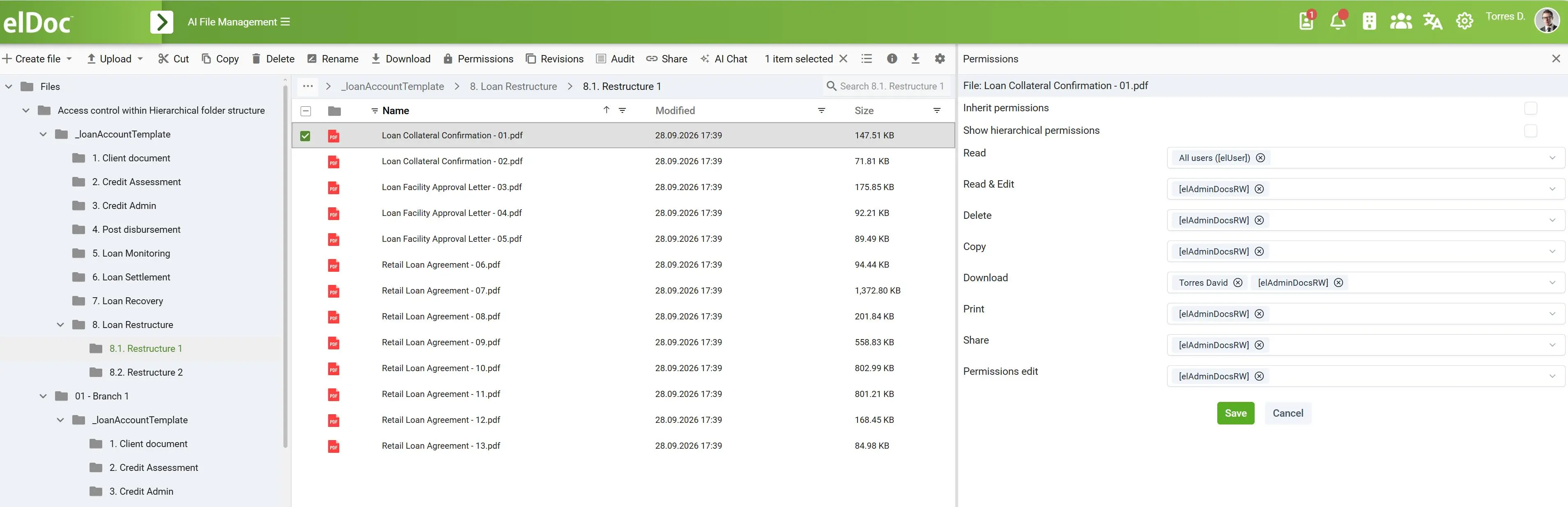
This challenge is addressed directly within elDoc through granular, role-based and document-level access controls.
A lawyer should never gain access to confidential information simply because an AI system can technically retrieve it.
One elDoc Environment. Multiple Teams. Multiple Clients. Separate Access.
A law firm can manage multiple legal teams and client matters within the same elDoc environment while maintaining separate access boundaries.
For example:
| Team | Client / Matter | Documents | elDoc Access |
|---|---|---|---|
| M&A Team | Client A — Acquisition | Due diligence, contracts, valuations, board materials | Accessible only to authorized M&A users |
| Litigation Team | Client B — Litigation | Evidence, correspondence, witness statements | Accessible only to the assigned litigation team |
| Corporate Team | Client C — Corporate Legal | Contracts, corporate records, legal opinions | Accessible to authorized corporate lawyers |
| Compliance Team | Client D — Investigation | KYC, investigation and compliance files | Restricted to designated compliance users |
| Government Legal Team | Restricted Matter | Internal records and legal documents | Accessible only to authorized officials |
This means organizations do not need a separate AI platform for every team or client.
Instead, elDoc provides one controlled document and AI environment while maintaining different access rights across teams, clients, matters, and files.
elDoc Can Reflect the Structure of the Legal Organization
Access can be organized around the way lawyers actually work:
Organization → Legal Team → Client → Matter / Case → Folder → Document → User / Role
Different users can therefore receive different permissions depending on their responsibilities.
Consider a confidential M&A transaction managed within elDoc. The same matter may involve partners, lawyers, paralegals, external counsel, and other participants — but they do not necessarily require the same level of control.
| Role | Example Permissions in elDoc |
|---|---|
| Partner | Can view, edit, download, print, copy, share, delete, and manage permissions across the client matter. |
| Matter Lead | Can access the complete matter, view, edit, download, print, share, organize documents, and manage access for the assigned team. |
| Lawyer | Can view, edit, search, and use authorized documents with AI, but may be restricted from deleting documents or changing permissions. |
| Paralegal | Can view and work with assigned documents, while download, external sharing, deletion, or permission management can remain restricted. |
| External Counsel | Can be granted view-only access to specifically selected documents, with printing, downloading, copying, sharing, and deletion disabled. |
| Client Representative | Can access only the documents or folders specifically made available to the client, without visibility into internal legal working files. |
For example, a Partner may have full access to the entire M&A matter, including the ability to download documents, share information, and manage permissions.
At the same time, an External Counsel user may be able to view only 25 specifically authorized documents from the same matter, without permission to download, print, copy, share, edit, or delete them.
Both users work within the same elDoc environment — but what they can see and what they can do can be governed by their respective roles and permissions.
The same principle extends to AI: AI-powered retrieval should operate within the documents and information the individual user is authorized to access.
Most Importantly: elDoc Makes AI Retrieval Access-Aware
Document permissions become even more important when AI and RAG are introduced.
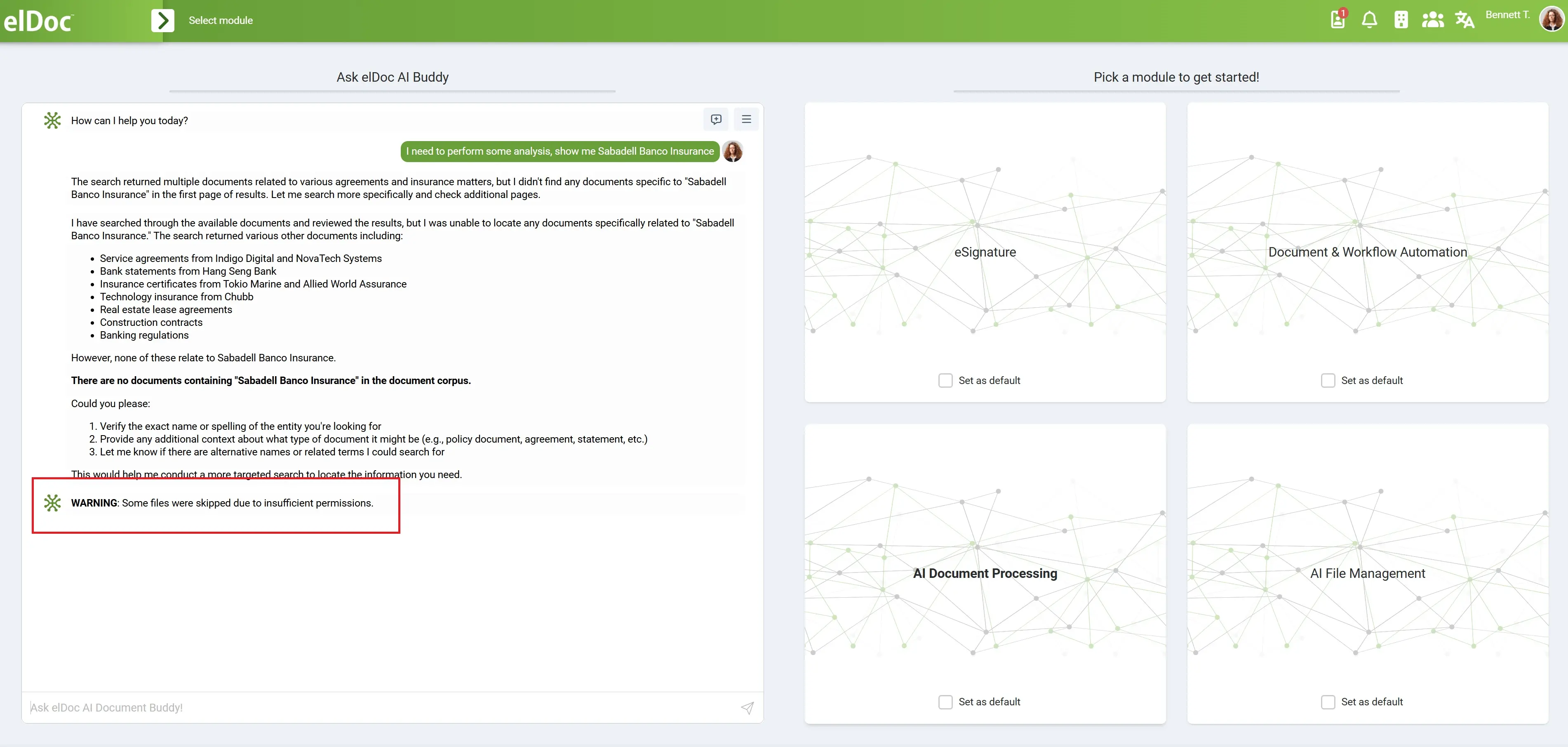
It would not be enough to prevent a lawyer from opening Client B’s document if an AI assistant could still retrieve information from that document and include it in an answer.
elDoc addresses this by keeping AI-powered retrieval aligned with authorized document access.
The principle is:
What a user is permitted to retrieve through AI should be governed by what that user is authorized to access.
The access chain therefore becomes:
User Identity → Role & Permissions → Authorized Documents → Authorized RAG Retrieval → AI Response
If Lawyer A is authorized for Client A, the AI knowledge available to that lawyer can be constrained accordingly.
If Lawyer B is authorized for Client B and Client C, their accessible knowledge scope can be different.
If a particular confidential file is restricted to selected partners, its information should remain outside the retrieval scope of other users.
AI Should Never Become a Shortcut Around Document Permissions
This is one of the fundamental principles behind secure Legal AI in elDoc.
AI should not create access to information that the user would not otherwise be authorized to access.
By combining team structures, roles, client and matter separation, granular document permissions, and access-aware AI retrieval, elDoc enables organizations to introduce AI without abandoning the information boundaries already required for legal work.
The result is not simply an AI assistant connected to a collection of legal files.
It is a controlled Legal AI environment where document access and AI access work together.
Private LLMs Change the Architecture
Many AI applications depend on external LLM APIs.
For ordinary use cases, this architecture can be efficient.
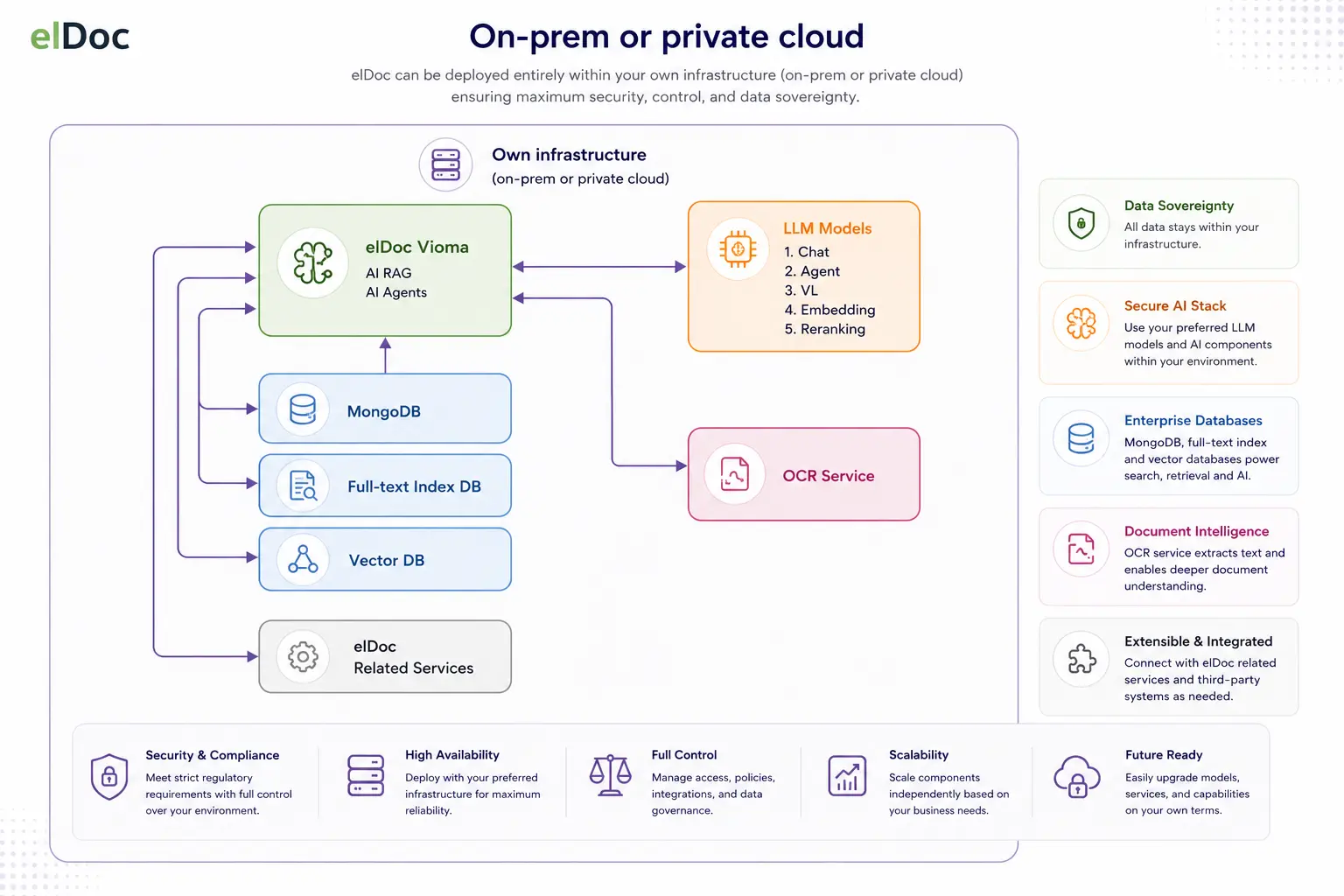
For sensitive legal environments, organizations may instead require locally or privately deployed models.
elDoc is designed to support an LLM-agnostic architecture, allowing the AI strategy to be adapted to organizational requirements rather than making the organization’s document strategy dependent on one external model provider.
This is particularly relevant for organizations that require:
- private LLM deployment;
- local inference;
- controlled infrastructure;
- model flexibility;
- data sovereignty;
- restricted external connectivity;
- separation from public AI services.
As AI models continue to evolve, this flexibility also helps avoid making the entire legal document architecture dependent on a single model.
The Vector Database Is Sensitive Too
There is another part of AI architecture that organizations sometimes overlook.
The LLM is not the only component that matters.
Modern enterprise RAG systems commonly transform document content into embeddings that are stored and searched through vector infrastructure.
For highly confidential legal repositories, organizations may therefore want to control not only the original files but also:
the extracted text, metadata, embeddings, indexes, vector databases, prompts and retrieved context.
Security cannot stop at the original PDF.
The complete information-processing chain matters.
With an appropriately configured elDoc deployment, this infrastructure can remain within the organization’s controlled environment.
Human Oversight Still Matters
Private AI does not eliminate another important legal AI risk: accuracy.
Large language models can generate incorrect information.
The SRA specifically identifies AI-generated inaccuracies and hallucinated legal authorities as a concern, while emphasizing that lawyers remain responsible for the work and advice they provide.
Security therefore requires more than preventing information leakage.
A robust legal AI strategy combines:
Infrastructure Control + Access Control + Information Governance + Human Oversight
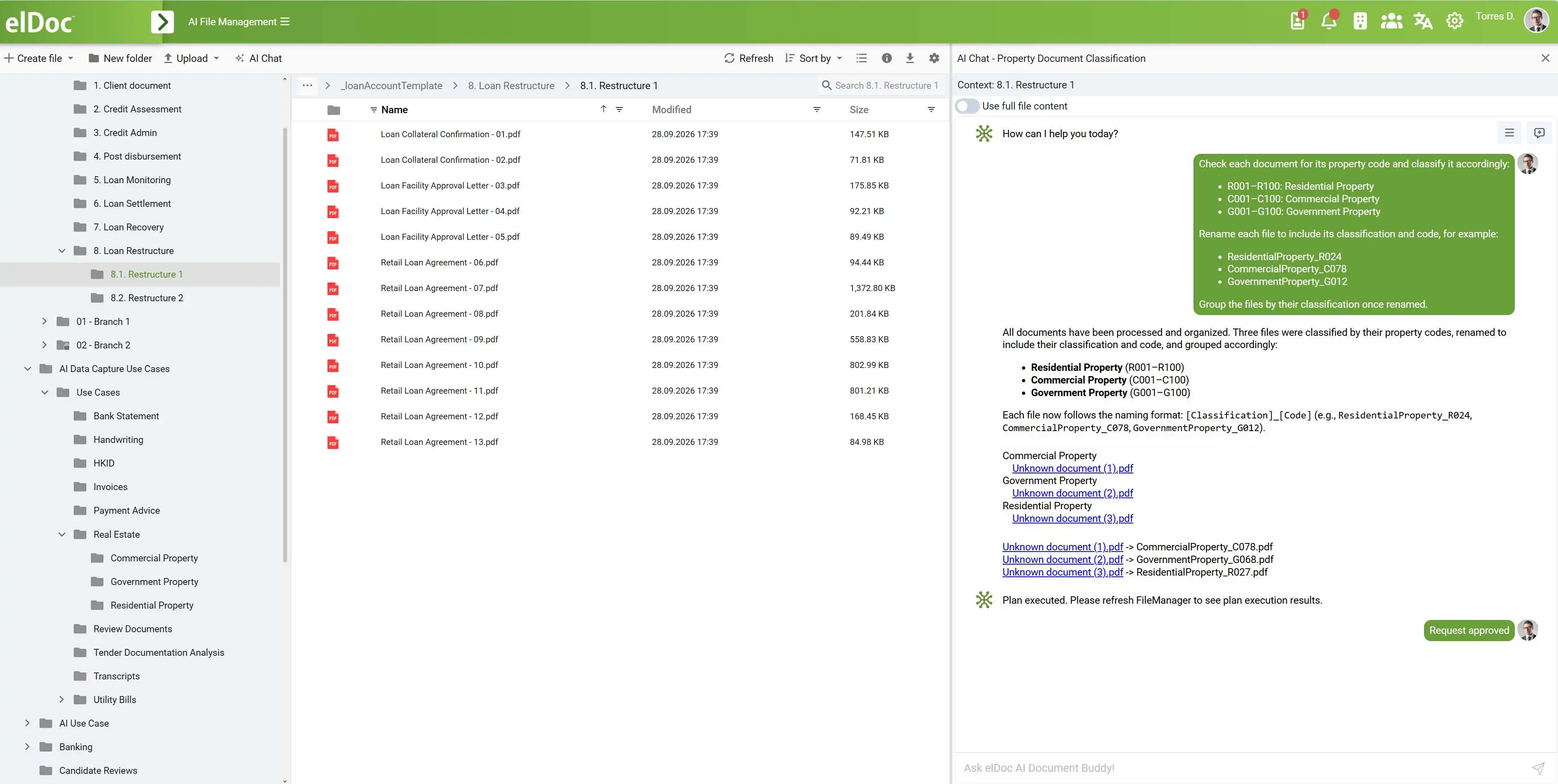
elDoc’s broader document-processing architecture is particularly useful here because AI can form part of a controlled workflow rather than operating as an isolated chatbot.
Documents can be captured, classified, extracted, validated and reviewed before information becomes part of downstream processes.
A Different Definition of Secure Legal AI
The next generation of Legal AI should not be evaluated only by how well an AI model can generate, summarize, or analyze text.
For organizations handling privileged, confidential, regulated, or government information, model performance is only one part of the equation.
Secure Legal AI requires organizations to evaluate the entire information and AI architecture.
| Security Area | The Question Legal Organizations Should Ask |
|---|---|
| Document Control | Where are my legal documents stored and processed? |
| AI Infrastructure | Where is the AI model running? |
| Model Control | Can my organization determine which AI models are used? |
| External Processing | Does any document content, prompt, or context leave our infrastructure? |
| Embeddings | Where are embeddings generated and stored? |
| Vector Database | Where is the vector database and who controls it? |
| Third-Party Services | Which external services, if any, receive information? |
| User Access | Who can access each client, matter, folder, and document? |
| AI Access Control | Does AI retrieval respect the same permissions as the underlying documents? |
| API Independence | Can the environment operate without external AI APIs? |
| Infrastructure Control | Can the complete solution be deployed within infrastructure controlled by the organization? |
| Network Isolation | Can the environment operate within a restricted or air-gapped network when required? |
From “How Good Is the AI?” to “How Controlled Is the AI?”
For sensitive legal environments, the evaluation therefore becomes broader:
AI Capability
Can the AI understand, search, summarize, extract, and work with legal documents?
Data Control
Can documents, metadata, embeddings, and indexes remain within the required infrastructure?
Access Control
Can different teams, clients, matters, roles, and individual documents have different permissions?
AI Control
Can the organization control which models are used and where inference takes place?
Infrastructure Control
Can OCR, document processing, RAG, vector databases, and AI models operate within an organization-controlled environment?
Connectivity Control
Can the solution operate without sending sensitive information to external APIs — or without Internet connectivity where required?
For organizations handling highly sensitive legal information, these questions can be just as important as model accuracy or AI functionality.
That is the broader definition of Secure Legal AI:
Not simply powerful AI for legal documents, but AI where the organization retains control over its documents, infrastructure, models, permissions, and knowledge.
elDoc: Secure Legal AI Without Giving Up Control
Legal teams should be able to benefit from AI while maintaining control over where sensitive information is stored, processed, and accessed.
elDoc brings the essential capabilities together in one controlled environment:
| Capability | Purpose |
|---|---|
| AI Document Processing & OCR | Read, classify, and process legal documents |
| Intelligent Data Extraction | Extract important legal information and metadata |
| Human Validation | Review and validate AI-processed information |
| Secure Document Management | Centrally manage sensitive legal documents |
| Data Encryption | Protect information at rest and in transit |
| Enterprise Search & RAG | Search and interact with authorized legal knowledge |
| Private LLMs | Process information using private or local AI models |
| On-Premises Deployment | Keep documents and AI within controlled infrastructure |
| Granular Access Control | Control viewing, editing, downloading, printing, copying, sharing, deleting, and permissions |
| Access-Aware AI | Ensure AI retrieval respects each user’s document permissions |
| Local Vector Infrastructure | Keep embeddings and vector databases under organizational control |
| Air-Gapped Deployment | Operate within restricted or isolated environments where required |
This makes elDoc particularly relevant for law firms, corporate legal teams, government authorities, regulated enterprises, litigation, investigations, and M&A where sensitive documents require stronger control.
Whether processing contracts, litigation evidence, an M&A data room, investigation files, or government records, the principle remains the same:
Bring AI to your legal documents — instead of requiring your legal documents to be sent to AI.
Explore how elDoc can support on-premises AI, private LLMs, secure RAG, document intelligence and controlled legal knowledge management — while keeping sensitive information within the environment your organization governs.
Talk to the elDoc team about your legal AI requirements and explore a secure private deployment for your organization.