
Sovereign AI Document Management: Keep Documents, Data and LLMs in Your Infrastructure

Generative AI is rapidly changing what enterprises expect from document management.
Traditional Document Management Systems were primarily designed to store, organize, search, share, and control documents. Today, organizations increasingly expect their document platforms to go much further: understand document content, extract information, answer questions, validate data, automate decisions, execute document-centric workflows, and provide AI Agents capable of working across enterprise knowledge.
But introducing Generative AI into document management creates an important architectural question:
Where do your documents, extracted data, embeddings, AI models, prompts, and AI-generated information actually reside and get processed?
For organizations operating in banking, financial services, government, healthcare, legal, manufacturing, and other regulated or data-sensitive industries, this question can be just as important as the AI capabilities themselves.
This is why modern enterprise document management increasingly requires two architectural principles:
Data & AI Sovereignty — maintaining control over where enterprise documents, data, indexes, embeddings, and AI processing reside.
LLM-Agnostic Architecture — avoiding dependency on a single AI provider or model and enabling organizations to select the AI stack appropriate for their security, performance, regulatory, and business requirements.
With elDoc, organizations can combine intelligent document management, Generative AI, Agentic RAG, and AI Document Agents while deploying the complete environment on-premise or within a private cloud infrastructure.
From Document Management to AI-Powered Document Intelligence
Enterprise documents contain enormous amounts of valuable business information.
Contracts contain obligations, renewal dates, clauses, risks, and commercial conditions. Invoices contain supplier information, purchase orders, payment details, VAT amounts, and line items. KYC files contain identities, supporting evidence, declarations, and compliance information.
Traditional document management makes this information accessible to people.
Generative AI makes it understandable and actionable by machines.
With an AI-powered document management architecture, organizations can move beyond simply finding a document and begin interacting with the knowledge contained inside it.
For example, users and automated processes can:
| Traditional Document Management | AI-Powered Document Management |
|---|---|
| Store documents | Understand document content |
| Search by metadata | Search by meaning and context |
| Full-text search | Semantic and Agentic RAG search |
| Manually review documents | Automatically analyze documents |
| Manually enter document data | Extract structured information with AI |
| Navigate folders and repositories | Ask questions across enterprise knowledge |
| Configure static workflows | Use AI to support decisions and trigger workflows |
| Users perform document tasks | AI Document Agents execute document-centric tasks |
This transformation, however, means that the AI architecture becomes part of the organization’s broader information architecture.
From Document Management to AI-Powered Document Intelligence: Documents are no longer simply stored and searched — with elDoc, they become AI-ready enterprise knowledge that users and AI Agents can understand, query, analyze, and act upon.
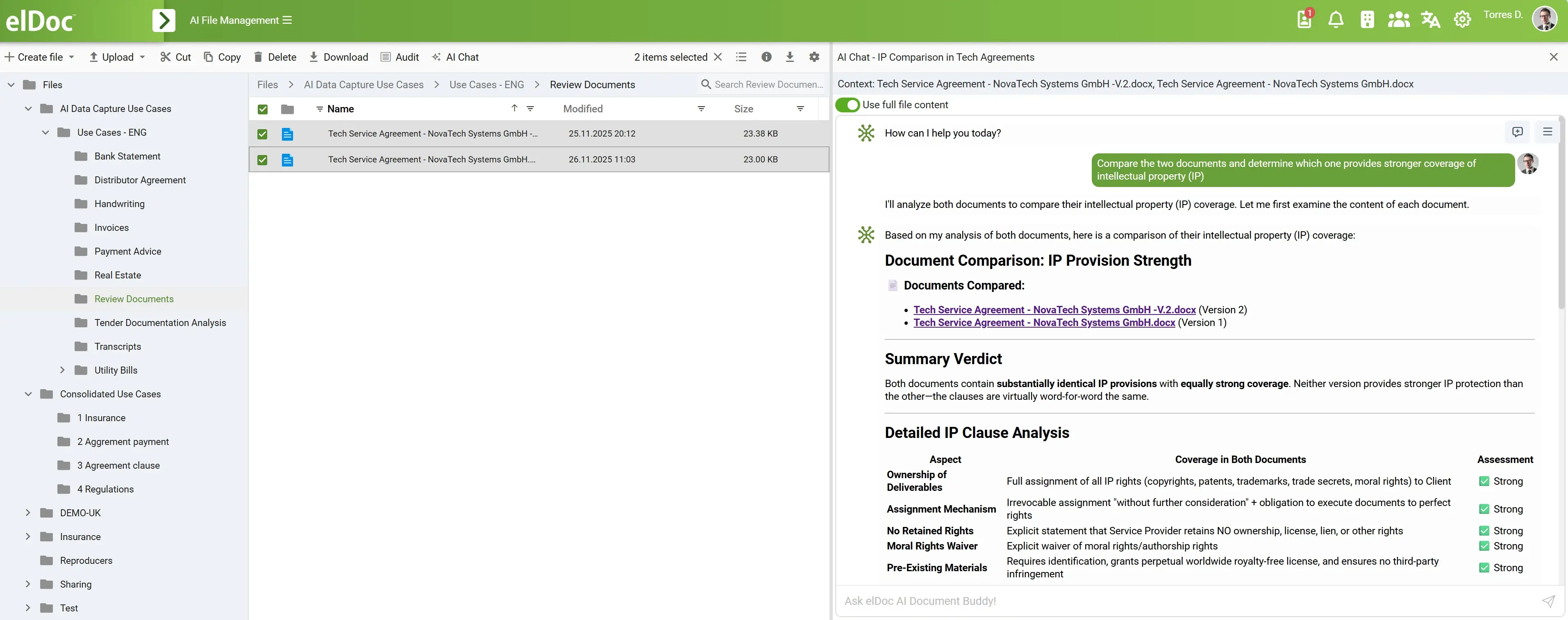
Data Sovereignty Is No Longer Enough
Enterprises have spent years developing policies defining where documents and business data may be stored.
Generative AI introduces additional layers of information that organizations must consider.
An enterprise AI environment may now include:
- original documents and files;
- document metadata;
- OCR-extracted content;
- full-text indexes;
- vector embeddings;
- vector databases;
- prompts and instructions;
- retrieved RAG context;
- AI-generated responses;
- model interactions;
- AI Agent operations and intermediate processing.
Consequently, organizations should increasingly think not only about Data Sovereignty, but about Data & AI Sovereignty.
Data & AI Sovereignty means maintaining control over where enterprise information is stored, where AI processing occurs, which models process that information, and how the complete AI environment is governed.
For some organizations, using public AI services is entirely appropriate.
For others, regulatory requirements, internal security policies, contractual obligations, customer confidentiality, or national data residency requirements may require a substantially more controlled architecture.
That is where on-premise and private cloud deployment become particularly important.
Keep Your Document and AI Environment Within Your Infrastructure
elDoc can be deployed within an organization’s own infrastructure, including on-premise environments and private clouds.
Instead of separating document management from the underlying AI architecture, enterprises can operate the components required for intelligent document processing, Generative AI, Agentic RAG, and AI Agents within an environment they control.
Depending on the implemented architecture, this can include:
| Component | Role in the Enterprise AI Architecture |
|---|---|
| elDoc | Provides a secure, user-friendly document management environment with folder structures, intuitive navigation, document access controls, search, sharing, and collaboration, combined with AI RAG and AI Agent capabilities for interacting with documents and enterprise knowledge. |
| MongoDB | Supports document data, metadata, application information, and other platform requirements. |
| Full-Text Index Database | Enables enterprise full-text search and retrieval across indexed document content. |
| Vector Database | Stores vector representations required for semantic retrieval, RAG, and AI-powered knowledge discovery. |
| OCR Services | Extract text and information from scanned and image-based documents, making their content available for indexing and subsequent AI processing. |
| LLM & AI Models | Organizations can use their preferred models for chat, AI Agents, vision-language processing, embeddings, reranking, and other AI tasks. |
| elDoc Related Services | Additional elDoc components, online document collaboration, and third-party services can operate as part of the broader architecture. |
The result: Your document management and AI environment can operate within infrastructure you control — giving your organization greater control over documents, extracted data, databases, full-text indexes, vector embeddings, AI services, and LLMs.
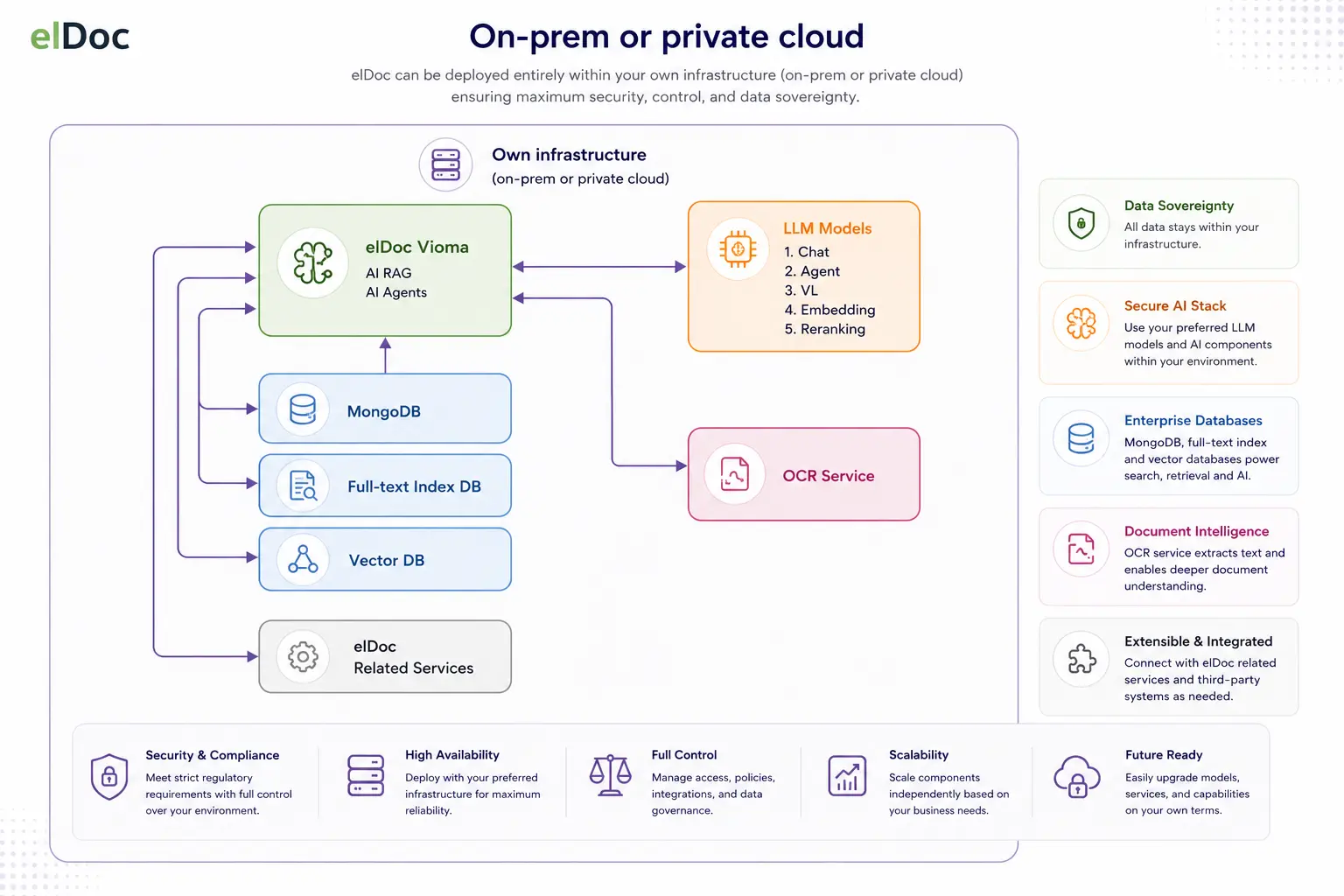
This provides an architectural foundation for organizations that require Data & AI Sovereignty without giving up the benefits of Generative AI.
One Architecture for Security, Control and Scalability
Running intelligent document management and AI within enterprise-controlled infrastructure provides several strategic advantages.
Data & AI Sovereignty
Documents and AI-related data can remain within infrastructure controlled by the organization, supporting internal data residency and governance requirements.
Secure AI Stack
Organizations can determine which LLMs, vision models, embedding models, reranking models, OCR services, and other AI components are permitted within their environment.
Enterprise Databases
MongoDB, full-text indexes, and vector databases provide the data and retrieval layers required for document management, search, RAG, and AI-powered processing.
Document Intelligence
OCR and AI models transform unstructured documents into machine-readable and actionable enterprise information.
Full Control
Organizations maintain greater control over infrastructure, access policies, integrations, AI models, data governance, and platform operations.
High Availability
The architecture can be deployed according to the organization’s preferred infrastructure and availability strategy.
Independent Scalability
Individual components can be scaled according to workload and business requirements instead of treating the entire AI environment as a single monolithic service.
Future-Ready Architecture
Models and AI components can evolve independently. As better models become available, organizations can introduce or replace components without rebuilding the entire document management platform.
On-Premise, Private Cloud — or the Architecture Your Enterprise Requires
There is no single deployment architecture suitable for every organization.
Some businesses prioritize the simplicity of cloud AI services.
Others need private infrastructure.
Highly regulated organizations may require critical documents, databases, vector stores, and AI models to remain entirely within controlled infrastructure.
Large enterprises may require a combination of deployment approaches depending on the sensitivity of particular workloads.
The important principle is architectural choice.
Enterprise AI should adapt to the organization’s security, compliance, infrastructure, and data residency requirements — rather than forcing the organization to adapt those requirements to a particular AI vendor.
The Biggest Mistake? Choosing Convenience Without Considering Control
One of the biggest mistakes enterprises can make when adopting AI-powered document management is evaluating solutions primarily on speed of deployment and initial cost.
A low-cost cloud AI document management service can look attractive: upload documents, activate AI, and start using it almost immediately. elDoc is also available as a cloud deployment option, providing the same ease of adoption while giving enterprises the flexibility to choose on-premise or private cloud deployment when greater control and data sovereignty are required.
But for a legal firm, financial institution, government organization, healthcare provider, or large enterprise, the more important questions often come later:
Where are your documents actually stored? Where are embeddings and indexes located? Which AI models process your information? Where does RAG processing happen? Who controls the underlying databases? Can sensitive information leave your environment? And what happens when your security, regulatory, or data residency requirements change?
Once Generative AI becomes part of document management, organizations are no longer protecting only the original files. They must consider the complete information and AI processing chain:
Documents → Extracted Data → Metadata → Full-Text Indexes → Vector Embeddings → RAG Context → LLM Processing → AI Agent Operations
This is why choosing an AI document management platform purely because it is cheap and cloud-based can create risks that are much more expensive to address later.
Designed for Environments Where Control Matters
elDoc is designed with regulated, security-conscious, and enterprise environments in mind.
Organizations can deploy elDoc on-premise or within a private cloud and build an architecture where key document management and AI components remain under their control — from document repositories, databases and indexes to vector stores, OCR services, RAG infrastructure, and selected AI models.
Combined with an LLM-agnostic architecture, this means enterprises do not have to design their document strategy around a single AI provider.
Enterprise AI Document Management should not force you to choose between AI innovation and control.
With elDoc, organizations can bring Document Management, Generative AI, Agentic RAG, and AI Document Agents together while retaining control over the infrastructure and AI architecture that processes their most important business information.
Build Enterprise AI Around Your Security Requirements — Not Around the Limitations of a Cloud Service
For regulated and document-intensive organizations, the right question is not simply:
“How quickly can we put our documents into AI?”
It is:
“How can we use AI across our documents while maintaining the level of security, sovereignty, governance, and architectural flexibility our organization requires?”
That is the problem elDoc is designed to address.
Talk to an elDoc expert to explore how to deploy secure, sovereign AI Document Management on-premise or in your private cloud.