
How Banks Are Using AI to Automate KYC While Maintaining Security and Compliance

The Evolution of KYC: From OCR and Rule-Based Automation to GenAI-Orchestrated Banking Operations
Know Your Customer (KYC) processes sit at the heart of every banking institution’s compliance and risk management framework. Banks are required to verify customer identities, assess risk profiles, maintain accurate records, and continuously monitor customers throughout the entire customer lifecycle.
For more than a decade, banks have invested heavily in KYC automation initiatives. Many institutions have implemented centralized onboarding systems, OCR technologies, machine learning models, workflow automation platforms, and robotic process automation (RPA) solutions to reduce manual effort and improve compliance efficiency.
While these technologies have delivered measurable improvements, most KYC processes remain fragmented and heavily dependent on human intervention.
Traditional KYC platforms typically rely on multiple disconnected technologies:
- Optical Character Recognition (OCR) for document digitization
- Machine Learning models for classification and extraction
- Rule-based validation engines
- Workflow management systems
- Robotic Process Automation (RPA)
- External compliance screening services
- Multiple banking and customer information systems
As a result, KYC teams often find themselves managing exceptions, manually reviewing documents, validating extracted data, reconciling information across systems, and coordinating multiple approval processes.
Despite years of investment, many banks continue to face significant operational challenges:
- Lengthy customer onboarding cycles
- Rising compliance costs
- Large volumes of manual reviews
- Data quality inconsistencies
- Regulatory pressure for stronger controls
- Complex remediation exercises
- Limited scalability during periods of high onboarding demand
- Difficulties maintaining complete audit trails across multiple systems
The challenge is not that banks lack automation. The challenge is that traditional automation technologies were designed to automate individual tasks rather than orchestrate and reason across an entire KYC process.
This is where Generative AI is fundamentally changing the landscape.
Unlike traditional OCR and machine learning solutions that perform isolated activities, GenAI can understand documents, interpret context, correlate information from multiple sources, generate structured outputs, summarize findings, explain decisions, and assist compliance teams throughout the entire onboarding and due diligence lifecycle.
Instead of automating a single step, GenAI enables the automation and orchestration of the complete KYC journey.
For example, a GenAI-powered KYC process can automatically:
- Classify incoming customer documentation
- Extract relevant customer information
- Validate completeness of submissions
- Identify missing information
- Cross-reference information across multiple documents
- Analyze ownership structures
- Generate customer summaries
- Assist with risk assessments
- Prepare due diligence reports
- Route cases through approval workflows
- Create auditable compliance records
The result is a significantly more intelligent and adaptive operating model that reduces manual effort while improving consistency and transparency.
However, for banks, automation alone is not enough.
Financial institutions operate under strict regulatory requirements related to data privacy, operational resilience, model governance, cybersecurity, and customer confidentiality. Public AI tools and consumer-grade AI services often cannot satisfy these requirements.
Banks require enterprise-grade AI platforms that provide:
- Full control over customer data
- Secure deployment models
- Role-based access controls
- Human-in-the-loop approvals
- Comprehensive audit trails
- AI governance controls
- Explainability and transparency
- Regulatory compliance support
- On-premise and private cloud deployment options
This is where elDoc has been specifically designed to support regulated financial institutions.
elDoc provides a secure Enterprise GenAI platform that combines Intelligent Document Processing, GenAI, Agentic AI, workflow orchestration, and enterprise governance into a single operational environment.
Rather than simply extracting information from documents, elDoc creates a GenAI-orchestrated KYC pipeline capable of managing the entire customer onboarding and due diligence process from document intake through review and approval.
The platform enables banks to automatically classify documents, extract and validate customer information, generate risk assessment summaries, support compliance investigations, orchestrate approval workflows, and maintain complete auditability throughout the process.
Built with security-by-design principles, elDoc supports deployment within on-premise, private cloud, or fully isolated banking environments, allowing financial institutions to maintain complete control over sensitive customer information while adopting the latest advances in Generative AI.
As KYC requirements continue to evolve, the future of compliance operations will not be driven by standalone OCR engines or disconnected automation tools. It will be driven by intelligent, secure, and governed GenAI platforms capable of orchestrating end-to-end banking processes at scale.
For banks seeking to modernize customer onboarding, reduce compliance costs, improve operational efficiency, and strengthen regulatory controls, GenAI represents the next major evolution of KYC automation.
How the elDoc Orchestrated GenAI KYC Pipeline Works
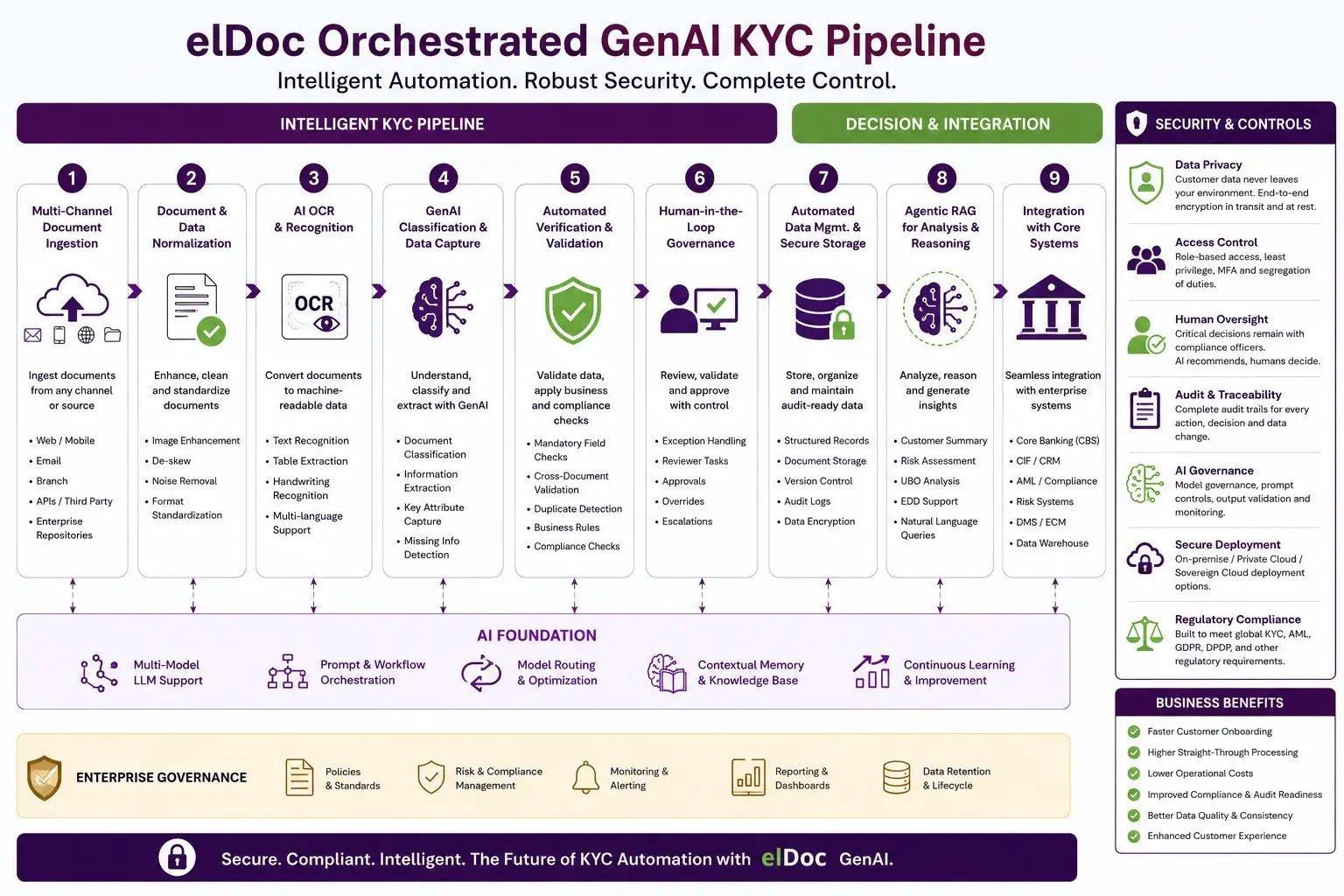
Unlike traditional KYC solutions that rely on multiple disconnected technologies, elDoc provides a fully orchestrated GenAI pipeline that manages the complete customer onboarding and due diligence lifecycle from document submission through decision support and integration with banking systems.
The platform combines Intelligent Document Processing (IDP), Computer Vision, AI OCR, Large Language Models (LLMs), Agentic RAG, workflow automation, and human oversight into a single enterprise architecture.
Step 1: Multi-Channel Document Ingestion
The process begins with secure ingestion of KYC documents from multiple channels via API, including:
- Customer onboarding portals
- Mobile applications
- Email submissions
- Branch operations
- Relationship managers
- Enterprise content repositories
- Third-party systems
This enables banks to centralize KYC processing regardless of where customer information originates.
Step 2: Document and Data Normalization
Customer documentation often arrives in different formats, qualities, languages, and layouts.
The Computer Vision layer automatically performs:
- Image enhancement
- Document normalization
- Data cleansing
- Format standardization
- Quality adjustments
This step improves downstream recognition accuracy while reducing the need for manual document preparation.
Step 3: AI-Powered Document Recognition
The AI OCR engine converts physical and digital documents into machine-readable content.
The platform can process using LLM:
- Passports
- National IDs
- Driver licenses
- Utility bills
- Corporate registration documents
- Tax records
- Financial statements
- Customer declarations
- Compliance forms
This creates a structured digital representation of all submitted information.
Step 4: GenAI Classification and Data Capture
Once documents are digitized, Vision Language Models (VLMs) and Large Language Models automatically understand document context.
Rather than relying solely on predefined templates, GenAI can:
- Classify document types
- Understand document structure
- Identify critical information
- Extract customer attributes
- Capture ownership information
- Identify missing fields
- Detect inconsistencies
This significantly reduces dependency on traditional template-based extraction methods.
Step 5: Automated Verification and Validation
Following extraction, the platform executes automated business validations and compliance checks.
Examples include:
- Mandatory field verification
- Cross-document consistency checks
- Duplicate detection
- Customer profile validation
- Regulatory compliance checks
- Custom bank-specific business rules
Potential issues are automatically flagged for review before progressing further in the process.
Step 6: Human-in-the-Loop Governance
While GenAI can automate large portions of KYC processing, banks require controlled human oversight.
elDoc supports Human-in-the-Loop workflows where compliance officers can:
- Review extracted information
- Validate AI recommendations
- Approve exceptions
- Request additional information
- Override automated decisions when necessary
This ensures regulatory compliance while maintaining operational efficiency.
Step 7: Automated Data Management and Secure Storage
Validated information is automatically stored within secure enterprise repositories.
The platform maintains:
- Structured customer records
- Supporting documentation
- AI-generated outputs
- Compliance evidence
- Audit logs
- Workflow history
All activities remain fully traceable for regulatory and audit purposes.
Step 8: Agentic RAG for KYC Analysis and Reasoning
One of the most significant advantages of modern GenAI platforms is the ability to reason over customer information rather than simply extract data.
Using Agentic Retrieval-Augmented Generation (RAG), elDoc can:
- Analyze complete customer files
- Generate onboarding summaries
- Identify potential compliance concerns
- Support beneficial ownership investigations
- Assist enhanced due diligence reviews
- Produce risk assessment recommendations
- Answer compliance questions using customer-specific data
Compliance teams can interact with customer files using natural language while maintaining full security controls.
Step 9: Integration with Core Banking Systems
Finally, validated customer information can be integrated into existing banking platforms through secure APIs.
This includes:
- Core Banking Systems (CBS)
- Customer Information Files (CIF)
- AML platforms
- Risk management systems
- Compliance platforms
- Document management repositories
- Enterprise data warehouses
The result is a seamless end-to-end KYC operation that minimizes manual effort while improving compliance accuracy and operational visibility.
LLM Flexibility: Choosing the Right AI Model for Banking
One of the major concerns financial institutions face when adopting Generative AI is avoiding dependency on a single AI provider.
Many AI solutions are tightly coupled to one model vendor, limiting flexibility, increasing risk, and creating challenges around governance and future scalability.
elDoc is designed with model flexibility at its core.
The platform supports multiple enterprise-grade Large Language Models, allowing banks to select the most appropriate model based on security requirements, performance expectations, regulatory constraints, and infrastructure strategy.
Supported deployment options may include but not limited to:
- OpenAI models
- Azure OpenAI
- Anthropic Claude
- Google Gemini
- Meta Llama
- Mistral AI
- DeepSeek
- Qwen
- Other open-source and enterprise LLMs
Deploy Models Where Your Data Resides
Banks can deploy and operate models:
- Fully on-premise
- Within private cloud environments
- In sovereign cloud environments
- In dedicated banking infrastructure
- In isolated enterprise environments
This enables organizations to align AI deployment with internal security and regulatory requirements.
Future-Proof AI Investments
The AI market is evolving rapidly.
Models that are considered state-of-the-art today may be replaced by more capable or cost-effective alternatives tomorrow.
Because elDoc separates business workflows from underlying AI models, banks can adopt new LLMs without redesigning their KYC processes or rebuilding integrations.
This protects AI investments while ensuring long-term flexibility and innovation.
For financial institutions operating in highly regulated environments, the combination of secure deployment, enterprise governance, and model flexibility provides a sustainable foundation for scaling AI across KYC, AML, onboarding, lending, compliance, and broader banking operations.
Explore How Leading Banks Are Automating KYC with Enterprise GenAI
Banks across the world are moving beyond traditional OCR, machine learning, and workflow automation to adopt a new generation of AI-powered KYC operations. By leveraging Generative AI, Intelligent Document Processing, Agentic AI, and secure workflow orchestration, financial institutions are accelerating customer onboarding, improving compliance efficiency, reducing operational costs, and strengthening regulatory controls.
Contact the elDoc team to learn how banks and regulated financial institutions are leveraging Enterprise GenAI to automate KYC processes securely within controlled environments. Our specialists can demonstrate real-world use cases, deployment architectures, security controls, and implementation approaches that enable organizations to modernize KYC while maintaining full compliance, governance, and auditability.
Schedule a discovery session with elDoc to explore how Enterprise GenAI can transform your KYC operations and accelerate your digital banking strategy.