
Generative AI in Banking: The Highest-ROI Use Cases for Financial Institutions

The Banking AI Adoption Challenge
Generative AI has become one of the highest strategic priorities for banks worldwide.
Across retail banking, corporate banking, compliance, risk, lending, and operations, financial institutions are actively exploring how AI can improve efficiency, reduce costs, accelerate customer service, and strengthen regulatory compliance.
However, despite growing investments and executive interest, many banks are struggling to achieve meaningful business outcomes from their AI initiatives.
The challenge is not the technology itself.
The challenge is identifying where Generative AI can create the greatest business value.
Many Banks Start with Chatbots
For many organizations, the first step into Generative AI is deploying internal AI assistants or chat-based solutions.
These solutions allow employees to:
- Search policies and procedures
- Access internal knowledge bases
- Ask questions about regulations
- Retrieve information from documents
While these capabilities can improve employee productivity, they rarely transform core banking operations.
Chat interfaces provide information.
They do not execute business processes.
As a result, many banks discover that chatbot deployments generate limited operational savings and only modest return on investment.
The Next Evolution: AI Agents
To move beyond information retrieval, many financial institutions are now investing in AI Agents.
AI Agents can perform specific tasks such as:
- Reviewing documents
- Extracting information
- Completing forms
- Generating summaries
- Creating reports
- Sending information to downstream systems
- Supporting compliance reviews
This represents a significant advancement beyond traditional chat solutions.
However, many AI Agent implementations still focus on automating individual activities rather than complete business processes.
An AI Agent may successfully review a document or populate a table, but the broader workflow often remains dependent on multiple manual handoffs and human intervention.
The Real Opportunity Lies in End-to-End Process Automation
The highest ROI from Generative AI is achieved when banks move beyond task automation and focus on complete process execution.
Banking operations are inherently complex.
Most processes involve:
- Multiple document types
- Data validation
- Compliance checks
- Risk assessments
- Human approvals
- Core banking system updates
- Audit and governance requirements
Automating only one activity within a process delivers incremental improvements.
Automating the entire workflow delivers transformational business value.
Where Banks Are Achieving the Highest ROI
Based on current market adoption, the highest returns are typically achieved in document-intensive processes that consume significant operational resources.
These include:
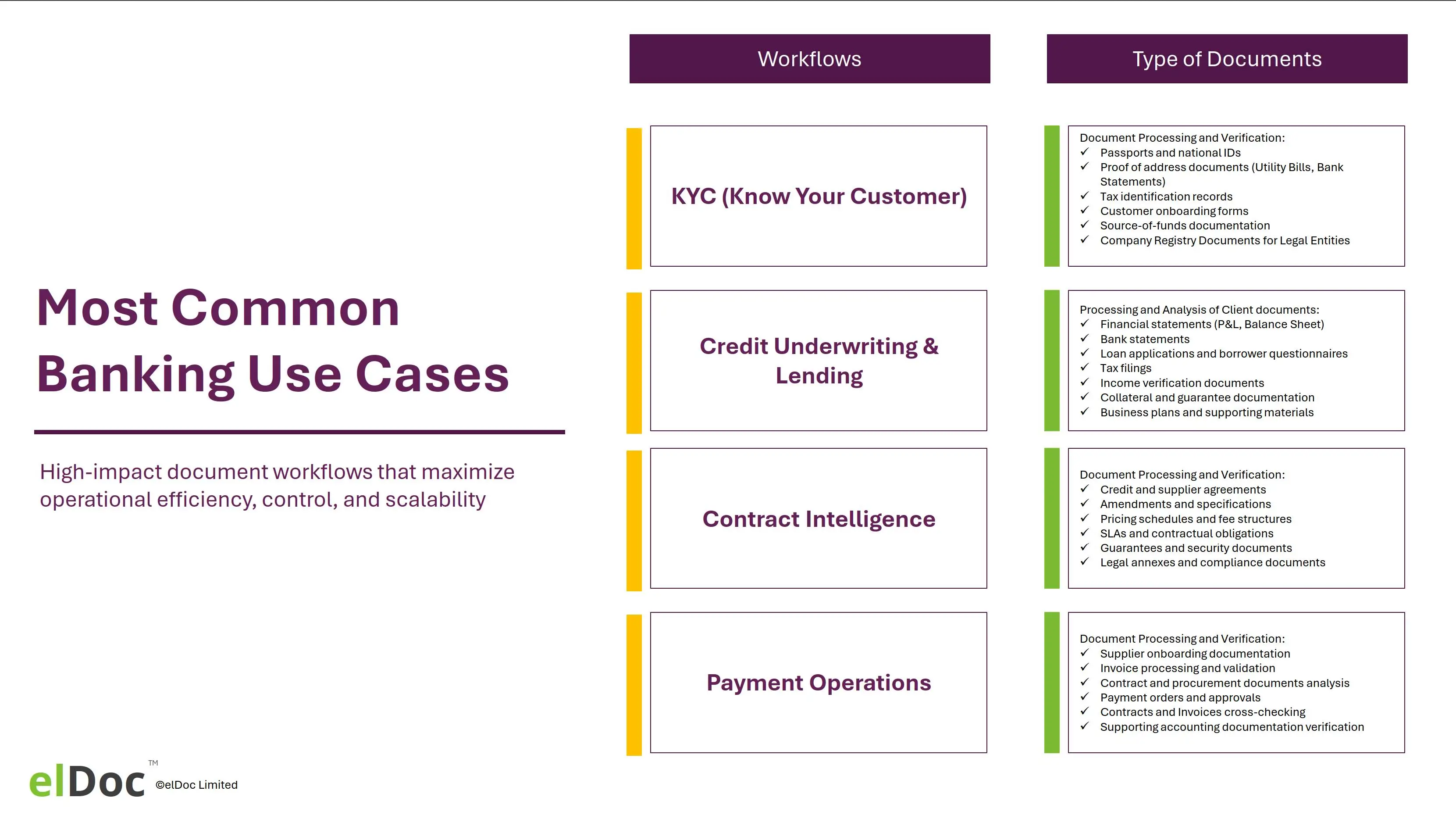
- KYC and Customer Onboarding
- Credit Underwriting and Lending
- Contract Intelligence
- Payment Operations
- Fraud Investigation
- Trade Finance Processing
- Regulatory Compliance Operations
These workflows combine high transaction volumes, complex documentation, regulatory requirements, and substantial manual effort—making them ideal candidates for Enterprise AI automation.
The following sections explore how banks are leveraging Generative AI across these high-impact use cases and the business outcomes they are achieving with platforms such as elDoc.
Why These Banking Processes Deliver the Highest ROI
Not every AI use case generates the same level of business value. The banking processes highlighted in this article consistently deliver the highest return on investment because they combine several characteristics that make them ideal candidates for Enterprise AI automation.
First, they are high-volume processes. Large banks may process hundreds of thousands or even millions of customer documents annually across onboarding, lending, payments, and compliance operations. When AI can automate even a portion of these activities, the operational savings quickly scale across the organization.
Second, these processes are often highly manual and labor-intensive. Teams spend countless hours reviewing documents, extracting information, validating data, performing compliance checks, and updating multiple systems. Much of this work is repetitive, rule-driven, and time-consuming, making it perfectly suited for AI-powered automation.
Third, banking workflows frequently involve multiple departments and handoffs. A typical KYC review or lending application may pass through operations teams, compliance officers, risk departments, relationship managers, and approvers before completion. Each handoff introduces delays, operational costs, and potential errors. By orchestrating the entire workflow, elDoc significantly reduces processing times while improving consistency and control.
Another important factor is regulatory and compliance requirements. Banks must maintain detailed audit trails, demonstrate adherence to internal policies, and comply with strict regulatory obligations. Generative AI combined with workflow automation can automatically document decisions, maintain complete audit records, validate compliance requirements, and ensure governance controls are consistently applied throughout the process.
These use cases also directly impact customer experience and revenue generation. Faster onboarding means customers can start using banking services sooner. Faster credit assessments accelerate lending decisions and revenue realization. More efficient payment and contract operations improve service quality while reducing operational friction. The benefits extend beyond cost reduction and directly contribute to business growth.
Perhaps most importantly, these workflows are already heavily dependent on documents. Since Generative AI excels at understanding, analyzing, validating, and reasoning across unstructured information, banking operations represent one of the strongest natural fits for Enterprise AI transformation.
For this reason, the highest ROI is rarely achieved through standalone chatbots or isolated AI agents. The greatest business value comes from deploying AI across complete operational workflows where thousands of repetitive decisions, validations, and document-processing activities occur every day.
Why Building Enterprise AI Internally Often Delays ROI
Many banks recognize the transformative potential of Generative AI and initially consider developing AI solutions internally. While this approach may provide flexibility, it often proves far more complex, costly, and time-consuming than anticipated.
A successful Enterprise AI platform requires significantly more than access to an LLM.
Banks must design and integrate document processing capabilities, workflow orchestration, AI agents, security controls, compliance frameworks, audit logging, human approval mechanisms, system integrations, model governance, monitoring, and infrastructure management. Each component requires specialist expertise, extensive testing, and ongoing maintenance.
As a result, many internally developed AI initiatives remain stuck in pilot phases, with organizations spending substantial budgets before achieving measurable operational outcomes.
The Hidden Cost of Building AI from Scratch
The majority of AI projects underestimate the effort required to move from a proof of concept to a production-grade banking solution.
Beyond model selection, organizations must address:
- Enterprise security and access controls
- Regulatory compliance requirements
- Auditability and traceability
- Building API for Integration with core banking systems
- Workflow management
- Document classification and extraction
- Human-in-the-loop approvals
- Model governance and monitoring
- Scalability and infrastructure management
While each individual component may appear manageable, combining them into a secure, reliable, and compliant operational platform can require months—or even years—of development effort.
During this period, operational inefficiencies remain unchanged and the expected business value from AI is delayed.
Why elDoc Delivers ROI Faster
elDoc eliminates the need to assemble multiple technologies and build custom AI infrastructure from the ground up.
The platform provides a complete Enterprise AI environment designed specifically for document-intensive business operations.
Out of the box, banks gain access to:
- Generative AI orchestration
- Agentic RAG
- Orchestrated GenAI for Intelligent Document Processing
- AI Agents
- Workflow automation
- Human approval workflows
- Audit and compliance controls
- Enterprise security framework
- Multi-LLM support
- Integration capabilities
- Audit and monitoring
This allows organizations to focus on transforming business processes rather than building technology foundations.
Instead of spending months developing components, banks can immediately begin automating high-value operational workflows.
Ready to Build a Business Case for Enterprise AI?
Generative AI delivers the greatest value when applied to high-volume, document-intensive banking processes such as KYC, customer onboarding, lending, contract management, and payment operations. The challenge is identifying where to start and how to achieve measurable ROI quickly while maintaining security, governance, and regulatory compliance.
The elDoc team works with banks to identify the highest-impact automation opportunities, estimate potential savings, and design an Enterprise AI roadmap tailored to your operational requirements.
Schedule a discovery session with our banking AI experts to explore how elDoc can help your organization automate end-to-end banking processes and start realizing ROI from day one.