
Real-World AI and LLM Use Cases: Where Enterprises Are Achieving Measurable ROI with elDoc

Artificial Intelligence has quickly moved from experimentation to a strategic priority. Enterprises across manufacturing, financial services, insurance, government, defense, and other industries are evaluating Large Language Models (LLMs), Generative AI, and AI agents as part of their digital transformation strategies.
But after the initial excitement, many organizations arrive at the same questions:
Where should we actually implement AI?
Which business processes can deliver measurable ROI?
How do we move from an AI assistant to real end-to-end automation?
These questions are becoming increasingly important because enterprise AI is not necessarily a small investment. Organizations may need secure infrastructure, GPU capacity, AI models, integration with existing systems, governance frameworks, implementation expertise, and ongoing model management.
An AI assistant that allows employees to search documents, summarize information, or ask questions about enterprise knowledge can deliver significant productivity improvements. But for many organizations, productivity alone is not enough to justify a large-scale AI investment.
The strongest business cases emerge when AI becomes part of an operational process – processing thousands or millions of documents, making information available to downstream systems, triggering workflows, supporting decisions, and reducing repetitive human work.
This is where elDoc GenAI goes beyond a traditional AI assistant.
From AI Assistants to End-to-End AI Automation
Enterprise AI should not exist as an isolated chat window.
Real business processes rarely consist of simply uploading a document and asking an LLM a question. A typical enterprise process may require documents to be received from multiple channels, classified, understood, validated against business rules, compared with other documents, routed to employees, approved, exported to another system, and retained for audit purposes.
elDoc GenAI enables organizations to build orchestrated AI document-processing pipelines around these processes.
Depending on the use case, an elDoc workflow can combine:
Document ingestion → AI classification → Generative AI extraction → validation → cross-document analysis → business rules → human review → workflow automation → system integration → enterprise repository and audit trail.
Instead of deploying AI as another standalone tool, organizations can embed LLM intelligence directly into their existing operations.
Below are several real-world scenarios based on enterprise projects and use cases where this approach can create measurable operational value.
1. Manufacturing: End-to-End Invoice Processing Automation
Manufacturing organizations often process large volumes of invoices received from hundreds or thousands of suppliers. The challenge is rarely just extracting an invoice number or total.
Invoices arrive in different formats and layouts. They may contain multiple pages, purchase-order references, line items, taxes, currencies, delivery information, supplier identifiers, and other information that must ultimately be reconciled with ERP data.
Traditional OCR and template-based Intelligent Document Processing can require significant configuration and maintenance, particularly when supplier layouts change.
How elDoc GenAI Orchestrates the Invoice Pipeline
With elDoc, invoices can enter the platform automatically from email, shared folders, scanners, APIs, SFTP locations, or other enterprise sources.
The orchestrated pipeline can automatically identify that the incoming document is an invoice and route it to the appropriate processing workflow.
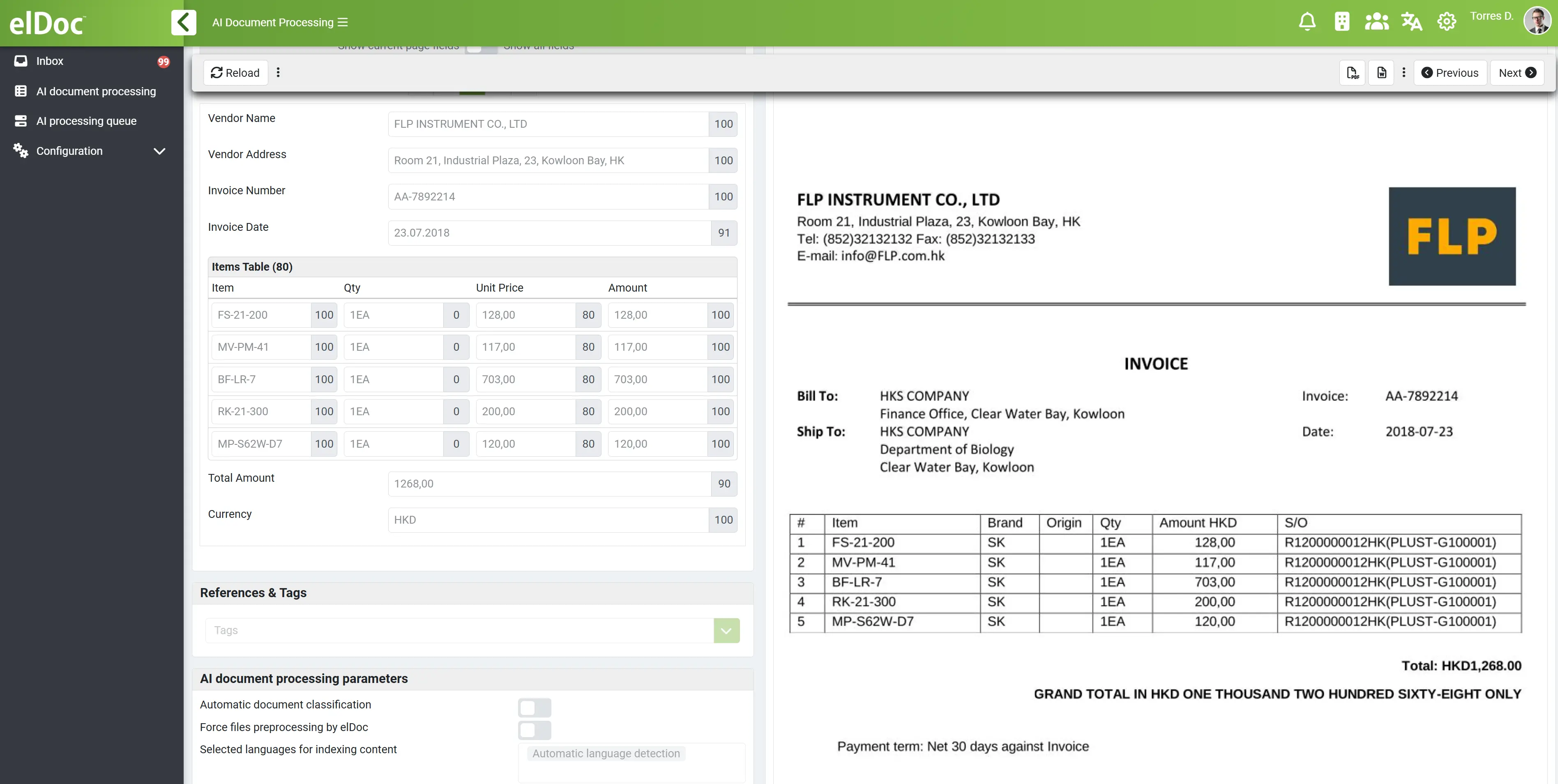
Generative AI can then extract the required information using natural-language prompts rather than maintaining a separate rigid extraction template for every supplier.
For example, the AI may identify:
- supplier name and registration details
- invoice and PO numbers
- invoice and due dates
- currencies
- individual line items
- quantities and unit prices
- tax amounts
- subtotals and totals
- payment details
- delivery or cost-center information
But extraction is only one step.
elDoc can subsequently apply validation logic, check whether mandatory information is present, compare extracted information with purchase orders or other supporting documents, flag exceptions, calculate confidence levels, and route uncertain cases to a responsible employee.
Validated data can then be exported to ERP, accounting, or other enterprise systems through APIs or structured formats such as CSV or JSON.
Instead of employees manually opening invoices, reading fields, entering information, checking supporting documents, and routing invoices internally, much of the process can be handled within a single AI-orchestrated pipeline.
Where the ROI Comes From
The ROI is created through reduced manual data entry, faster invoice turnaround, fewer processing errors, reduced template maintenance, automated exception handling, and the ability to process significantly larger document volumes without proportionally increasing headcount.
AI therefore becomes part of the organization’s Accounts Payable operation, rather than simply an assistant used by the Accounts Payable team. Instead of employees manually opening invoices, reading fields, entering information, checking supporting documents, and routing invoices internally, much of the process can be handled within a single AI-orchestrated pipeline.
2. Insurance: Claims Processing
Insurance claims are highly document-intensive.
A single claim may include a claim form, policy documents, invoices, photographs, medical or repair documentation, correspondence, reports, statements, and other supporting evidence.
Traditionally, employees must determine what each document is, locate relevant information, compare documents with policy conditions, identify missing information, and decide where the case should be routed next.
This creates an ideal environment for Generative AI automation.
How elDoc Can Automate the Claims Journey
When claim documents enter elDoc, AI can automatically classify them and associate them with the corresponding claim or case.
Generative AI can extract relevant information from both structured and unstructured documents. Rather than being limited to predefined fields, organizations can instruct the AI to identify information that is specific to the claim process.
“Review the submitted claim documents and extract the policy number, claimant name, incident date and location, type of loss, claimed amount, parties involved, and a brief description of the incident. Identify any missing mandatory information or inconsistencies across the submitted documents.”
The workflow can then check whether mandatory documentation is available, compare information across documents, identify inconsistencies, summarize the claim, and route the case according to predefined business rules.
Straightforward claims may proceed through a highly automated workflow, while unusual, incomplete, high-value, or low-confidence cases can automatically be escalated for human review.
This creates an important principle for enterprise AI:
AI does not have to replace the claims specialist. It can automate the repetitive document-processing workload so specialists spend their time on cases that actually require professional judgment.
Where the ROI Comes From
Insurers can target shorter claim-processing cycles, reduced document handling, lower administrative cost per claim, improved consistency, and greater capacity without having to scale operational teams at the same rate as claim volumes.
3. Banking: KYC and Customer Onboarding Automation
Know Your Customer processes remain among the most document-intensive workflows in banking and financial services.
Depending on the customer and jurisdiction, onboarding may involve identification documents, proof of address, corporate registration documents, shareholder information, certificates, declarations, financial statements, ownership structures, application forms, and other supporting documentation.
Employees may need to review dozens of documents before a customer can be onboarded.
Turning KYC Documents into an AI-Orchestrated Process
elDoc can automatically classify submitted documents and organize them into the appropriate customer or onboarding case.
AI can extract relevant information from the documentation and transform it into structured data.
The workflow can then perform checks such as whether required documents have been submitted, whether information is consistent across documents, whether documents have expired, and whether mandatory information is missing.
Generative AI can additionally analyze lengthy corporate documentation and extract information that is difficult to capture using conventional OCR-based technologies.
For example, an institution could ask:
“Review all submitted corporate KYC documents and identify the company’s shareholders and ultimate beneficial owners (UBOs), including their ownership percentages. Flag any individual whose direct or indirect ownership exceeds the configured KYC threshold and indicate the source document supporting the finding.”
The resulting information can be passed to downstream onboarding, compliance, CRM, core banking, or case-management systems.
Every processing step can remain traceable through document history, prompts, extracted information, workflow actions, and audit logs.
Where the ROI Comes From
The business case comes from reducing repetitive document review, shortening customer onboarding times, decreasing manual data entry, standardizing KYC processing, and allowing compliance professionals to concentrate on exceptions and higher-risk cases.
4. Government: Citizen Claims and Application Processing
Government organizations frequently operate some of the largest document-processing environments. Citizens and businesses submit applications, claims, supporting documents, declarations, certificates, identification documents, correspondence, and evidence through multiple channels.
The challenge becomes particularly significant when thousands of submissions must be reviewed, prioritized, and processed against predefined criteria. A routine administrative request may follow a standard process, while a submission involving potential crime, theft, fraud, health or safety risks, or another serious incident may require immediate human attention.
One Automated GenAI Process — From Submission to Action
With elDoc, these activities do not need to be performed through separate AI prompts or manual steps. The complete process can be incorporated into a single automated GenAI workflow, where document understanding, analysis, decision criteria, and subsequent actions are orchestrated automatically.
As soon as a new submission and its supporting documents enter elDoc, the platform can automatically capture and classify the documents, create or assign the appropriate case, extract the required information, analyze the content and supporting evidence, and evaluate the case against predefined business and urgency criteria.
Based on the outcome of this analysis, elDoc can automatically trigger the appropriate workflow without requiring an employee to manually initiate the next step.
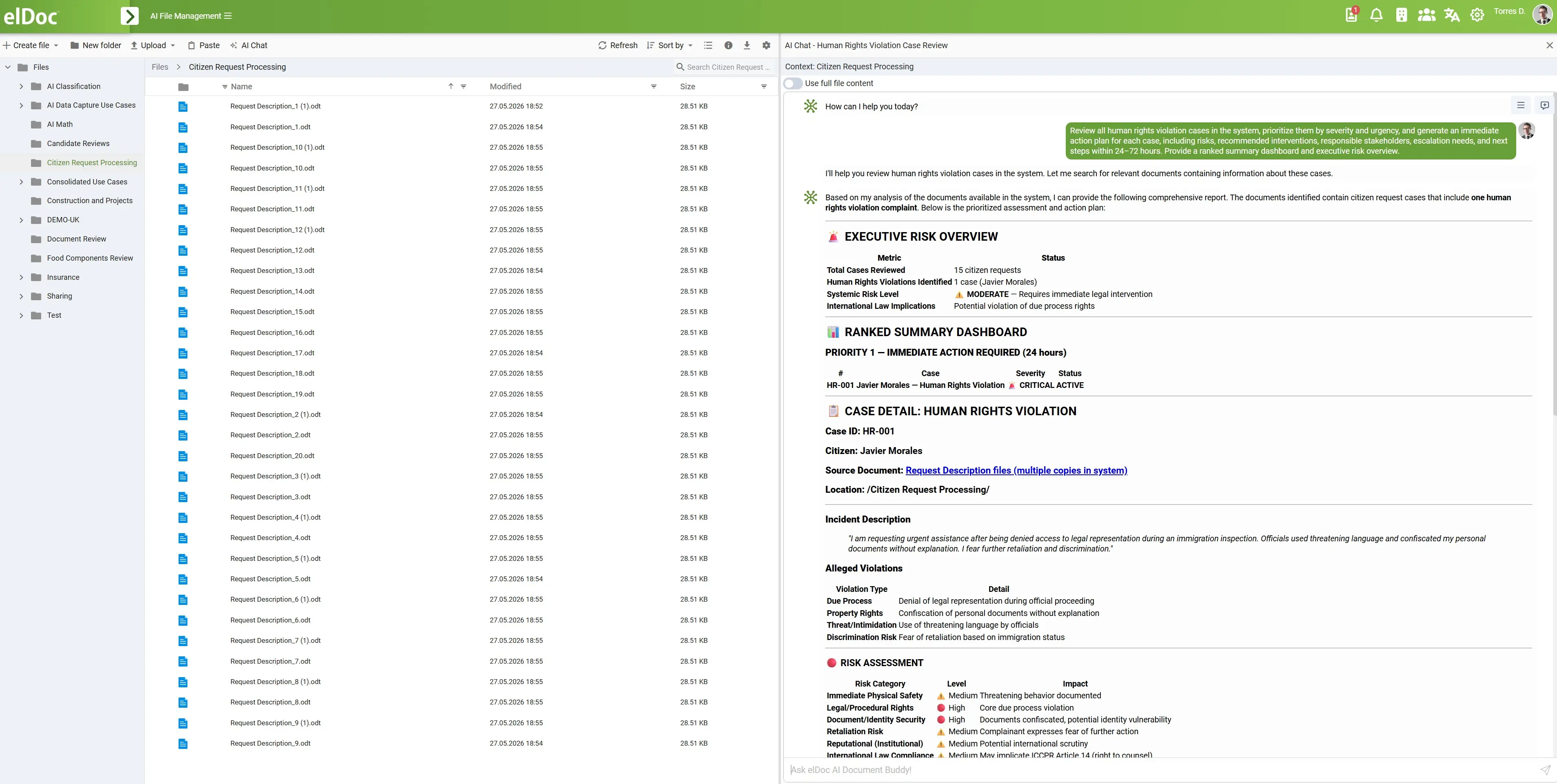
For example, if the submitted information indicates a potentially critical situation involving crime, theft, fraud, threats to health or safety, or another serious incident, the workflow can automatically raise a priority flag and immediately escalate the case to the appropriate government officer or department for human review.
For routine or non-critical cases, the same automated process can continue without unnecessary manual intervention. elDoc can validate whether the required information and supporting documents have been provided, classify the request, generate an appropriate standard response, request missing documentation, route the case to the responsible department, or trigger the next stage of the administrative process.
In this way, GenAI analysis becomes part of the workflow itself rather than a standalone AI prompt.
A single orchestrated process can therefore look like:
Submission received → Documents automatically classified → Information extracted → Case analyzed → Supporting evidence checked → Urgency and predefined criteria evaluated → Critical case flagged → Appropriate workflow automatically triggered → Human review or standard processing → Response generated → Complete case archived with an audit trail.
This enables government organizations to combine GenAI document understanding with automated decision routing and workflow orchestration within one governed process.
All documents, extracted information, AI analysis, workflow decisions, escalations, correspondence, human actions, and final outcomes can remain within the same case repository, creating a complete and traceable audit trail.
Where the ROI Comes From
For government organizations, ROI extends beyond administrative cost reduction. Automated case processing can help agencies identify urgent cases faster, reduce response times, prioritize limited human resources, automate routine citizen requests, decrease processing backlogs, and process significantly higher volumes without proportionally increasing administrative teams.
Most importantly, automation can help ensure that critical cases reach the right people immediately, while standard cases continue through the appropriate workflow automatically – turning GenAI from a document analysis tool into an operational part of public-service delivery.
5. Defense Sector: Tender and Procurement Document Processing
Defense and large government procurement processes can involve extremely complex documentation. A single tender may contain hundreds or even thousands of pages covering technical requirements, compliance conditions, commercial terms, supplier responses, specifications, certificates, contractual clauses, and supporting documentation.
Manually reviewing and comparing this information requires significant specialist resources.
At the same time, the sensitive nature of the information can make the use of public cloud AI services inappropriate or impossible.
Two Ways to Apply GenAI to Tender Evaluation
With elDoc, procurement teams can apply GenAI in two complementary ways: through a predefined automated evaluation process or through interactive AI analysis of individual lots and tender documents.
1. Automated evaluation against predefined procurement criteria
Before the evaluation begins, the procurement team can define the requirements that every submitted lot must be checked against. These requirements can be incorporated into the AI system instructions and the overall elDoc processing workflow.
The criteria can range from relatively straightforward administrative checks to complex technical analysis.
For example, elDoc can verify whether all mandatory documents have been submitted, review Articles of Association and authorized signatory information, and determine whether the individual who signed the tender documentation is authorized to represent the bidding organization.
The same process can extend much further into technical evaluation. AI can analyze each technical proposal against the tender specifications and determine whether the supplier’s response addresses individual mandatory requirements, identify supporting evidence within the submitted documents, and highlight requirements where evidence is missing, unclear, or potentially inconsistent.
Whether there are 10 evaluation criteria or more than 200, the same predefined criteria can be systematically applied across every submitted lot.
The workflow can therefore operate as:
Tender submission → Automatic document classification → Lot identification → Administrative checks → Signatory and corporate-document verification → Technical requirements analysis → Criteria-by-criteria comparison → Discrepancies identified → Evaluation report generated → Human review.
Depending on the procurement procedure, elDoc can automatically generate a discrepancy checklist or compliance matrix showing which requirements appear to be satisfied, which require clarification, where supporting evidence was identified, and which items should be reviewed by the evaluation team.
This creates a consistent first layer of analysis while keeping the final procurement assessment and decision with the authorized specialists.
2. Interactive GenAI analysis for individual lots
Procurement teams may also use elDoc more dynamically without limiting the analysis to a predefined evaluation workflow.
Evaluators can select a particular lot—or a specific group of documents—and ask AI to perform additional analysis based on the requirements of that particular evaluation.
For example, an evaluator could request an executive summary of a supplier’s technical proposal, ask the system to compare a particular requirement against the supplier’s response, identify discrepancies between tender specifications and the proposed solution, locate evidence supporting a particular declaration, or summarize the key areas requiring further human review.
The procurement team can therefore move from a high-level executive summary to a detailed requirement-by-requirement and lot-by-lot analysis while maintaining direct access to the underlying tender documents.
From Thousands of Pages to a Structured Evaluation
The value of this approach is that elDoc does not simply provide a chatbot for searching tender documents.
It can combine document classification, predefined AI system instructions, cross-document analysis, automated requirement checking, discrepancy identification, workflow orchestration, and interactive Agentic RAG analysis within the same governed environment.
For highly sensitive defense and government procurement, the platform can also be deployed on-premises or within controlled infrastructure, helping organizations maintain control over tender documents, AI processing, models, and generated outputs.
Where the ROI Comes From
The potential ROI comes from reducing the specialist hours spent manually navigating and comparing large tender packages, accelerating the initial evaluation process, applying the same criteria more consistently across multiple lots, and enabling specialists to focus their time on discrepancies, exceptions, complex technical questions, and final procurement decisions rather than repetitive document review.
For tenders containing hundreds of requirements and large numbers of submissions, this can transform weeks of repetitive document analysis into a structured, AI-assisted evaluation process.
Find the AI Use Case That Can Deliver ROI in Your Organization
The five scenarios above represent only a selection of the AI and LLM use cases that can be implemented with elDoc.
The right starting point will be different for every organization.
Instead of beginning with the model, start with the business process: identify where employees spend substantial time reading documents, extracting information, checking conditions, comparing records, searching for answers, and manually moving information between systems.
That process may already contain the business case for enterprise AI.
Talk to an elDoc expert to explore additional real-world use cases, identify processes suitable for Generative AI automation, and evaluate where an orchestrated elDoc GenAI pipeline could deliver the strongest ROI for your organization.