
elDoc Multilingual AI for Malay, Khmer and Southeast Asian Documents

Southeast Asia is one of the world’s most linguistically diverse business environments.
Organizations across Malaysia, Cambodia, Singapore, Indonesia, Thailand, Vietnam and the wider ASEAN region process enormous volumes of documents in different languages, scripts and formats every day.
A single business process may involve documents in Malay, Khmer, English or other regional languages — and sometimes multiple languages within the same document.
elDoc brings multilingual document processing into one enterprise AI platform.
By combining OCR, AI document classification, intelligent data extraction, document understanding, validation and workflow automation, elDoc helps organizations transform multilingual documents into structured, searchable and actionable business information.
Enterprise AI That Goes Beyond English
Many AI and document-processing demonstrations begin with clean, English-language documents.
Enterprise reality in Southeast Asia is different.
Organizations may need to process:
- Government applications in Malay
- Khmer forms and official documents
- English and Malay business correspondence
- Multilingual invoices and purchase documents
- Contracts and agreements
- Customer onboarding and KYC documents
- Insurance applications and claims
- Certificates and supporting documentation
- Historical and scanned archives
- Documents combining local languages with English
For these organizations, multilingual processing cannot be treated as an additional feature.
It needs to be part of the enterprise document AI architecture.
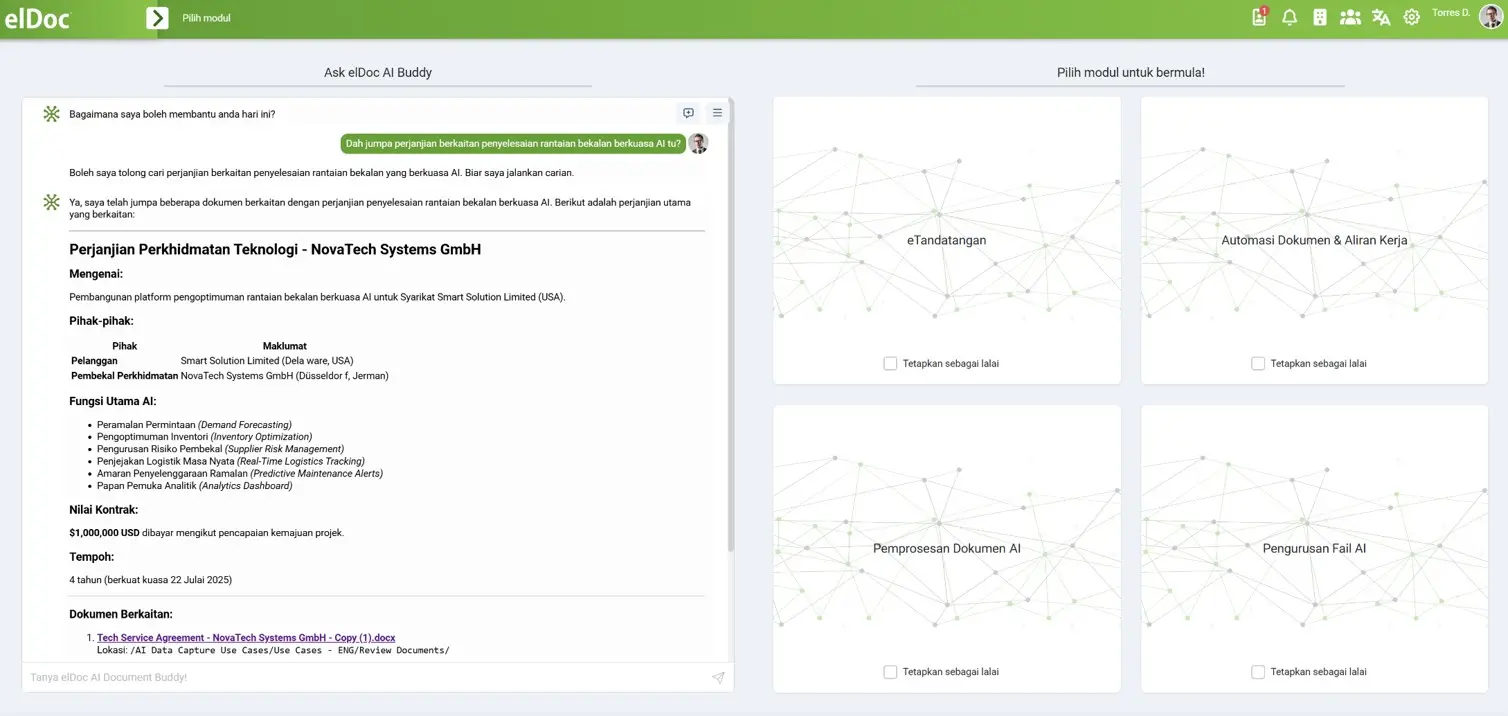
elDoc Can Read, Understand and Operate in Malay
Malay is widely used across government, financial services, education, commerce and enterprise operations in Malaysia and the wider Southeast Asian region.
elDoc supports Malay-language document processing, enabling organizations to recognize document content and incorporate it into intelligent processing workflows:
Read → Classify → Extract → Validate → Organize → Route → Search
For example, a Malay-language application can be classified, relevant information extracted and validated, and the resulting data routed into the appropriate business process.
Importantly, Malay support extends beyond document processing. The elDoc user interface can also be localized in Malay, allowing users to navigate the platform, work with documents and interact with elDoc functionality in their local language.
This creates a more complete multilingual experience: organizations can process documents in Malay while providing employees with an elDoc interface localized for Malay-speaking users.
The objective is not simply to recognize Malay text. It is to provide a localized enterprise AI and document processing environment in which information can be understood, structured, searched and used throughout business workflow
elDoc AI for Khmer Documents
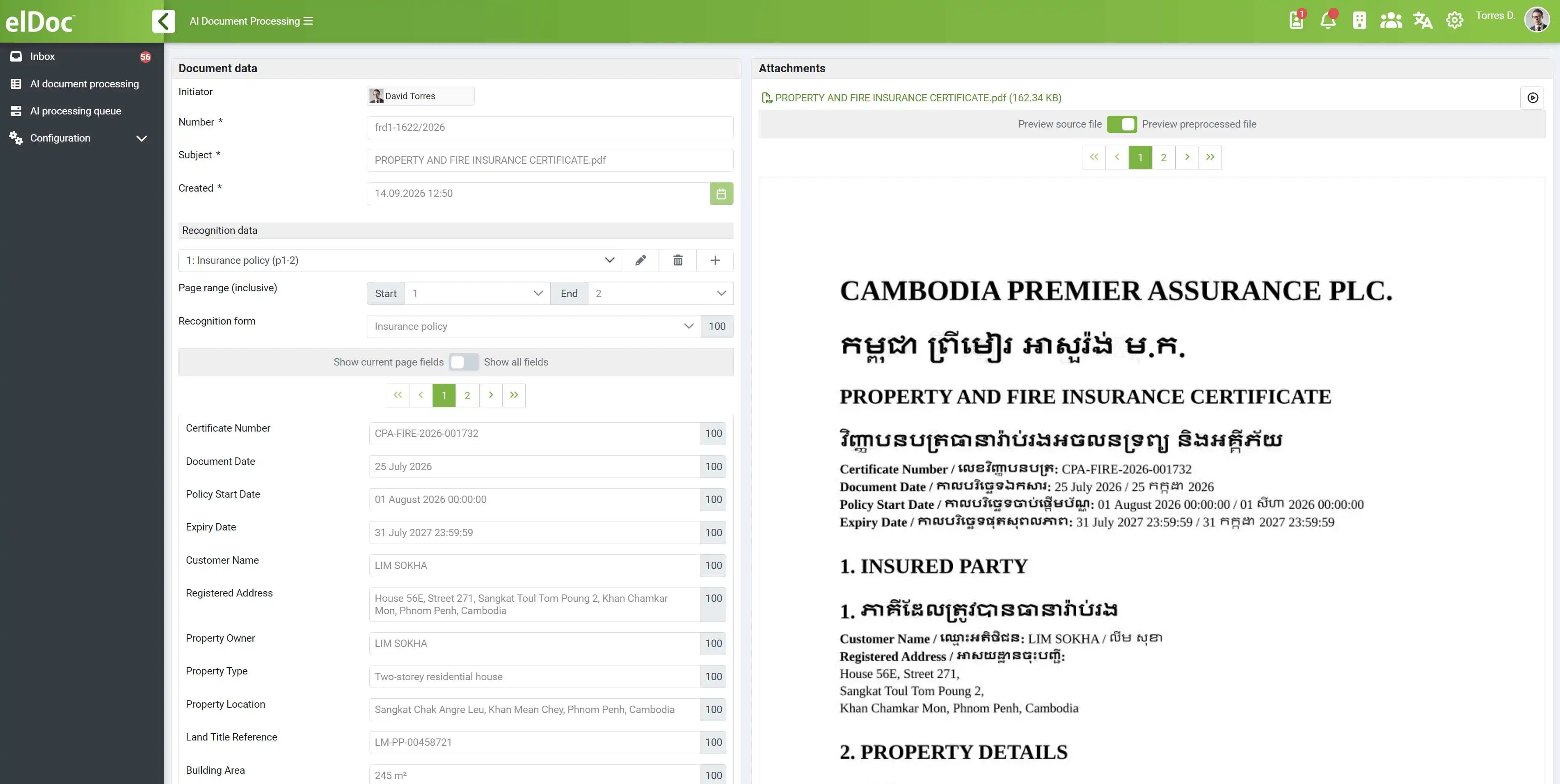
Khmer presents a different document-processing challenge.
Its script structure is significantly different from Latin-based languages and can be more demanding for traditional OCR, particularly when working with scanned documents, historical records, complex layouts, different fonts or lower-quality images.
This is where a flexible document AI architecture becomes important.
Rather than depending on one OCR technology for every document and every language, elDoc can support different recognition and AI approaches according to the requirements of the project.
This allows organizations to evaluate the most appropriate technology for processing Khmer documents and extracting the information required by the business process.
Multiple OCR and AI Technologies in One Platform
There is no single OCR engine that is optimal for every language, document type and deployment scenario.
elDoc is therefore designed to support multiple document recognition and AI technologies rather than being tied to one OCR engine.
Depending on the configuration and project requirements, this can include technologies such as:
| Technology | Role in Document Processing | Potential Use |
|---|---|---|
| Google Cloud Vision OCR | Cloud-based text recognition | Multilingual OCR and complex document recognition |
| PaddleOCR | Open-source OCR technology | Multilingual and configurable document recognition |
| Tesseract OCR | Established open-source OCR | Traditional text recognition and selected language processing |
| Vision-Language Models (VLMs) | Multimodal document understanding | Understanding content, layout and contextual relationships |
| Large Language Models (LLMs) | Language and semantic processing | Extraction, interpretation and downstream AI tasks |
The appropriate technology can depend on the language, document type, layout complexity, expected accuracy, infrastructure, security requirements and deployment model.
This is an important architectural advantage for multilingual organizations.
Instead of forcing every document through the same engine, the technology can be selected and configured around the actual business requirement.
From Multilingual OCR to Multilingual Document Intelligence
OCR answers an important question:
What text appears on this document?
Enterprise AI needs to go further:
What is this document, what information does it contain, and what should happen with it?
elDoc can combine multiple capabilities to build an end-to-end multilingual document processing workflow.
| Stage | elDoc Capability | Business Outcome |
|---|---|---|
| 1. Capture | Receive documents from configured sources | Centralize incoming documents |
| 2. Read | OCR and AI-based recognition | Convert document content into machine-readable information |
| 3. Classify | AI Document Classification | Determine what type of document was received |
| 4. Extract | AI Data Extraction | Capture names, IDs, dates, amounts and other required information |
| 5. Understand | AI/VLM-based document processing | Interpret information within document context |
| 6. Validate | Rules and human validation | Check important information before downstream use |
| 7. Organize | Metadata and document management | Build structured, searchable document records |
| 8. Automate | Workflow automation | Route information to the appropriate business process |
| 9. Search & Ask | AI-powered retrieval | Find and work with authorized enterprise information |
The result is much more than digitization.
Documents become structured information that can participate in enterprise workflows.
One Document Can Contain Multiple Languages
Multilingual processing does not always mean one document equals one language.
A business document in Malaysia, for example, may contain Malay and English on the same page.
A regional organization may receive an English-language form together with supporting documents in another local language.
Invoices may contain local-language descriptions alongside English product names, numbers, currencies and international company information.
Enterprise document AI therefore needs to work with the document as a whole, rather than relying exclusively on a simplistic language-by-language processing model.
Modern OCR and multimodal AI technologies make it possible to build more flexible processing architectures for these mixed-language environments.
Multilingual AI for Southeast Asian Enterprises
The same architectural principle extends beyond Malay and Khmer.
Organizations operating across Southeast Asia may encounter documents in languages and scripts including:
Malay · Khmer · Indonesian · Thai · Vietnamese · English · Chinese and others
Language support ultimately depends on the selected OCR or AI technology, the specific model, document type and deployment configuration.
This is why elDoc takes a technology-flexible approach.
Rather than claiming that one AI model solves every language and every document-processing problem equally well, organizations can select and evaluate the appropriate recognition and AI technologies for their particular documents.
Human Validation Where Accuracy Matters
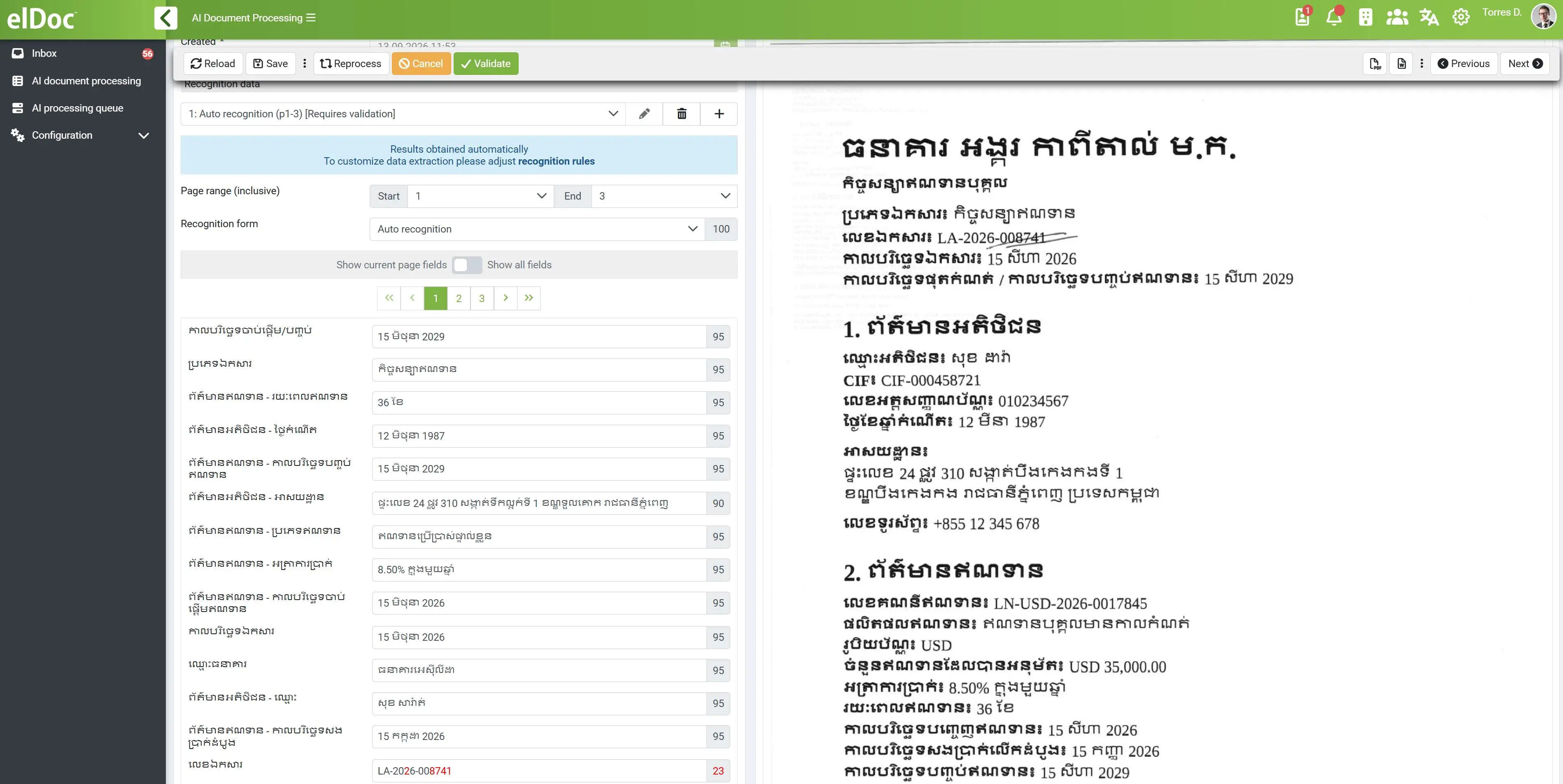
No responsible enterprise AI implementation should assume that every AI-generated result is automatically correct.
Document quality, language, handwriting, scan resolution, typography and document complexity can all affect recognition and extraction performance.
elDoc workflows can incorporate human validation where business-critical information needs to be reviewed.
For example:
AI extracts information → validation rules are applied → uncertain or critical fields are reviewed → validated information continues through the workflow.
This provides a practical balance between automation and human oversight.
Accuracy Should Be Tested on Your Documents
Language support alone does not determine document-processing accuracy.
Two documents written in the same language can produce very different results depending on:
- scan quality
- image resolution
- document layout
- font
- handwriting
- tables
- stamps and signatures
- background noise
- document age
- OCR technology
- selected AI model
- extraction requirements
For this reason, elDoc recommends evaluating multilingual AI using representative real-world documents from the intended business process.
A proof of concept can determine which combination of OCR, AI models, validation and workflow configuration is most appropriate before production deployment.
One Enterprise AI Platform for Southeast Asian Documents
Organizations operating across Southeast Asia should not need a different document-processing platform every time they encounter another language, document type or business process.
elDoc brings multiple document and AI capabilities together within one enterprise environment, providing a scalable foundation for multilingual document processing.
| elDoc Capability | What It Does | Why It Matters for Multilingual Enterprises |
|---|---|---|
| Multilingual OCR | Recognizes and converts document content into machine-readable text across supported languages and scripts. | Enables organizations to digitize documents in languages such as Malay, Khmer and other regional languages, depending on the selected OCR technology. |
| AI Document Classification | Automatically identifies and categorizes incoming documents based on their content and characteristics. | Different document types and languages can be automatically directed to the appropriate processing workflow. |
| Intelligent Data Extraction | Extracts required information such as names, dates, reference numbers, addresses, amounts and other business fields. | Turns multilingual documents into structured data that can be used by enterprise systems and processes. |
| Vision-Language Models (VLMs) | Analyzes both the visual structure and content of documents using multimodal AI. | Helps process complex documents where meaning depends on text, layout, tables and contextual relationships. |
| Document Understanding | Goes beyond text recognition to interpret the context and meaning of document information. | Helps organizations understand what information a document contains and how it relates to the business process. |
| Human Validation | Allows users to review, verify and correct AI-extracted information where required. | Provides human oversight for critical or uncertain information, particularly where accuracy requirements are high. |
| Workflow Automation | Routes documents, information and tasks according to configured business rules and processes. | Multilingual documents can participate in the same controlled enterprise workflows as other business information. |
| Secure Document Management | Organizes documents and associated metadata within a controlled enterprise repository. | Provides centralized management of multilingual information with users, roles, permissions and controlled access. |
| AI-Powered Enterprise Search | Enables users to discover and retrieve relevant information from enterprise documents. | Makes multilingual document repositories more accessible by turning stored documents into searchable enterprise knowledge. |
| Localized User Interface | Enables the elDoc interface to be localized for different languages, including Malay. | Employees can work with elDoc in a familiar local-language environment, extending multilingual support beyond document processing itself. |
Bring Your Malay, Khmer or Multilingual Documents
The most meaningful test of multilingual AI is not a generic language-support list.
It is your own documents.
Bring representative Malay, Khmer or other Southeast Asian documents and define what information your organization needs to read, classify, extract, validate, organize or search.
Talk to an elDoc expert to evaluate your multilingual document processing use case and identify the right OCR, AI and deployment architecture for your organization.