
elDoc: A Privacy-First Alternative to Legora for Sensitive Legal Documents

Artificial intelligence is rapidly transforming how law firms, corporate legal departments, government legal teams, and compliance organizations work with contracts, case files, correspondence, evidence, due-diligence materials, regulatory documentation, and institutional knowledge.
Legal AI platforms such as Legora demonstrate how powerful AI can become when applied specifically to legal work. Legora provides capabilities for legal research, drafting, document review, redlining, workflows, and other lawyer-focused activities.
But when organizations work with highly sensitive legal information, AI capability is only part of the decision.
The other question is considerably more fundamental:
Who controls the documents, AI models, infrastructure, retrieval layer, and data generated by the AI?
Legal repositories can contain some of an organization’s most sensitive information:
- attorney-client privileged communications;
- litigation strategies and evidence;
- confidential contracts and commercial terms;
- M&A and due-diligence materials;
- personal and regulated information;
- intellectual property;
- financial information;
- investigation records;
- trade secrets;
- board and executive communications; and
- government or classified information.
For these organizations, adopting Legal AI is therefore not simply a question of “Which AI can analyze our legal documents?”
The more important question becomes:
“How can we use powerful AI while maintaining the level of infrastructure, data residency, model, access, and information-governance control our organization requires?”
This is where elDoc offers a fundamentally different architectural approach.
Legora and elDoc Approach Legal AI From Different Directions
Legora is primarily a cloud-based Legal AI platform purpose-built for lawyers, providing convenient access to AI capabilities for legal research, drafting, document review, redlining, workflows, and other lawyer-focused activities.
elDoc approaches Legal AI from a different perspective.
Rather than focusing exclusively on legal professionals, elDoc is designed for organizations that work with sensitive and regulated documents of many different types—including legal files, contracts, compliance documentation, financial records, corporate information, government documents, and confidential enterprise content.
Its architecture is particularly relevant for organizations operating in highly regulated or security-sensitive environments, where control over documents, infrastructure, AI processing, data residency, permissions, and information governance can be critical requirements.
This creates a fundamentally different proposition.
elDoc takes a broader approach to Legal AI combining AI with secure document management, compliance, governance, and automation for organizations operating in regulated and security-sensitive environments.
For elDoc, legal documents are part of a wider controlled information environment that may also include compliance records, regulatory documentation, contracts, financial records, corporate files, evidence, and other sensitive information. The platform is designed to help organizations apply AI across this content while maintaining strict control over data residency, infrastructure, granular document permissions, AI processing, workflows, and human oversight.
This makes elDoc particularly relevant where Legal AI is not only a productivity tool, but part of a broader security, compliance, and information-governance strategy.
For legal departments, government organizations, financial institutions, defense-related organizations, and other regulated enterprises, this distinction can be particularly important.
The Key Difference: Infrastructure Sovereignty Is a Core elDoc Priority
For elDoc, security, privacy, data sovereignty, and infrastructure control are not secondary deployment considerations. They are strategic priorities built into the product architecture.
This is particularly important because elDoc is designed for organizations that may process highly sensitive documents across legal, financial, government, compliance, corporate, and other regulated environments.
Privacy in enterprise AI is sometimes summarized through statements such as:
“Your data is encrypted.”
or:
“Your information isn’t used to train the model.”
These are important controls—but elDoc takes the question considerably further.
When sensitive documents are processed with AI, organizations need to consider the entire information-processing chain: where documents are stored, where OCR takes place, where embeddings are generated, where vector data resides, which LLM processes the information, what AI agents can access, and whether any part of that information needs to leave the organization’s controlled environment.
Security and Control Across the Entire AI Document Architecture
These considerations form an important part of elDoc’s product strategy and architecture:
| Strategic Control Area | What elDoc Is Designed to Address |
|---|---|
| Document Residency | Organizations can determine where sensitive documents are stored and maintain them within controlled infrastructure where required. |
| AI Processing | AI processing can be architected according to the organization’s infrastructure and security requirements. |
| LLM Control | Organizations can select an appropriate AI model strategy, including privately controlled or locally deployed models. |
| OCR Processing | Document recognition can be incorporated into controlled document-processing pipelines rather than treated as an unrelated external step. |
| Embeddings | Embedding generation can form part of a private AI architecture where sensitive document information remains controlled. |
| Vector Database | Enterprise semantic knowledge and vector infrastructure can remain within the organization’s environment. |
| Permission-Aware RAG | AI retrieval can be governed by enterprise permissions so that RAG does not become a shortcut around document access controls. |
| Identity & Access | Authentication, roles, permissions, and document access form part of the underlying information-governance architecture. |
| Encryption & Security | Protection of information at the infrastructure and application layers is treated as a core enterprise requirement. |
| AI Agent Governance | AI agents can operate within defined access, document, workflow, and governance boundaries. |
| Auditability | Document and system activities can remain traceable to support governance and accountability. |
| Network Isolation | Architectures can be designed for environments where external connectivity is restricted or unavailable. |
Not an Add-On: A Product Design Principle
For elDoc, these capabilities are not simply a collection of enterprise features added around an AI assistant.
They reflect a broader product principle:
Organizations should be able to benefit from enterprise AI without giving up control over the documents, infrastructure, permissions, and AI architecture that protect their information.
This principle influences how elDoc approaches document management, AI processing, RAG, AI agents, deployment, permissions, workflows, and system architecture.
elDoc therefore supports cloud, private cloud, hybrid, and on-premises deployments, allowing organizations to select an architecture aligned with their security policies, regulatory obligations, data-residency requirements, and operational environment.
For particularly sensitive environments, control can extend beyond the document repository itself.
The architecture can be designed so that document storage, OCR, document processing, embeddings, vector databases, RAG, LLM/VLM inference, AI agents, workflows, and audit information remain within infrastructure controlled by the organization.
For elDoc, private AI is not simply about keeping documents private. It is about giving organizations the architectural choice to keep the entire document intelligence environment under their control.
This is one of the key strategic directions of the elDoc platform and an important distinction for organizations operating in highly regulated, security-sensitive, or data-sovereignty-conscious environments.
Private RAG for Confidential Legal Knowledge
Retrieval-Augmented Generation (RAG) allows AI to retrieve relevant information from an organization’s own knowledge base and use it as context when answering questions.
For legal organizations, that knowledge base may contain millions of sensitive documents:
Contracts · Case Files · Legal Opinions · Correspondence · Regulatory Materials · Precedents · Due-Diligence Files · Internal Templates
This creates an important security question:
Where does the organization’s vectorized legal knowledge reside—and who can access it?
With elDoc, RAG can operate as part of a private, controlled AI environment. Document processing, embeddings, vector storage, metadata indexing, retrieval, and AI reasoning can remain within the organization’s infrastructure.
Legal Documents → Private Repository → Embeddings → Private Vector Database → Permission-Aware RAG → Private AI → Authorized User
Just as importantly, elDoc can apply document permissions to AI retrieval. If a user is not authorized to access specific information, RAG should not become another route to discovering it.
With elDoc, organizations can bring AI to their confidential legal knowledge rather than moving confidential knowledge to an external AI environment.
This makes Private RAG and permission-aware AI an important part of elDoc’s strategy for highly regulated and security-sensitive organizations.
Permission-Aware Legal AI with Granular File-Level Access
Keeping legal information private solves only part of the problem.
A legal AI platform must also understand that not every lawyer should have the same access to every document.
Legal teams may simultaneously handle confidential M&A transactions, litigation, investigations, employment disputes, competing clients, and restricted regulatory matters. Access therefore needs to be controlled not only at the repository or directory level, but potentially for each individual file.
This is where elDoc takes permission-aware Legal AI further.
Granular Access Rights per Legal File
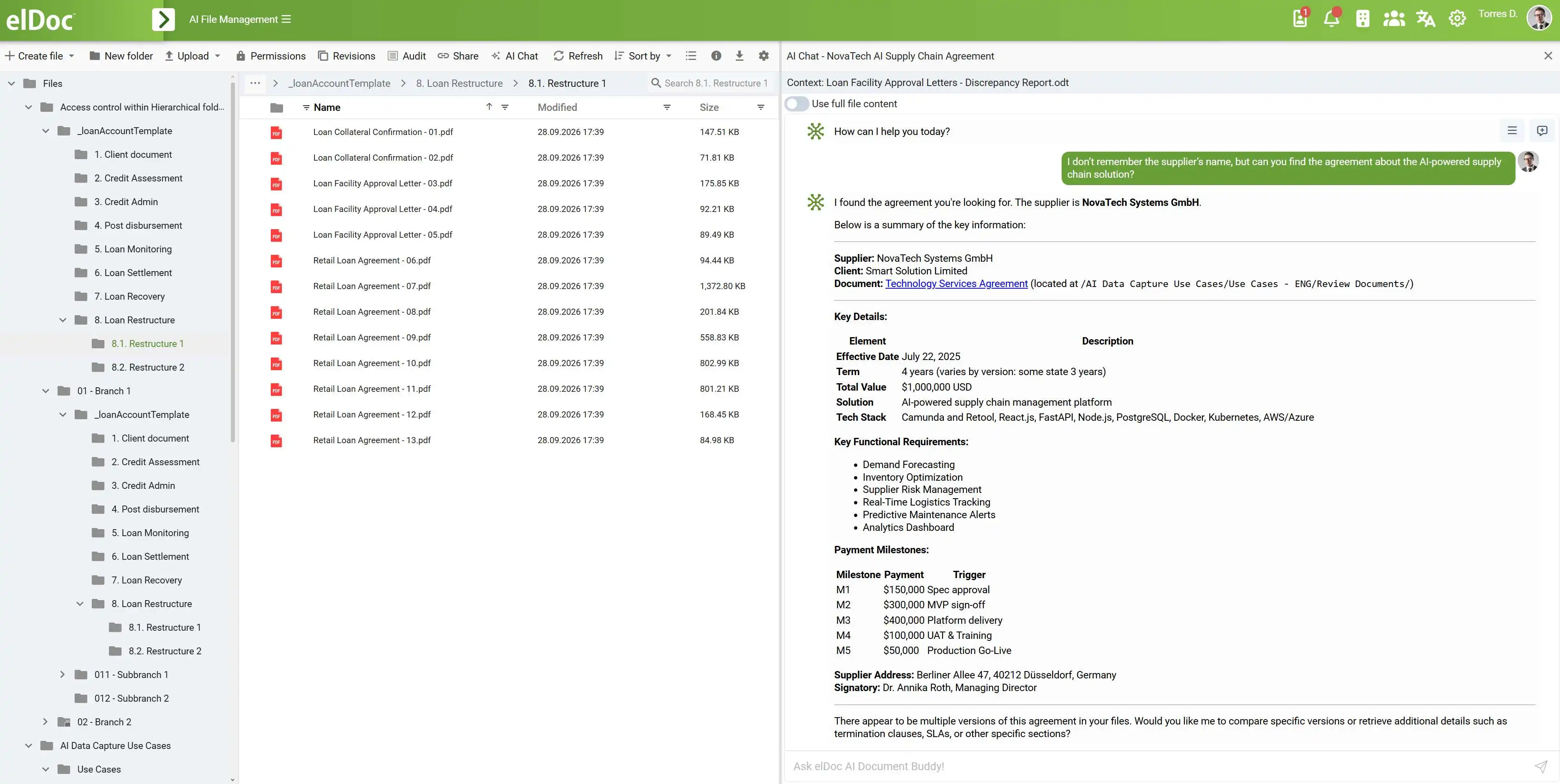
elDoc can apply granular permissions to individual documents, defining what a particular user is allowed to do with a specific file.
For example, several lawyers may work within the same legal matter and have access to the same directory, while their permissions for a particular document can be completely different:
| User | Example File-Level Access |
|---|---|
| Lawyer A | Can read the document, but cannot edit, download, print, copy, or share it |
| Lawyer B | Can read and edit the document and download a working copy |
| Lawyer C | Can read and share the document with authorized external counterparts, but cannot edit or delete it |
| Matter Lead | Can read, edit, copy, download, print, share, and delete the document |
| Matter Administrator | Can manage the document and edit its permissions, including determining who else may access it |
| Restricted User | May have access to the matter or directory but no access to this particular file |
elDoc provides file-level controls including Read, Read & Edit, Delete, Copy, Download, Print, Share, and Permissions Edit, with support for inherited and hierarchical permissions.
Access to a legal matter does not automatically mean access to every document—or permission to perform every action on that document.
This level of granularity is particularly important for legal reviews, M&A transactions, investigations, litigation, due diligence, and other matters where strict information barriers must be maintained.
elDoc AI Agents: Automation With Governance and Human Oversight
AI can significantly simplify the work of lawyers—not only by finding information, but by performing document-intensive tasks such as:
Search → Analyze → Compare → Extract → Validate → Generate → Classify → Organize → Route → Update
But elDoc places control at the core of AI automation.
elDoc AI Document Agents operate inside the same governed document environment as the legal files themselves. This means AI actions can be connected with elDoc permissions, workflows, approval steps, and audit trails rather than allowing an AI agent to operate independently from document governance.
With elDoc, AI Agents can do the work—but lawyers can remain in control of sensitive actions.
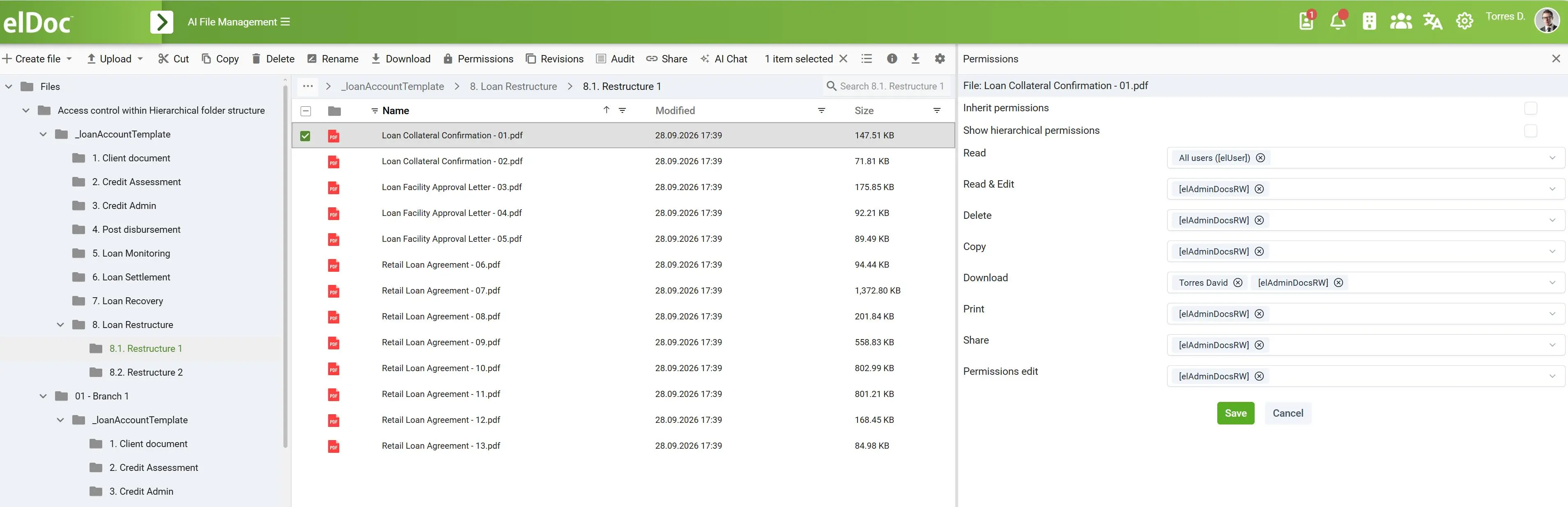
For example, an elDoc AI Agent may analyze hundreds of legal files and determine that certain documents should be classified, renamed, tagged, reorganized, or moved.
Instead of allowing the AI to make sensitive repository changes automatically, elDoc can incorporate a human approval step:
elDoc AI Agent → Proposed Action → Lawyer Review → Approve / Reject → elDoc Executes Action → Audit Trail
This principle can extend across different legal processes:
| elDoc AI Capability | What the AI Agent Can Do | How elDoc Keeps Control |
|---|---|---|
| Contract Analysis | Extract clauses, parties, dates, obligations and other information | Results can be presented to a lawyer for validation |
| Contract Comparison | Compare agreements and identify differences or missing information | Lawyer reviews the AI findings |
| Due Diligence | Analyze, classify and organize large document collections | Exceptions and sensitive actions can be routed for review |
| Compliance Validation | Check documents against policies, templates or business rules | Findings can enter an elDoc approval workflow |
| Document Generation | Prepare drafts, summaries or reports | Generated content can require human review |
| Document Organization | Classify, rename, tag, move or reorganize files | Repository changes can require authorized approval |
| Workflow Automation | Route documents and initiate subsequent actions | elDoc permissions and predefined workflow rules govern execution |
The important distinction is that AI Agents are not placed outside the document-management environment. In elDoc, AI automation can work together with the platform’s existing document permissions, granular access controls, workflows, human validation, and auditability.
elDoc’s objective is governed AI automation: let AI perform more of the repetitive legal document work while keeping sensitive decisions and actions under human and organizational control.
For legal teams, this means AI can deliver substantial productivity gains without requiring the organization to surrender governance over what happens to its documents.
From Document Review to Actual Execution
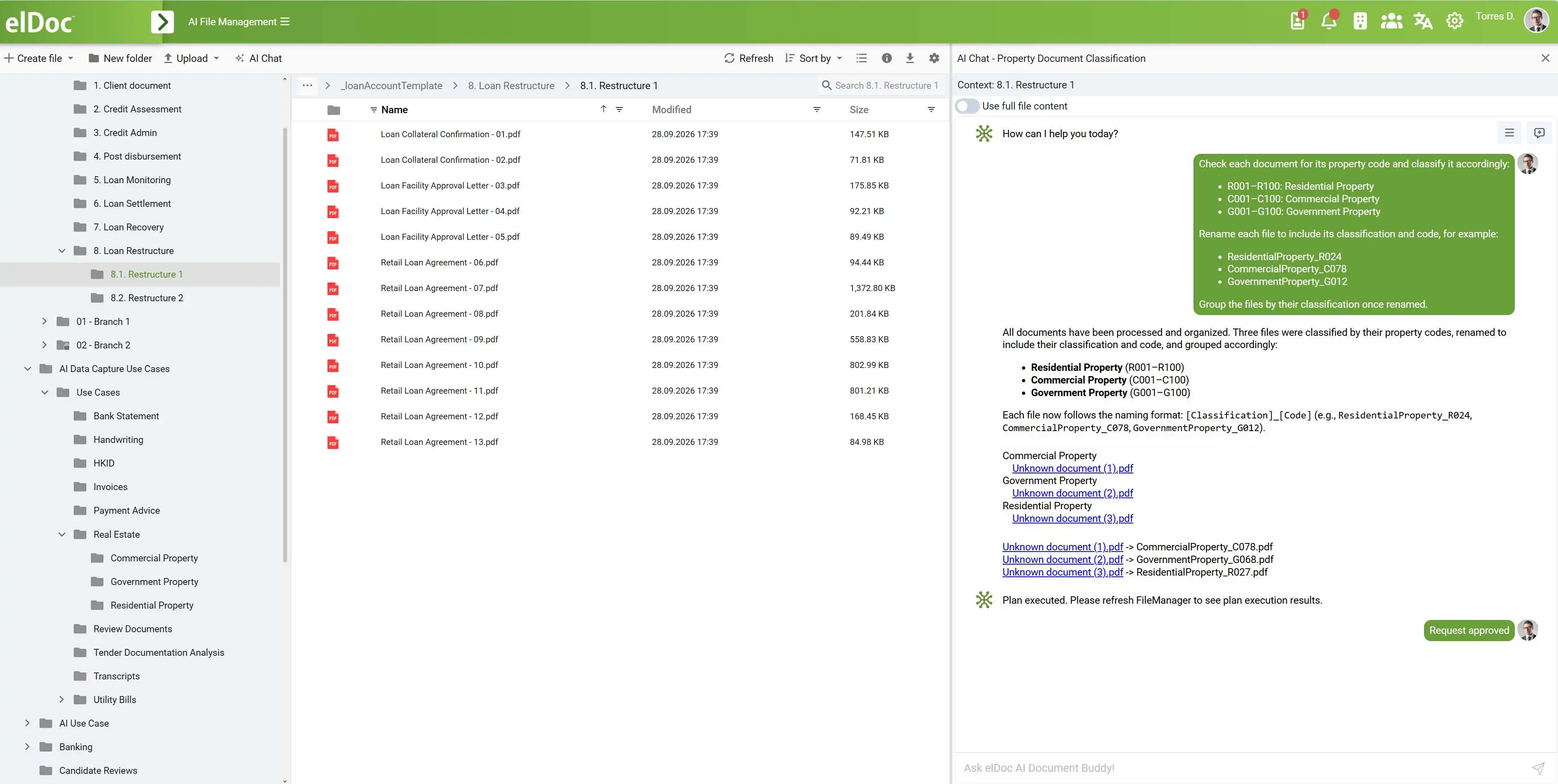
elDoc AI Agents are not limited to reading, searching, or reviewing existing legal documents. They can also participate in the next stage of the process: executing document-related tasks and creating new content or documents based on the results of their analysis.
For example, after reviewing a contract or a collection of legal files, an elDoc AI Agent can be configured to:
- create a new document based on approved information;
- generate a contract draft, amendment, summary, report, or legal memo;
- populate a document from an approved template;
- create structured metadata and document records;
- classify and place the newly created document in the appropriate location;
- initiate the next review or approval workflow; and
- route the document to the appropriate lawyer or authorized user.
A controlled process could therefore move from analysis all the way to execution:
Review Existing Documents → Analyze → Extract Information → Generate New Document → Lawyer Reviews → Approves → elDoc Creates & Stores Document → Next Workflow Step → Audit Trail
With elDoc, AI can move beyond telling lawyers what it found. It can help turn those findings into actual documents and controlled actions within the same governed environment.
This creates a path from Legal AI assistance to Legal AI execution, while elDoc keeps permissions, human approval, document governance, and traceability at the core of the process.
OCR Is Built Into the elDoc Legal AI Workflow
Legal teams should not have to worry about whether a document is digitally generated, scanned, or image-based before they can work with it using AI.
Legal repositories naturally contain scanned agreements, signed contracts, court filings, historical records, correspondence, evidence, TIFF files, scanned PDFs, and documents with complex layouts.
elDoc handles this automatically as part of document ingestion.
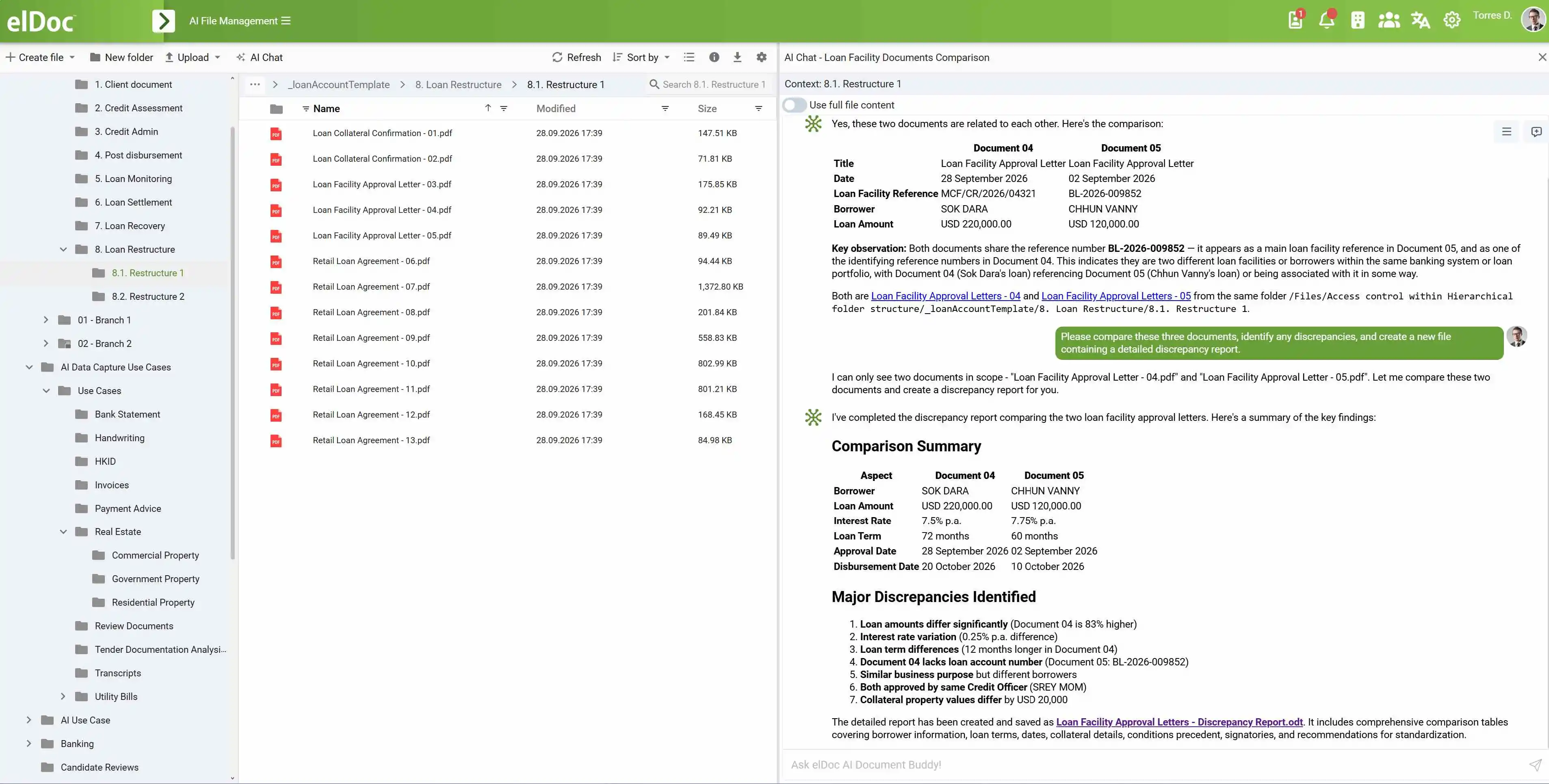
When a document is uploaded, elDoc can automatically apply OCR where required and prepare its content for subsequent AI processing, indexing, search, and RAG. There is no separate OCR workflow or manual preprocessing step required from the legal team.
Upload → Automatic OCR → Understand → Classify → Extract → Index → Store → Search → RAG
For lawyers, it is simply a document. elDoc takes care of making its content readable and usable by AI.
This means scanned and digital documents can become part of the same AI-ready legal repository, allowing lawyers to search, analyze, retrieve, and work with information without having to think about the underlying document format.
From Multilingual Document Reading to Translation
Legal work increasingly crosses languages and jurisdictions. Contracts, evidence, correspondence, corporate records, and supporting documentation may arrive in different languages and document formats.
With elDoc, the legal team does not need to build a separate process for every language.
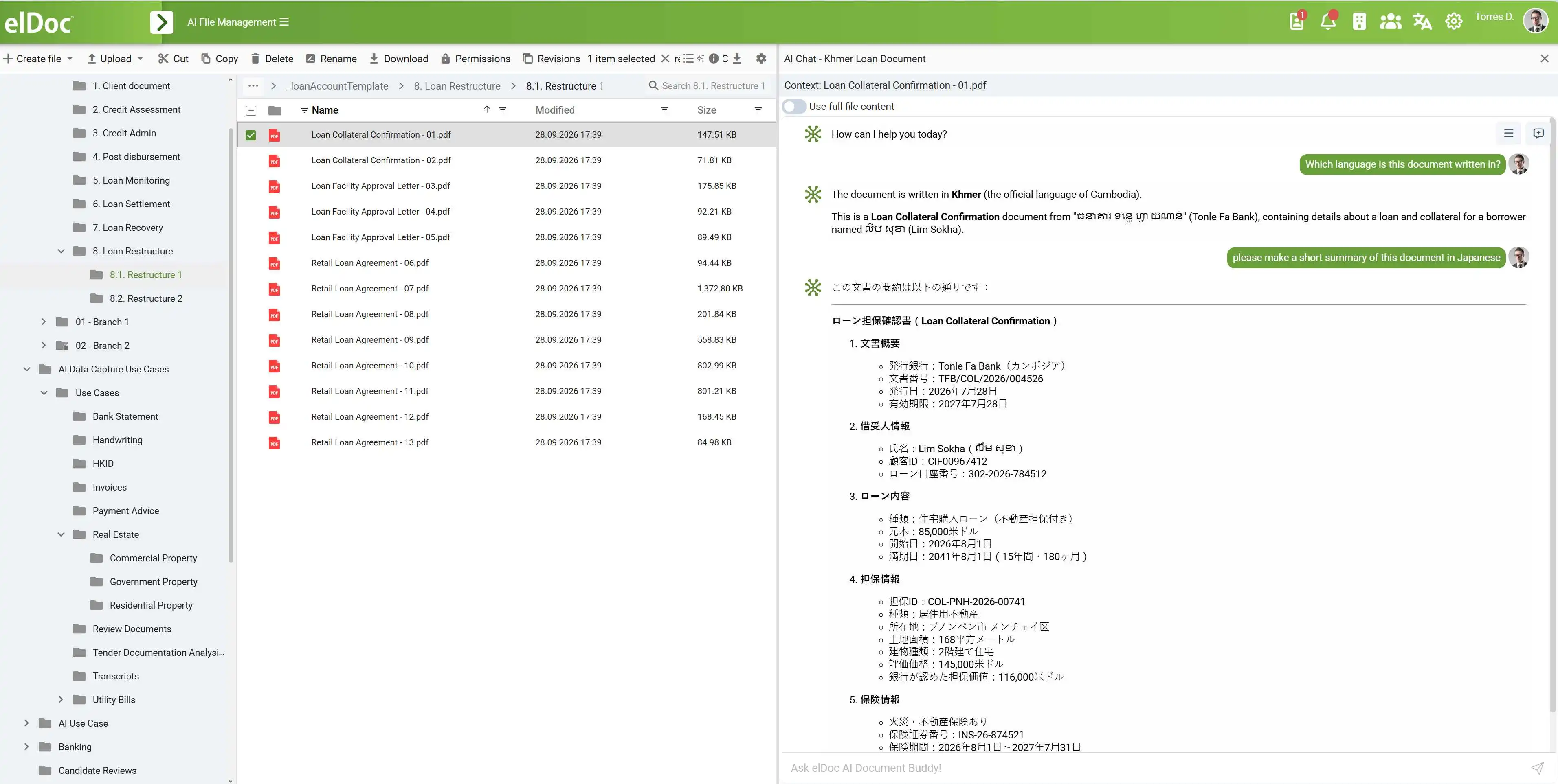
elDoc combines multilingual OCR, document understanding, AI processing, and translation, allowing lawyers to work with multilingual document repositories within the same environment.
Upload → Recognize Language → OCR → Understand → Translate → Search → Analyze → RAG
A document may be written in Chinese, Japanese, Korean, Malay, Khmer, German, Spanish, French, or another supported language, while the lawyer can work with its content in the language most convenient for them.
The language of the original document does not have to become a barrier for the legal team. elDoc helps make multilingual legal information readable, searchable, translatable, and accessible to AI within the same document workflow.
This is particularly valuable for cross-border legal matters, international contracts, multilingual due diligence, investigations, and global corporate legal teams working across large document collections.
LLM-Agnostic Legal AI: Avoid Dependency on a Single Model
Legal teams should not have to build their entire AI strategy around one LLM provider.
Different models have different strengths. One may perform better at complex reasoning, another at multilingual documents, another at summarization or extraction, while some models may be too narrow for a particular legal domain or raise concerns around privacy, jurisdiction, governance, or responsible AI policies.
Relying on a single provider can therefore limit both AI capability and organizational choice.
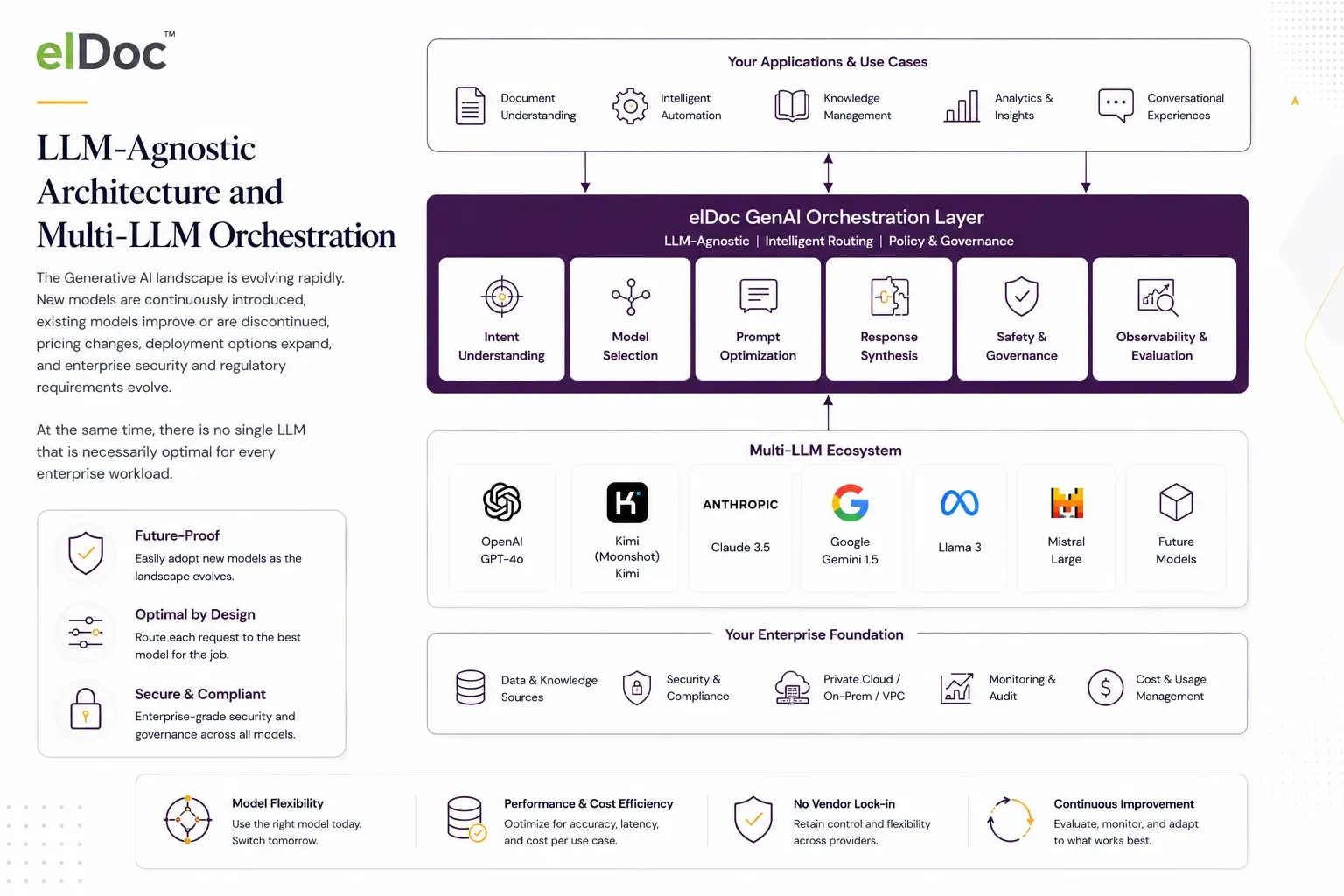
This is why elDoc is designed around an LLM-agnostic architecture.
Depending on the organization’s requirements and deployment architecture, elDoc can work with different cloud, private, or locally deployed LLMs and VLMs, rather than permanently tying the legal document environment to one model ecosystem.
This gives legal teams greater flexibility to select AI according to:
Legal Expertise · Reasoning Quality · Language · Privacy · Jurisdiction · Governance · Performance · Cost · Deployment Requirements
The best AI model for one legal task may not be the best model for another. elDoc keeps the architecture flexible so organizations can choose the models appropriate for their documents, policies, and legal work.
As AI models continue to evolve, this also helps organizations adopt new models without rebuilding their entire legal document infrastructure around a single AI provider.
On-Premises and Air-Gapped Legal AI
For some legal organizations, cloud deployment is simply not an option.
Government agencies, defense organizations, critical infrastructure operators, regulated enterprises, and teams handling highly sensitive investigations may require legal documents and AI processing to remain entirely within their own infrastructure.
This is a key area of focus for elDoc.
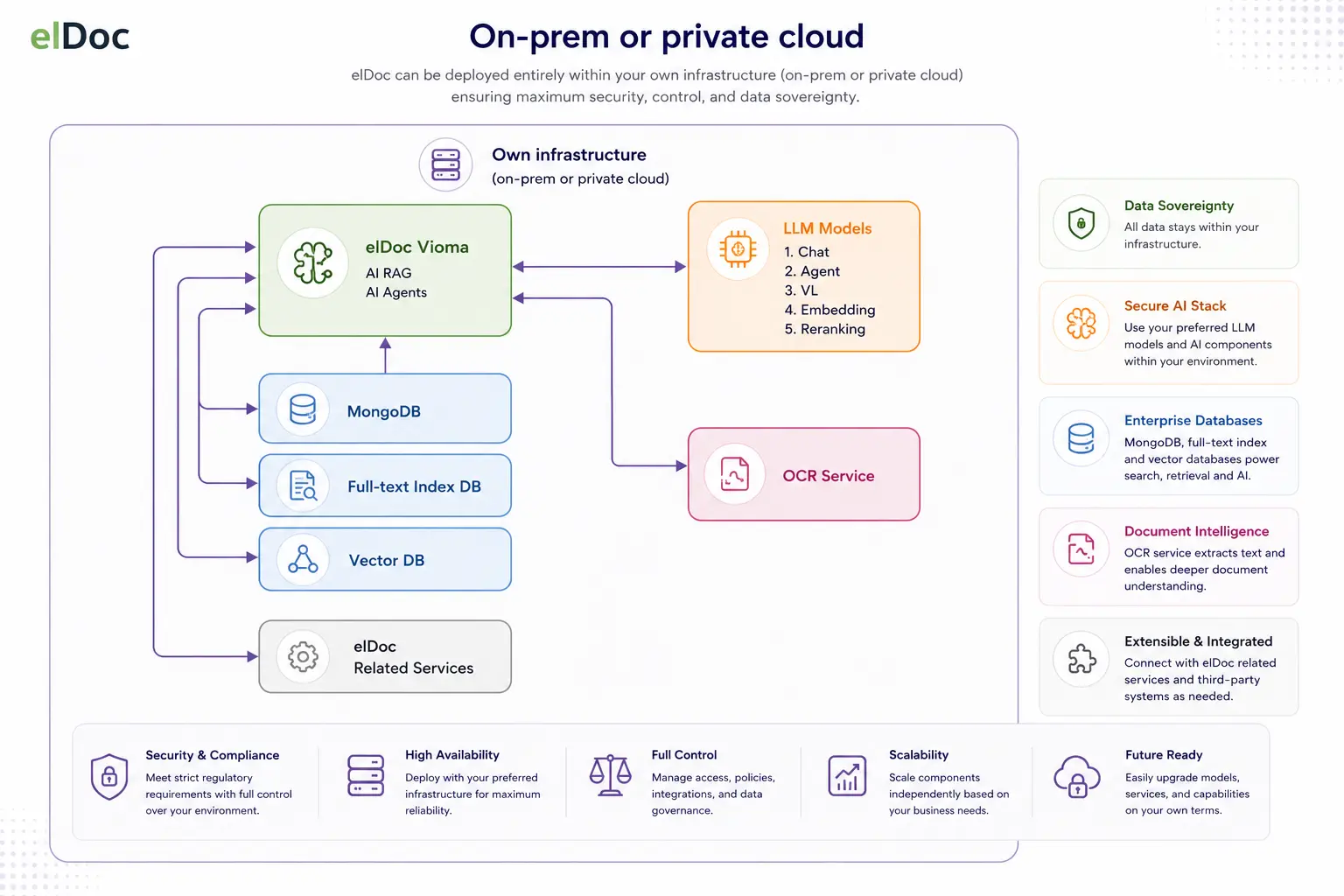
elDoc can be deployed fully on-premises, allowing organizations to maintain control over both their legal document repository and the AI infrastructure used to process it.
For environments requiring an even stronger security boundary, elDoc can support air-gapped deployment, where the platform operates within an isolated network without dependency on external cloud AI services.
The complete Legal AI stack can remain local:
Document Storage → OCR → AI Processing → Embeddings → Vector Database → RAG → LLM/VLM → AI Agents → Workflows → Audit
With elDoc, on-premises does not have to mean giving up Legal AI. The documents and the AI processing them can remain inside the organization’s controlled infrastructure.
This enables organizations to use advanced document intelligence even where documents, prompts, embeddings, or AI requests cannot be transmitted to external services due to security policies, confidentiality requirements, or infrastructure restrictions.
For highly sensitive legal environments, on-premises and air-gapped AI are not simply deployment options—they can be fundamental requirements.
When elDoc Becomes Particularly Compelling
elDoc becomes especially relevant when Legal AI requirements extend beyond lawyer productivity into enterprise security, infrastructure control, information governance, and document automation.
| When the Organization Says… | How elDoc Addresses It |
|---|---|
| “Our legal documents cannot leave our infrastructure.” | Deploy elDoc fully on-premises, keeping sensitive legal documents within organization-controlled infrastructure. |
| “Our AI processing must remain private.” | Use private or locally deployed LLMs/VLMs so sensitive document content and prompts do not need to be sent to external AI providers. |
| “Our vector database must remain inside our network.” | Keep embeddings, vector storage, retrieval, and RAG infrastructure within the organization’s environment. |
| “AI must respect our existing document permissions.” | Apply permission-aware RAG together with granular file-level access controls, determining who can read, edit, copy, download, print, share, delete, or manage permissions. |
| “We have millions of scanned legal documents.” | elDoc handles OCR automatically upon upload, preparing scanned documents for indexing, search, extraction, RAG, and AI analysis. |
| “We work with legal documents in multiple languages.” | Combine multilingual OCR, document understanding, translation, search, and AI so legal teams can work seamlessly across languages. |
| “We need AI to perform tasks—not only answer questions.” | Use elDoc AI Document Agents to analyze, classify, extract, compare, generate, organize, route, and update documents. |
| “AI actions must remain under lawyer control.” | Introduce human approval steps before sensitive AI actions are executed, with workflow governance and audit trails. |
| “We want AI to create documents, not just review them.” | Move from analysis to execution: generate new documents, populate templates, review, approve, store, and continue the workflow within elDoc. |
| “Our legal processes require structured reviews and approvals.” | Connect AI directly with elDoc workflows, validation, human review, approvals, and subsequent document actions. |
| “Our environment cannot connect to the public Internet.” | Deploy elDoc within a fully on-premises or air-gapped environment, including local AI infrastructure. |
| “We don’t want to depend on one LLM provider.” | Use elDoc’s LLM-agnostic architecture to select different cloud, private, or locally deployed models according to the task and organizational requirements. |
| “We need control over the entire legal document lifecycle.” | Manage the complete process within one environment: Capture → OCR → Classify → Secure → Search → Analyze → Generate → Review → Approve → Sign → Retain. |
The common thread across these scenarios is control.
elDoc is particularly compelling when an organization wants the benefits of Legal AI while maintaining control over its documents, infrastructure, AI models, permissions, workflows, and sensitive actions.
This is where elDoc moves beyond an AI assistant and becomes part of the organization’s secure Legal AI and document infrastructure.
Disclaimer
Legora is an independent company and is not affiliated with, endorsed by, or associated with elDoc. References to Legora in this article are provided solely for informational and comparative purposes based on publicly available information.
Product capabilities, security measures, deployment options, and other features may change over time. Organizations should verify current information directly with Legora when evaluating its services.
The comparison reflects elDoc’s perspective on different approaches to Legal AI and enterprise document infrastructure and is not intended to imply that Legora lacks appropriate security, privacy, or governance controls.
All trademarks, product names, and company names belong to their respective owners.
Take Control of Your Legal AI Infrastructure
Legal AI should make your team faster and more productive without requiring you to compromise control over sensitive documents, AI processing, or infrastructure.
With elDoc, legal teams can combine Private AI, On-Premises Deployment, Permission-Aware RAG, AI Document Agents, OCR, Workflow Automation, and Granular Document Governance within one secure environment.
Whether you are evaluating an alternative to cloud-based Legal AI, building a private legal knowledge base, or deploying AI in a highly regulated or air-gapped environment, elDoc gives you the flexibility to design Legal AI around your security requirements—not the other way around.
Your legal documents. Your infrastructure. Your AI. Your control.
Request an elDoc demo to see how Private Legal AI can work with your organization’s real document workflows and security requirements.