
Enterprise AI Platform with Secure AI Framework and LLM-Agnostic Architecture

Why Enterprises Need a Secure AI Platform – Not Just an LLM
The rapid rise of Large Language Models (LLMs) prompted many organizations to experiment with Generative AI. Business users quickly recognized the enormous potential of AI to improve productivity, automate repetitive work, and unlock knowledge hidden within millions of enterprise documents.
However, for large enterprises and especially organizations operating in regulated industries the question was never simply which LLM to use. The real challenge became how to adopt AI securely without compromising governance, compliance, intellectual property, or data sovereignty.
Public AI services may be suitable for general-purpose tasks, but enterprise environments require far greater control. Sensitive documents, contracts, engineering drawings, customer records, financial reports, and government information cannot simply be uploaded to external AI services without considering regulatory obligations, security policies, and internal governance.
As a result, organizations increasingly recognize that the foundation of Enterprise AI is not the language model itself, but a Secure Enterprise AI Platform that governs how AI accesses information, executes tasks, and integrates with existing business systems.
The language model becomes just one component of a much broader architecture. The elDoc platform provides the security, governance, orchestration, and flexibility needed to deploy AI responsibly across the organization while allowing businesses to choose the LLMs that best meet their requirements today and easily adopt new models as technology evolves.
For organizations in government, healthcare, financial services, manufacturing, utilities, energy, defense, and critical infrastructure, security cannot be added later. It must be embedded into every layer of the AI platform from the very beginning.
A secure enterprise AI framework ensures that every AI interaction follows the same governance and security policies that already protect enterprise information and business processes.
Core capabilities in elDoc include:
- Enterprise authentication (Active Directory, LDAP, MFA)
- Role-based access control
- Document-level permissions inherited from enterprise repositories
- Encryption of documents, embeddings, and vector databases
- Comprehensive audit trails for every AI interaction
- Human approval workflows for sensitive or high-risk actions
- Deployment flexibility across on-premise, private cloud, hybrid cloud, and sovereign cloud environments
- Compliance with internal governance policies and industry regulations, monitoring, and audit
Rather than forcing organizations to adapt their security policies to fit an AI service, a secure elDoc Enterprise AI Platform allows AI to operate within the organization’s existing security boundaries.
Every AI agent only accesses the information that an individual user is already authorized to view. Every response is generated using governed enterprise knowledge. Every action is traceable, auditable, and fully aligned with corporate compliance requirements.
This secure-by-design approach enables organizations to embrace Generative AI with confidence while retaining complete ownership of their data, maintaining regulatory compliance, and preserving the flexibility to choose, combine, and replace LLMs as the AI landscape continues to evolve.
LLM-Agnostic Architecture: Freedom to Choose the Best AI
The AI landscape is evolving at an unprecedented pace. Every few months, new Large Language Models introduce better reasoning, improved multilingual capabilities, lower latency, enhanced document understanding, or significantly lower operating costs.
Choosing a single LLM today does not guarantee it will remain the best option tomorrow.
This is why forward-looking organizations are moving away from AI platforms tightly coupled to a single model provider. Instead, they are adopting LLM-agnostic architectures that provide the flexibility to integrate and switch between multiple commercial, open-source, or private language models without redesigning business applications or workflows.
An LLM-agnostic architecture separates the enterprise AI platform from the underlying language models. The platform manages enterprise knowledge, security, workflows, integrations, and AI governance, while LLMs become interchangeable reasoning engines selected according to the task at hand.
This approach protects organizations from vendor lock-in while enabling them to continuously benefit from innovation across the rapidly changing AI ecosystem.
One Enterprise, Multiple AI Models
In practice, no single language model is the best at everything.
Some models excel at complex reasoning and multi-step planning. Others deliver exceptional performance for document extraction, code generation, multilingual communication, or long-context document analysis. Open-source models may be preferred for confidential workloads running entirely on-premise, while cloud-based foundation models may provide greater performance for public-facing applications.
An enterprise AI platform should therefore be able to orchestrate multiple LLMs simultaneously rather than forcing every request through a single model.
For example, an organization may use:
- a high-performance reasoning model for Agentic RAG;
- a cost-efficient model for document summarization;
- a specialized model for OCR correction and data extraction;
- a multilingual model for translation and international collaboration;
- a private on-premise model for classified or regulated information;
- a cloud-based model for non-sensitive business tasks.
Each AI request is automatically routed to the model best suited for the specific workload, balancing performance, quality, security, latency, and cost.
This intelligent orchestration enables enterprises to optimize AI investments while ensuring users always receive the best possible results.
How elDoc’s LLM-Agnostic Architecture Works
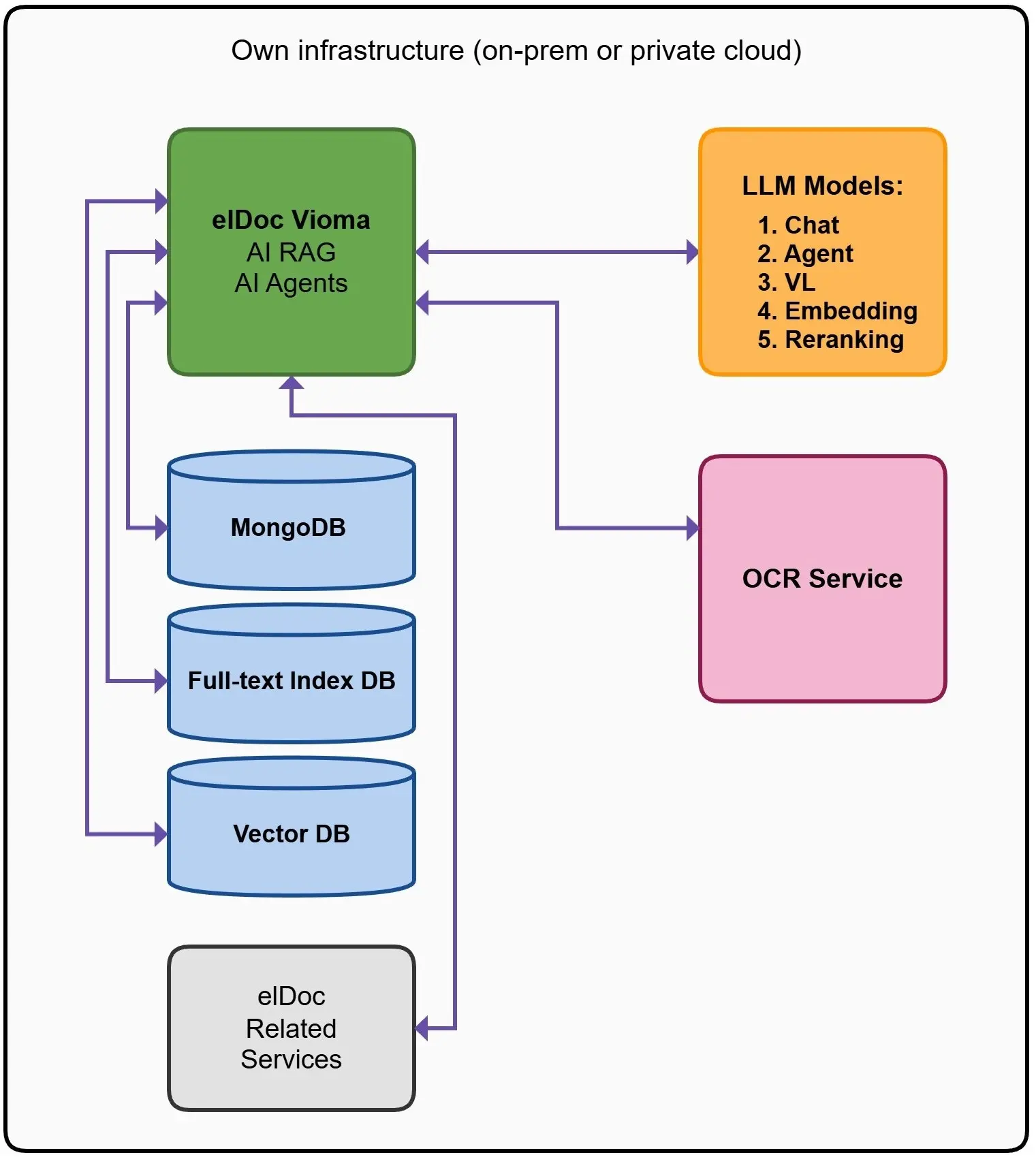
The diagram illustrates one of the core design principles behind elDoc: the platform itself is independent of any specific Large Language Model. Instead of embedding business logic into a single AI model, elDoc acts as an intelligent orchestration layer that securely coordinates enterprise knowledge, AI models, OCR services, and business applications.
This architecture allows organizations to continuously adopt the best AI technologies without changing their business applications or compromising security.
1. All Components Remain Inside the Customer’s Infrastructure
The entire AI platform operates within the organization’s own environment whether deployed on-premises, in a private cloud, or within a sovereign cloud.
This means that enterprise documents, vector databases, metadata, AI agents, and orchestration services remain under the organization’s full control.
Only the selected LLMs need to be connected, and these may also run entirely inside the customer’s infrastructure when required by security or regulatory policies.
2. elDoc — The Enterprise AI Platform
At the core of the architecture is elDoc, the intelligent platform that connects enterprise users, business applications, enterprise knowledge, and AI models into a single secure environment.
Unlike public AI services, where users interact directly with a language model, employees interact with elDoc. It is the platform that provides the user experience, enforces security policies, executes business processes, orchestrates AI services, and integrates with enterprise systems.
In other words, elDoc is the Enterprise AI Platform, while LLMs are simply one of the technologies it utilizes.
What Users Actually See
Employees never need to know which LLM is answering their question or processing a document.
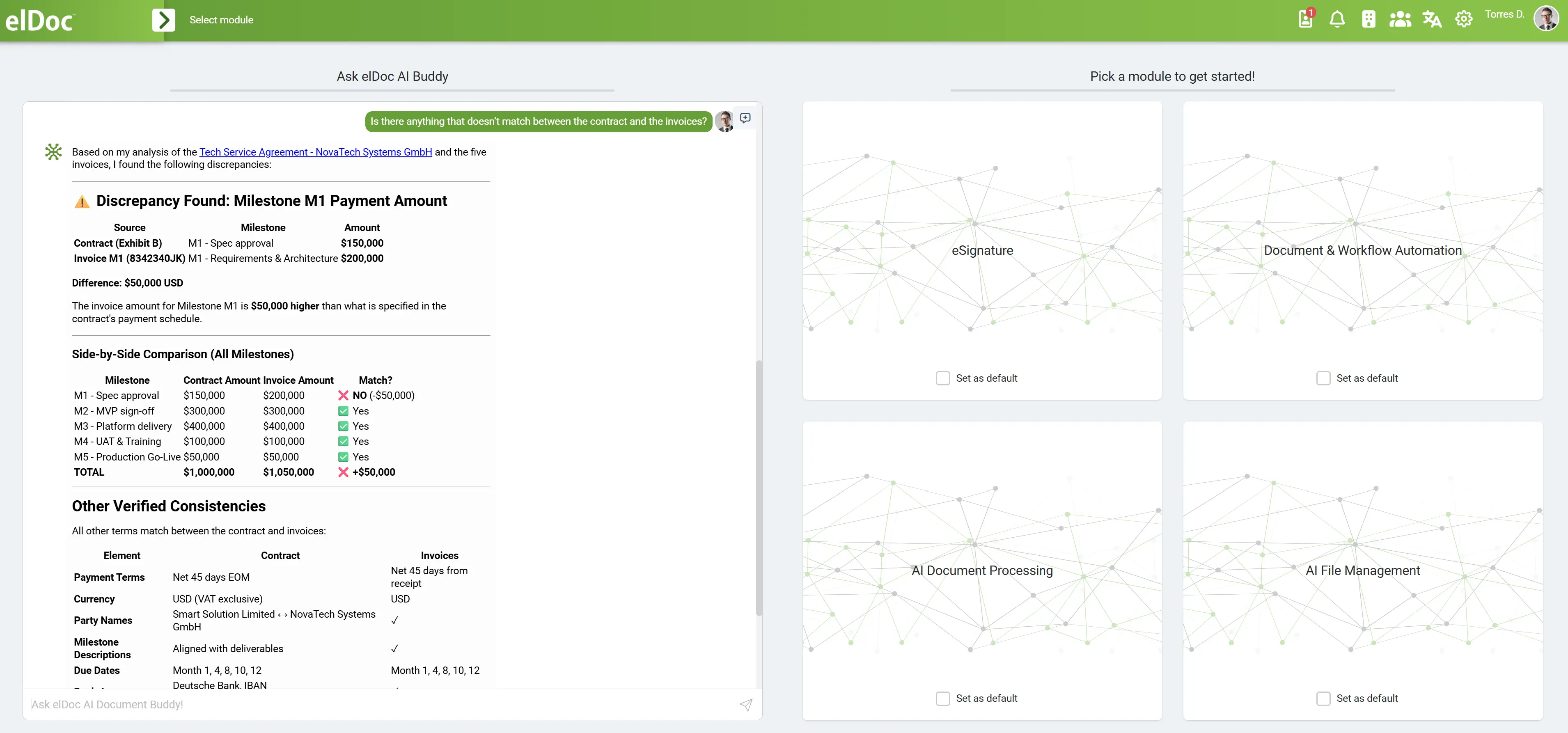
Instead, they work with a familiar enterprise application where they can:
- Chat securely with enterprise knowledge using Agentic RAG.
- Search documents across multiple repositories through a single interface.
- Launch AI Document Agents to perform business tasks.
- Summarize contracts, reports, emails, and technical documentation.
- Compare document versions and identify changes.
- Extract information from invoices, forms, correspondence, and engineering documents.
- Generate reports, meeting minutes, letters, and business documents.
- Start or approve business workflows.
- Collaborate securely with colleagues using document sharing and approval processes.
- etc.
To the user, it feels like one intelligent enterprise application – not a collection of AI tools.
The Brain Behind Every AI Request
Every interaction begins with elDoc not with an LLM.
Before any AI model is called, the platform performs a series of enterprise operations.
It authenticates the user through corporate identity providers such as Microsoft Active Directory, LDAP, MFA. It verifies permissions, organizational roles, and security policies before determining which enterprise information may be accessed.
The platform then decides:
- which repositories should be searched;
- whether semantic search, keyword search, or both should be used;
- whether scanned documents require OCR processing;
- which AI Document Agents should participate;
- whether the result requires validation, reranking, or additional reasoning;
- whether human approval is required before executing an action.
This orchestration occurs automatically, allowing employees to focus on business tasks rather than AI technology.
3. Enterprise Knowledge Layer
The intelligence of any Enterprise AI Platform depends on the quality, accessibility, and organization of enterprise knowledge.
Rather than storing all information in a single repository, elDoc uses a specialized Enterprise Knowledge Layer consisting of multiple databases, each optimized for a different purpose. Together, they enable Agentic RAG, AI Document Agents to retrieve, understand, correlate, and reason over enterprise information with exceptional speed and accuracy.
This layered approach combines traditional database technologies with modern semantic AI search, allowing the platform to answer complex business questions that would be impossible using keyword search alone.
MongoDB – Enterprise Metadata Repository
MongoDB stores the structured information that powers the platform, including document metadata, classifications, extracted entities, workflow states, user permissions, and audit logs. It serves as the operational knowledge repository that connects documents with business context.
Full-Text Search Database
The Full-Text Search Database provides high-speed keyword search across enterprise content. It indexes document titles, filenames, metadata, and text, allowing users and AI agents to quickly locate documents using exact words, phrases, document numbers, or business attributes.
Vector Database
The Vector Database stores AI embeddings that represent the semantic meaning of enterprise documents. It enables Agentic RAG to retrieve information based on context rather than keywords, allowing AI to find relevant documents even when different terminology is used.
Together, these three repositories provide hybrid retrieval, combining structured metadata, keyword search, and semantic search to deliver the most relevant information to AI agents and Large Language Models. This ensures more accurate answers, better reasoning, and higher-quality business outcomes.
4. OCR Services – Intelligent Document Recognition
Enterprise documents often arrive as scanned PDFs, paper records, images, or photographs captured with mobile devices. As soon as these documents are uploaded into elDoc, the platform automatically invokes the configured OCR service to recognize and extract their content.
elDoc supports multiple cloud and on-premise OCR engines, allowing organizations to choose the solution that best fits their accuracy, performance, security, and compliance requirements.
Once OCR is completed, the extracted text is automatically indexed, enriched with metadata, converted into vector embeddings, and becomes immediately available for Full-Text Search, Agentic RAG, AI Document Agents, and workflow automation. This ensures that even scanned and image-based documents become fully searchable, understandable, and actionable by AI.
LLM-Agnostic Architecture and Multi-Model AI
One of the key strengths of elDoc is its LLM-agnostic architecture. Rather than relying on a single Large Language Model, the platform supports multiple AI models simultaneously, allowing organizations to select the most appropriate model for each business task.
Behind the scenes, elDoc utilizes at least five specialized AI models, each optimized for a different function, including conversational AI, reasoning and AI agents, document understanding, vision-language processing, semantic embeddings, and result reranking. This modular architecture enables every component of the AI workflow to use the model best suited to its specific purpose.
Organizations are free to choose from leading commercial, private, or open-source LLMs, including OpenAI GPT, Anthropic Claude, Google Gemini, Meta Llama, Kimi, Mistral, DeepSeek, Qwen, and models deployed entirely on-premises.
For example:
- Enterprise Chat Assistants may use a cost-efficient model such as GPT-4.1 Mini, Gemini Flash, or Llama 3, providing excellent conversational performance while minimizing operational costs.
- Complex reasoning tasks, such as analyzing contracts, generating legal summaries, or supporting strategic decision-making, can leverage more advanced models like Claude Opus or GPT-5, where higher reasoning capability delivers greater business value.
- Chinese-language documents or organizations operating across Asia may choose DeepSeek or Qwen, which are optimized for Chinese language understanding and regional business contexts.
- Highly confidential workloads can be processed entirely using private on-premise LLMs, ensuring sensitive information never leaves the organization’s infrastructure.
Because elDoc separates the Enterprise AI Platform from the underlying language models, organizations can continuously evaluate and adopt new AI technologies without changing their applications, workflows, or user experience. As the AI landscape evolves, models can be replaced, combined, or optimized to balance accuracy, performance, security, and cost, ensuring that enterprise AI investments remain future-proof and free from vendor lock-in.
Build a Secure Enterprise AI Platform with elDoc
Generative AI is transforming how organizations work but lasting success depends on more than choosing the latest language model. It requires a secure, governed, and future-ready platform that can connect enterprise knowledge, automate business processes, and evolve with the rapidly changing AI landscape.
With elDoc, organizations gain a secure Enterprise AI Platform featuring an LLM-agnostic architecture, Agentic RAG, AI Document Agents, Intelligent Document Processing, and seamless integration with existing enterprise systems whether deployed on-premises, in a private cloud, or in a hybrid environment.
Talk to an elDoc expert to discover how your organization can securely deploy Generative AI, choose the LLMs that best fit your business and compliance requirements, and transform enterprise documents and knowledge into intelligent business automation.
Schedule a personalized demo today and explore the future of secure Enterprise AI.