
RIP Chatbots: Why Agentic RAG Is Replacing Them

For years, chatbots were positioned as the future of business automation. From customer service widgets to internal assistants, organizations invested heavily in conversational interfaces with the expectation of achieving greater efficiency, faster response times, and scalable operations across the enterprise. However, in practice, most chatbots fell short of delivering true intelligence or meaningful business impact. Today, a new paradigm has emerged –Agentic RAG (Retrieval-Augmented Generation enhanced with reasoning and execution capabilities) and it is not merely an evolution of chatbots.
It represents a fundamental shift. Rather than improving chatbots, it is replacing them entirely.
What Is a Chatbot, Really?
At its core, a chatbot is a conversational interface built on top of either predefined logic or a language model, designed to simulate interaction between humans and systems. Traditional chatbots generally fall into two main categories:
- Rule-based bots
These rely on scripted flows, decision trees, and predefined responses. They are predictable but rigid, often failing when conversations deviate from expected paths. - LLM-powered chatbots
These use large language models to generate natural language responses, offering more flexibility. However, they frequently lack deep contextual awareness, reliable grounding in enterprise data, and consistent control over outputs.
While both types can mimic conversation effectively, their capabilities are largely surface-level. They can respond sometimes impressively – but they do not truly understand context, reason across information, or take action in a dependable, enterprise-grade manner.
The Limitations of Chatbots
Despite their popularity, chatbots face a set of fundamental constraints that limit their real business value — especially in complex, data-driven enterprise environments.
1. No True Understanding of Enterprise Context
Chatbots typically operate without deep, native integration into internal systems and data sources. They struggle to accurately interpret complex business documents such as contracts, invoices, policies, or regulatory filings, and cannot reliably understand relationships across multiple documents or data points.
2. Heavy Dependence on Training and Maintenance
Chatbots require continuous training, tuning, and prompt engineering to remain relevant. As business rules, documents, and processes evolve, maintaining chatbot accuracy becomes an ongoing effort — often requiring manual updates, retraining cycles, or restructuring of conversation flows. This makes them costly to scale and difficult to keep aligned with rapidly changing enterprise environments.
3. Inability to Work with Dynamic, Large-Scale Data
Modern enterprises operate on vast volumes of data that are constantly changing. Chatbots are not designed to effectively handle:
- Large, distributed document repositories
- Real-time data updates
- Cross-system data dependencies
As a result, they often rely on static snapshots of information or limited context windows, leading to outdated, incomplete, or inconsistent responses.
4. Hallucinations and Uncontrolled Responses
LLM-based chatbots can generate responses that sound correct but are factually wrong or unverifiable. In regulated industries, this creates significant risks related to compliance, financial accuracy, and decision-making.
5. Limited Auditability and Control
Enterprises require full traceability of actions, decisions, and data access. Most chatbot solutions lack:
- Role-based access control
- Detailed audit logs
- Governance frameworks for compliance
This makes them unsuitable for sensitive or regulated operations.
What Businesses Actually Need Today
Modern enterprises don’t need better conversations. They need intelligent execution at scale — systems that can not only communicate, but also understand, reason, decide, and act across complex and constantly evolving data environments. This shift is driven by the reality that business operations are no longer simple, linear, or static. They are data-intensive, document-heavy, and highly dynamic. What organizations truly require includes:
Deep Understanding of Complex Documents
Enterprises deal with contracts, invoices, policies, regulatory filings, and technical documentation — often in unstructured or semi-structured formats. AI must go beyond surface-level text and:
- Interpret meaning, clauses, and obligations
- Understand context across different document types
- Extract and structure critical data accurately
Advanced Reasoning Across Large and Distributed Data Sets
Business decisions rarely depend on a single document. They require multi-step reasoning across multiple sources, such as:
- Comparing invoices against contracts and purchase orders
- Validating policies against regulatory requirements
- Identifying inconsistencies, risks, or anomalies
This involves:
- Cross-document analysis
- Context-aware reasoning
- Logical validation against rules and conditions
And critically, this must work on large-scale datasets — thousands or millions of documents — that are continuously updated.
Real-Time Interaction with Dynamic Data
Enterprise data is not static. It changes constantly across systems like ERP, CRM, and document repositories. What’s needed is:
- Access to live, up-to-date data
- Ability to process changes instantly
- Continuous synchronization across systems
Static knowledge or pre-trained responses are no longer sufficient.
A New Generation: Agentic RAG with elDoc in Action
This is where a new generation of enterprise AI emerges — elDoc – Agentic RAG platform. Unlike traditional chatbots, elDoc does not simply respond to queries. It operates as an intelligent execution layer that combines retrieval, reasoning, and real-world action across enterprise systems and data. It can understand context, work with large and continuously evolving datasets, apply business logic, and execute processes — all within a controlled, secure environment.
What This Looks Like in Practice
1. Employee Knowledge & Decision Support
A user asks:
“Which training courses should I take based on my role and current company requirements?”
elDoc:
- Retrieves internal training policies, role requirements, and learning catalogs
- Analyzes the employee’s position, department, and progression path
- Recommends relevant courses aligned with both compliance and career growth
2. HR Policy Interpretation in Real Time
A user asks:
“How many vacation days am I entitled to this year?”
elDoc:
- Accesses HR policies, employment contracts, and regional regulations
- Applies rules based on tenure, role, and location
- Cross-checks with current leave balance from HR systems
- Provides a precise, auditable answer — not a generic estimate
3. Financial Data Validation and Risk Detection
A user asks:
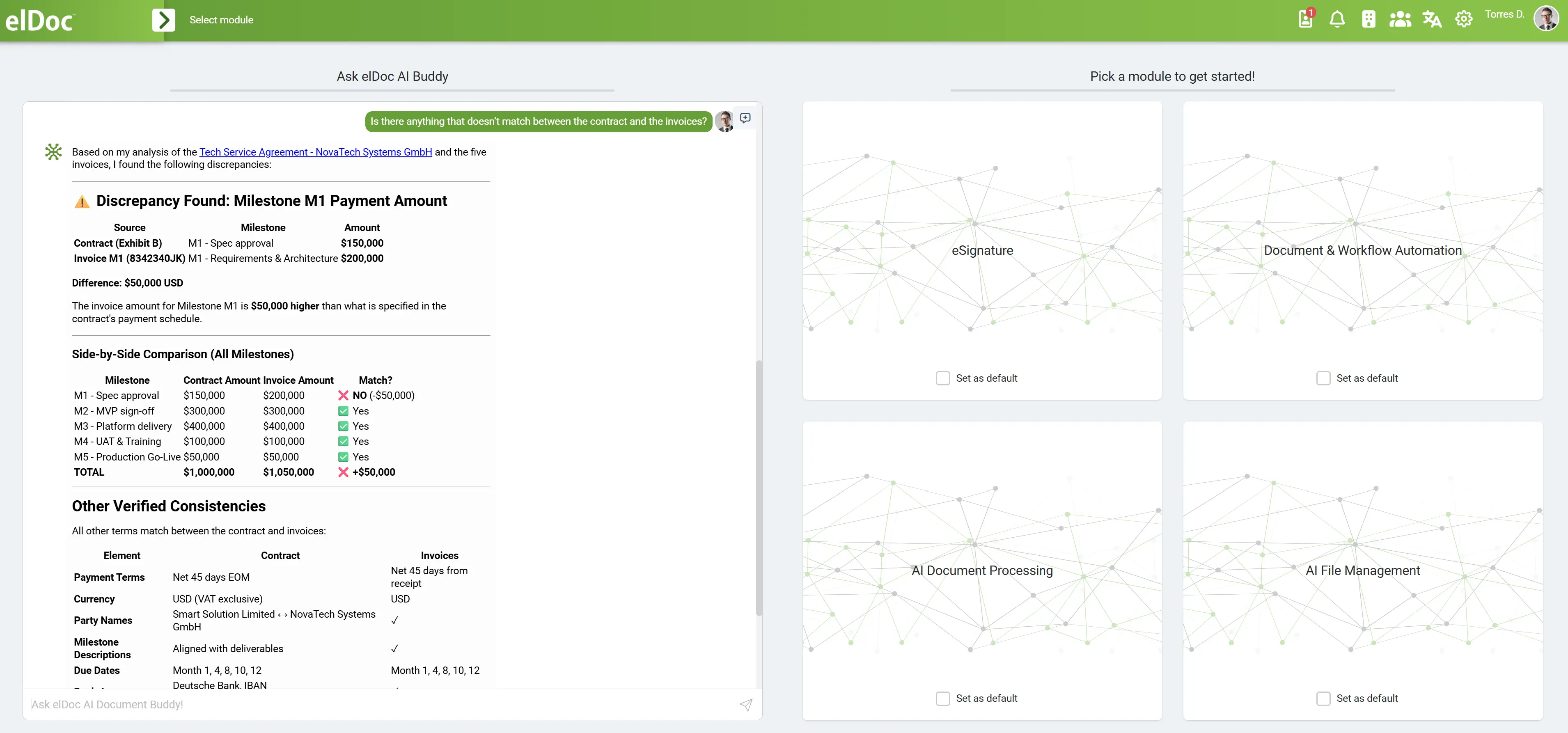
“Does this invoice match the contract and purchase order?”
elDoc:
- Extracts data from the invoice (including scanned documents via AI OCR)
- Compares it against contract terms and PO details
- Validates pricing, quantities, and conditions
- Flags discrepancies or risks
What Is Agentic RAG — and Why Chatbots Can’t Compete
Agentic RAG (Retrieval-Augmented Generation with reasoning and execution) represents a fundamental shift from conversational AI to intelligent enterprise execution. It combines real-time data retrieval, context-aware generation, multi-step reasoning, and the ability to take action — enabling systems to not only answer questions, but also analyze complex information, make decisions, and trigger workflows across business systems. In contrast, traditional chatbots operate primarily at the level of conversation: they rely on pre-trained or limited context, require continuous training, struggle with large and dynamically changing datasets, and lack the ability to reason across multiple documents or execute tasks. While chatbots can simulate dialogue, they cannot reliably validate financial data, interpret contracts in context, or act within enterprise processes. Agentic RAG, on the other hand, works with live enterprise data, performs cross-document analysis at scale, applies business rules, and executes end-to-end operations within governed, auditable environments. In simple terms, chatbots provide answers – Agentic RAG delivers decisions and action, making it a far more powerful and enterprise-ready paradigm.
Can I Start Using elDoc Agentic RAG for Enquiries?
Yes – getting started with elDoc Agentic RAG is straightforward and flexible, designed to fit seamlessly into your existing data landscape.
You can begin by simply uploading your documents and data into elDoc, where the platform immediately enables intelligent querying, reasoning, and interaction across your content. This includes contracts, policies, invoices, knowledge bases, and more — all becoming instantly accessible through a secure, AI-powered interface.
Alternatively, if your data already resides in existing systems, elDoc can operate as an API layer on top of your infrastructure. It integrates directly with your enterprise systems such as ERP, DMS, CRM, or databases, allowing you to leverage Agentic RAG capabilities without moving or duplicating data.
In both scenarios, elDoc enables users to:
- Ask natural language questions
- Receive precise, context-aware answers
- Perform cross-document analysis
- Trigger workflows and actions where needed
This means you can move from static data and manual searches to a fully interactive, intelligent enquiry and execution system — all powered by Agentic RAG.
How elDoc Agentic RAG Is Available?
elDoc Agentic RAG is designed for enterprise flexibility and can be deployed in multiple ways depending on your security, compliance, and infrastructure requirements.
Cloud Deployment
elDoc can be delivered as a fully managed cloud solution, enabling rapid deployment without the need for internal infrastructure. This option is ideal for organizations looking for scalability, faster time-to-value, and minimal IT overhead, while still benefiting from secure, enterprise-grade architecture.
On-Premise Deployment
For organizations with strict data sovereignty, regulatory, or security requirements, elDoc can be deployed entirely within your own environment. This ensures full control over data, infrastructure, and access, making it suitable for highly regulated industries such as finance, government, and healthcare.
Hybrid Deployment
elDoc also supports hybrid architectures, combining the best of both worlds. Sensitive data and critical processes can remain on-premise, while scalable AI capabilities and integrations can be leveraged in the cloud. This approach provides flexibility, performance, and compliance tailored to complex enterprise environments.
In all deployment models, elDoc delivers the same core capability: secure, intelligent Agentic RAG that can understand, reason, and act on your enterprise data at scale.
Beyond Conversations: Enter the Age of Autonomous Enterprise Intelligence
The era of chatbots as standalone solutions is coming to an end. While they introduced a new way of interacting with systems, they were never designed to handle the complexity, scale, and dynamic nature of modern enterprise operations. Businesses today require more than conversation — they require systems that can understand vast and evolving data, reason across multiple sources, and execute decisions with accuracy and control. This is exactly what Agentic RAG with elDoc delivers. It transforms AI from a passive interface into an active execution layer, capable of turning documents into decisions and decisions into actions. Organizations that embrace this shift are not just improving efficiency — they are redefining how work gets done, moving toward fully intelligent, automated, and scalable operations.
The question is no longer whether chatbots can be improved.
The real question is how quickly they can be replaced.