
Ready-to-Use Agentic RAG for On-Premise (Local) AI Deployment

Build Enterprise AI Beyond the Cloud
Many organizations began their Generative AI journey by experimenting with cloud-based AI services. It was the fastest and simplest way to validate use cases, launch pilots, and demonstrate early business value.
However, as AI initiatives move from experimentation to enterprise-wide deployment, many organizations encounter the same challenge: the majority of their valuable business knowledge cannot be processed in public cloud AI services.
Contracts, financial records, customer information, legal documents, engineering documentation, HR files, intellectual property, and other sensitive business data are often subject to strict security, compliance, and data residency requirements. As a result, organizations discover that cloud AI can only access a small portion of their enterprise knowledge, limiting the value of AI across the business.
Building a secure on-premise AI platform from scratch is rarely a simple alternative. Developing an enterprise-grade Agentic RAG solution requires integrating document repositories, vector databases, AI models, security frameworks, identity management, workflow automation, and governance—often resulting in years of engineering effort before the platform is ready for production.
This is where a ready-to-use Agentic RAG platform makes the difference.
Instead of assembling and maintaining numerous AI components, organizations can deploy a complete enterprise solution that runs entirely on-premise, in a private cloud, or within an air-gapped environment.
elDoc provides a production-ready Agentic RAG platform that combines secure document management, enterprise knowledge, AI Document Agents, Intelligent Document Processing, workflow automation, and multi-LLM orchestration into a unified platform. Organizations gain the ability to securely access, understand, and automate work across their entire enterprise knowledge base—while keeping complete control of their data, infrastructure, and AI models.
What Is Agentic RAG in elDoc?
Retrieval-Augmented Generation (RAG) has become the foundation of enterprise AI because it enables Large Language Models (LLMs) to retrieve information from an organization’s own documents rather than relying solely on their pre-trained knowledge.
A traditional RAG solution typically follows a straightforward process:
- A user asks a question.
- The system searches a knowledge base for relevant documents.
- The retrieved information is provided to the LLM.
- The LLM generates a response based on that content.
This significantly improves accuracy and reduces AI hallucinations, making enterprise knowledge accessible through natural language conversations.
However, traditional RAG is primarily designed to answer questions. It retrieves information, summarizes documents, and provides recommendations, but it generally stops once the response has been generated.
Agentic RAG extends this concept by introducing AI Agents that can reason, plan, and execute tasks in addition to retrieving knowledge.
Instead of performing a single search, AI agents can determine which information is needed, search across multiple repositories, compare and validate information from different documents, maintain context throughout a multi-step process, and decide what actions should follow.
Depending on business rules and user permissions, Agentic RAG can:
- search across enterprise knowledge repositories
- understand business context rather than simple keywords
- reason across multiple documents and structured business data
- validate retrieved information before presenting results
- identify inconsistencies, missing information, or potential risks
- generate new business documents, reports, or summaries
- trigger business workflows and approval processes
- update enterprise applications through secure integrations
- collaborate with users by requesting clarification or approvals
- coordinate multiple AI agents working on different parts of a business process
Rather than acting as an intelligent enterprise search engine, Agentic RAG functions as an enterprise AI workforce that combines knowledge retrieval, reasoning, decision support, and business process automation.
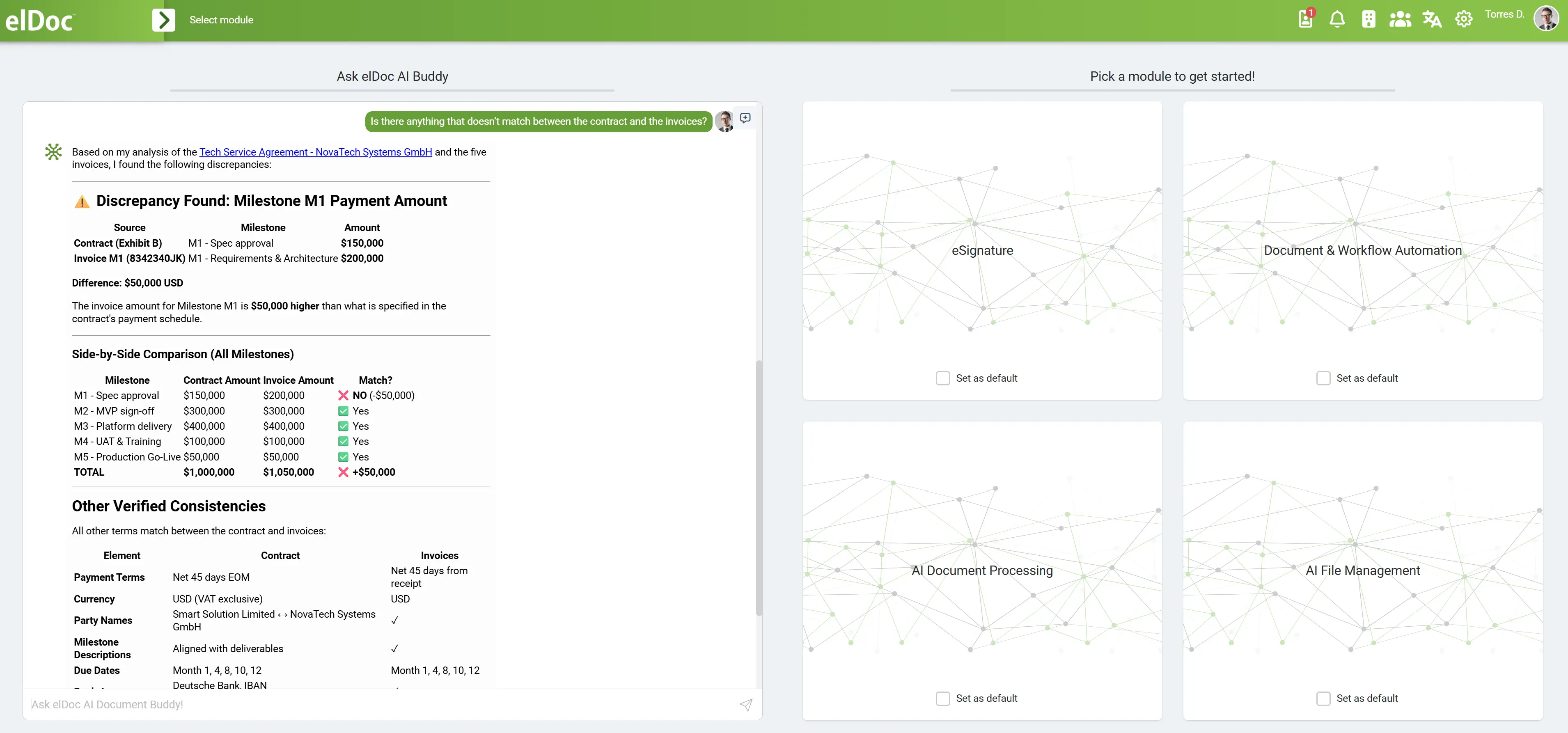
The result is a platform where AI not only answers questions but also helps organizations complete work—from understanding enterprise knowledge to executing document-centric business tasks under human oversight and enterprise governance.
Why Building Agentic RAG Is More Complex Than It Appears
At first glance, building an Agentic RAG solution may seem straightforward. A wide range of open-source frameworks and AI tools make it possible to create a proof of concept within days or weeks. This often creates the impression that deploying enterprise AI is simply a matter of connecting a Large Language Model to a vector database and a collection of documents.
The reality is very different.
Moving from a successful prototype to a secure, scalable, and production-ready enterprise platform requires far more than AI models and document retrieval. Organizations must build an ecosystem that can securely manage enterprise knowledge, understand documents, orchestrate AI agents, integrate with business applications, and operate under strict governance and compliance requirements.
A production-ready Agentic RAG platform typically needs to combine intelligent document processing, enterprise document repositories, search and indexing services, vector databases, embedding models, multiple Large Language Models, AI agent orchestration, workflow automation, identity and access management, permission-aware retrieval, audit logging, monitoring, and secure integrations with ERP, CRM, HR, and other enterprise systems.
Beyond the technology itself, every component must be configured, integrated, tested, secured, monitored, and continuously maintained. AI models evolve rapidly, security requirements change, enterprise knowledge grows every day, and business processes require ongoing refinement. Ensuring that AI retrieves only authorized information, produces reliable responses, and complies with organizational policies becomes an ongoing operational responsibility rather than a one-time implementation project.
As a result, many organizations spend months assembling individual technologies before they can deliver their first production-ready AI assistant. Even then, they often end up managing numerous disconnected components instead of operating a unified enterprise AI platform.
Rather than investing significant time building and maintaining AI infrastructure, many enterprises are choosing ready-to-deploy platforms that provide Agentic RAG, AI Document Agents, workflow automation, enterprise knowledge management, and security as a single integrated solution, allowing them to focus on business outcomes instead of system integration.
Ready-to-Deploy Agentic RAG with elDoc
Building an enterprise-ready Agentic RAG platform should not require organizations to integrate dozens of individual technologies before delivering business value. elDoc provides a production-ready architecture that brings together every core component required for secure enterprise AI into a single, unified platform.
Rather than assembling document repositories, search engines, vector databases, OCR services, AI frameworks, LLMs, and workflow engines from different vendors, organizations can deploy a fully integrated solution that is designed to work together from day one.
Enterprise Agentic RAG Architecture
The architecture is centered around elDoc, the intelligent orchestration layer that coordinates every AI interaction. Instead of communicating directly with individual AI models or databases, users interact with a single enterprise AI platform capable of understanding requests, retrieving business knowledge, reasoning across multiple sources, selecting the most appropriate AI models, and executing business actions.
Beneath the orchestration layer, elDoc combines several specialized knowledge repositories that work together to deliver highly accurate enterprise retrieval.
- Enterprise Metadata Repository manages document metadata, extracted business entities and organizational context.
- Enterprise Search Index provides high-performance full-text search across millions of enterprise documents.
- Semantic Vector Database stores document embeddings, enabling AI to retrieve information based on meaning and business context rather than keywords alone.
By combining traditional search with semantic retrieval, elDoc delivers hybrid search that significantly improves the relevance and accuracy of Agentic RAG responses.
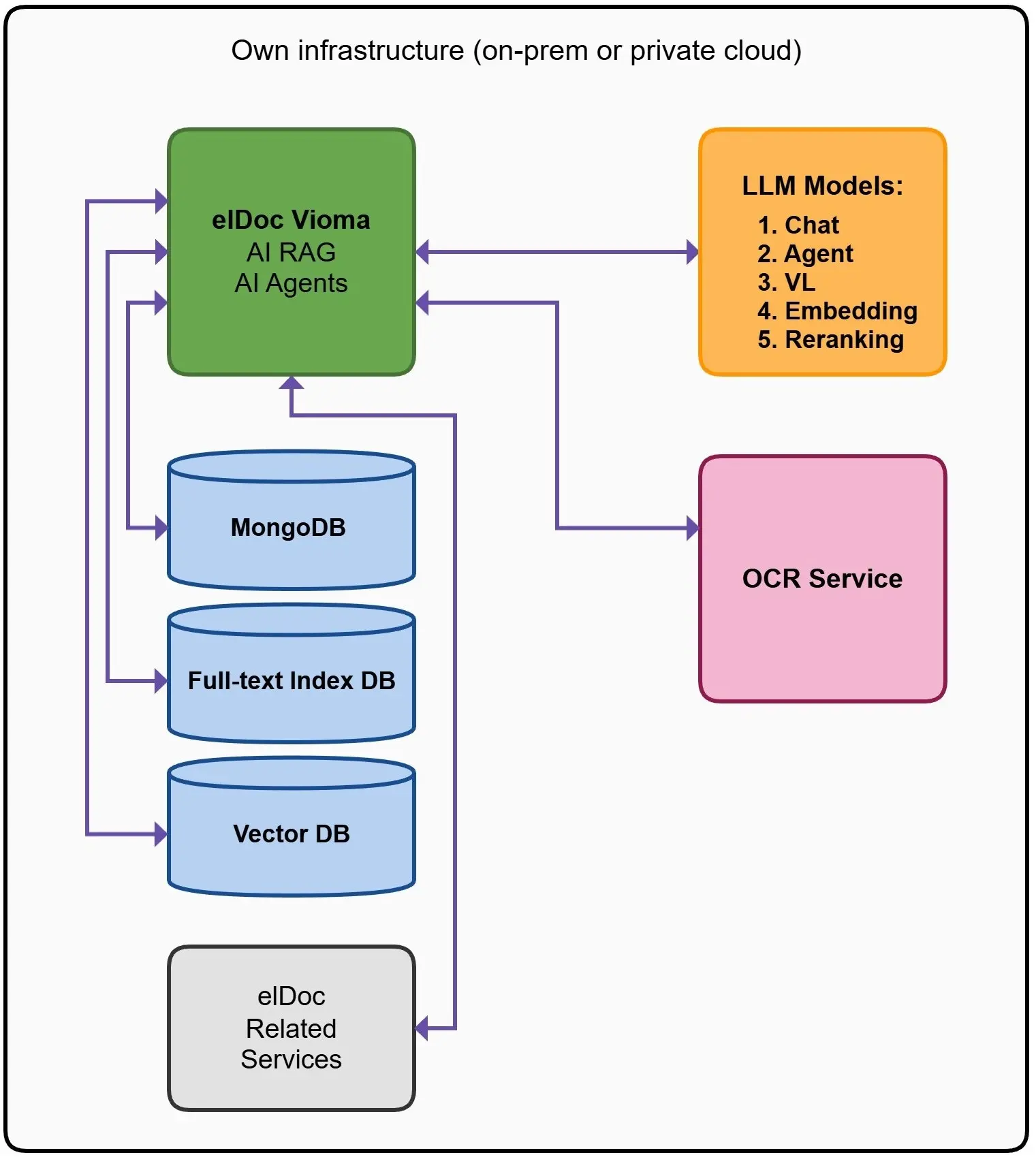
The platform also includes Multi-LLM Orchestration, allowing organizations to use different AI models for different business tasks. Instead of relying on a single Large Language Model, elDoc intelligently selects the optimal model for conversational AI, agent reasoning, document understanding, embeddings, or reranking retrieved information. This approach improves accuracy while optimizing performance and infrastructure costs.
Unlike many AI solutions that simply connect an LLM to a vector database, elDoc delivers a complete enterprise AI platform where document management, enterprise search, semantic retrieval, AI Document Agents, workflow automation, security, governance, and multiple AI models operate as a single integrated ecosystem.
The result is a production-ready Agentic RAG platform that enables organizations to deploy secure enterprise AI within their own infrastructure—whether on-premise, in a private cloud, or in an air-gapped environment—without the complexity of building and maintaining the underlying architecture themselves.
Designed for Fully On-Premise Enterprise AI
For many organizations, Generative AI is not limited by technology – it is limited by where sensitive business information can be processed. Financial institutions, government agencies, healthcare providers, manufacturers, and other regulated industries often cannot upload confidential documents or business data to public AI services due to security policies, regulatory requirements, contractual obligations, or data residency laws.
elDoc was built from the ground up to address these challenges by enabling organizations to deploy a complete Agentic RAG platform entirely within their own infrastructure.
Whether deployed in a corporate data center, private cloud, hybrid environment, or fully air-gapped network, the platform allows enterprises to adopt Generative AI without compromising control over their information.
Deployment options include:
- Fully on-premise
- Private cloud
- Hybrid cloud
- Air-gapped environments with no Internet connectivity
Unlike cloud-native AI services that require enterprise knowledge to be transmitted to external providers, elDoc keeps every stage of the AI lifecycle inside the organization’s trusted environment. Documents are stored locally, OCR and document processing run within the enterprise, embeddings are generated internally, vector databases remain under customer control, and AI models execute within the organization’s own infrastructure.
This means organizations retain complete ownership and governance of:
- Enterprise documents and archives
- Business knowledge and metadata
- AI models and LLMs
- Embedding models
- Vector databases
- User identities and authentication services
- Encryption keys
- Infrastructure and compute resources
- AI interactions and conversation history
- Audit logs and compliance records
Because the entire AI platform operates within the organization’s security perimeter, existing enterprise security policies continue to apply. Role-based access control, document-level permissions, identity management, encryption, audit logging, and governance are enforced consistently across documents, AI agents, and business workflows.
The platform also supports organizations pursuing AI sovereignty, allowing them to choose their preferred AI models, control where data is processed, determine how enterprise knowledge is indexed, and comply with local regulatory and industry-specific requirements without depending on external AI providers.
With elDoc, no confidential documents, business knowledge, customer information, or AI interactions need to leave the organization. Enterprises gain the benefits of modern Agentic RAG and AI Document Agents while maintaining complete control over their data, infrastructure, and compliance obligations.
Orchestrate Multiple LLMs or Bring Your Own Models
No single Large Language Model (LLM) delivers the best performance for every enterprise workload. A model that excels at conversational AI may not provide the highest accuracy for document extraction, while a powerful reasoning model may be unnecessary for everyday enterprise search. Relying on a single model often forces organizations to compromise between accuracy, performance, cost, and security.
elDoc is designed to orchestrate multiple AI models within a single platform, allowing each business process to use the model best suited for the task.
For example, organizations can simultaneously use:
- A lightweight chat model for fast enterprise conversations
- A reasoning model for complex document analysis and decision support
- Vision-language models for understanding scanned documents and images
This multi-model architecture enables organizations to optimize both AI quality and infrastructure costs while ensuring each business process benefits from the most suitable technology.
Bring Your Own Models
Every organization has different security, regulatory, and performance requirements. Some prefer fully open-source models running locally, while others require commercial models for specific workloads. Many organizations adopt a hybrid strategy that combines both.
elDoc provides complete flexibility by allowing organizations to bring their own AI models into the platform. Enterprises can deploy and manage their preferred LLMs without being locked into a single vendor or cloud provider.
Supported deployment strategies include:
- Open-source LLMs running entirely on-premise
- Commercial enterprise LLMs
- Vision-language models (VLMs)
- Domain-specific fine-tuned models
- Cloud-hosted models where permitted
- A combination of local and cloud models within the same environment
Because the platform separates AI orchestration from the underlying models, organizations can introduce new LLMs as technology evolves without redesigning their applications or rebuilding their Agentic RAG infrastructure.
Future-Proof Your Enterprise AI
The AI landscape is evolving rapidly, with new models delivering improvements in reasoning, multilingual capabilities, document understanding, and efficiency every few months. Locking enterprise applications to a single model increases both technical risk and long-term costs.
elDoc provides a model-agnostic architecture that protects organizations from vendor lock-in. AI agents, workflows, and business applications remain unchanged while the underlying models can be upgraded, replaced, or combined as business needs evolve.
This flexibility enables enterprises to continuously adopt the latest advances in Generative AI while maintaining complete control over security, governance, infrastructure, and operational costs.
Permission-Aware Enterprise Knowledge and AI Governance
Enterprise AI must operate within the same security and governance framework as the rest of the organization. An AI assistant should never become a shortcut around existing access controls, exposing confidential documents or sensitive business information simply because a user asked a question in natural language.
elDoc is built on the principle that AI should respect enterprise governance—not bypass it.
Every AI interaction is permission-aware. Before retrieving information, the platform verifies the user’s identity, evaluates their permissions, and ensures that only authorized documents, business data, and knowledge are included in the AI’s reasoning process. If a user does not have permission to access a document, that information is neither retrieved nor used to generate a response.
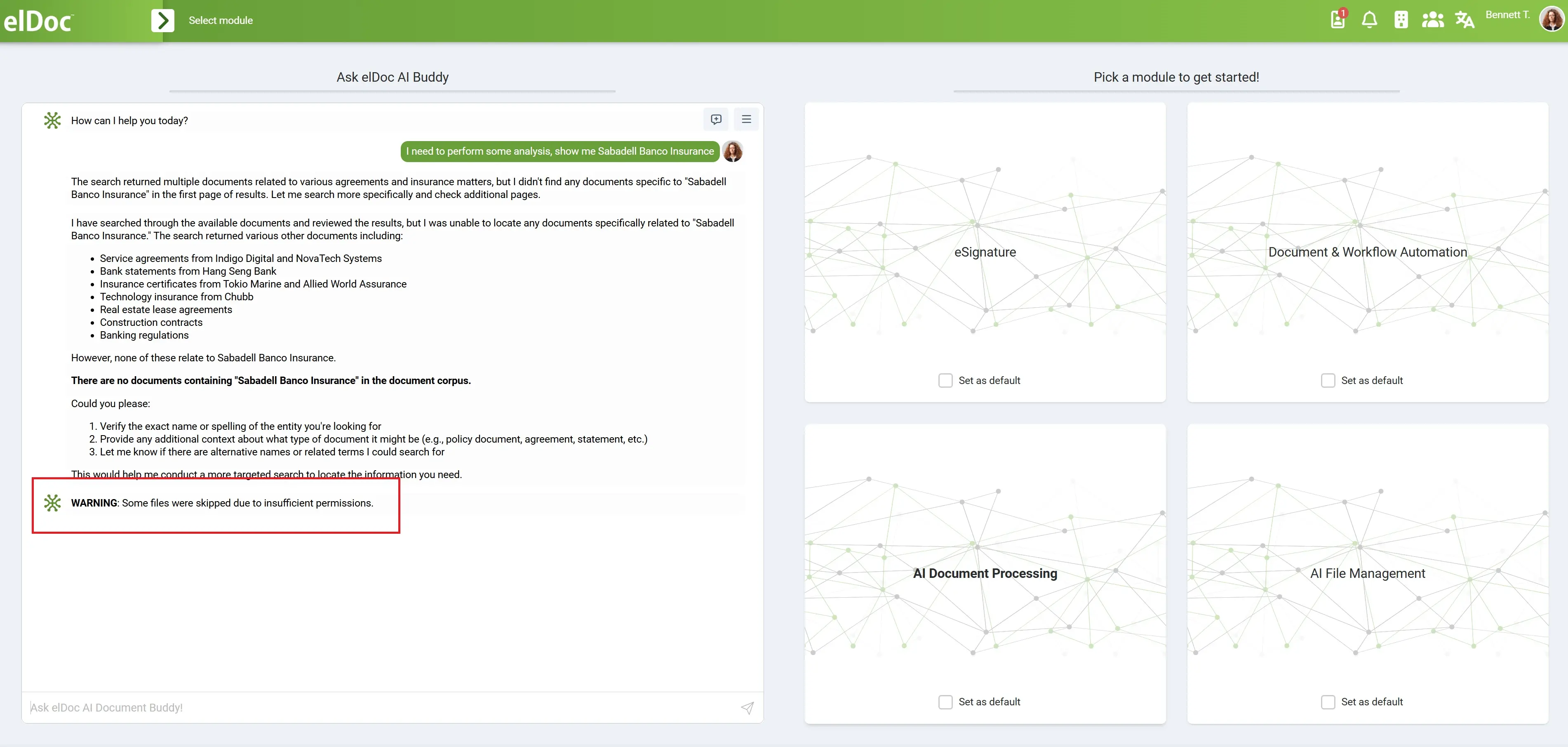
This enables organizations to deploy Agentic RAG confidently across departments while protecting confidential business information and maintaining compliance with existing security policies.
The platform supports enterprise-grade security through:
- Role-Based Access Control (RBAC)
- Workspace and team permissions
- Department and organizational unit security
- Document- and folder-level permissions
- Metadata-based security filtering
- Permission-aware search and retrieval
- Integration with enterprise identity providers (Active Directory, LDAP, SSO, OAuth)
- Complete audit trails and activity logging
Unlike many AI solutions that retrieve information from an entire vector database, elDoc applies security filtering before information is retrieved and sent to the LLM. AI only reasons over content the user is authorized to access, ensuring responses always reflect existing enterprise permissions.
Enterprise AI Governance
Security is only one part of responsible enterprise AI. Organizations also need governance over how AI models are deployed, how decisions are made, and how AI-generated content is monitored and controlled.
elDoc provides a comprehensive AI governance framework that enables organizations to confidently scale Generative AI while maintaining transparency, accountability, and regulatory compliance.
The platform supports governance across the entire AI lifecycle, including:
- Centralized orchestration of multiple LLMs
- Model selection policies based on business processes
- Human-in-the-loop approvals for critical decisions
- AI activity monitoring and operational oversight
- Configurable AI guardrails and business rules
- Data residency and sovereignty controls
- Encryption of enterprise data in transit and at rest
- Compliance with internal governance and industry regulations
- Audit, Monitoring, System logs
- High-Availability for Disaster Recovery Planning
Every interaction can be logged and traced—from the user’s request, through the documents retrieved, to the AI models involved and the final response generated. This level of transparency helps organizations demonstrate compliance, investigate decisions, improve AI quality, and establish trust in enterprise AI systems.
Rather than functioning as an isolated chatbot, elDoc becomes a governed enterprise AI platform where security, permissions, compliance, and AI oversight are embedded into every interaction. Organizations gain the confidence to deploy Agentic RAG and AI Document Agents across the enterprise, knowing that AI operates within the same governance framework as their documents, business processes, and corporate policies.
AI Agents That Do More Than Answer Questions
For many organizations, the first experience with Generative AI is an enterprise chatbot that answers questions based on company documents. While this significantly improves access to knowledge, it addresses only a small part of the business process.
Employees still need to interpret the answer, locate supporting documents, prepare reports, update business systems, send emails, initiate approvals, and complete numerous manual tasks before the work is actually finished.
Agentic RAG changes this paradigm.
Instead of acting solely as an intelligent assistant that retrieves information, AI agents become active participants in business processes. They understand the user’s objective, determine the sequence of actions required, retrieve and validate relevant information, interact with enterprise systems, and execute tasks according to business rules—all while keeping employees in control of critical decisions.
For example, rather than simply answering questions about an invoice, an AI agent can classify the document, extract key business information, validate totals against purchase orders, identify discrepancies, generate an approval summary, notify the responsible manager, and initiate the approval workflow.
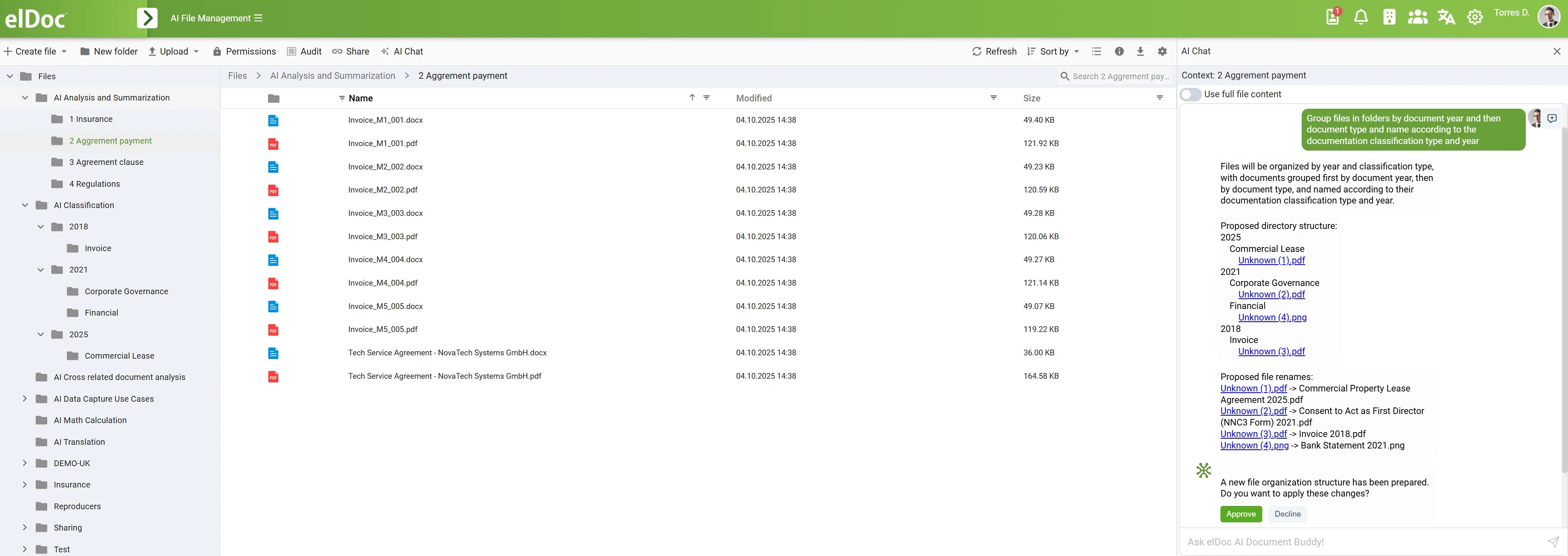
Because these agents operate on top of Agentic RAG, every action is grounded in trusted enterprise knowledge rather than relying solely on the language model. They can reason across multiple documents, combine information from structured and unstructured data, verify facts before taking action, and collaborate with employees whenever human approval is required.
Organizations are no longer limited to deploying a single AI assistant. Multiple specialized AI Document Agents can work together, each responsible for a specific business capability. One agent may classify and index incoming documents, another extract business information, another analyze contracts, while others generate reports, validate financial documents, coordinate approval workflows, or maintain enterprise knowledge. Together, these agents create an intelligent ecosystem that automates complex document-centric business processes.
Built for Enterprise Scale
Enterprise knowledge is one of an organization’s most valuable assets, but it is also one of its most difficult resources to manage. Every day, new documents are created, contracts are signed, invoices are processed, reports are generated, emails are exchanged, and business data is updated across multiple systems. Over time, this information becomes distributed across departments, repositories, and applications, making it increasingly difficult for employees to locate, understand, and use.
Large enterprises often manage millions of documents accumulated over decades of business operations. Knowledge exists not only in document management systems but also in file shares, SharePoint sites, ERP and CRM platforms, email systems, scanned paper archives, engineering repositories, collaboration platforms, and numerous line-of-business applications. Much of this information remains unstructured, duplicated, or isolated within departmental silos.
As organizations grow, so does the complexity of managing enterprise knowledge. Simply indexing documents or providing keyword search is no longer sufficient. Employees need AI that understands business context, relationships between documents, organizational structures, customers, suppliers, projects, contracts, products, financial records, and historical business decisions.
elDoc is designed specifically for this enterprise scale.
The platform can securely manage and process:
- Millions of enterprise documents
- Decades of historical archives
- Multiple document repositories
- Structured and unstructured business data
- Emails and business correspondence
- Scanned documents and paper archives
- Contracts and legal documentation
- Engineering and technical documentation
- Corporate policies and procedures
- Financial records and transactional documents
Rather than treating these as isolated sources of information, elDoc transforms them into a unified, AI-ready enterprise knowledge platform. Using Intelligent Document Processing, semantic indexing, metadata enrichment, and Agentic RAG, every document becomes part of an interconnected knowledge ecosystem that AI can understand and reason over.
This enables employees to ask questions across the entire organization instead of searching individual systems. AI can combine information from multiple repositories, understand relationships between documents and business entities, and provide responses based on the complete organizational context rather than a single file or database.
Because the platform is built for enterprise-scale deployments, organizations can continuously expand their knowledge base without redesigning their AI architecture. As new documents, repositories, departments, and business applications are added, they become part of the same secure knowledge platform, allowing AI agents to deliver increasingly comprehensive insights and automate more sophisticated business processes.
The result is more than enterprise search. It is a continuously evolving, AI-powered knowledge platform where documents, business data, and organizational expertise become trusted, connected, and immediately accessible through intelligent search, AI Document Agents, and Agentic RAG.
Does elDoc Enterprise Agentic RAG Require Massive GPU Infrastructure? Not Necessarily.
One of the biggest misconceptions about deploying Generative AI on-premise is that organizations must make a substantial upfront investment in GPU infrastructure before they can realize the benefits of Agentic RAG.
In practice, infrastructure requirements are driven by business use cases, the number of users, and the AI models supporting those workloads—not simply by the decision to run AI within your own environment.
Many elDoc customers begin with a single AI server equipped with just two or four GPUs. This is often more than sufficient for initial deployments, including enterprise Agentic RAG, AI Document Agents, intelligent document search, and document processing. As adoption grows, organizations can expand incrementally by adding GPUs, additional AI servers, or new AI models. This phased approach minimizes initial investment while providing a straightforward path to enterprise-scale AI.
Another common misconception is that every AI request requires the largest and most powerful language model. In reality, most enterprise workloads do not.
For example, enterprise search, document classification, metadata extraction, and everyday AI conversations can typically be handled by lightweight, highly efficient models. More computationally intensive models are only required for advanced reasoning, complex document analysis, vision-language processing, or specialized business scenarios.
This is where elDoc’s multi-LLM orchestration provides a significant advantage.
Lightweight local models handle routine interactions, while larger reasoning models are invoked only when their capabilities are needed. Embedding models generate semantic representations for Agentic RAG, reranking models improve retrieval quality, and OCR and document intelligence services operate independently. Each AI component performs the task it is optimized for, maximizing performance while minimizing infrastructure consumption.
This intelligent orchestration delivers several important advantages:
- Lower GPU infrastructure investment
- Reduced operational costs
- Faster response times for everyday AI workloads
- Higher throughput for concurrent users
- Independent scaling of AI services as demand grows
- The flexibility to introduce new AI models without redesigning applications
Because elDoc is model-agnostic, organizations are never locked into a specific hardware platform or LLM vendor. They can deploy open-source models, commercial enterprise models, or a combination of both, selecting the infrastructure that best aligns with their performance, security, and budget requirements. Whether running on a single AI server, a scalable GPU cluster, or a hybrid architecture combining local and approved cloud models, the platform evolves alongside the organization’s AI strategy.
The objective is not to build the largest AI infrastructure—it’s to build the most efficient one. By combining Agentic RAG, intelligent model orchestration, and enterprise knowledge, elDoc enables organizations to achieve high-quality AI outcomes while optimizing GPU investment, reducing operating costs, and maintaining complete control over their data and infrastructure.