
elDoc Plug-and-Play Pipeline for Intelligent Document Processing with LLMs

With the rapid market penetration of Large Language Models (LLMs) and the rise of AI agents, the Intelligent Document Processing (IDP) market has been reborn with an entirely new perspective and set of expectations. Organizations no longer expect document systems to simply scan and extract text. They now expect intelligent platforms capable of understanding, reasoning, validating, automating, and interacting with enterprise documents in real time.
This shift triggered a massive wave of innovation across the industry. Many organizations rushed to build GenAI-powered document-processing solutions from scratch by assembling OCR engines, vector databases, orchestration frameworks, AI agents, prompt workflows, and multiple LLMs.
However, many of these early implementations struggled in production.
The reason was simple: Intelligent Document Processing is not just about plugging an LLM into a workflow.
Modern GenAI document processing requires a solid, robust, scalable, and enterprise-grade pipeline architecture capable of handling:
- Complex document variations
- OCR inconsistencies
- Validation and compliance workflows
- Human review processes
- Multi-model orchestration
- Enterprise integrations
- Security and governance
- High-volume transactional processing
- Reliability and observability
Without a stable orchestration layer, AI agents alone cannot deliver reliable enterprise automation. Modern enterprises require document-processing platforms that are scalable, intelligent, secure, and rapidly deployable. Organizations handling invoices, contracts, claims, forms, logistics documents, and compliance records can no longer rely on fragmented automation systems.
elDoc addresses this challenge through a ready-to-use, plug-and-play GenAI document-processing pipeline designed for end-to-end enterprise automation.
The elDoc platform provides:
- Multi-channel document ingestion
- AI-powered OCR and document recognition
- Vision Language (VL) + LLM extraction
- Automated validation workflows
- Human-in-the-loop review
- Agentic Retrieval-Augmented Generation (RAG) for deep document analysis
- ERP integration and data posting
- Secure storage and orchestration
Unlike traditional systems that require extensive customization and integration effort, elDoc delivers a unified architecture that enterprises can deploy rapidly while still maintaining flexibility and scalability.
The orchestrated GenAI invoice-processing pipeline within elDoc seamlessly manages the full journey from invoice intake to ERP posting, enabling intelligent automation across the complete invoice lifecycle.
Document processing has evolved from rule-based Optical Character Recognition (OCR) systems into intelligent, context-aware workflows powered by Large Language Models (LLMs). Organizations now expect systems that can extract, classify, summarize, validate, and transform documents with minimal human intervention.
However, one of the biggest challenges in enterprise AI adoption is not the LLM itself – it is the pipeline around it.
Traditional document-processing architectures are often rigid:
- OCR engines are tightly coupled to extraction logic
- Classification models are difficult to replace
- Validation rules are embedded deep inside code
- Workflow orchestration becomes complex over time
- Scaling to new document types requires major re-engineering
This is where the concept of a plug-and-play pipeline architecture becomes critical.
A plug-and-play document-processing pipeline allows organizations to:
- Swap OCR providers without redesigning workflows
- Integrate multiple LLMs dynamically
- Reuse components across use cases
- Scale document types independently
- Add validation, enrichment, or retrieval modules incrementally
- Support hybrid AI + deterministic processing
This article explores how we designed elDoc a modern plug-and-play architecture for document processing using LLMs.
What Is a Plug-and-Play Pipeline for Document Processing?
A plug-and-play pipeline is a modular document-processing architecture where each stage is isolated, standardized.
Each module:
- Has a defined input/output contract
- Operates independently
- Can be swapped without affecting the entire system
- Communicates through structured interfaces
- Supports orchestration and observability
The elDoc platform provides a ready-to-use orchestrated pipeline that combines AI OCR, computer vision, LLMs, automation, validation, and enterprise integration into a unified workflow. The architecture supports scalable document processing and intelligent document automation across enterprise environments.
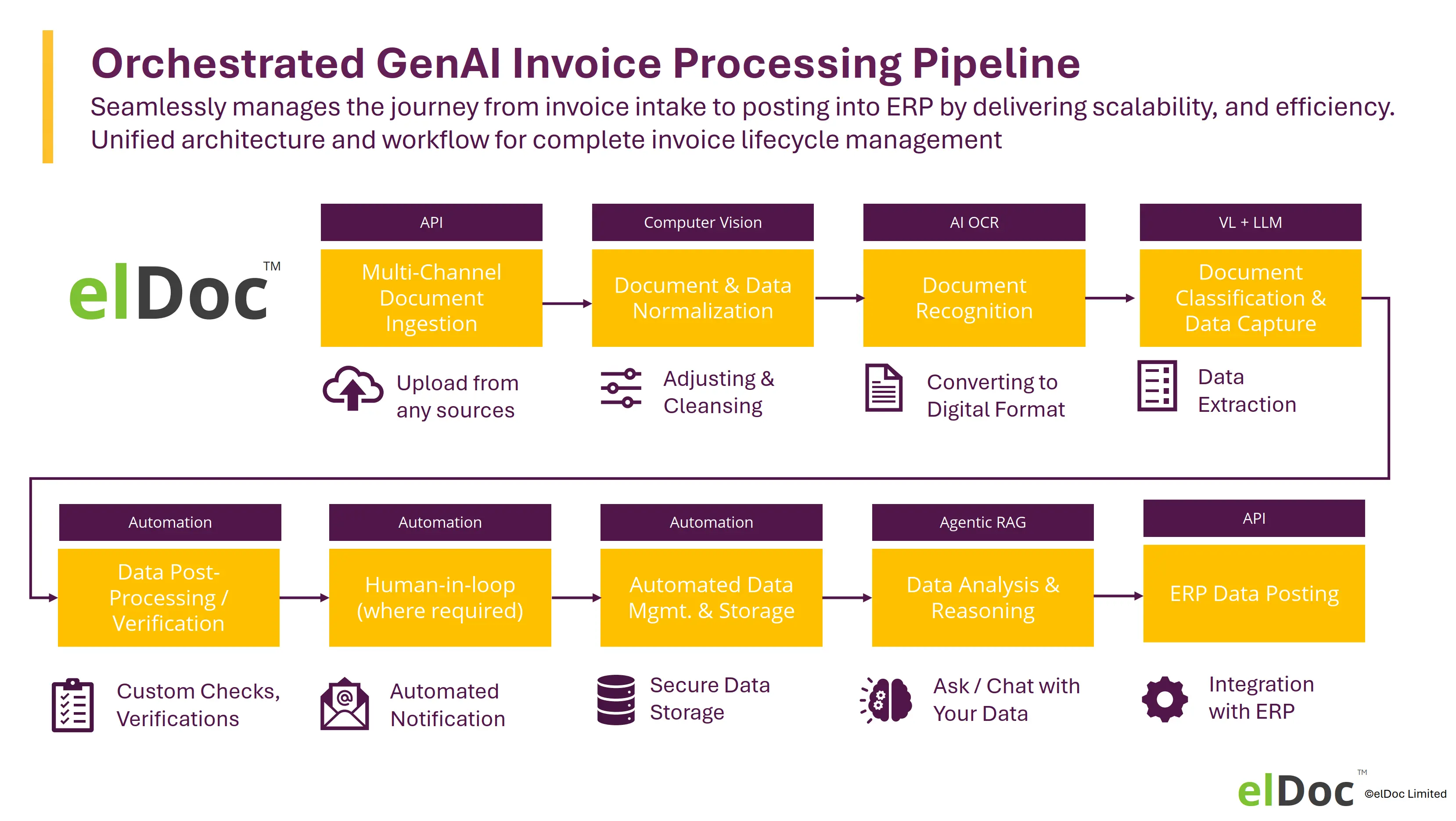
elDoc Core Pipeline Components
1. Multi-Channel Document Ingestion
elDoc enables ingestion from multiple enterprise channels through APIs and connectors.
Supported channels include:
- Shared folders
- Cloud storage
- ERP exports
- Mobile uploads
- Scanners
- SFTP
- Web portals
- Enterprise applications
This ingestion layer allows organizations to upload documents from virtually any source while preserving metadata and ensuring traceability. At the same time, elDoc also provides a user-friendly interface where business users can upload and process documents directly through the platform without requiring technical integration. The ingestion strategy is entirely driven by business requirements and processing scale.
For example:
- High-volume enterprise processing involving thousands or hundreds of thousands of documents is best handled through APIs and automated integrations.
- Smaller-scale operations or department-level processing can be managed directly by users through the elDoc interface.
This flexibility enables organizations to adopt elDoc progressively from manual user-driven workflows to fully automated enterprise-scale document orchestration. Whether processing 100 documents or 100,000 documents, elDoc provides the same unified orchestration, validation, and AI-driven processing pipeline.
2. Document and Data Normalization
Using computer vision technologies, elDoc automatically adjusts and cleanses incoming documents before recognition.
Capabilities include:
- Image enhancement
- Noise removal
- Orientation correction
- Layout normalization
- Resolution optimization
- Page segmentation
This normalization stage significantly improves downstream OCR and extraction accuracy.
Depending on deployment scenarios and enterprise requirements, clients can choose different OCR technologies within the elDoc pipeline.
For example:
- Google Cloud Vision API for scalable cloud-native OCR processing
- PaddleOCR for flexible open-source multilingual OCR deployments
- or Tesseract
This plug-and-play OCR approach allows organizations to select the most suitable recognition engine based on:
- Cost considerations
- Deployment architecture
- Language support
- Accuracy requirements
- Compliance constraints
- Cloud or on-premise preferences
The OCR abstraction layer within elDoc ensures that enterprises can switch OCR providers without redesigning the overall workflow. This stage forms the digital foundation for intelligent processing.
3. VL + LLM Document Classification and Data Capture
elDoc integrates Vision Language (VL) models and Large Language Models (LLMs) to classify documents and extract structured business data with high accuracy and contextual understanding.
The LLM-powered extraction layer enables high-accuracy data capture even for unstructured, semi-structured, or highly variable invoice formats. One of the major advantages of elDoc is its flexibility in allowing enterprises to choose which LLMs and Vision Language models to use based on their specific business requirements, deployment preferences, and processing scenarios.
Different organizations have different priorities. For example:
- Some clients prioritize high-speed processing for large transactional volumes
- Some require advanced understanding of complex layouts and graphical document structures
- Some focus on multilingual processing capabilities
- Others require higher reasoning capabilities for compliance or financial validation
- Some enterprises prefer cloud-hosted models, while others require private or on-premise deployments
Depending on these requirements, elDoc can work with multiple model providers and architectures, enabling organizations to optimize for:
- Speed
- Accuracy
- Cost efficiency
- Layout understanding
- Complex table extraction
- Visual reasoning
- Security and compliance
This plug-and-play AI architecture allows enterprises to evolve their AI stack over time without redesigning the overall document-processing workflow.
4. Automated Post-Processing and Verification
After extraction, elDoc applies configurable validation and business-rule automation.
Examples include:
- Duplicate invoice checks
- Tax validation
- Vendor verification
- Amount reconciliation
- Business policy enforcement
- Compliance checks
This stage reduces manual review while improving processing accuracy. The ability to combine AI extraction with configurable deterministic business rules significantly improves reliability, reduces manual review effort, and increases enterprise trust in automated document-processing workflows.
5. Human-in-the-Loop Automation
Human-in-the-loop processing is one of the most important stages within the elDoc pipeline architecture. While AI, LLMs, and automation significantly improve document-processing efficiency, it is not realistic or advisable to rely entirely on AI for every scenario. Certain cases still require human validation and decision-making to ensure business reliability and operational accuracy.
elDoc is designed with this principle in mind.
The exception-handling workflow is not treated as a separate external system – it is a fully integrated part of the overall processing pipeline and orchestration workflow.
Exceptions may occur for different reasons, including:
- Low-confidence AI extraction results
- OCR recognition failures
- Incorrect document classification
- Missing business information
- Validation-rule failures
- ERP matching inconsistencies
- Compliance-related issues
- Customer-specific business exceptions
Once an exception is detected, elDoc automatically triggers the appropriate workflow actions.
This may include:
- Automatic email notifications to assigned users or teams
- Workflow escalation procedures
- Validation task assignments
- Exception queues and review routing
Users can then access a user-friendly validation interface directly within elDoc to quickly review and correct the document.
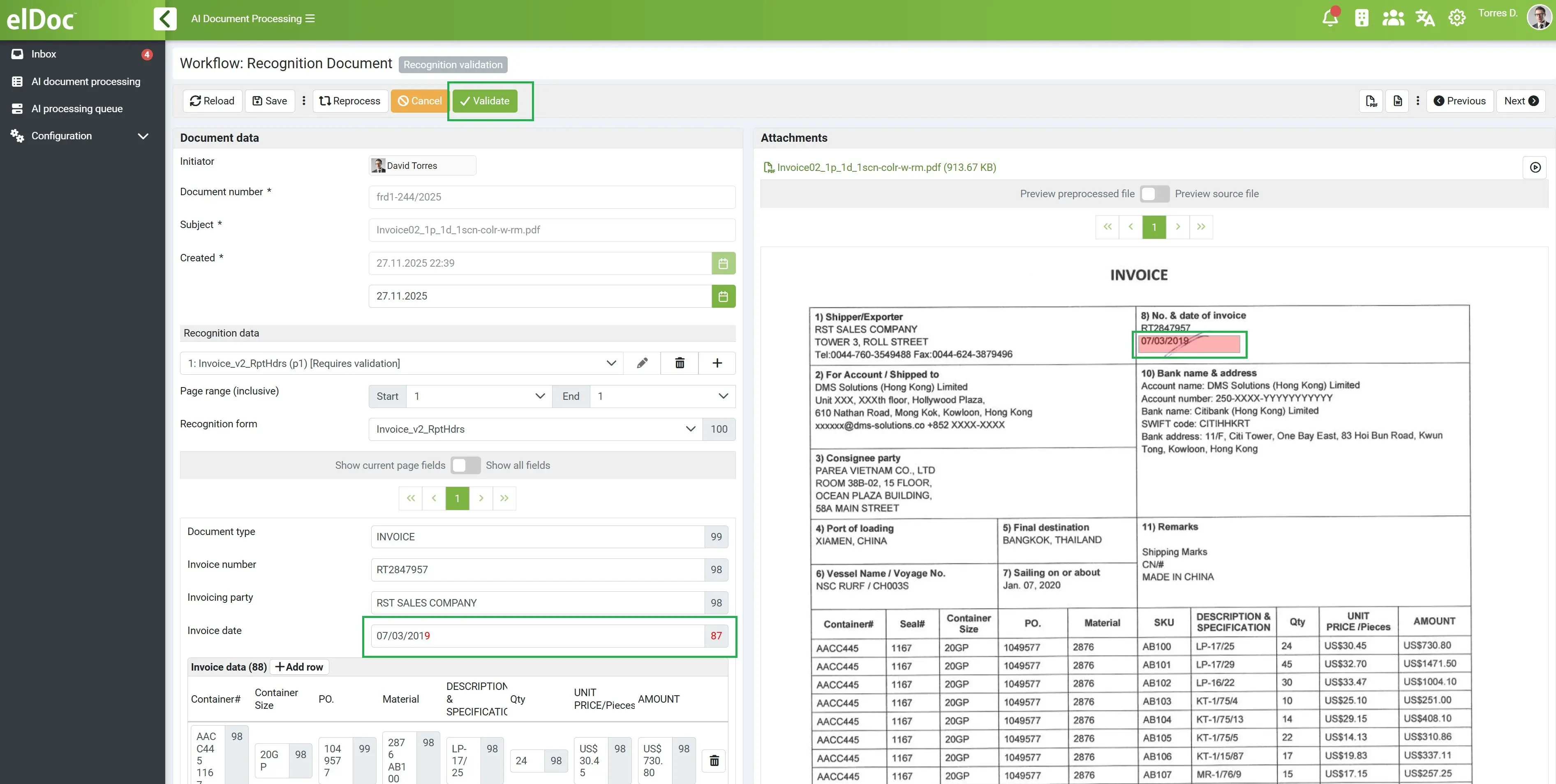
The interface enables users to:
- Review extracted fields
- Validate AI-generated outputs
- Correct missing or incorrect values
- Approve or reject processing steps
- Resolve business-rule exceptions
- Continue workflow approvals
Once validation or correction is completed, the document automatically returns back into the processing pipeline and continues through the remaining workflow stages without restarting the entire process.
This hybrid AI + human orchestration model provides several major advantages:
- Higher enterprise reliability
- Reduced operational risk
- Better compliance handling
- Faster exception resolution
- Improved user trust in AI automation
- Continuous workflow continuity
By embedding human validation directly into the orchestration pipeline, elDoc delivers a practical and enterprise-ready approach to intelligent document processing where AI and human expertise work together seamlessly.
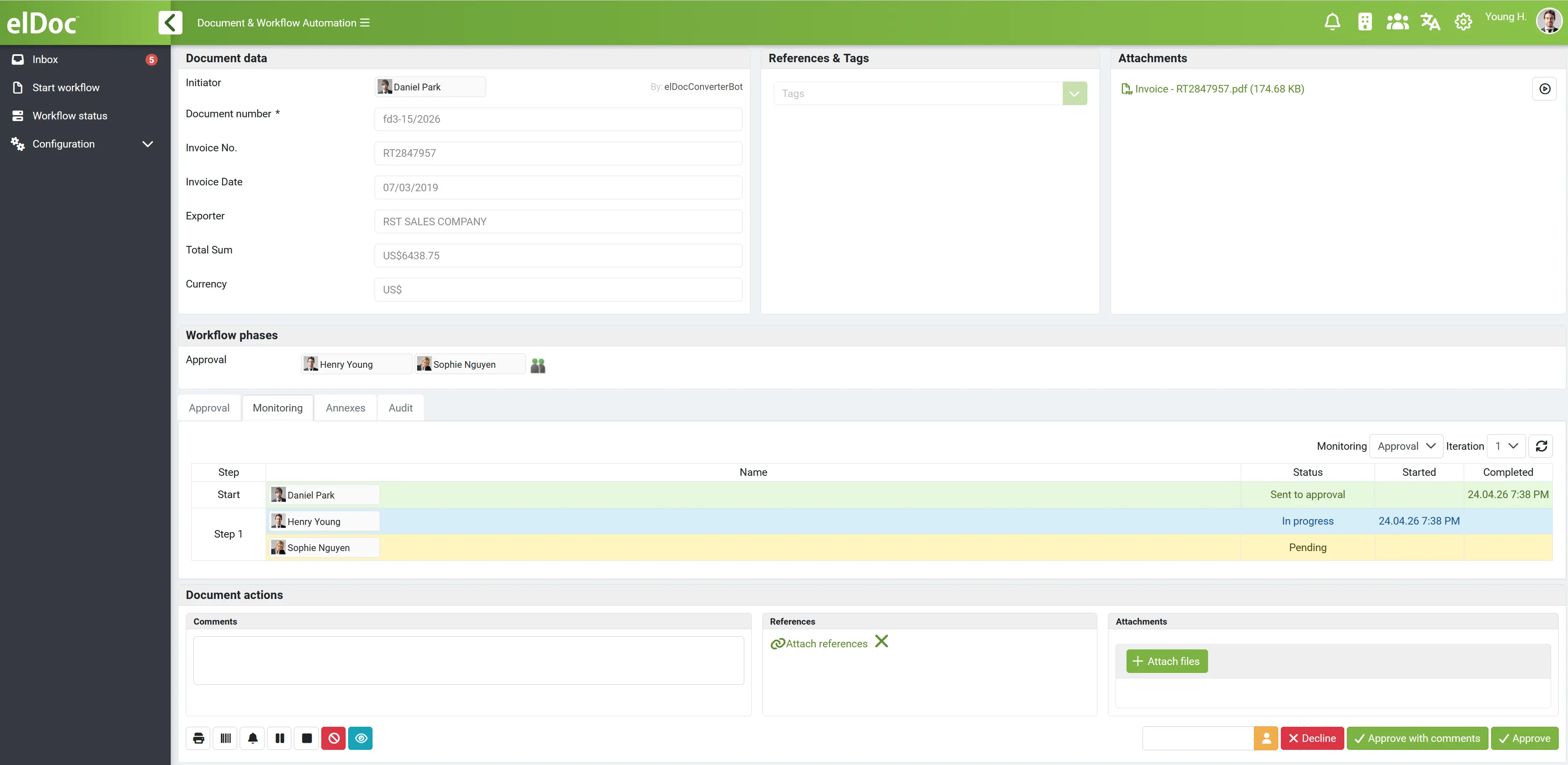
6. Triggering Automated Approval Workflows
In many enterprise scenarios, document processing does not end with extraction and validation alone. Business documents such as invoices, contracts, procurement requests, compliance forms, and financial approvals often require additional authorization and review workflows before final processing or ERP posting can occur. To address this, elDoc includes fully integrated automated approval workflow capabilities as part of its intelligent document-processing pipeline. Once documents are processed, validated, and classified, elDoc can automatically trigger approval workflows based on configurable business rules and organizational policies.
Examples include:
- Invoice approval workflows
- Contract review and approval
- Procurement authorization
- Budget validation
- Compliance approval
- Legal review processes
- etc
The workflow engine supports multiple approval models, including:
- Sequential approvals
- Parallel approvals
- Multi-stage approval chains
Once triggered, elDoc automatically sends approval notifications via email or integrated workflow channels to the appropriate users.
Approvers can then:
- Review documents directly within elDoc
- Validate extracted information
- Approve or reject workflows
- Add comments or feedback
- Request corrections or additional review
One of the key strengths of the elDoc approval framework is its full auditability and workflow traceability.
The platform tracks:
- Who approved the document
- When the approval occurred
- Which workflow stage was completed
- Approval comments and actions
- Workflow escalations
- Rejected or modified approvals
- Complete approval history and logs
This provides strong governance, compliance, and operational transparency for enterprise organizations. elDoc also supports advanced organizational flexibility for real-world business operations.
7. Automated Data Management and Secure Storage
elDoc is not only a document-processing platform – it is also an intelligent enterprise data-management and knowledge foundation system. All processed documents, extracted data, validation results, approval histories, workflow actions, and metadata become valuable digital assets for the organization. Instead of treating documents as temporary processing inputs, elDoc transforms them into structured, searchable, and reusable enterprise knowledge.
The platform securely stores:
- Original uploaded documents
- OCR outputs
- Extracted business data
- Approval histories
- Workflow logs
- Validation records
- User actions and audit trails
- AI-generated insights and metadata
elDoc supports:
- Secure document repositories
- Metadata indexing
- Full audit trails
- Compliance retention policies
- Encryption and access control
- Structured and unstructured storage
- Enterprise search and retrieval
This centralized and structured data foundation becomes extremely valuable for future GenAI and business intelligence initiatives. As more documents are processed through elDoc, the platform continuously builds a richer enterprise knowledge base that can support intelligent decision-making across departments and business functions. This enables organizations to move beyond simple automation into AI-driven operational intelligence. By combining intelligent processing, secure storage, workflow history, and GenAI-ready data management, elDoc helps enterprises unlock long-term strategic value from their document ecosystems.
8. Agentic RAG Data Analysis and Reasoning
One of the major differentiators of elDoc is its advanced Agentic RAG (Retrieval-Augmented Generation) capability, which transforms traditional document-processing systems into intelligent enterprise knowledge and reasoning platforms. Most document-processing solutions stop after extraction, validation, and ERP posting. elDoc goes significantly further.
Because elDoc securely stores processed documents, extracted business data, workflow histories, validation records, approval actions, and metadata, the platform continuously builds a structured enterprise knowledge layer that can be leveraged by GenAI models and intelligent agents.
This enables organizations not only to process documents but also to understand, analyze, reason over, and generate insights from enterprise data at scale.
The platform allows users to:
- Ask natural-language questions about enterprise documents
- Chat with invoices, contracts, and business records
- Retrieve contextual business information
- Perform intelligent reasoning across multiple document sources
- Generate operational insights from historical records
- Discover anomalies, patterns, and risks
- Support financial and procurement decision-making
- Analyze approval and workflow trends
- Search enterprise knowledge semantically instead of manually
Unlike traditional keyword search systems, Agentic RAG enables semantic understanding of enterprise information.
For example, users can ask questions such as:
“Show all invoices from suppliers with delayed approvals in the last 6 months.”
“Which vendors frequently submit invoices with tax inconsistencies?”
“Summarize contracts expiring next quarter with high financial exposure.”
“Identify procurement risks across business units.”
“Compare invoice trends by supplier and region.”
“Which departments generate the highest exception rates?”
Instead of simply retrieving documents, elDoc intelligently reasons over the stored data using AI agents and contextual retrieval mechanisms.
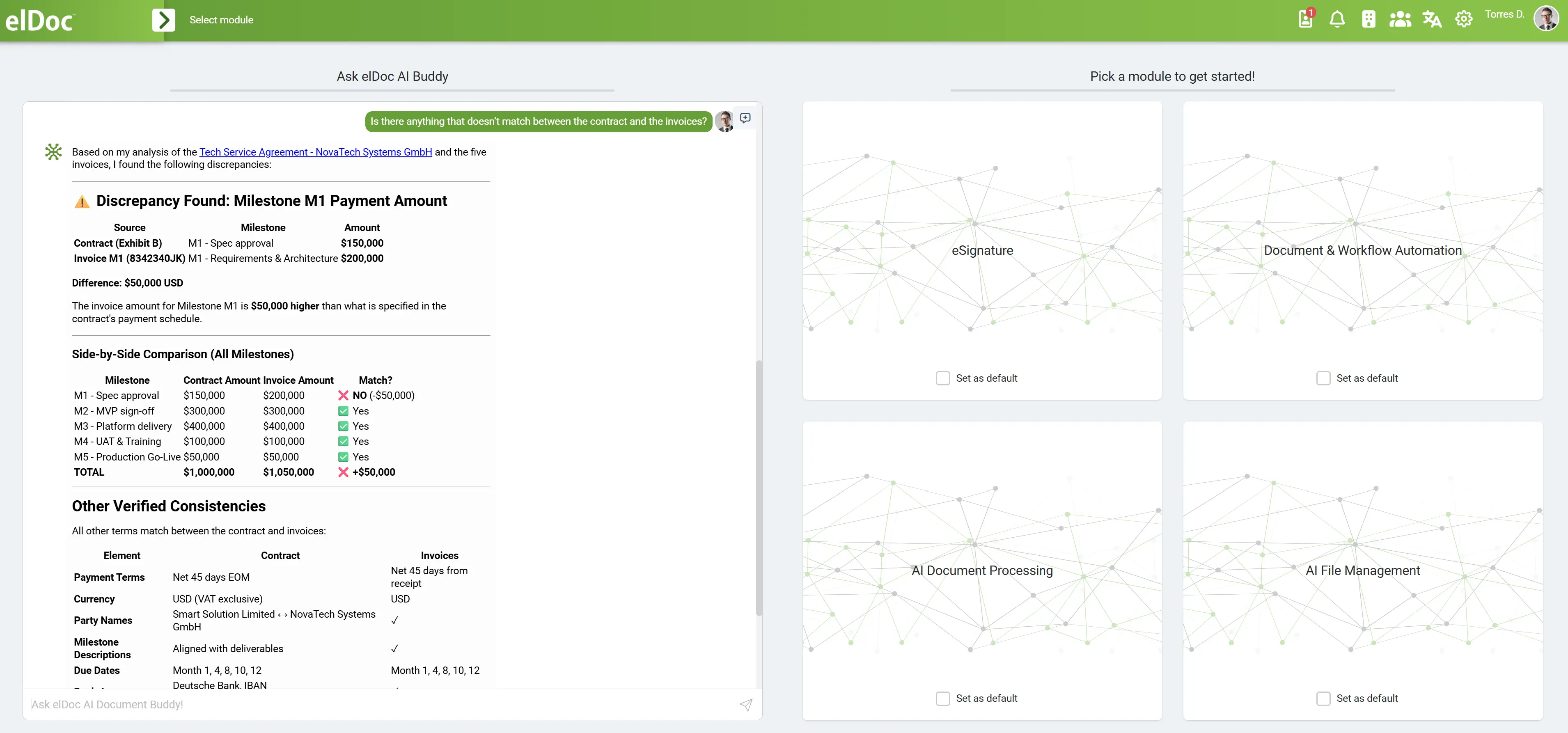
The Agentic RAG architecture combines several advanced capabilities:
- Retrieval-Augmented Generation (RAG)
- Vector search and semantic retrieval
- Multi-agent orchestration
- Context-aware reasoning
- Workflow-aware intelligence
- LLM-powered summarization and analysis
- Historical document memory and referencing
AI agents within elDoc can dynamically retrieve relevant records, analyze relationships between documents, reason over business workflows, and generate contextual responses or recommendations.
Because the system has access not only to documents but also to workflow histories, validations, approvals, user actions, and metadata, the reasoning process becomes significantly more powerful than standard document search.
Another major advantage is that elDoc supports enterprise-specific contextual grounding.
Organizations can enrich the RAG system with:
- Internal policies
- Supplier master data
- ERP records
- Regulatory documentation
- Procurement rules
- Accounting guidelines
- Industry-specific knowledge bases
This allows the AI agents to reason within the context of the organization’s actual business environment rather than relying only on generic LLM knowledge. The result is a new generation of intelligent document operations where enterprise data becomes an active strategic asset rather than passive archived content. By combining intelligent document processing, secure enterprise storage, semantic retrieval, and agentic reasoning, elDoc enables organizations to move from simple automation toward AI-driven operational intelligence and decision augmentation.
9. ERP Data Posting and Enterprise Integration
The final stage of the elDoc pipeline focuses on seamless enterprise integration and automated data synchronization across business systems. While ERP integration is a major component, elDoc is not limited only to ERP connectivity. The platform is designed as an enterprise integration layer capable of connecting intelligent document workflows with a wide range of business applications, platforms, and operational systems. After documents are processed, validated, approved, and enriched, elDoc can automatically transfer structured data and workflow results into downstream enterprise environments.
This may include:
- ERP systems
- Accounting platforms
- Procurement systems
- CRM platforms
- HR systems
- Compliance and governance platforms
- Data warehouses and analytics systems
- Workflow and BPM platforms
- Cloud storage systems
- Enterprise content management systems
- Internal APIs and custom enterprise applications
Examples of supported enterprise platforms include:
- SAP
- Oracle
- Microsoft Dynamics
- NetSuite
- Salesforce
- Workday
- ServiceNow
- SharePoint
- Custom ERP and business platforms
This flexibility allows organizations to integrate elDoc into existing enterprise ecosystems without redesigning their operational infrastructure. Another major advantage is that all integrations remain fully traceable and monitored within the elDoc platform.
Organizations can monitor:
- Integration statuses
- Data transfer logs
- Failed transactions
- Retry workflows
- Processing histories
- API activities
- Approval-to-posting timelines
This ensures operational transparency, auditability, and enterprise-grade governance.
Accelerating Enterprise AI Automation with elDoc
The rapid evolution of LLMs, Vision AI, and AI agents has fundamentally changed the expectations around Intelligent Document Processing. Organizations today are no longer looking only for OCR extraction tools. They expect intelligent platforms capable of understanding documents, validating business logic, orchestrating workflows, integrating with enterprise systems, and generating operational insights through AI-driven reasoning.
However, building a production-ready GenAI document-processing platform is significantly more complex than connecting a few AI models together.
True enterprise-grade Intelligent Document Processing requires:
- Robust orchestration pipelines
- Scalable AI infrastructure
- OCR abstraction layers
- Validation and compliance workflows
- Human-in-the-loop automation
- Approval orchestration
- Enterprise integrations
- Monitoring and observability
- Security and governance
- Agentic RAG intelligence capabilities
Many organizations attempting to build these solutions internally quickly discover that developing a stable, scalable, and enterprise-ready platform can require 12 to 24 months – sometimes longer before reaching production maturity. At the same time, the market is moving rapidly, and businesses cannot afford to delay automation initiatives while building foundational infrastructure from scratch.
elDoc provides an alternative approach.
Instead of spending years assembling disconnected components, enterprises and partners can start automating document workflows from day one using a proven plug-and-play Intelligent Document Processing platform.
The elDoc platform has been designed, tested, and optimized across multiple enterprise deployments and large-scale processing environments.
It provides:
- Ready-to-use GenAI document workflows
- Scalable orchestration pipelines
- AI OCR and Vision Language processing
- Flexible LLM integrations
- Human validation workflows
- Intelligent approval automation
- Agentic RAG capabilities
- Enterprise integration frameworks
- Secure storage and governance
- Operational scalability across industries and business scenarios
Whether organizations process hundreds, thousands, or millions of documents, elDoc enables them to accelerate AI adoption while reducing implementation risk, operational complexity, and time-to-value. The future of enterprise automation will not belong only to organizations that adopt AI models – it will belong to those that successfully operationalize AI through scalable, resilient, and intelligent business workflows. elDoc helps organizations move from experimentation to real enterprise AI operations enabling faster deployment, intelligent automation, operational visibility, and long-term strategic value creation.