
Enterprise AI Search & Knowledge with Generative AI

Generative AI is fundamentally changing how employees interact with enterprise information. Instead of navigating multiple applications, searching through folders, or relying on keyword-based search engines, users increasingly expect AI to provide direct answers, explain complex topics, compare documents, summarize reports, and even complete business tasks on their behalf.
This shift is transforming traditional enterprise search into something far more powerful—an Enterprise AI Knowledge Platform. Rather than simply retrieving documents, modern AI platforms understand enterprise content, reason across multiple knowledge sources, and deliver trusted responses grounded in organizational data.
However, achieving this capability requires much more than deploying a Large Language Model (LLM). Organizations need a secure architecture that connects enterprise repositories, understands documents at scale, orchestrates multiple AI models, and enforces enterprise-grade security and governance.
This is the foundation on which elDoc is built.
How elDoc Builds a Secure Enterprise AI Knowledge Platform
For decades, enterprise search meant typing keywords into a search box and hoping the right document appeared somewhere in hundreds of results.
Generative AI has fundamentally changed that expectation.
Employees no longer want documents.
They want answers.
They want AI that understands contracts, invoices, engineering drawings, policies, procedures, emails, reports, meeting minutes, manuals, ERP records, CRM data, and every other piece of enterprise knowledge.
More importantly, they expect AI not only to answer questions, but also to perform work.
This shift represents the evolution from Enterprise Search to an Enterprise AI Knowledge Platform.
That is exactly what elDoc was designed to deliver.
Why LLMs Alone Cannot Understand Your Business
Many organizations begin their AI journey by deploying a Large Language Model such as ChatGPT, Llama, Mistral, DeepSeek, or another commercial or open-source model. While these models are exceptionally capable at understanding language, reasoning, and generating human-like responses, they have no inherent knowledge of your organization’s business, documents, or operational processes.
An LLM does not know your contracts, engineering drawings, policies, ERP records, customer correspondence, project documentation, or decades of accumulated institutional knowledge. It has no understanding of document relationships, approval histories, business rules, or the security permissions that determine who is allowed to access specific information. Without this context, even the most advanced language model can only produce responses based on publicly available knowledge or the limited information explicitly provided in a prompt.
For Enterprise AI to deliver reliable business value, the language model must be connected to trusted organizational knowledge. This requires far more than simply uploading documents into a chatbot. Enterprise information must first be securely connected, intelligently processed, indexed, classified, and continuously synchronized across repositories. At the same time, every AI interaction must respect existing access permissions, governance policies, and compliance requirements to ensure that sensitive information is only available to authorized users.
This secure knowledge layer is what transforms a general-purpose language model into an enterprise-ready AI assistant. Rather than replacing the LLM, it provides the business context, trusted data, and governance framework that enable AI to deliver accurate, explainable, and permission-aware responses. This is precisely the role of elDoc—serving as the secure Enterprise AI Knowledge Platform that connects organizational knowledge with one or multiple language models, enabling AI to understand your business rather than simply generate text.
elDoc Creates a Secure Enterprise Knowledge Fabric
A Large Language Model alone is not an Enterprise AI platform. While an LLM provides powerful reasoning and language capabilities, it does not offer the secure framework required to understand, organize, govern, and continuously access enterprise knowledge. It has no native ability to connect to business repositories, process millions of documents, enforce enterprise security policies, or maintain a trusted and up-to-date knowledge base.
elDoc fills this gap by creating a secure Enterprise Knowledge Fabric that transforms fragmented business information into AI-ready knowledge. Rather than treating documents as isolated files, the platform continuously ingests, understands, enriches, and indexes enterprise content so it can be securely accessed by AI agents and language models.
As information is connected to the platform, elDoc automatically performs intelligent processing, including optical character recognition (OCR) for scanned documents and images, AI-powered document classification, metadata extraction, semantic document chunking, full-text indexing, vector embedding generation, relationship mapping, version control, and knowledge indexing. This process creates a unified semantic layer that enables AI to understand not only individual documents but also the relationships between information across the enterprise.
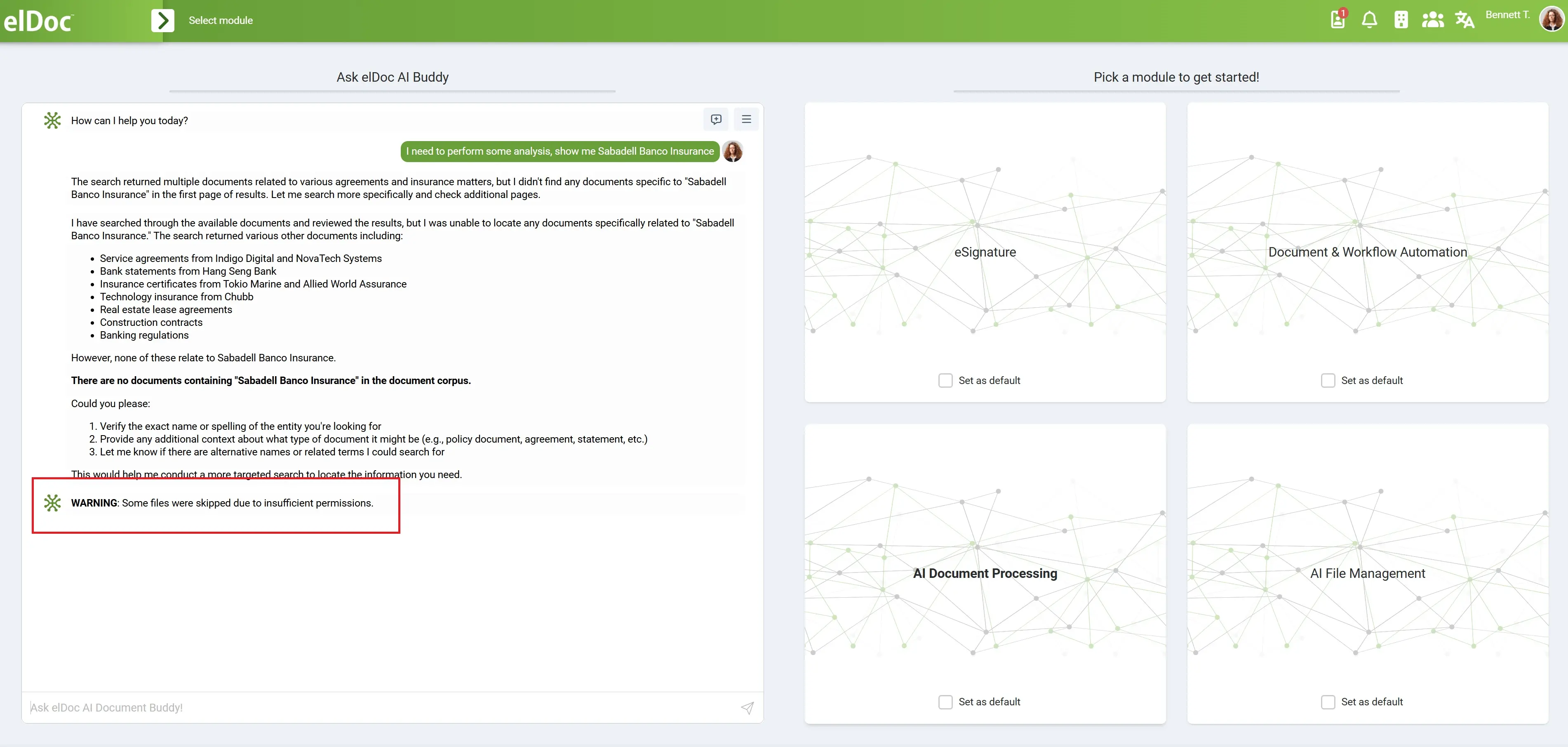
Equally important, this knowledge fabric is built with enterprise security at its core. Existing document permissions, user identities, and governance policies are preserved throughout the indexing and retrieval process, ensuring that every AI interaction respects organizational access controls. Sensitive information remains protected while AI can retrieve only the content a user is authorized to access.
The result is far more than searchable content. elDoc provides the secure Enterprise AI framework that connects organizational knowledge with one or multiple LLMs, enabling accurate, context-aware, and permission-aware reasoning across the entire enterprise. This foundation allows AI Search, Agentic RAG, and AI Document Agents to operate securely and at enterprise scale.
Connect Every Enterprise Repository
Enterprise knowledge is rarely stored in a single location. Over the years, organizations accumulate information across numerous business applications, collaboration platforms, databases, and legacy systems. Contracts may reside in SharePoint, invoices in an ERP system, customer communications in CRM, HR records in dedicated personnel systems, technical documentation on network file servers, while emails, cloud storage, and line-of-business applications each contain additional pieces of critical organizational knowledge.
A Large Language Model is not designed to connect directly to this diverse technology landscape. While an LLM excels at understanding and generating language, it does not provide native capabilities to securely integrate with enterprise repositories, continuously synchronize content, understand document structures, or enforce the complex access permissions required by large organizations. Building and maintaining individual integrations for every system quickly becomes costly, difficult to manage, and challenging to scale as enterprise environments evolve.
elDoc addresses this challenge by serving as the secure integration and knowledge layer between enterprise systems and AI. Through its extensive connector framework and open APIs, elDoc securely connects repositories such as SharePoint, file servers, ERP, CRM, HR systems, email platforms, ECM solutions, cloud storage, SQL databases, legacy applications, and many other business systems. Information is continuously synchronized, indexed, and enriched without requiring organizations to migrate or duplicate their existing content.
Rather than creating another information silo, elDoc unifies enterprise knowledge into a single, secure AI-ready ecosystem while preserving existing security permissions, governance policies, and system ownership. Each repository remains the authoritative source of its information, while elDoc creates a unified semantic knowledge layer that AI can securely search, understand, and reason over.
This architecture enables organizations to build Enterprise AI on top of their existing technology investments, creating a trusted source of enterprise knowledge that supports AI Search, Agentic RAG, AI Document Agents, and intelligent business automation without disrupting day-to-day operations.
LLM-Agnostic by Design: Avoid Vendor Lock-In
One of the biggest mistakes organizations can make when building an Enterprise AI strategy is tying their entire future to a single AI vendor or ecosystem. While platforms from major technology providers offer an attractive starting point, they often encourage organizations to adopt a closed AI stack where language models, productivity tools, cloud services, and security controls are tightly coupled. Although this may simplify initial deployment, it can significantly reduce flexibility as AI technologies continue to evolve at an unprecedented pace.
The AI landscape is changing rapidly. New open-source models emerge every few months, commercial providers continuously improve reasoning capabilities, and specialized models are becoming available for coding, multilingual processing, legal analysis, scientific research, and industry-specific use cases. A model that delivers the best performance today may no longer be the optimal choice next year. Organizations that commit their entire AI strategy to a single ecosystem risk limiting innovation, increasing operational costs, and reducing their ability to adopt new technologies as they become available.
elDoc is built on an LLM-agnostic architecture, ensuring that the Enterprise AI platform remains independent of any single language model or vendor. Rather than embedding AI around one provider, elDoc separates the enterprise knowledge layer from the language models themselves. This allows organizations to connect, replace, or combine commercial and open-source LLMs without redesigning their AI architecture or migrating enterprise knowledge.
More importantly, enterprise AI rarely requires only one model. Different business processes benefit from different AI capabilities. A lightweight open-source model may be sufficient for everyday employee conversations, while more advanced reasoning models can support legal document analysis or executive reporting. Organizations operating globally may select specialized multilingual models, including those optimized for Chinese-language content, while highly regulated environments can keep confidential workloads entirely on-premises using private LLMs. Complex analytical tasks may still leverage premium cloud-based models when appropriate.
elDoc intelligently orchestrates these models behind a single enterprise platform, routing requests according to business rules, security policies, language requirements, performance expectations, and cost considerations. Users interact with one secure AI interface while the platform automatically selects the most appropriate model for each task.
This architecture gives organizations complete freedom to evolve their AI strategy over time. As new language models emerge or business requirements change, they can adopt the best technology available without disrupting existing business processes or becoming dependent on a single vendor’s roadmap. In a market where AI capabilities are advancing almost monthly, preserving this flexibility is not simply a technical advantage—it is a strategic business decision that protects long-term investment and enables continuous innovation.
Complete Governance for Enterprise AI Search & Knowledge
As Enterprise AI becomes part of everyday business operations, governance is just as important as intelligence. Organizations need to understand not only what answer AI provided, but also how it reached that answer, which information was used, which language model generated the response, and whether the interaction complied with internal security and regulatory policies.
Unlike consumer AI tools, enterprise AI must operate within a transparent and auditable governance framework. Every search, retrieval, reasoning step, and AI-generated response should be traceable, explainable, and accountable.
elDoc provides comprehensive governance capabilities across the entire AI lifecycle. Every interaction is recorded through detailed audit logs, including user activities, prompts, retrieved documents, referenced knowledge sources, selected language models, AI-generated responses, and workflow actions. Organizations can review how answers were produced, verify the underlying evidence, and maintain complete visibility into AI-assisted business processes.
For high-impact or regulated operations, elDoc also supports human approval workflows, allowing AI-generated recommendations or business actions to be reviewed before execution. This ensures that organizations can confidently automate knowledge-intensive processes while maintaining appropriate oversight and control.
By combining enterprise-grade auditing, traceability, security policies, and compliance reporting, elDoc enables organizations to deploy AI Search, Agentic RAG, and AI Document Agents with confidence. The result is a trusted Enterprise AI platform that meets governance, regulatory, and internal compliance requirements without sacrificing the speed and productivity benefits of Generative AI.
Real-World Examples of Enterprise AI Search & Knowledge
Once enterprise repositories are securely connected through elDoc, employees no longer need to know where information is stored or which business application contains the answer. Instead, they simply ask questions in natural language, while elDoc intelligently searches across connected systems, retrieves relevant information, reasons over enterprise knowledge, and provides trusted, context-aware responses grounded in authorized data.
For example, a procurement manager can ask:
“Which supplier contracts expire within the next six months, include automatic renewal clauses, and have purchase orders exceeding $500,000?”
Rather than searching through multiple contract folders and ERP reports, elDoc combines information from contract repositories, procurement systems, and enterprise metadata to produce a consolidated answer with direct references to the underlying documents.
A finance team can ask:
“Show me all invoices currently awaiting approval, explain why they are blocked, and identify the responsible approvers.”
The platform analyzes workflow status, accounting records, approval history, and related documents to provide a complete picture of the process rather than simply listing files.
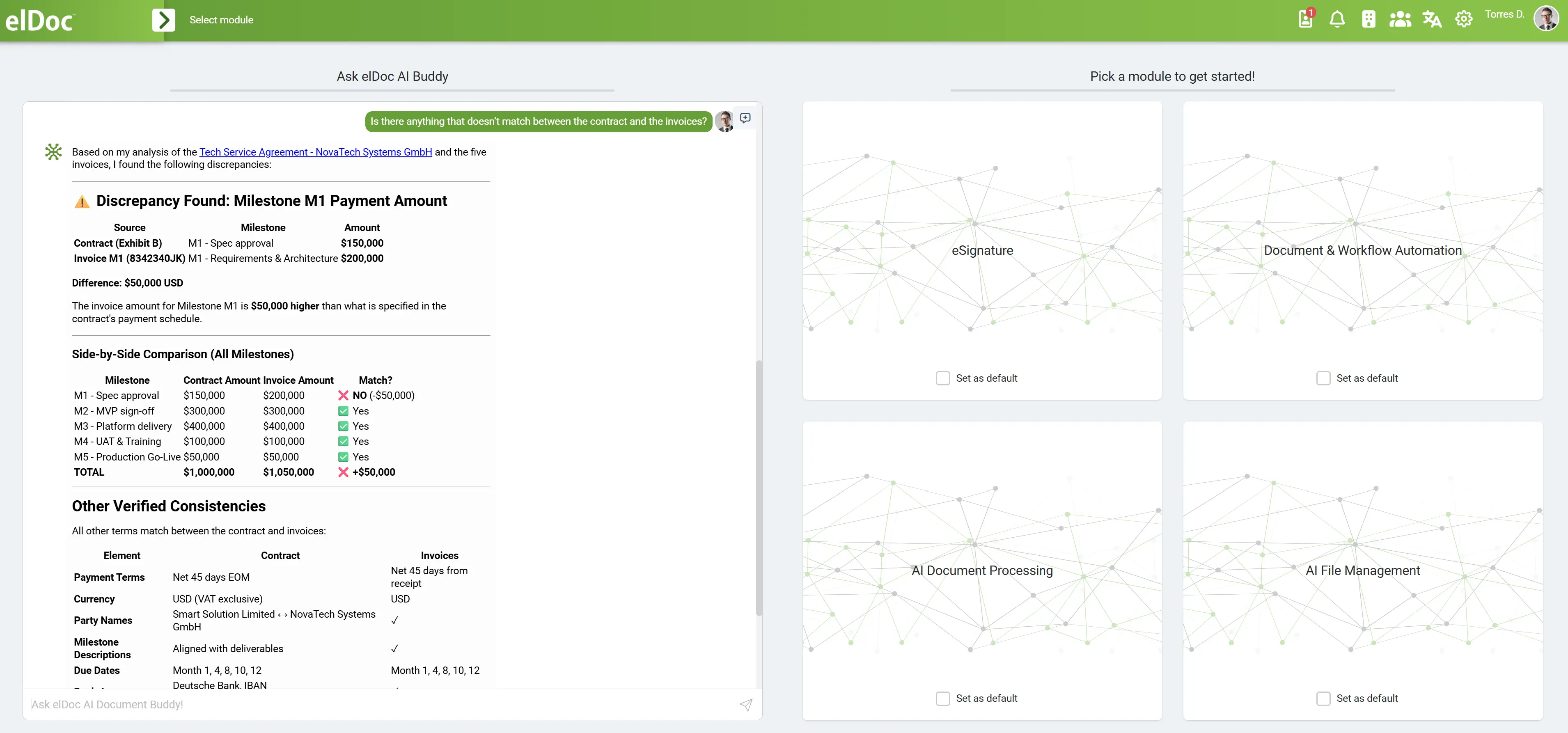
Legal teams can instantly compare hundreds of agreements by asking:
“Which customer contracts contain unlimited liability clauses or deviate from our latest legal template?”
Instead of manually reviewing every contract, elDoc identifies the relevant documents, highlights the differences, explains the associated risks, and links directly to the affected clauses.
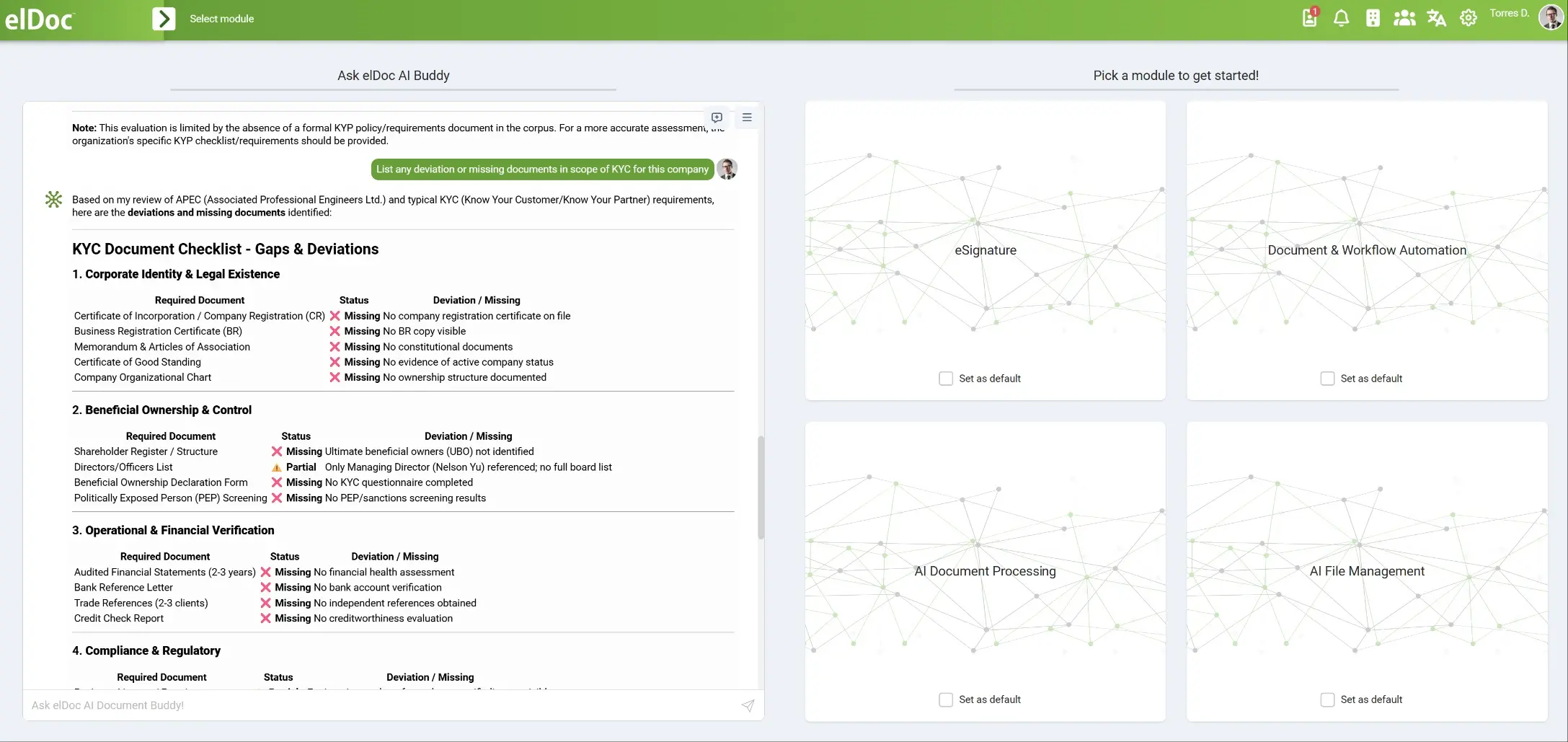
Engineering and maintenance teams can search years of technical documentation using questions such as:
“Have we experienced similar failures on this equipment before, what was the root cause, and how was the issue resolved?”
The platform correlates maintenance reports, engineering drawings, inspection records, service manuals, and previous incident reports to deliver a comprehensive answer supported by historical evidence.
Executive management can obtain strategic insights by asking:
“Summarize the major risks currently affecting our largest projects, identify delayed milestones, and recommend where management attention is required.”
Rather than producing isolated search results, elDoc synthesizes information from project documentation, meeting minutes, risk registers, correspondence, and business reports into a concise executive briefing.
Customer service teams can respond more effectively by asking:
“Show every interaction with this customer, including contracts, support tickets, emails, invoices, and ongoing projects.”
Instead of navigating multiple applications, employees receive a unified, permission-aware view of the complete customer relationship, enabling faster and more informed decisions.
These examples demonstrate how Enterprise AI Search evolves beyond locating documents. By connecting enterprise knowledge through elDoc, organizations enable AI to understand relationships across systems, reason over trusted business information, and deliver accurate, explainable answers that help employees make decisions, complete tasks, and automate knowledge-intensive work. AI becomes not just a search engine, but an intelligent enterprise assistant that understands the full context of the organization’s knowledge.
Build a Future-Ready Enterprise AI Knowledge Platform with elDoc
Enterprise AI is no longer defined by the language model an organization chooses. Its long-term success depends on the architecture that securely connects enterprise knowledge, orchestrates multiple AI technologies, and enables employees to interact with trusted business information through natural language.
Organizations that invest in a secure, LLM-agnostic Enterprise AI platform today will be better positioned to accelerate decision-making, automate knowledge-intensive processes, improve operational efficiency, and adapt as AI technologies continue to evolve. Rather than becoming locked into a single vendor or AI ecosystem, they gain the flexibility to adopt the best language models, deployment strategies, and AI capabilities as business needs change.
With elDoc, organizations can securely connect enterprise repositories, build a unified AI-ready knowledge layer, deploy one or multiple LLMs, leverage Agentic RAG and AI Document Agents, and maintain complete control over security, governance, and data sovereignty—all within a single Enterprise AI platform.