
elDoc vs Microsoft Copilot vs Google Cloud Gemini: Agentic RAG for Enterprise Documents

The GenAI Awakening and the Risk Behind It
With the emergence of tools like ChatGPT, businesses across industries rapidly uncovered the power of Generative AI. What began as curiosity quickly turned into adoption:
- Teams used AI to draft documents
- Analysts queried data in natural language
- Operations explored automation opportunities
The value was undeniable.
But so were the risks.
“Consumer AI was built for convenience not for compliance, governance, or control.”
Organizations attempting to integrate public AI into internal workflows faced serious concerns:
- Sensitive data exposure
- Lack of auditability
- No control over how information is retrieved or combined
- Unclear regulatory compliance
This forced a strategic pivot.
The Move to Enterprise AI — Copilot and Gemini
To address these risks, businesses turned to enterprise-grade solutions like:
- Microsoft Copilot
- Google Cloud Gemini
These platforms promised:
- Safer integration with enterprise ecosystems
- Better alignment with internal permissions
- Scalable AI capabilities within trusted environments
And they delivered meaningful improvements. But not without limitations.
The Hidden Limitations of Copilots and Gemini in Real Enterprise Environments
“Copilots and Gemini are excellent assistants — but enterprises don’t run on assistance. They run on controlled, end-to-end processes.”
While tools like Microsoft Copilot and Google Cloud Gemini have proven their value as personal productivity enhancers, their limitations become clear when deployed in large, complex organizations.
1. Fragmented Enterprise Data: The Reality Copilots and Gemini Struggle With
In real organizations:
- Data is distributed across departments (HR, Legal, Finance, Operations)
- Systems are siloed (ERP, CRM, document management systems)
- Information exists in different formats and structures
This includes:
- Structured databases
- Emails and internal communications
- PDFs and contracts
- Scanned documents (very common in banks, insurance, and government)
“Enterprise knowledge is not in one place — and rarely in one format.”
Even when Copilot is integrated with tools like SharePoint:
- It primarily works on indexed, readable, modern formats
- It struggles with low-quality scans, legacy archives, and unstructured files
- OCR and deep semantic understanding are often inconsistent
The SharePoint Limitation
Even when using platforms like Microsoft SharePoint with Copilot integration, there is a critical gap:
“There is no out-of-the-box, deeply integrated AI-powered OCR layer that ensures full semantic understanding of scanned documents.”
While basic OCR capabilities may exist within the broader ecosystem, they are:
- Not consistently embedded into the AI reasoning layer
- Not optimized for high-accuracy enterprise document interpretation
- Not sufficient for complex use cases like:
- Contract clause extraction
- Regulatory validation
- Cross-document comparison
- Intelligent Document processing on large scale
The result?
“AI responses that look complete — but are not.”
This leads to:
- Missing critical clauses in contracts
- Ignoring legacy records
- Overlooking compliance-relevant data
And ultimately:
False confidence in incomplete answers
The Hidden Cost: Building the Missing Layer
To truly make scanned and unstructured documents usable for AI, businesses often need to:
- Implement external OCR solutions
- Build custom data processing pipelines
- Integrate multiple services across their architecture
- Normalize and structure extracted data
This introduces:
- Additional infrastructure complexity
- Increased costs (tools, compute, licensing)
- Dependency on specialized resources (AI engineers, data engineers)
- Ongoing maintenance and optimization efforts
“What appears as an AI-ready environment often requires significant behind-the-scenes engineering to actually work.”
2.The Risk of False Positives with Copilots and Gemini
Because copilots:
- Retrieve only what they can “see”
- Do not validate completeness
- Do not cross-check against full knowledge bases
They can generate:
- Confident summaries missing key details
- Recommendations based on incomplete datasets
- Answers that appear correct but are factually insufficient
“In enterprise AI, a partially correct answer can be more dangerous than no answer.”
In industries like banking, insurance, or government, this is not just a limitation—it is a risk exposure.
The Agentic Gap: Why Answers May Be Incomplete
Tools like Microsoft Copilot and Google Gemini are not built as true Agentic RAG frameworks. While they are powerful assistants, they primarily operate in a prompt-response mode, rather than executing structured, multi-step reasoning across enterprise knowledge.
This has important implications:
“Without agentic reasoning, AI cannot guarantee completeness — only convenience.”
- They do not autonomously determine whether all relevant data sources have been explored
- They do not validate whether retrieved information is complete or contextually sufficient
- They rely on what is readily accessible and indexed, not necessarily what is critically required
As a result:
- Answers may only reflect partial data coverage
- Important documents (especially historical, siloed, or unstructured ones) may be missed
- Analysis may lack depth, cross-referencing, and validation
“AI may provide an answer — but not always the full answer.”
3. Permissions and Access Control: Copilots and Gemini struggle to handle dynamic access changes
Copilot and Gemini rely heavily on existing permission layers, but they do not deeply reason about:
- Role changes (e.g., employee transfers departments)
- Immediate revocation of sensitive access
- Contextual eligibility of information
Consider:
- An employee moves from Finance to Operations
- A contractor’s access should expire immediately
- A manager is promoted and gains broader visibility
“Access in enterprises is dynamic — AI must keep up in real time.”
Questions arise:
- Is access updated instantly across all AI interactions?
- Are historical permissions still influencing results?
- Can AI enforce context-aware restrictions, not just static ones?
In many cases:
“Permissions are respected — but not intelligently enforced.”
4. Why Chatting with Microsoft Copilot and Google Gemini Falls Short for Enterprises
Copilots and Google Gemini excel at:
- Summarizing documents
- Answering questions
- Assisting with content creation
But enterprises need much more:
Real Business Requirements
- Document review workflows
- Policy validation
- Contract comparison
- Compliance checks
- Approval processes
These are:
Multi-step, rule-driven, auditable processes
Copilots, however, remain:
- Prompt-based
- User-driven
- Stateless between interactions
They do not:
- Execute workflows
- Enforce business logic
- Validate outputs against policies
“Chat is a feature. Business value comes from execution.”
5. Copilot and Gemini: Effective Assistants but Lacking End-to-End Process Automation
True enterprise value comes from:
- Automating decision flows
- Embedding AI into operations
- Ensuring consistency across processes
“AI that answers is helpful. AI that acts is transformative.”
Without this:
- AI remains a productivity tool
- Adoption stays fragmented
- ROI remains limited
The Core Gap: Assistance vs Enterprise Execution
This is the fundamental limitation:
| Copilots / Gemini | Enterprise Needs |
|---|---|
| Assist users | Execute processes |
| Respond to prompts | Plan and act autonomously |
| Use available data | Ensure complete, validated data |
| Respect permissions | Enforce dynamic, contextual access |
| Provide answers | Deliver auditable outcomes |
“Copilots and Google Gemini optimize individuals. Enterprises need systems that optimize outcomes.”
The Reason elDoc Was Built
“The real value of GenAI is not in fragments of intelligence — but in orchestrated, governed execution.”
elDoc is designed to address exactly these gaps.
What elDoc Does Differently
1. Full Knowledge Coverage
- Handles structured, unstructured, and scanned documents within a unified system
- Ensures no critical data is missed across the entire enterprise knowledge base
- Built on Agentic RAG, enabling AI to retrieve, understand, validate, and act on data
- Supports all document types and formats, including legacy and image-based files
- Eliminates the need for additional OCR tools or complex integration pipelines
- Delivers intelligent document understanding, including context extraction and cross-referencing
- Ensures complete, accurate, and reliable outputs for decision-making
- Provides robust APIs to connect with enterprise systems such as ERP, CRM, and core platforms. Indexes connected data for Agentic RAG understanding and action
- Ensures AI can reason across systems, not just within isolated repositories
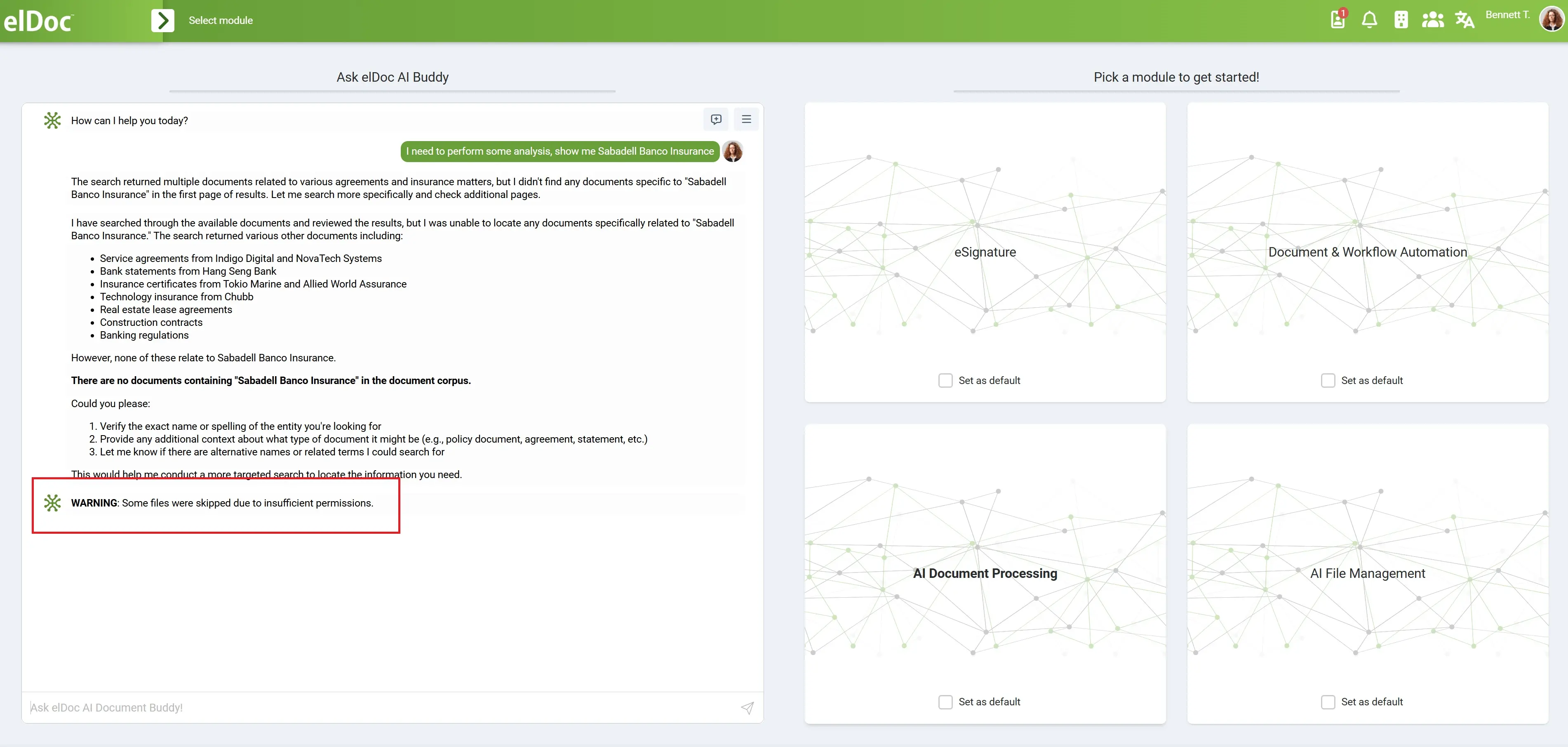
2. Zero-Trust, Dynamic Access Control
- Real-time enforcement of permissions
- Role-aware and context-aware filtering
- Immediate adaptation to organizational changes
3. Historical and Complete Understanding
- Automatically indexes new and updated document versions, ensuring the latest and historical data are always available
- Provides version-aware retrieval, allowing users to access the correct state of information at any point in time
- Enables time-based reasoning, answering questions in the context of when data was valid
- Goes beyond static answers by reasoning and acting on analysis through Agentic RAG
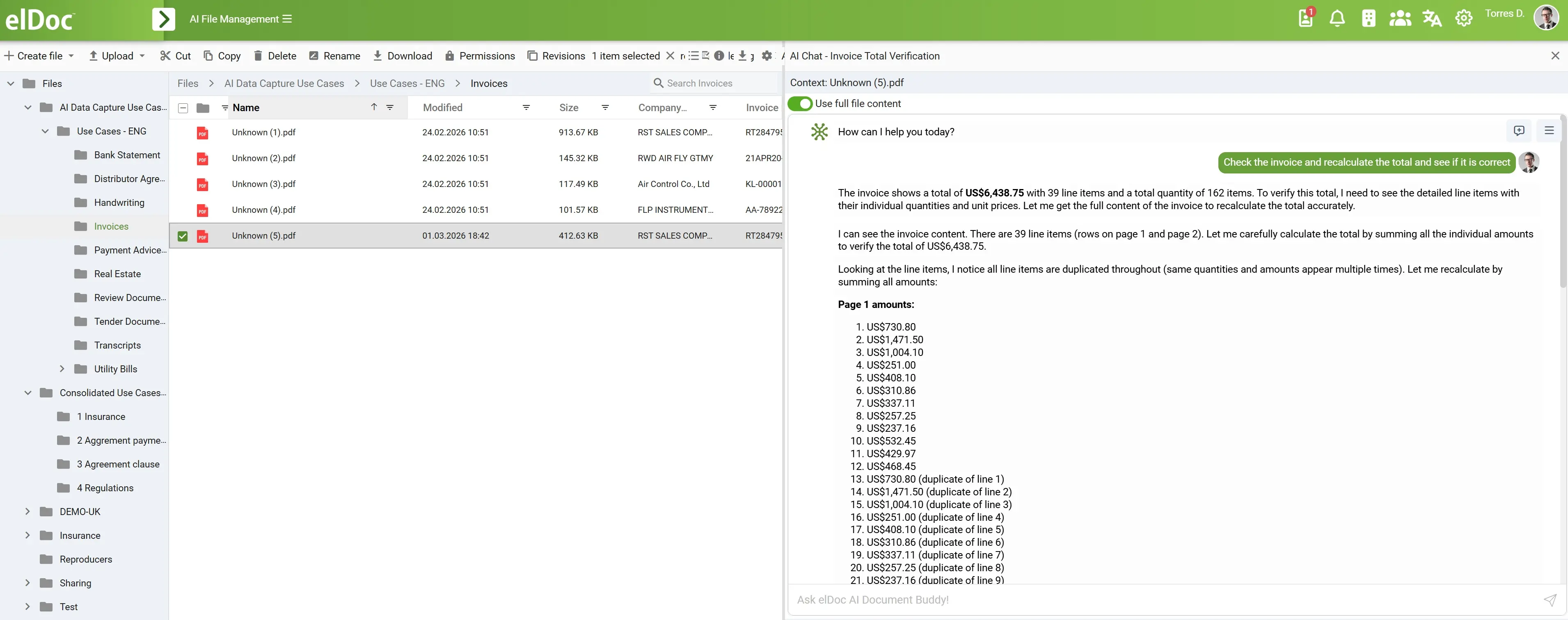
- Integrates with specialized tools and functions (e.g., financial calculations like cash flow) to ensure outputs are accurate and computed, not just inferred
- Avoids reliance on guesswork by combining data retrieval with deterministic processing where needed
- Ensures high precision in analytical tasks, especially in finance, operations, and compliance scenarios
- Delivers compliance-grade traceability across all AI actions and workflows
- Maintains detailed audit logs of user interactions and AI operations, including:
- Document classification via prompts
- Automated filing and structuring of documents
- Retrieval and analysis steps
- Supports full audit and governance requirements, enabling transparency and accountability
- Provides end-to-end visibility into how decisions and outputs were generated
4. GenAI as Part of the Document Processing Pipeline
“The real value of GenAI is not in chatting with documents — it’s in executing processes end-to-end.”
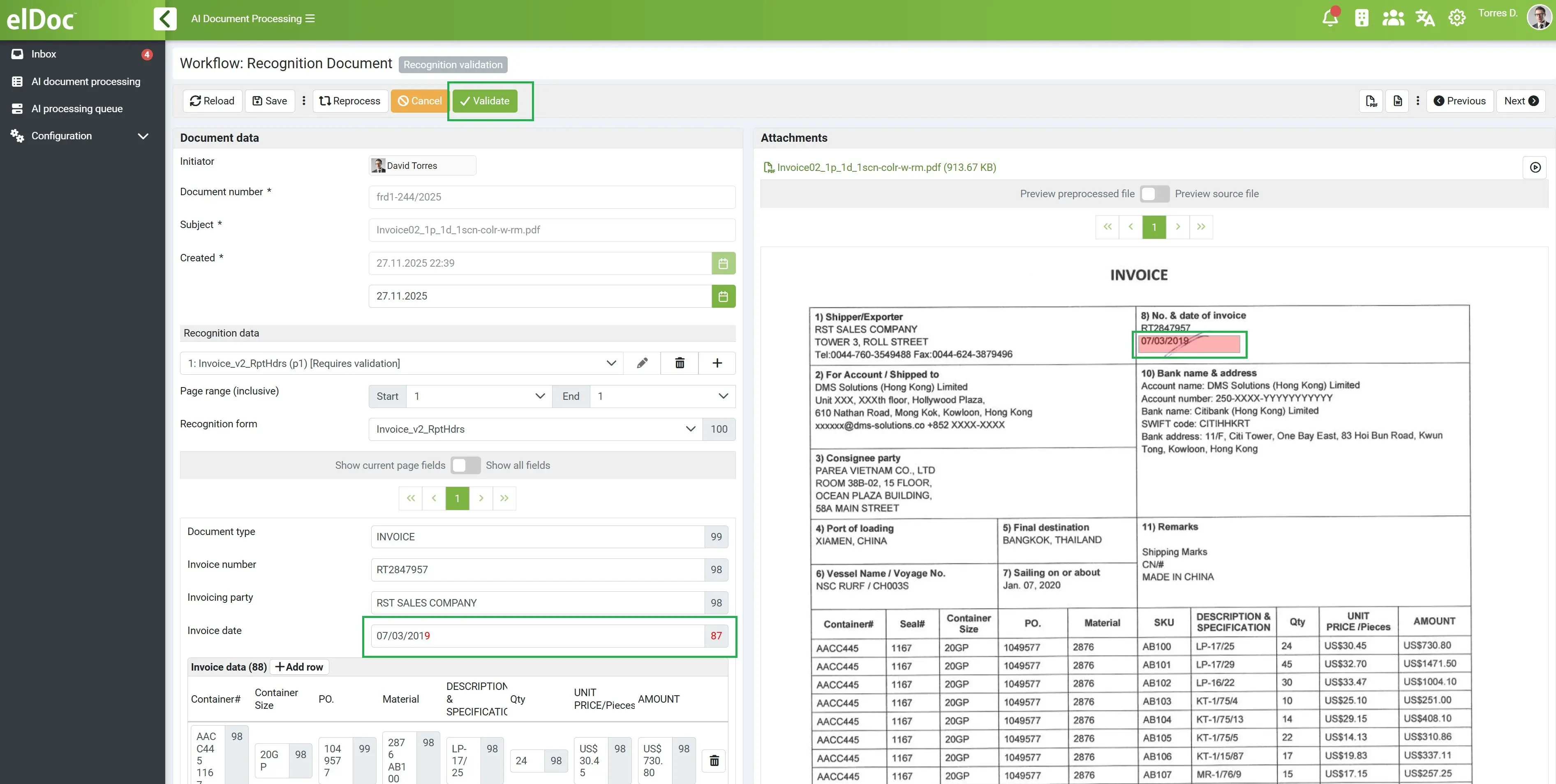
elDoc is not just a platform for summarization or Q&A. It is designed to operate as part of large-scale document processing pipelines, where AI is embedded into real business workflows.
- Processes high volumes of documents at scale, not just individual files
- Supports end-to-end execution, from ingestion to final output
- Combines GenAI with validation, verification, and rule-based controls
- Applies post-processing rules to ensure outputs meet business and regulatory requirements
- Handles exceptions intelligently, routing edge cases for review or escalation
- Moves beyond simple data extraction to structured, governed processing workflows
- Enables automation across complete business processes, not isolated tasks
5. Architecture Flexibility — No Vendor Lock-In
“Enterprise AI should adapt to your architecture — not the other way around.”
Unlike tightly coupled ecosystems such as Microsoft Copilot or Google Gemini, elDoc is designed with flexibility and independence at its core.
- Built as an LLM-agnostic platform, allowing businesses to choose and switch between models freely
- Supports integration with multiple LLM providers (public, private, or on-premise)
- Enables organizations to run their own models for full control over data, privacy, and performance
- Avoids vendor lock-in, giving businesses long-term architectural freedom
- Allows hybrid AI strategies, combining different models for different tasks (e.g., cost vs performance optimization)
- Future-proofs investments by ensuring compatibility with next-generation AI models
- Gives enterprises control over where and how AI runs (cloud, private cloud, or on-premise environments)
6. Deployment Flexibility — On-Premise, Hybrid, or Cloud
“Enterprise AI must adapt to regulatory, security, and operational realities — not force a one-size-fits-all model.”
elDoc is designed to fit seamlessly into enterprise environments, offering full flexibility in how and where it is deployed.
- Supports on-premise deployment for maximum data control and compliance
- Enables private cloud environments aligned with enterprise security policies
- Offers hybrid architectures, combining on-premise systems with cloud scalability
- Adapts to data residency and sovereignty requirements across regions and industries
- Ensures sensitive data can remain within internal infrastructure, without external exposure
- Integrates with existing enterprise IT landscapes without forcing migration
- Provides consistent functionality and governance across all deployment models
7. A True Foundation for Building an Enterprise GenAI Hub
“GenAI delivers real value when it moves from isolated use cases to a unified enterprise capability.”
elDoc is not just a solution for a single workflow—it is designed as a scalable foundation for building a GenAI Hub across the enterprise.
- Built on Agentic RAG, enabling intelligent, multi-step reasoning and action across all document-driven processes
- Designed with security and permission control at its core, ensuring safe and governed AI adoption at scale
- Offers LLM flexibility, allowing integration with multiple models and future-proofing AI strategy
- Provides a unified knowledge layer, connecting documents, systems, and processes across departments
- Enables organizations to move from single-use cases to enterprise-wide adoption
- Supports standardization of document processing, validation, and decision workflows
- Scales from one process (e.g., invoices or KYC) to full enterprise document excellence
- Acts as a central platform to orchestrate AI across departments, eliminating silos
“The journey of enterprise AI is not about adopting tools — it’s about building systems you can trust.”
The evolution from ChatGPT to enterprise copilots from Microsoft and Google has shown what GenAI can do. But it has also made one thing clear:
Power without control is not enterprise-ready.
Why elDoc Matters
“The true value of GenAI is realized when it becomes embedded, governed, and scalable across the enterprise.”
elDoc is built to enable exactly that:
- Not fragmented AI use
- Not isolated productivity gains
- But enterprise-wide transformation through controlled intelligence