
How Agentic RAG Works in elDoc: Orchestrating AI Agents, Search, and Reasoning Across Enterprise Data

Modern enterprises are actively exploring AI, yet many are still at an early stage of maturity.
Some organizations equate AI with a simple chatbot interface — a conversational layer on top of data. Others have moved a step further and implemented RAG (Retrieval-Augmented Generation), enabling AI to search documents and provide grounded answers.
However, even with RAG, the interaction often remains linear and reactive: a user asks a question → the system retrieves documents → the model generates an answer. While this is a significant improvement over traditional search, it still lacks true reasoning and autonomy.
The Gap: From Chatbots → RAG → Agentic RAG
Many companies today are still:
- Treating chatbots as AI strategy, without deeper integration into business processes
- Implementing basic RAG, but limiting it to single-step retrieval and response
- Missing the next evolution where AI can think, plan, and act across multiple steps
At the same time, a large portion of the market is not yet aware that this next stage already exists: 👉 Agentic RAG is no longer a concept – it is already a working, enterprise-ready approach.
Why Access to Documents Is No Longer Enough
Modern enterprises don’t just need access to documents. They need systems that can:
- Understand context across multiple sources
- Reason over fragmented information
- Identify gaps, inconsistencies, and risks
- Take action, not just provide answers
A human expert does not stop at retrieving information. They analyze, cross-check, validate, and build conclusions. This is exactly the capability that traditional systems and even basic RAG fail to deliver.
Enter Agentic RAG in elDoc
This is where Agentic RAG (Retrieval-Augmented Generation) in elDoc fundamentally changes how enterprises work with documents and data. Instead of a simple, single-step question-and-answer interaction, elDoc introduces AI agents that operate with intent, logic, and autonomy. These agents don’t just respond – they think through problems and execute tasks in a structured way, similar to how a human expert would approach complex work.
They are capable of:
- Breaking down complex tasks into multiple logical steps
- Dynamically determining what information is required
- Performing iterative searches across documents and data sources
- Analyzing and validating retrieved information
- Combining findings into structured, meaningful outputs
- Executing tasks when actions are required
From Passive Answers to Active Intelligence
Unlike traditional document systems or basic AI search, elDoc combines multiple technologies into a cohesive intelligence pipeline that goes far beyond simple retrieval. It doesn’t just return information. It understands, reasons, and acts.
With Agentic RAG, elDoc:
- Understands your data in context, not just keywords
- Plans how to approach each task, rather than reacting to a single query
- Executes multi-step reasoning, connecting information across documents
- Delivers outcomes, such as reports, insights, or completed tasks – not just answers
Agentic RAG in Action: From Question to Result
To truly understand the power of Agentic RAG, it’s important to see how it works in a real scenario.
Let’s take a simple but common business task:
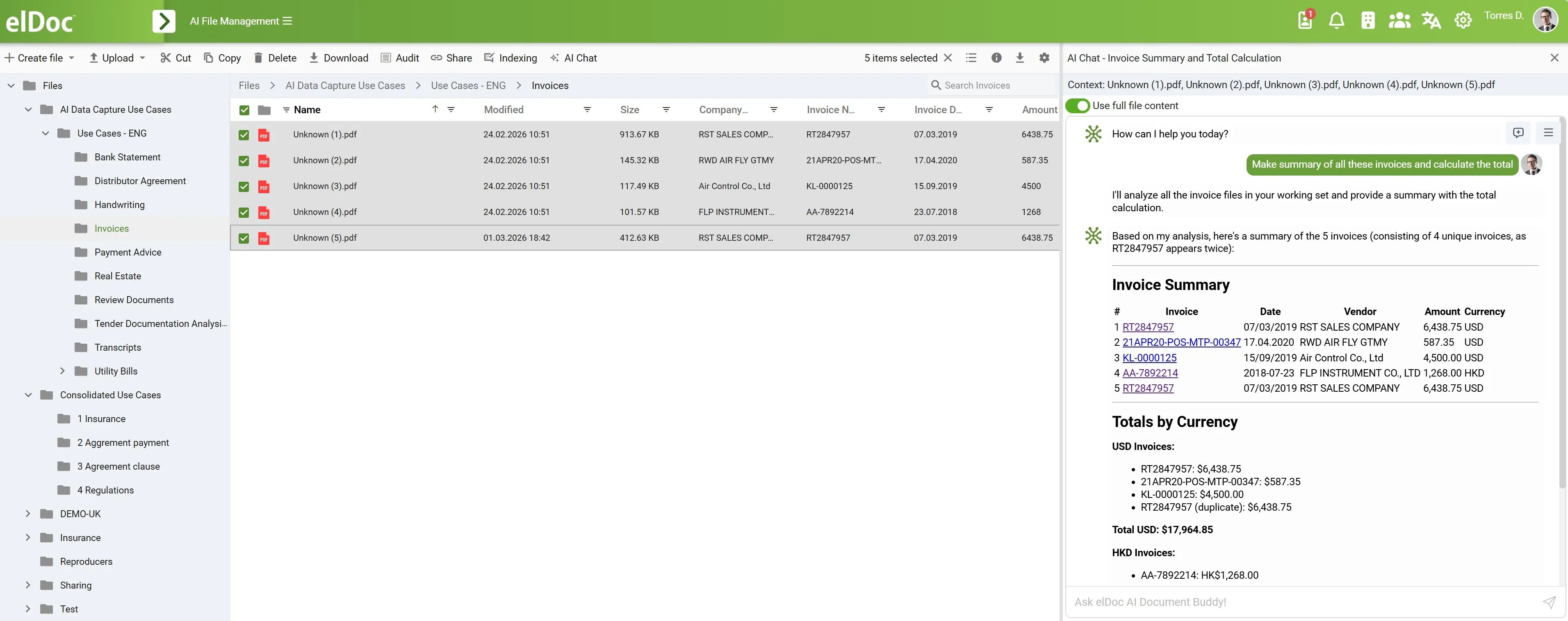
A user selects multiple invoice documents and asks:
“Make a summary of all these invoices and calculate the total.”
At first glance, this may seem like a simple request.
In reality, it involves multi-step reasoning, cross-document analysis, data validation, and financial calculation.
What Happens Behind the Scenes
Unlike a traditional system that would simply return documents or even a basic RAG system that would generate a text answer – elDoc activates an AI agent workflow. This agent does not respond immediately. It thinks first, then acts.
Step 1: Understanding the Task
The agent interprets the request and identifies the objective:
- Summarize multiple invoices
- Extract key financial data
- Calculate totals
- Ensure accuracy (including duplicates and currencies)
This is already beyond simple retrieval – it’s task comprehension.
Step 2: Breaking Down the Problem
Instead of handling everything at once, the agent decomposes the task:
- Read all selected documents
- Extract structured data
- Normalize formats (dates, currencies, values)
- Identify duplicates
- Aggregate totals
This step is critical – it mirrors how a human analyst would approach the task.
Step 3: Multi-Document Retrieval & Processing
The agent then:
- Accesses all selected invoice files
- Uses OCR (if needed) to extract text from scans
- Applies both semantic and structured understanding to identify relevant fields
It doesn’t just “read” documents – it understands their structure and meaning.
Step 4: Cross-Document Reasoning
Here is where Agentic RAG becomes truly powerful.
The agent:
- Detects that one invoice appears twice
- Validates invoice numbers across documents
- Groups invoices by currency
- Ensures no data is double-counted
This is not retrieval – this is reasoning across documents.
Step 5: Aggregation and Calculation
Once the data is validated, the agent:
- Structures the information into a clean summary
- Calculates totals per currency
- Produces a final consolidated result
All of this happens automatically, without manual input.
Step 6: Generating the Final Output
The result is not just text — it is a business-ready output:
- A structured invoice summary
- Clearly listed entries
- Identified duplicates
- Accurate totals by currency
From Simple Query to Intelligent Execution
What starts as a simple, natural-language request quickly evolves into a fully orchestrated AI workflow. The user does not specify steps, rules, or logic. They don’t define how to extract fields, how to detect duplicates, or how to calculate totals. They simply ask.
Behind the scenes, however, elDoc activates an intelligent execution layer. The system interprets intent, designs a plan, and carries out a sequence of actions by combining retrieval, analysis, validation, and computation into a single seamless flow. Each step builds on the previous one, ensuring that the final result is not only complete, but also accurate and context-aware. But what makes this even more powerful is what happens under the hood.
Agentic RAG in elDoc is not limited to language models alone. Depending on the task, elDoc can also leverage specialized tools that improve precision, reliability, and business relevance of the output. For example, it may use calculation tools to ensure mathematically correct totals, validation logic to detect inconsistencies, or other domain-specific tools that help the system better understand and act on enterprise data. This means the system is not merely generating text – it is combining reasoning with execution mechanisms that support real business outcomes.
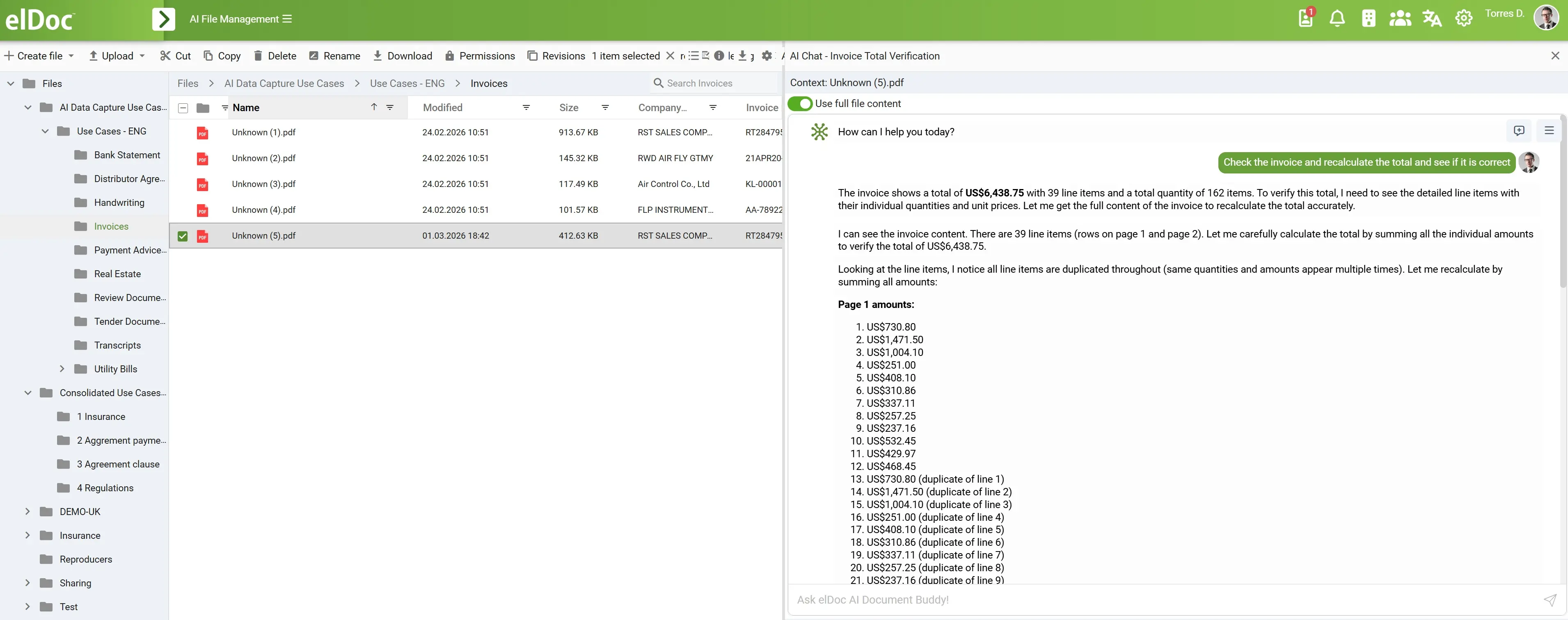
In practice, elDoc brings together:
- LLM reasoning to understand requests, plan steps, and interpret results
- Retrieval systems to find the right information across documents
- Supporting tools to calculate, validate, structure, and refine outputs with greater precision
This is the key difference:
👉 The user provides the what
👉 elDoc determines the how
This Example Clearly Illustrates the Difference
What looks like a simple query on the surface is, in reality, a task that requires coordination across multiple capabilities: document retrieval, OCR, field extraction, duplicate detection, validation, calculation, and final reporting. That is why the difference between a traditional system, basic RAG, and Agentic RAG in elDoc becomes so important.
This example clearly illustrates the difference:
| Traditional System | Basic RAG | Agentic RAG in elDoc |
|---|---|---|
| Returns documents | Answers question | Solves the task |
| No understanding | Limited context | Deep reasoning |
| Manual work required | Partial automation | Full workflow execution |
In other words, traditional systems help users find documents.
Basic AI helps users ask questions.
Basic RAG helps users get grounded answers.
Agentic RAG in elDoc helps users actually complete the task. That is the real shift from passive access to information, to active intelligence and execution across enterprise documents.