
AI-Powered Document and Data Archiving: Transform Enterprise Archives into Intelligent Knowledge with Agentic RAG

AI-Powered Document and Data Archiving: Transform Enterprise Archives into Intelligent Knowledge
For many organizations, years of business knowledge are buried inside archived documents.
Contracts, invoices, engineering drawings, project files, emails, reports, policies, audit records, HR files, technical documentation, customer correspondence, and scanned paper documents often remain stored only because regulations require it – not because employees can actually use them.
Traditional archiving systems focus on storage, retention, and compliance.
Modern organizations need much more.
They need archives that can answer questions, discover hidden relationships, support AI Agents, and instantly retrieve knowledge across millions of historical documents.
This is where AI-powered archiving and Agentic RAG (Retrieval-Augmented Generation) fundamentally change enterprise information management.
Instead of becoming a digital warehouse, your archive becomes an intelligent knowledge base that works for your business every day.
The Problem with Traditional Archives
For decades, organizations have accumulated enormous volumes of business information. While these archives contain valuable institutional knowledge, most were designed for storage not for finding, understanding, or using information efficiently.
Common challenges include:
- Millions of archived documents spread across years or decades
- Incomplete, inconsistent, or outdated metadata that no longer reflects the current business context
- Paper archives that have never been digitized, yet contain valuable historical records and business knowledge
- Scanned PDFs and image-based documents without searchable text
- Multiple file formats across legacy and modern systems
- Duplicate and redundant information
- Disconnected repositories, network drives, file shares, and cloud storage
- Legacy ECM and Document Management Systems with limited search capabilities
- Knowledge scattered across departments and business applications
- Slow, manual searching that depends on filenames, folders, or outdated indexing
As organizations evolve, employees change roles, systems are replaced, and documents are moved between repositories. Metadata that was once accurate often becomes incomplete or obsolete, making it increasingly difficult to locate critical information.
At the same time, many organizations still maintain extensive paper archives containing contracts, engineering drawings, customer files, invoices, legal records, and historical correspondence. Although these documents represent valuable corporate assets, they remain largely inaccessible because they cannot be searched or understood by traditional systems.
As a result, employees spend countless hours searching for information they know already exists. They often recreate documents, repeat previous work, or make decisions without access to historical knowledge simply because finding the right information is too difficult.
The information technically exists—but in practice, it remains hidden, inaccessible, and unable to deliver value to the business.
Only when archives become AI-ready—with intelligent and semantic indexing, and Agentic RAG—can organizations unlock decades of accumulated knowledge and transform historical records into an active enterprise intelligence resource.
How to Transform Existing Archives into AI-Ready Enterprise Knowledge
For AI to deliver accurate, trustworthy answers, enterprise archives must first be transformed into structured, searchable knowledge. This applies not only to digital repositories but also to decades of paper records that often contain some of the organization’s most valuable information.
Rather than manually reviewing and organizing millions of documents, AI can automate the entire process.
With elDoc, organizations can convert legacy archives into an AI-ready knowledge base through intelligent document processing and Agentic RAG.
1. Digitize Paper Archives
Many organizations still maintain extensive paper archives containing contracts, engineering drawings, invoices, HR records, customer files, legal documents, technical documentation, and other valuable business records. While these archives contain decades of organizational knowledge, they often remain inaccessible because the information exists only on paper or as scanned images.
elDoc seamlessly integrates with existing enterprise scanners, multifunction devices, and document capture workflows, allowing organizations to digitize paper records using their preferred scanning infrastructure. Documents can also be imported from legacy repositories, file shares, and existing document management systems.
Once documents are uploaded, elDoc automatically performs Optical Character Recognition (OCR), converting scanned images and image-based PDFs into fully searchable, machine-readable content. This creates the foundation for AI-driven classification, metadata extraction, semantic indexing, Enterprise Search, and Secure Agentic RAG.
To meet different deployment and security requirements, elDoc supports high-performance OCR engines that can be deployed either in the cloud or fully on-premise, including air-gapped environments where documents never leave the organization’s infrastructure. This enables enterprises to digitize and process sensitive information while maintaining complete control over their data and complying with security, privacy, and regulatory requirements.
The original scanned documents are always preserved alongside the extracted text, ensuring regulatory compliance, long-term retention, audit readiness, and legal evidentiary requirements, while making historical paper archives immediately searchable and ready for AI-powered knowledge discovery.
2. Understand Every Document with AI
Digitizing documents is only the first step. While OCR makes documents searchable, it does not explain what the document is, why it matters, or how it relates to your business.
This is where AI transforms traditional archives into enterprise knowledge.
As each document is ingested, elDoc analyzes its content and understands its business context—not just the text on the page. Instead of relying on filenames, folders, or manually assigned metadata, AI automatically identifies what the document represents and classifies it accordingly.
Depending on the document type, elDoc can recognize:
- Document type
- Business purpose
- Key entities
- Dates and timelines
- Organizations
- Customers and suppliers
- Projects and departments
- Financial information
- Products and assets
- Business topics
- Relationships between related documents
For organizations with millions of archived documents, performing this level of inventory, classification, and organization manually is simply not practical. It would require years of effort, significant human resources, and still produce inconsistent results.
With AI, the entire archive can be analyzed automatically and consistently at enterprise scale. Every document is classified using the same business rules and AI models, creating a standardized and searchable knowledge repository regardless of when or where the document was originally created.
The result is a comprehensive digital inventory of your enterprise knowledge. Documents are no longer just scanned files—they become structured business assets that can be searched, filtered, organized, and connected based on their meaning, business context, and relationships to other information across the organization.
By understanding the content of every document, elDoc lays the foundation for intelligent indexing, semantic search, workflow automation, and Secure Agentic RAG, enabling organizations to unlock the full value of decades of accumulated business knowledge.
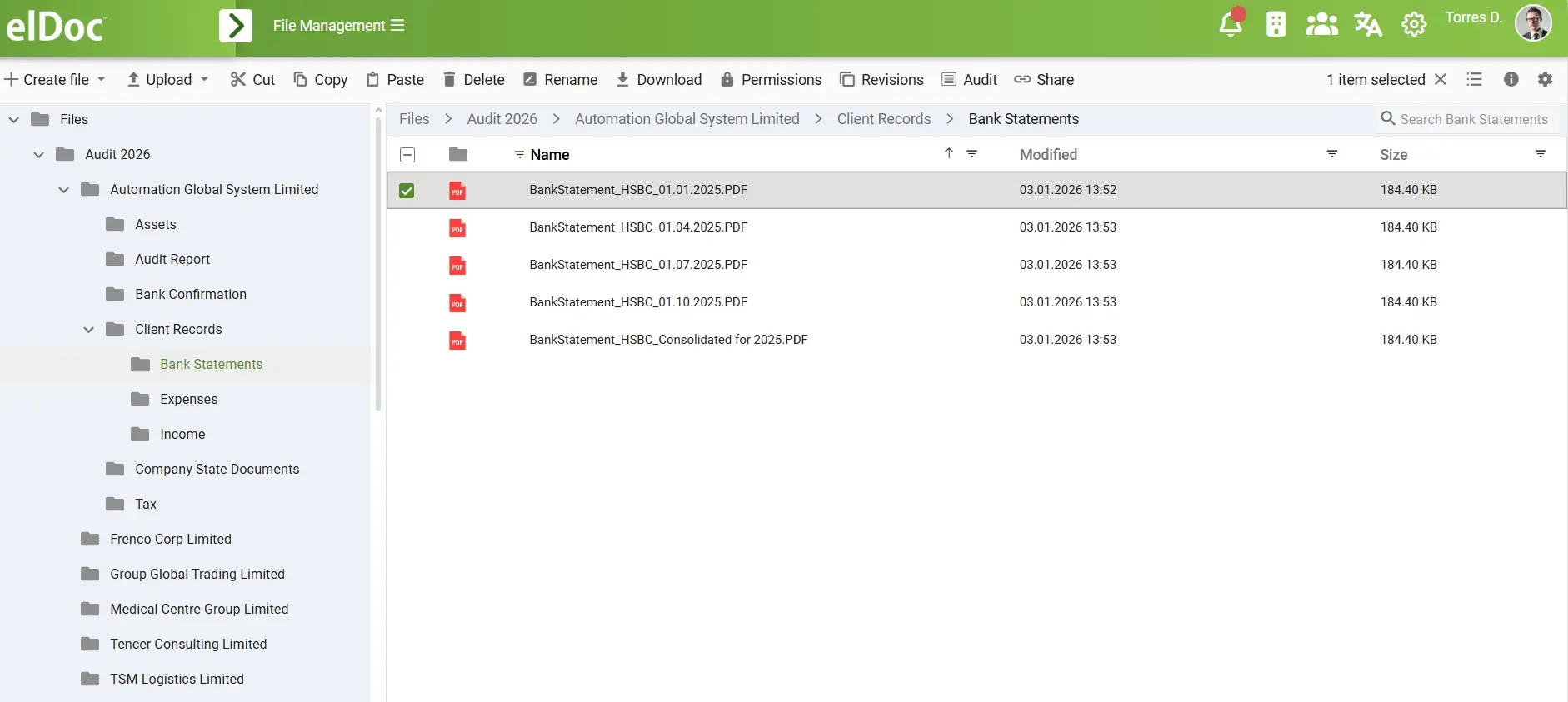
3. Automatically Generate Rich Metadata
One of the biggest challenges with legacy archives is missing, inconsistent, or outdated metadata. elDoc automatically enriches every document with AI-generated metadata, including:
- Business category
- Department
- Document type
- Customer or supplier
- Project
- Contract or invoice number
- Keywords
- Topics
- Retention classification
- Compliance tags
elDoc automatically enriches every document with AI-generated metadata during ingestion, transforming static files into structured, AI-ready knowledge.
Intelligent Metadata Generation
As documents are uploaded, AI analyzes their content and generates metadata based on configurable system prompts that define what information should be extracted for each document type. Rather than applying the same fields to every file, elDoc understands the document and captures the most relevant business attributes automatically.
Organizations can also define their own AI prompts to enrich documents with custom metadata, business classifications, tags, summaries, or other information specific to their processes and governance requirements.
Document-Specific Intelligence
Different document types require different metadata. elDoc automatically identifies the document type and applies the appropriate extraction and indexing logic, ensuring each document is enriched according to pre-defined index fields.
Build an AI-Ready Knowledge Index
The enriched metadata forms a structured knowledge layer that powers semantic search, Enterprise RAG, and Agentic AI. Beyond traditional indexing, AI generates business context, classifications, relationships, keywords, and other semantic attributes that make enterprise knowledge significantly easier to discover and use.
As business requirements evolve, archives can be reprocessed with updated AI prompts to generate new metadata, classifications, and insights – ensuring your knowledge base continuously improves over time.
The result is an intelligent archive where documents are automatically organized, richly indexed, and immediately ready for AI-powered search, retrieval, and enterprise knowledge discovery.

Enterprise Access Control and Permission-Aware AI
Enterprise AI is only as trustworthy as the security model behind it. While AI should make information easier to find, it must never bypass existing access controls or expose confidential content to unauthorized users.
elDoc is built with permission-aware AI, ensuring that every search, retrieval, and AI-generated response respects your organization’s existing security policies.
Seamless Identity Integration
elDoc integrates with enterprise identity providers, including Microsoft Active Directory and LDAP, to synchronize users, groups, roles, and organizational structures. This enables organizations to leverage their existing identity management infrastructure without maintaining separate user permissions for AI.
As employees join, change departments, or leave the organization, access rights are automatically synchronized, ensuring AI always reflects the latest organizational permissions.
Additional Access Control Policies
In addition to synchronizing users and groups from Microsoft Active Directory or other enterprise identity providers, elDoc provides an additional layer of fine-grained access control for enterprise content.
Organizations can define permissions for individual documents, folders, workspaces, projects, document categories, or entire repositories, allowing access to be tailored for specific users, groups, departments, or business units.
These policies can complement existing Active Directory permissions or be used to reinforce security for sensitive documents, confidential projects, regulated information, or newly digitized archives where access controls may not previously exist.
This enables organizations to implement document-level and workspace-level security that reflects their business structure and governance requirements, while maintaining centralized user authentication through their existing identity management systems.
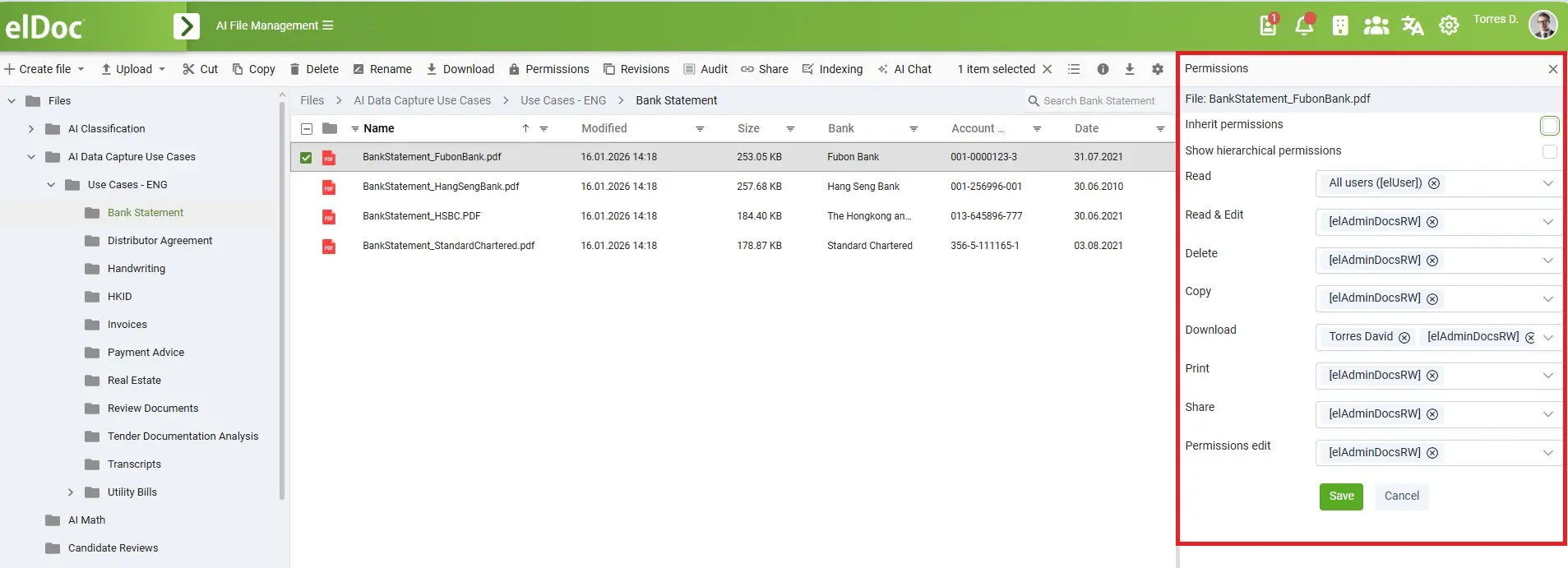
The same permissions are automatically enforced across the entire platform—including document browsing, traditional enterprise search, semantic search, and Secure Agentic RAG—ensuring AI never retrieves or generates information beyond a user’s authorized access.
This creates a consistent security model where every user sees only the documents and AI-generated answers they are entitled to access, regardless of how they interact with the system.
AI That Respects Existing Permissions
Every document, folder, workspace, project, and repository retains its existing security settings.
When a user performs a search—whether through traditional enterprise search or by asking a question in natural language—AI only retrieves and reasons over the information that user is already authorized to access.
If a document is restricted to the Legal department, confidential to HR, or available only to a specific project team, it is automatically excluded from searches and AI responses for everyone else.
AI never bypasses document permissions, making enterprise knowledge accessible without compromising confidentiality.
Secure Knowledge for Every User
Because permissions are enforced during both document retrieval and AI reasoning, every employee receives answers based only on the information they are allowed to see.
This allows organizations to deploy Enterprise Search and Agentic RAG across the entire business while maintaining strict separation between departments, business units, projects, customers, or security classifications.
Whether users search manually, apply filters, or interact with AI using natural language, they experience the same secure, permission-aware view of enterprise knowledge.
Enterprise Security by Design
Combined with Role-Based Access Control (RBAC), document-level security, workspace permissions, encryption, audit trails, and on-premise or private cloud deployment, elDoc provides a trusted foundation for Enterprise AI.
The result is a secure knowledge platform where employees can confidently use AI to discover information faster, while organizations maintain complete control over who can access what data, how AI uses enterprise knowledge, and how every interaction is governed and audited
Transform Your Archive into Searchable Enterprise Knowledge powered with AI
Once documents have been digitized, classified, organized, and enriched with AI-generated metadata, they become immediately available through powerful enterprise search capabilities.
Users can quickly locate information using traditional search methods by filtering documents based on metadata, document type, business category, department, project, date, custom attributes, AI-generated tags, or any other indexed field. Even repositories containing millions of documents can be searched in seconds, enabling employees to quickly find exactly the information they need.
Unlike conventional keyword-based search, elDoc also builds a semantic knowledge index that understands the meaning and business context of every document. This allows users to discover related information even when they don’t know the exact filename, keyword, or storage location. Documents are connected by their content, business entities, topics, and relationships, making enterprise knowledge significantly easier to find and reuse.
By transforming unstructured documents into structured, intelligently indexed knowledge, elDoc creates a single enterprise knowledge foundation that supports not only fast document retrieval and advanced filtering, but also the next generation of AI-powered knowledge discovery.
This AI-ready knowledge index becomes the foundation for Secure Agentic RAG, enabling AI Agents to retrieve, reason over, and generate answers using your organization’s trusted enterprise knowledge while respecting all security and access permissions.