
Automate Invoice Processing with GenAI: Best-in-Class OCR, LLM, and RAG for Your Data

RIP Traditional OCR. Why Templates, Regex, and “Sensitive AI” Can No Longer Handle Real-World Invoices
Traditional OCR once seemed like the answer to invoice automation but it was never designed for the complexity of real business documents. Template-based extraction assumes invoices follow fixed layouts, yet suppliers constantly change formats, move fields, or add new information. Every small variation forces teams to rebuild templates, adjust rules, and retest workflows, turning “automation” into ongoing manual maintenance.
Regex rules only add to the fragility. While powerful for detecting patterns, regex cannot understand context. The same number can represent a total, a subtotal, or a tax amount depending on placement. Dates appear in countless formats, currencies vary, and multilingual invoices instantly break assumptions. Regex guesses until it fails—and finance teams are left resolving exceptions.
Even early AI-powered OCR systems improved text recognition but remained highly sensitive. Minor layout shifts, poor scan quality, or new vendors caused extraction accuracy to drop. These systems could read text, but they could not understand what the data actually meant. Exception rates stayed high, and trust in automation remained low.
The core issue is simple: invoices are not just text – they are financial documents with structure, intent, and meaning. Knowing a number is useless unless the system understands whether it is a tax amount, a total, or a line item. Traditional OCR stops at recognition, while modern finance operations demand understanding.
This is why it’s time to say RIP to traditional OCR. GenAI represents a fundamental shift from brittle, rule-based extraction to true document intelligence. By combining OCR for capture, LLMs for contextual understanding, and RAG for validation and grounding, GenAI systems interpret invoices the way humans do only faster, more accurately, and at enterprise scale.
Does This Mean You No Longer Need OCR?
Capture with OCR, Understand with LLMs, Ask Questions with RAG
Saying RIP to traditional OCR does not mean OCR is no longer needed. It means OCR should stop pretending to be something it was never meant to be. OCR is excellent at recognizing text from documents – but it should not be responsible for understanding meaning, handling logic, or making business decisions.
In elDoc, OCR is used exactly for what it does best: high-quality data recognition, powered by multiple proven OCR engines rather than a single fragile dependency. elDoc leverages and orchestrates industry-leading OCR technologies such as PaddleOCR, Google Vision OCR, Qwen3-VL and other enterprise-grade and offline OCR engines, selecting the most suitable one based on use case scenarios. This ensures strong recognition performance across scans, images, and PDFs – without locking customers into one OCR vendor.
On top of OCR, Computer Vision handles the visual reality of documents: correcting orientation, detecting edges, cleaning scans, understanding layout, and identifying tables and regions. This step ensures invoices are visually and structurally prepared before intelligence is applied.
Next, LLMs take over not to “read” text, but to understand context. They interpret what each number, date, and line item actually represents, normalize formats across vendors and countries, and handle variations that templates and regex never could.
Finally, RAG (Retrieval-Augmented Generation) grounds everything in trusted enterprise data – purchase orders, contracts, vendor records, and historical invoices – so results are explainable.
The takeaway is simple:
OCR is still essential but only as one layer in a modern GenAI stack.
OCR captures. Computer Vision normalizes. LLMs understand. RAG answers.
That’s how elDoc moves beyond brittle, sensitive OCR automation and delivers true document intelligence that works in the real world, at scale.
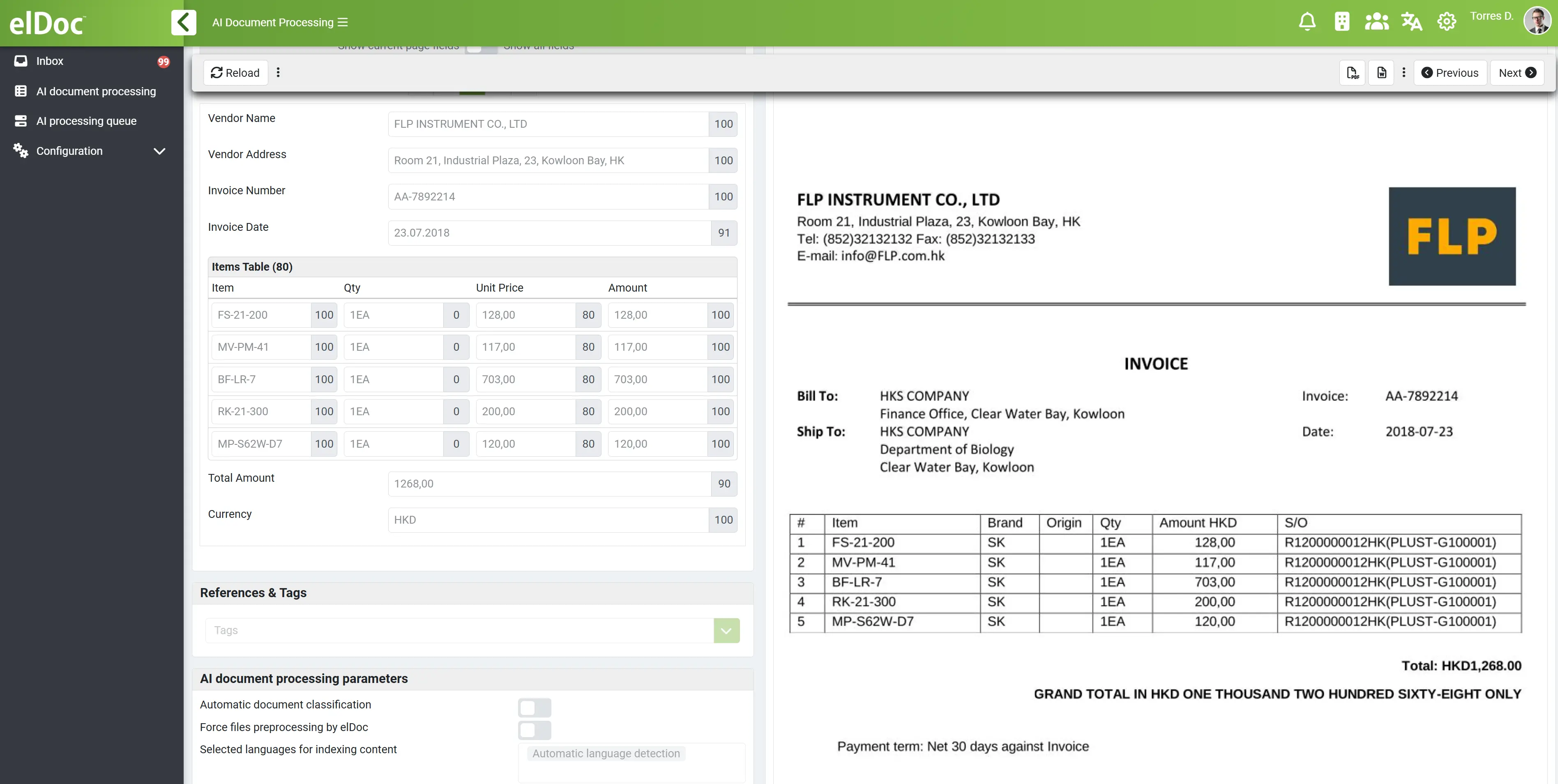
GenAI Goes Beyond Data Capture: from Extracting Fields to Unlocking Hidden Financial Insights
Traditional invoice automation stops once the data is captured. GenAI goes much further. It transforms invoices from static records into a living source of insight that finance teams can interact with, analyze, and question – simply by asking.
Once invoices are captured with OCR, understood by LLMs, and validated through RAG, GenAI unlocks intelligence that was previously hidden across thousands of documents. Instead of exporting data to spreadsheets or BI tools, finance teams can now analyze invoices in natural language, in real time.
GenAI enables instant insight across areas such as:
- Discrepancies between invoices and purchase orders
- Compliance with contracts and negotiated pricing
- Duplicate or suspicious charges across vendors
- VAT, tax, and currency inconsistencies
- Spend patterns by supplier, category, or period
Most importantly, this insight is no longer locked behind dashboards or reports – it’s accessible through simple questions.
“Show me invoices where the billed amount does not match the purchase order.”
“Which invoices are not compliant with contract pricing or terms?”
“Highlight vendors with recurring discrepancies over the last 6 months.”
“Are there invoices with VAT amounts outside expected ranges?”
“Which suppliers increased prices without contract updates?”
Because GenAI is grounded with RAG, every answer is traceable back to the original invoice, purchase order, or contract making insights explainable, auditable, and trusted.
This is the real shift GenAI brings: not just faster data capture, but continuous financial intelligence. Invoices stop being archived documents and become a searchable, analyzable knowledge base that supports better control, stronger compliance, and smarter financial decisions – simply by asking.
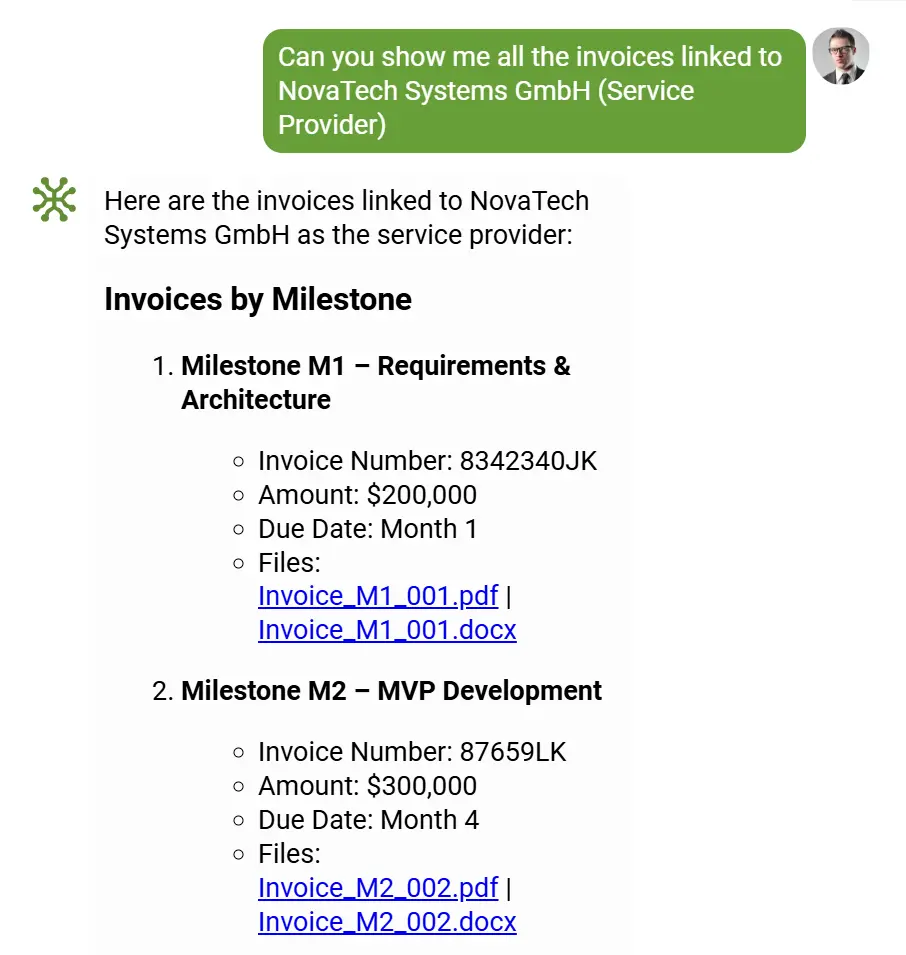
The Most Critical Concern Is Solved: GenAI for Invoice Processing — On-Premise, Cloud, or Hybrid
For many organizations, the biggest blocker to adopting GenAI for invoice processing is not the technology itself – it’s deployment and data control. Finance and procurement teams deal with highly sensitive information, and sending invoices, contracts, and purchase orders outside the organization is often not an option.
This concern is now resolved.
GenAI for invoice processing is available both on-premise and in the cloud, and elDoc is designed from the ground up to support all deployment models without compromising intelligence, performance, or security.
elDoc brings full invoice process automation with a GenAI-powered bot that can run:
- Fully on-premise — all documents, OCR, LLMs, and RAG stay inside your infrastructure
- In the cloud — fast deployment, scalability, and enterprise-grade security
- Hybrid — sensitive data processed locally, with selected services running in the cloud
In all scenarios, organizations remain in control of their data. Invoices are never used for external model training, AI processing stays within the chosen environment, and access is governed by enterprise-grade permissions and audit trails. This flexibility removes the final barrier to GenAI adoption in finance. Whether driven by compliance, regulation, or internal policy, organizations no longer need to choose between innovation and data sovereignty.
GenAI invoice automation is no longer a future promise – it is deployable today, securely, and on your terms.