
Alternatives to ChatGPT for Enterprises: How to Safely Adopt GenAI Without Data Leaks or Business Risk

Why Everyone Is Talking About GenAI – and Why Business Must Be Careful
GenAI went mainstream the moment ChatGPT appeared. Almost overnight, millions of people began using AI every day – to write, analyze, summarize, and generate ideas in seconds. For business leaders, this sparked huge expectations:
- Faster operations
- Lower operational costs
- Almost magical insights hidden in data
It looked like a productivity revolution. But the reality inside enterprise environments is far more complex.
Unlike consumer use, businesses operate under strict constraints:
- Regulatory and compliance requirements
- Data security and privacy obligations
- Accountability for information leaks
- Legal and reputational exposure
What feels like innovation on the surface can quickly turn into risk at scale.
That leads companies to a critical question:
“How can we unlock real business value from GenAI without introducing new vulnerabilities, security gaps, or compliance risks?”
Consumer AI ≠ Enterprise AI
ChatGPT is undeniably impressive. It demonstrates the raw power of modern GenAI and shows what is possible when intelligence becomes accessible to everyone. However, it was designed as a consumer product, not as a corporate platform.
Why ChatGPT Works So Well for Individuals
For individual users, ChatGPT delivers immediate value:
- Simple and intuitive to use
- Strong general-purpose intelligence
- Instant responses with no setup or integration required
It excels at personal productivity, creativity, and exploration.
Why It Becomes a Problem in Enterprise Environments
Inside a company, the same simplicity creates serious risk.
The core issue is both simple and dangerous:
Employees share internal company data with an external service.
Once that happens, the business loses control.
Companies typically have no visibility into:
- Where the data is sent
- How and where it is stored
- Whether it is logged or retained
- Whether it may be reused for model training or analytics
At the same time, while GenAI’s raw capability is enormous, its applied, business-oriented functionality remains limited.
ChatGPT does not understand:
- Internal processes and decision logic
- Corporate policies and approval flows
- Compliance requirements
- Role-based access rules
As a result, consumer GenAI tools remain powerful assistants – but weak foundations for enterprise-grade operations.
Why Companies Are Starting to Ban Consumer AI Tools
Over the past decade, companies have invested enormous resources into building secure digital environments. Layer by layer, they strengthened their security perimeter with firewalls, multi-factor authentication, data encryption, strict access controls, regular audits, and industry certifications. These measures required not only significant budgets, but also years of operational discipline and organizational change.
And yet, all of this protection can be undermined in seconds. A single copy-paste of an internal document, contract, or financial report into a public AI tool can bypass every carefully designed control. No firewall is triggered. No intrusion is detected. No alert is raised. From the perspective of traditional cybersecurity systems, nothing “malicious” has happened. This is why consumer AI tools introduce a fundamentally new type of risk.
“The most dangerous actor is not a hacker, but a well-intentioned employee who simply wants to work faster. One copy-paste can move sensitive data outside the company’s control and silently break the entire security perimeter.”
As a result, many organizations are not banning AI because they fear innovation. They are banning it because existing consumer tools were never designed to operate within enterprise security, compliance, and governance frameworks – and the risk is simply too high to ignore.
Is ChatGPT an Enterprise Solution?
It is an important question and one many organizations are now asking seriously, especially after experimenting with GenAI inside their teams. ChatGPT demonstrates what modern AI is capable of, and it has played a major role in accelerating GenAI adoption worldwide. However, when evaluated through an enterprise lens with requirements around security, compliance, governance, and operational integration – the answer becomes clear.
No.
ChatGPT was never designed to operate as an enterprise-grade system. It excels as a general-purpose AI assistant, but enterprises require far more than intelligence alone. They need solutions that align with business processes, enforce access controls, respect data boundaries, and integrate seamlessly into existing operational environments.
This gap becomes visible across both functional and technical dimensions.
Functional and Business Limitations
❌ Not tailored to specific business processes
❌ Operates primarily at a generic level with a single data context
❌ Lacks understanding of internal policies, procedures, and decision logic
❌ Cannot be embedded into end-to-end enterprise workflows
❌ Cannot support complex, mission-critical business use cases
Technical and Enterprise Limitations
❌ No IAM or RBAC model
❌ No granular permission-based access control
❌ Unsafe or uncontrolled handling of historical corporate data
❌ No control over where data is physically stored
❌ Limited ability to perform structured operations on internal documents
❌ Insufficient scalability for enterprise workloads
❌ No complete audit trails or user activity logging
❌ No guarantees of alignment with corporate security policies
Public GenAI tools are powerful and impressive – but they are universal smart assistants, not operational platforms for enterprise work.
The Most Common Pitfalls When Adopting GenAI in Enterprise Environments
After banning or restricting consumer AI tools like ChatGPT, many organizations feel pressure to “do something” with GenAI – quickly. The intent is right, but the initial reaction is often driven by technology excitement rather than operational reality. This leads to a set of very common, and very costly, reflexes.
Companies tell themselves:
“Let’s just connect an LLM to our systems. We’ll deploy our own model, keep everything internal, plug AI into SharePoint or Google Drive, and build one universal chatbot for everyone.”
On the surface, these approaches seem logical. In practice, they almost always fail.
Why These Approaches Break Down in Enterprise
An LLM without deep business context can only generate generic answers. It may sound intelligent, but it cannot make decisions, follow internal rules, or respect operational constraints. Instead of accelerating work, it creates ambiguity and requires constant human correction. Without governance, access to data becomes uncontrolled. Sensitive information is exposed to users who should never see it, and there is no clear accountability for how data is used, shared, or transformed.
When GenAI is not embedded into real business processes, it becomes a standalone tool – interesting to experiment with, but disconnected from daily operations. Employees may try it once or twice, but productivity does not change. The result is an expensive proof of concept that never reaches production. Finally, without enterprise-grade security, organizations inherit serious compliance, audit, and regulatory risks. There is no full visibility into who accessed what, when, and why. This makes GenAI not only ineffective, but dangerous in regulated environments.
The Core Problem
The common mistake is treating GenAI as a technology component rather than a business capability. In enterprise environments, GenAI cannot be “bolted on.” It must be governed, contextualized, and integrated into workflows from day one — otherwise it remains a smart toy instead of a real productivity engine.
What a Secure Enterprise GenAI Platform Is Really Made Of
GenAI is not a model. It is a corporate platform combined with processes and control. Successful enterprise adoption does not start with the question, “Which LLM should we choose?” It starts with understanding the business itself because in enterprise environments, value is created through governed execution, not isolated intelligence. Before selecting any model or technology, organizations must clearly define where the real business pain points are, which processes can be meaningfully accelerated or automated, which data can and cannot be used by AI, and which roles should have access, and at what level. Without this clarity, GenAI becomes either a risky experiment or a generic assistant that never reaches production.
Only after these foundations are in place does it make sense to select models, design architectures, connect data sources, and introduce GenAI into production environments with confidence. This shift in thinking from models to platforms, from experimentation to governance is what separates successful enterprise GenAI initiatives from failed pilots and stalled proofs of concept.
What Really Defines a Secure Enterprise GenAI Platform
Enterprise GenAI is often misunderstood as “just an LLM deployed internally.” In reality, a secure and scalable GenAI solution for business is not a single component, but a carefully designed, integrated platform.
Security-First by Design – Not as an Afterthought
In enterprise environments, GenAI must operate inside existing security perimeters, not around them. This means security is not optional or “added later” — it is the default state. A true enterprise GenAI platform must support identity and access management, role-based permissions, multi-factor authentication, environment isolation, and the elimination of backdoors. Every interaction must be validated, logged, audited, and scored for risk and confidence. Data must be encrypted, exchanged securely, and protected by high-availability and disaster recovery mechanisms. Most importantly, GenAI must operate strictly within the company’s internal security policies, not override them.
This is the baseline — not an advanced feature.
GenAI Is Not Just an LLM – It Is a Coordinated Technology Stack
One of the most common enterprise mistakes is equating GenAI with a language model. In practice, enterprise GenAI requires a fully aligned technology stack, where each component plays a specific role:
Language models combined with RAG enable controlled interaction with corporate knowledge. OCR and Computer Vision make it possible to work with real-world documents, scans, and images. Custom AI logic and business rules adapt intelligence to company-specific processes. Enterprise Search including full-text, keyword, and vector search provides semantic understanding across structured and unstructured data. Corporate databases ensure a reliable data foundation, while validation and scoring pipelines continuously assess quality, relevance, and risk.
Without this coordination, GenAI remains generic. With it, GenAI becomes operational.
Not a Standalone Tool – a Business Platform
Another critical distinction is that enterprise GenAI is not an isolated assistant. It must function as a business platform, capable of:
- Launching workflows, approvals, and document-centric processes directly from the system
- Supporting specialized, high-value operational use cases
- Centrally storing and reusing historical data across multiple scenarios
- Serving different teams with different access levels and responsibilities
- Integrating with existing enterprise systems via APIs
GenAI only creates value when it works with specific use cases, embedded directly into day-to-day business operations.
GenAI Embedded Into Business Reality – Not Isolated Experiments
At elDoc, GenAI was never designed as a standalone assistant or an experimental chatbot. We built a holistic enterprise GenAI platform where artificial intelligence is deeply embedded into real business processes not separated from them. GenAI operates inside the corporate environment, governed by business rules, security policies, and operational logic.
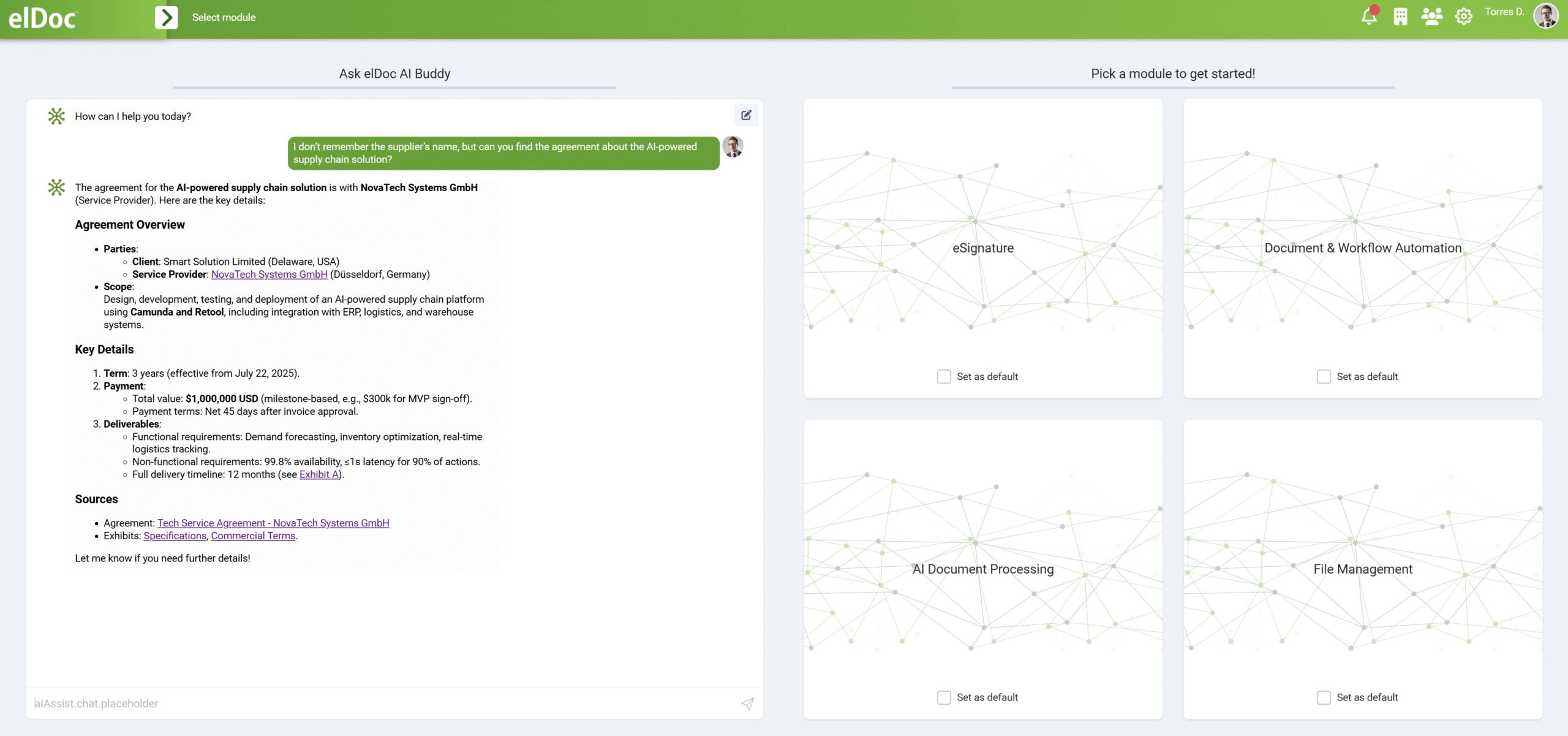
From the Platform, Not From Prompts
Unlike consumer GenAI tools, elDoc allows organizations to directly launch business processes from the platform itself.
Business users can:
- Launch workflows and approval chains
- Execute intelligent document processing
- Trigger document-centric business processes
- Perform secure-file sharing
- Link your counterparts (suppliers, partners, clients) to your workflows
- Sort out, classify and organize your documents intelligently
- Perform data capture and structure data for analysis and integration with third-party systems
- Perform deep document and cross-related analysis securely
- Collaborate on documents simultaneously with full version control
- Review and sign documents securely both internally and with external counterparties
- and many more
All of this happens within a single controlled environment, without copying data to external services or breaking security boundaries. GenAI works as part of the process, not alongside it.
elDoc is Built for High-Value, Specialized Use Cases
elDoc is designed to support specific, high-impact operational scenarios, not generic conversations or one-size-fits-all AI responses. GenAI is applied only where it delivers measurable, repeatable business value. This is especially critical in document-centric processes such as invoice processing, bank statement analysis, transcript processing, and financial documentation workflows where accuracy, traceability, and reliability matter as much as speed.
GenAI with Control, Validation, and Verification
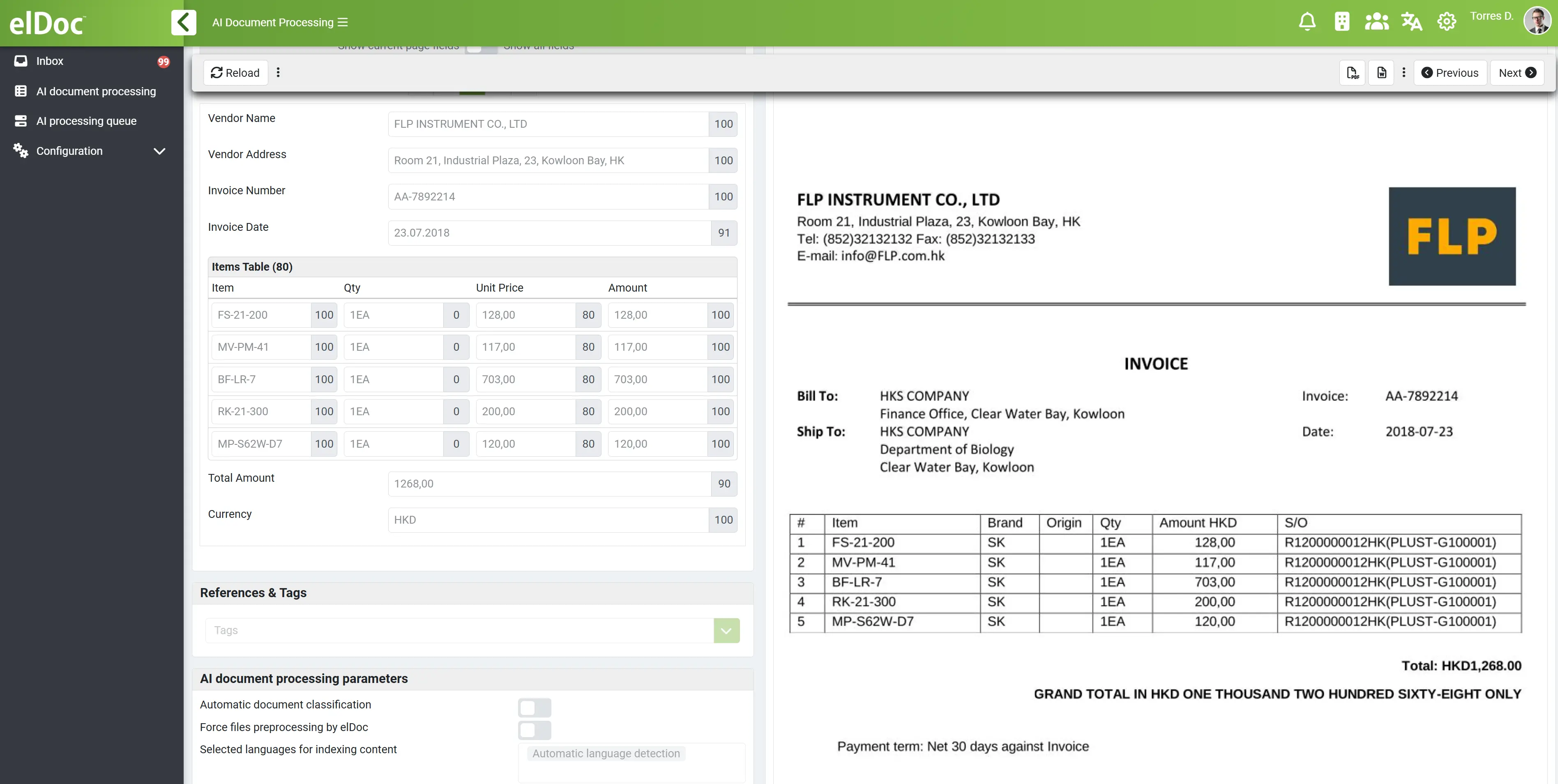
In elDoc, GenAI does not operate in isolation and is never treated as an infallible decision-maker. Instead, every AI-driven result is supported by built-in validation, scoring, and post-processing mechanisms.
For example, during invoice or bank statement processing, elDoc:
- Extracts and structures data using GenAI and document intelligence
- Applies validation rules and business logic to verify extracted values
- Assigns confidence and quality scores to each result
- Enables post-processing workflows where users can review, adjust, and approve outputs
This approach ensures that not everything is blindly delegated to AI. Users retain control over critical outputs, significantly reducing false positives and preventing downstream errors.
Reliability at Enterprise Scale
Validation and verification in elDoc are not optional add-ons – they are mandatory parts of the platform. This is what allows GenAI to operate at enterprise scale without compromising trust or compliance. By combining GenAI efficiency with rule-based validation, scoring, and human-in-the-loop control where needed, elDoc delivers:
- High processing efficiency
- Reliable, repeatable outcomes
- Scalable automation across large document volumes
Each use case reflects how the business actually operates with clear logic, defined rules, and predictable outcomes turning GenAI from an experimental technology into a robust operational capability.
Centralized Knowledge and Historical Data Reuse in elDoc
One of the most fundamental limitations of consumer GenAI tools such as ChatGPT is that they can only analyze what is explicitly provided in the current interaction. They have no persistent access to a company’s historical documents, no understanding of long-term patterns, and no ability to reason across terabytes of corporate data that cannot and should not be shared with external services.
Enterprise decision-making, however, depends precisely on this context.
elDoc addresses this gap by providing centralized, governed storage of historical documents and structured data, creating a continuously growing corporate knowledge base. Invoices, bank statements, contracts, transcripts, and operational documents are not treated as isolated files, but as connected data points across time.
Cross-Document and Cross-Period Analysis
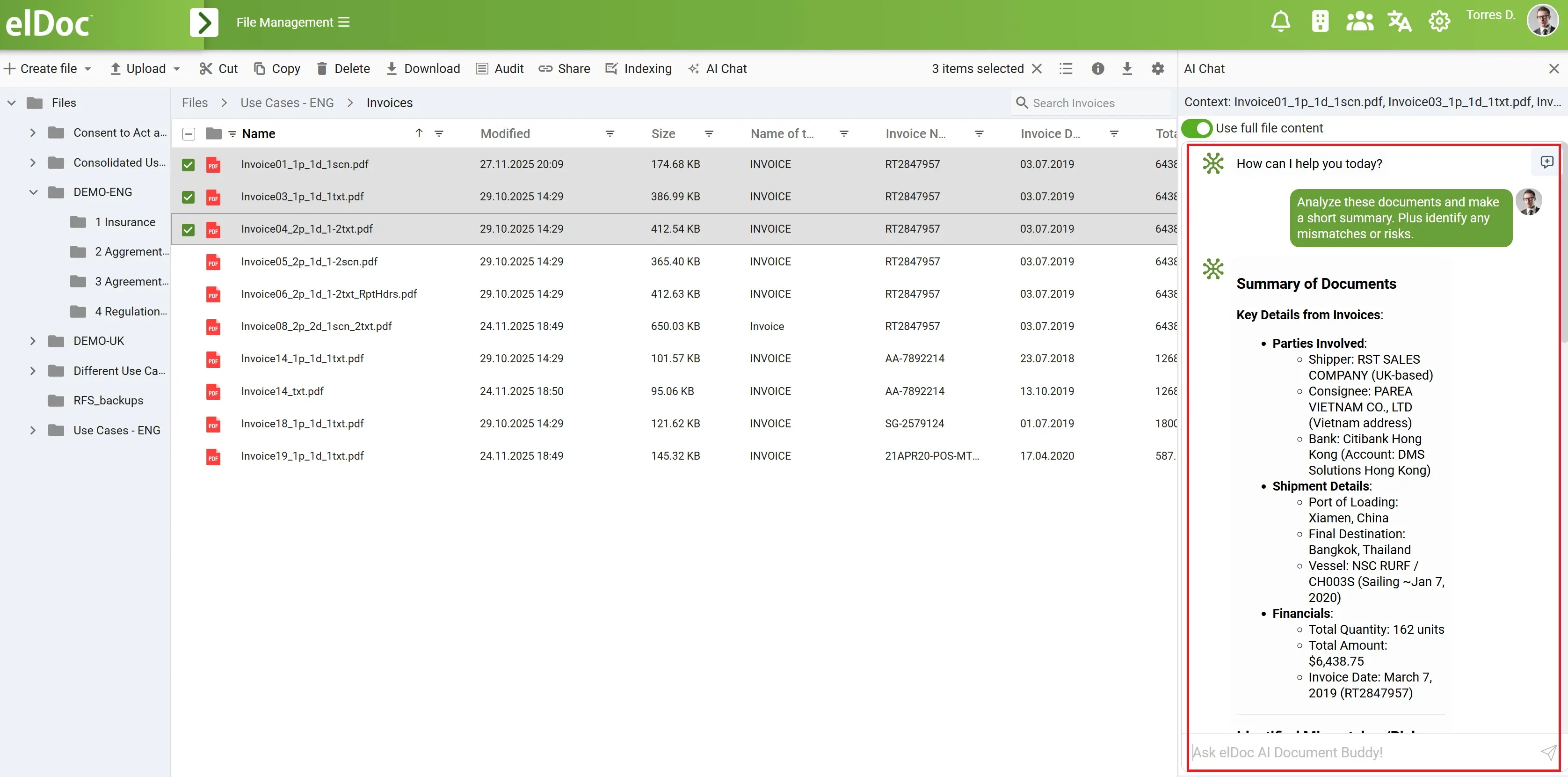
Because historical data is stored, indexed, and structured within the platform, elDoc enables GenAI to perform cross-related analysis that is impossible with ad-hoc AI tools. The platform can compare documents across periods, correlate values between different document types, detect trends and anomalies, and validate new data against historical baselines.
For example, GenAI can:
- Compare current invoices against historical pricing patterns
- Detect discrepancies across suppliers, accounts, or time periods
- Analyze bank statements in relation to invoices, contracts, or payments
- Validate extracted data using historical consistency checks
This transforms document processing from simple extraction into continuous analytical intelligence.
Built for Scale, Control, and Compliance
Centralized data management in elDoc ensures continuity across business operations while maintaining full traceability and auditability. Every document, data point, and AI-assisted decision can be traced back to its source, version, and approval state. At the same time, strict access controls govern who can view, analyze, or reuse historical data. Sensitive information remains protected, while GenAI operates only within authorized boundaries.
From Single Documents to Institutional Knowledge
By reusing historical data across multiple processes and scenarios, elDoc enables progressively better insights and more reliable outcomes over time. The platform does not just analyze individual documents — it builds institutional knowledge that evolves with the business. This is where enterprise GenAI delivers its true value: not in analyzing a single uploaded file, but in understanding the business across months and years securely, at scale, and under full control.
Role-Based Access and Enterprise Governance
In enterprise environments, not all users are equal — and they should not be treated as such. Different teams operate under different responsibilities, data sensitivities, and risk profiles. elDoc is designed around this reality and enforces it by default through strict role-based access control and enterprise governance mechanisms.
Every interaction with documents, data, and GenAI capabilities in elDoc is governed by clearly defined roles, permissions, and policies. Users can only access what they are explicitly authorized to see, process, or approve — nothing more.
Fine-Grained Access Control by Design
elDoc implements role-based access control (RBAC) and permission models that define:
- Which documents a user can view, edit, approve, or sign
- Which data fields within documents are visible or masked
- Which GenAI functions a user is allowed to invoke
- Which workflows a user can initiate, participate in, or approve
This ensures that sensitive information is never exposed outside its intended scope, even internally.
Identity, Authentication, and Environment Security
The platform integrates with enterprise identity systems and supports:
- Strong authentication mechanisms (including MFA)
- Secure session management
- Environment isolation to prevent unauthorized lateral access
- Elimination of hidden or implicit access paths
Every user action is tied to a verified identity, creating a clear chain of accountability.
Full Auditability, Logging, and Traceability
Governance in elDoc is not theoretical – it is operational.
The platform provides:
- Full audit trails of user actions
- Detailed logs of document access, modifications, approvals, and AI-assisted operations
- Traceability across document versions, workflows, and decisions
This makes elDoc suitable for regulated industries and internal audits, where transparency and evidence are mandatory.
Controlled GenAI Usage – Not Open Access
Crucially, GenAI capabilities in elDoc are permissioned, not universally available. Organizations can define:
- Which roles can use GenAI
- For which use cases
- On which data types
- Under which validation and approval rules
This prevents uncontrolled experimentation and ensures that AI is applied only where it is safe, compliant, and valuable.
Governance Built In, Not Added Later
Unlike ad-hoc AI integrations, governance in elDoc is built into the platform architecture from day one. Security policies, access controls, validation layers, and audit mechanisms are not optional features – they are foundational components. As a result, organizations do not need to choose between innovation and control. elDoc enables GenAI to operate securely, transparently, and responsibly, at enterprise scale.
High Availability and Disaster Recovery by Design
elDoc is engineered for high availability and operational resilience. The platform supports:
- High-availability deployments with redundancy across services and components
- Failover mechanisms to ensure continuous operation
- Disaster Recovery Planning (DRP) with defined RPO and RTO objectives
- Backup and restore strategies for both documents and metadata
This ensures business continuity even in the event of infrastructure failures, outages, or disasters.
Fully Isolated and on-premise Deployments
For organizations with the highest security requirements, elDoc supports fully isolated deployment models, including environments with no external internet connectivity.
In these scenarios:
- All processing occurs entirely within the customer’s infrastructure
- No data leaves the environment under any circumstances
- GenAI operates without calling external APIs or cloud services
- Security boundaries are strictly enforced at the network and system level
This makes elDoc suitable for regulated industries, critical infrastructure, government, defense, and financial institutions where air-gapped or restricted environments are mandatory.
Adopt GenAI Strategically – Not Chaotically
GenAI should be adopted strategically, not chaotically. When introduced without governance, business context, and control, it creates more risk than value – stalled pilots, compliance concerns, and unreliable outcomes. elDoc enables a structured, secure path forward. By embedding GenAI directly into real business processes with built-in validation, governance, and enterprise-grade security from day one – organizations can move beyond experimentation and into production with confidence.
If you’re ready to turn GenAI into a controlled, scalable business capability, explore elDoc or request a demo and PoC to see how enterprise GenAI should really work.